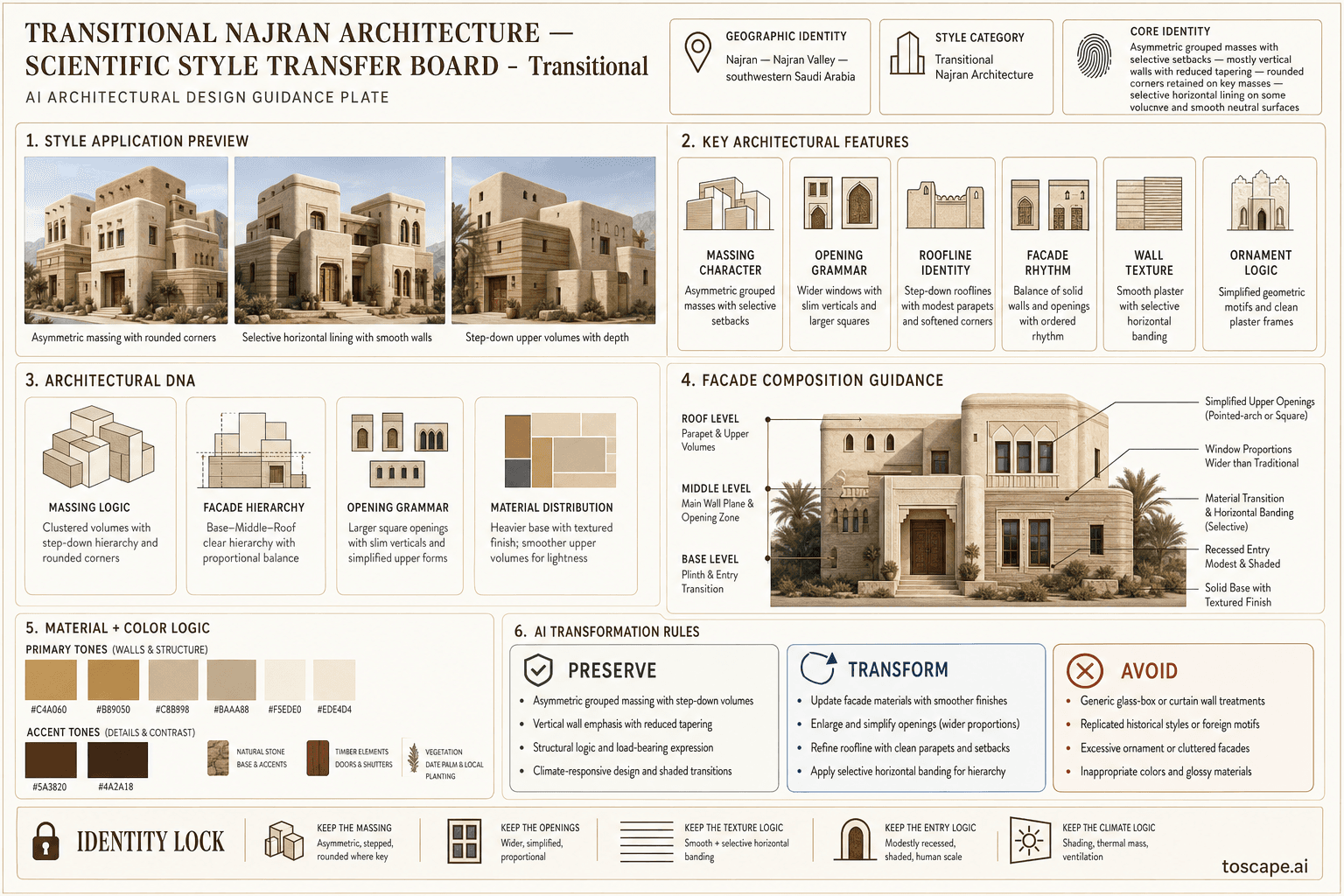
Najran Transitional
Saudi Arabia · Najran Highlands
A balanced modernization of Najran vernacular using simplified forms, broader openings, controlled ornament, rounded corners, and flatter parapets while preserving regional identit...
Definition
Najran Transitional is a regional architectural identity from Saudi Arabia. A balanced modernization of Najran vernacular using simplified forms, broader openings, controlled ornament, rounded corners, and flatter parapets while preserving regional identit.
- Country
- Saudi Arabia
- Region
- Najran Highlands
- Massing
- Transitional Najran preserves the asymmetric clustered logic of Traditional but REDUCES the full tower-like taper.
- Materials
- Earth-clay colors and rendered surfaces remain primary. Substitute materials are explicitly permitted: brick walls, wood-finish elements, compatible modern frames where original materials are impractical .
- Palette
- Earth-toned wall masses, gypsum white accents, and warm timber details define the palette.
- Climate response
- The style still responds to Najran's hot climate through roof terraces, shaded openings, recessed entries, and substantial wall surfaces. Privacy remains important, especially at lower levels.
Overview
Najran Transitional is a Saudi architectural identity rooted in Najran Highlands. Najran vernacular adapted through contemporary building methods and urban requirements. Najran — Najran Valley — southwestern Saudi Arabia.
Visual DNA
Massing & Form
Transitional Najran preserves the asymmetric clustered logic of Traditional but REDUCES the full tower-like taper. Building masses step down as height increases and are organized as distinct grouped volumes .
Facade Language
Facade rhythm comes from a controlled mix of traditional and simplified elements: SELECTIVE horizontal lining (some volumes carry banding; adjacent masses remain smooth and neutral), varied opening sizes, framed entries, and a clearer modular grouping of masses . The facade no longer requires full-width banding on ever...
Materials & Texture
Earth-clay colors and rendered surfaces remain primary. Substitute materials are explicitly permitted: brick walls, wood-finish elements, compatible modern frames where original materials are impractical .
Color Palette
Earth-toned wall masses, gypsum white accents, and warm timber details define the palette. The building should read as desert mineral first, with ornament or painted detail working as a controlled secondary layer rather than a competing facade field.
Ornament & Detail
Ornament is REDUCED and better integrated into the massing. Transitional Najran does not abandon character; it EDITS it .
Climate Response
The style still responds to Najran's hot climate through roof terraces, shaded openings, recessed entries, and substantial wall surfaces. Privacy remains important, especially at lower levels.
Landscape & Ground
Najran — Najran Valley — southwestern Saudi Arabia. The style still responds to Najran's hot climate through roof terraces, shaded openings, recessed entries, and substantial wall surfaces.
Reference elevation
Najran Transitional — characteristic facade composition, Najran Highlands.
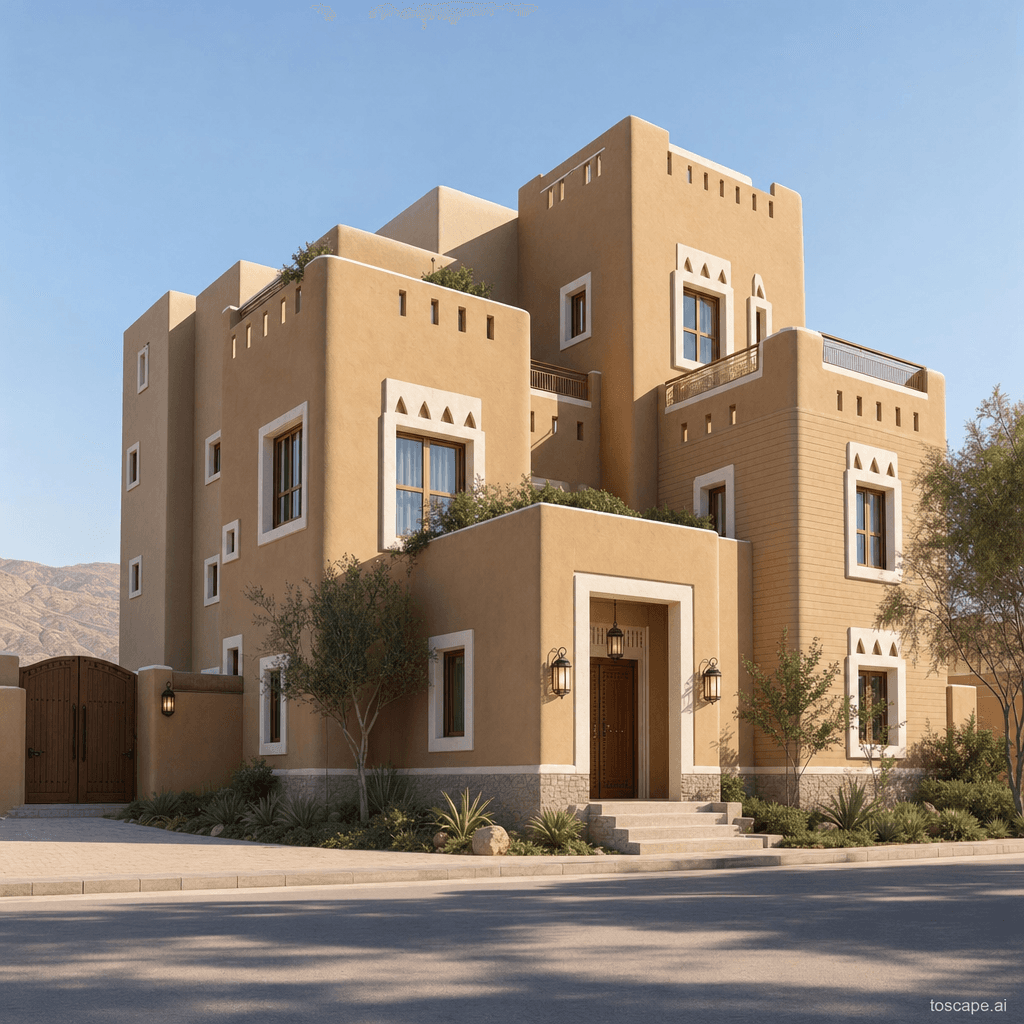
Context Snapshot
Transitional Najran architecture — moderated reinterpretation of the tower-house tradition with reduced tapering, wider openings, simpler parapets, and selective material contrast Najran vernacular adapted through contemporary building methods and urban requirements Najran — Najran Valley — southwestern Saudi Arabia
Contemporary Relevance
Najran Transitional is the bridge between conservation and current construction across Najran Highlands, allowing contemporary programs to keep regional identity legible while using modern structure, services, and envelope systems. It is the most practical mode for streetscapes that need to feel rooted without becoming literal replicas.
Use this style in Toscape
Explore Najran Transitional directly inside Toscape using the Facade Re-Style and Design Options workflows.
Open Najran Transitional in the galleryFrequently asked questions
What is Najran Transitional?
Najran Transitional is a regional architectural identity from Saudi Arabia. A balanced modernization of Najran vernacular using simplified forms, broader openings, controlled ornament, rounded corners, and flatter parapets while preserving regional identit.
What materials define Najran Transitional?
Earth-clay colors and rendered surfaces remain primary. Substitute materials are explicitly permitted: brick walls, wood-finish elements, compatible modern frames where original materials are impractical .
What is the Najran Transitional color palette?
Earth-toned wall masses, gypsum white accents, and warm timber details define the palette. The building should read as desert mineral first, with ornament or painted detail working as a controlled secondary layer rather than a competing facade field.
Where does Najran Transitional come from?
Transitional Najran architecture — moderated reinterpretation of the tower-house tradition with reduced tapering, wider openings, simpler parapets, and selective material contrast Najran vernacular adapted through contemporary building methods and urban requirements Najran — Najran Valley — southwestern Saudi Arabia.
When should architects use Najran Transitional?
Najran Transitional is the bridge between conservation and current construction across Najran Highlands, allowing contemporary programs to keep regional identity legible while using modern structure, services, and envelope systems. It is the most practical mode for streetscapes that need to feel rooted without becoming literal replicas.
How do you render Najran Transitional in Toscape?
Open Toscape on Windows, load your own photo, elevation, sketch, or CAD view, then apply the Najran Transitional reference from the built-in style library. The Facade Re-Style and Design Options workflows keep your project geometry and camera while shifting materials, proportion, and detailing toward Najran Transitional.