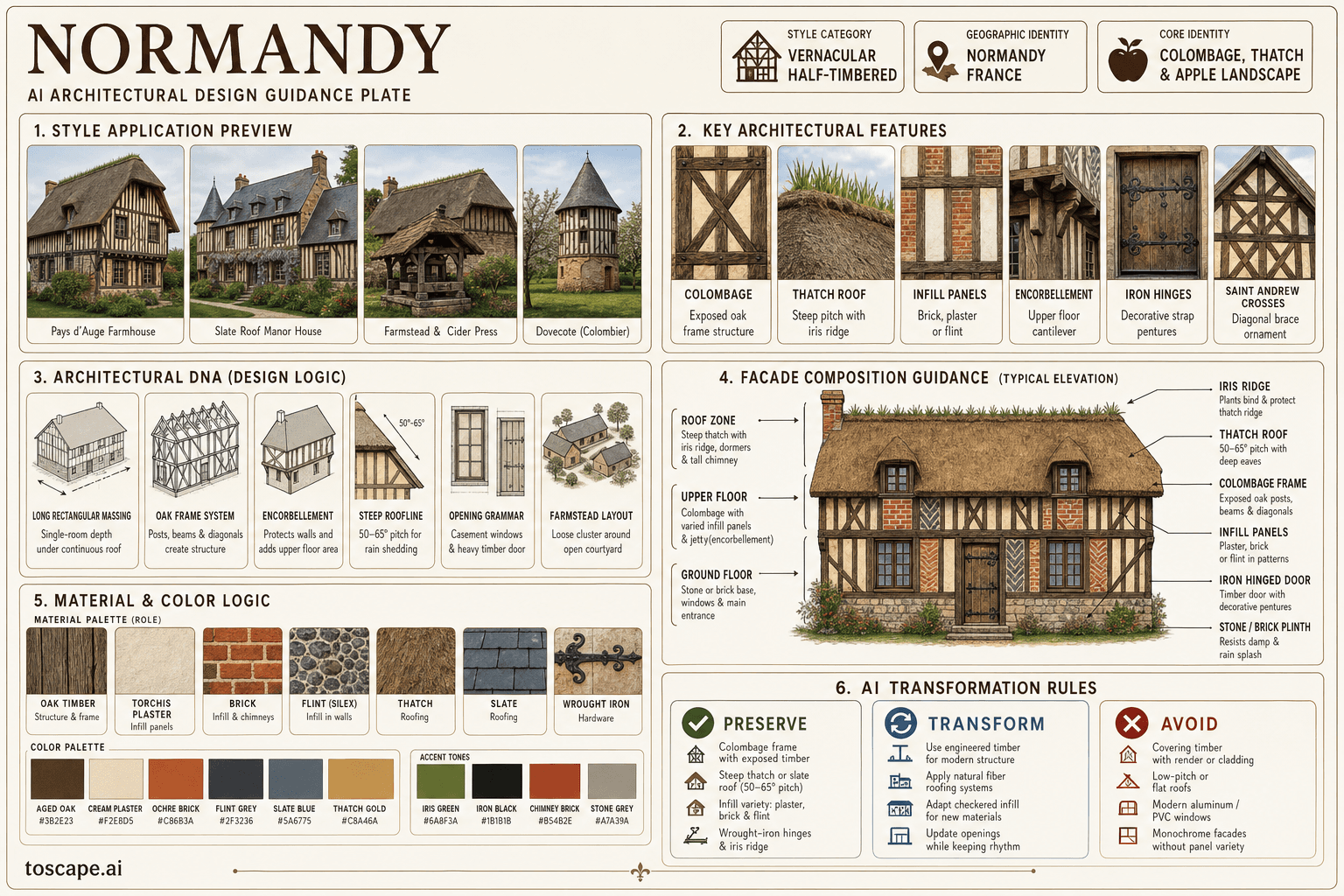
Normandy
France · Normandy region (Pays d'Auge, Pays de Caux, Cotentin, Bocage Normand)
Norman Half-Timbered, Thatch & Slate Roofs & Pays d'Auge Vernacular
Definition
Normandy is a regional architectural identity from France. Norman Half-Timbered, Thatch & Slate Roofs & Pays d'Auge Vernacular.
- Country
- France
- Region
- Normandy region (Pays d'Auge, Pays de Caux, Cotentin, Bocage Normand).
- Massing
- Long rectangular plan, single-room depth, with dwelling and agricultural spaces under continuous roof. Two stories with steep attic.
- Materials
- Chêne (oak): primary structural timber — massive sections, naturally dark brown to silver-grey patina.
- Palette
- White, cream, pale sand, warm timber, and shadow-driven dark metal accents define the palette.
- Climate response
- Oceanic: mild wet winters, cool summers, high humidity, frequent rainfall throughout year, strong westerly winds.
Overview
Normandy is a regional architectural identity in France. Normandy region (Pays d'Auge, Pays de Caux, Cotentin, Bocage Normand) — Norman colombage architecture. Exposed dark brown oak half-timbering (colombage normand) with colombage fill panels in warm ochre brick, cream plaster, or flint (silex) infill, steep roofs in thatch (chaume) with iris ridge or grey-blue slate (ardoise), asymmetrical massing with cantilevered upper floors (encorbellement), apple orchard landscape...
Visual DNA
Massing & Form
Long rectangular plan, single-room depth, with dwelling and agricultural spaces under continuous roof. Two stories with steep attic.
Facade Language
Visible timber frame grid: irregular but rhythmical — vertical posts spaced 1-2m, horizontal rails at floor levels, diagonal braces in upper panels. Colored infill panels create checkerboard or banded effect: cream plaster, warm ochre brick, dark flint alternating.
Materials & Texture
Chêne (oak): primary structural timber — massive sections, naturally dark brown to silver-grey patina. Torchis (cob/daub): clay-straw mix on lath, lime-plastered — cream to warm white finish.
Color Palette
White, cream, pale sand, warm timber, and shadow-driven dark metal accents define the palette. The facade should stay bright and climate-aware rather than heavy, gray, or over-saturated.
Ornament & Detail
Carved timber: Saint Andrew's crosses (croix de Saint-André) between posts — both structural diagonal bracing and ornamental; curved braces (guettes courbes); carved figures on corner posts (poteaux corniers) — human faces, animals, religious symbols. Thatch ridge: sculpted geometric patterns (lignes, chevrons, losange...
Climate Response
Oceanic: mild wet winters, cool summers, high humidity, frequent rainfall throughout year, strong westerly winds. Thatch: excellent insulation (R-value ~4-5), breathable, durable in wet climate when properly maintained and steeply pitched.
Landscape & Ground
Normandy region (Pays d'Auge, Pays de Caux, Cotentin, Bocage Normand) — Norman colombage architecture. Oceanic: mild wet winters, cool summers, high humidity, frequent rainfall throughout year, strong westerly winds.
Reference elevation
Normandy — characteristic facade composition, Normandy region (Pays d'Auge, Pays de Caux, Cotentin, Bocage Normand).
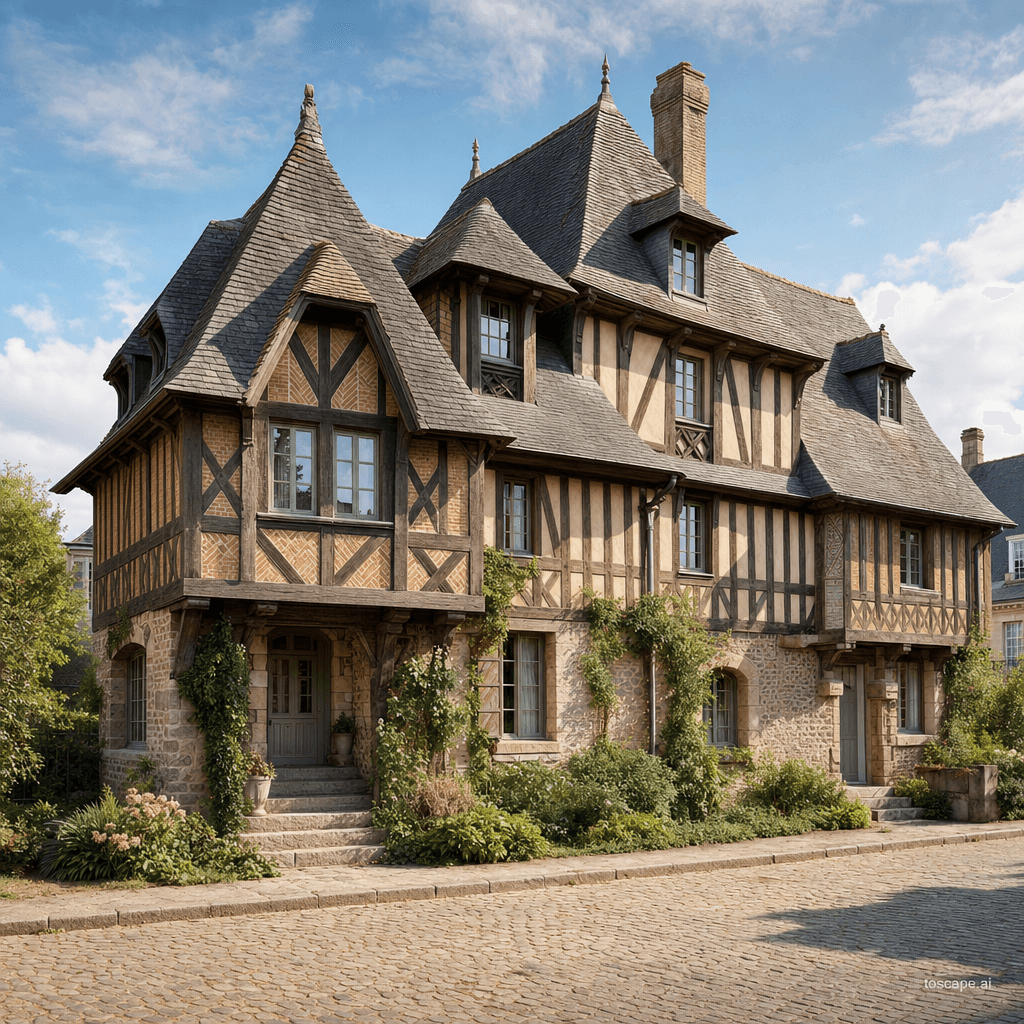
Context Snapshot
Normandy region (Pays d'Auge, Pays de Caux, Cotentin, Bocage Normand) — Norman colombage architecture Oceanic: mild wet winters, cool summers, high humidity, frequent rainfall throughout year, strong westerly winds.
Contemporary Relevance
Normandy is useful today for residential, hospitality, civic, and place-branding work that needs France-specific character grounded in local massing, material tone, climate response, and settlement logic rather than generic international styling.
Use this style in Toscape
Explore Normandy directly inside Toscape using the Facade Re-Style and Design Options workflows.
Open Normandy in the galleryFrequently asked questions
What is Normandy?
Normandy is a regional architectural identity from France. Norman Half-Timbered, Thatch & Slate Roofs & Pays d'Auge Vernacular.
What materials define Normandy?
Chêne (oak): primary structural timber — massive sections, naturally dark brown to silver-grey patina. Torchis (cob/daub): clay-straw mix on lath, lime-plastered — cream to warm white finish.
What is the Normandy color palette?
White, cream, pale sand, warm timber, and shadow-driven dark metal accents define the palette. The facade should stay bright and climate-aware rather than heavy, gray, or over-saturated.
Where does Normandy come from?
Normandy region (Pays d'Auge, Pays de Caux, Cotentin, Bocage Normand) — Norman colombage architecture Oceanic: mild wet winters, cool summers, high humidity, frequent rainfall throughout year, strong westerly winds.
When should architects use Normandy?
Normandy is useful today for residential, hospitality, civic, and place-branding work that needs France-specific character grounded in local massing, material tone, climate response, and settlement logic rather than generic international styling.
How do you render Normandy in Toscape?
Open Toscape on Windows, load your own photo, elevation, sketch, or CAD view, then apply the Normandy reference from the built-in style library. The Facade Re-Style and Design Options workflows keep your project geometry and camera while shifting materials, proportion, and detailing toward Normandy.