Northeastern Isan
Thailand · Northeast Thailand (Isan)
Isan Wooden Stilt Houses, Rice Barns & Khmer-Lao Vernacular Fusion
Definition
Northeastern Isan is a regional architectural identity from Thailand. Isan Wooden Stilt Houses, Rice Barns & Khmer-Lao Vernacular Fusion.
- Country
- Thailand
- Region
- Northeast Thailand (Isan)
- Massing
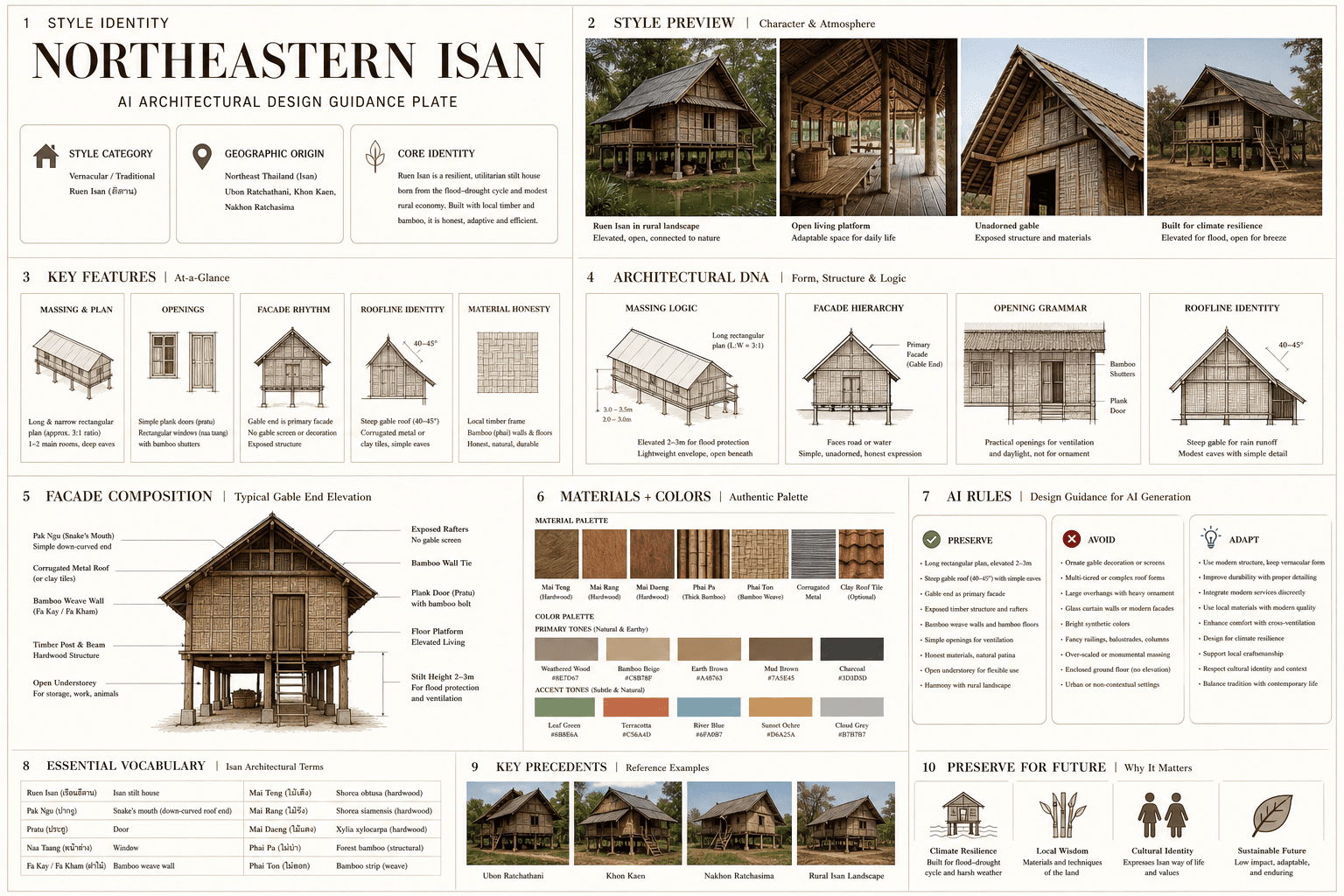
- Long, narrow rectangular plan (typical 3:1 length-to-width ratio), with one or two main rooms. Gable roof, lower pitch (40-45°) than Central Thai, with simpler geometry.
- Materials
- Mai phai (bamboo): the primary building material — various species: phai pa (forest bamboo — thick-walled, structural).
- Palette
- Warm earth, sandy beige, ochre, clay brown, and sun-softened mineral tones should dominate, with palm green or weathered timber as secondary accents.
- Climate response
- Tropical savanna (Aw) with extreme seasonal contrast — the defining driver of Isan architecture. Monsoon (May-October): 1,200-1,500mm rainfall, river basins flood extensively (Mun, Chi, Mekong tributaries).
Overview
Northeastern Isan is a regional architectural identity in Thailand. Northeast Thailand (Isan) — Ubon Ratchathani, Khon Kaen, Nakhon Ratchasima. Ruen Isan — simpler, more utilitarian vernacular than Central or Northern Thai traditions, reflecting the region's economic modesty and harsh climate (flood-drought cycle).
Visual DNA
Massing & Form
Long, narrow rectangular plan (typical 3:1 length-to-width ratio), with one or two main rooms. Gable roof, lower pitch (40-45°) than Central Thai, with simpler geometry.
Facade Language
Gable end is primary facade — typically faces road or water. The gable is unadorned relative to other Thai regions: no kalae, minimal or no pan lom bargeboard, open gable with exposed bamboo rafter ends visible.
Materials & Texture
Mai phai (bamboo): the primary building material — various species: phai pa (forest bamboo — thick-walled, structural), phai liang (cultivated bamboo — thinner for wall weaving), phai ruak (for flooring). Bamboo ages from pale green-golden to warm honey-brown, eventually grey.
Color Palette
Warm earth, sandy beige, ochre, clay brown, and sun-softened mineral tones should dominate, with palm green or weathered timber as secondary accents. The palette should read as land-derived rather than polished or urban-generic.
Ornament & Detail
The Isan aesthetic is one of functional simplicity — ornament is minimal, derived from material texture and structural expression rather than applied decoration. Woven bamboo patterns (lai khit): the diamond and herringbone weave of fa khay wall panels — the primary "ornament" is this textured surface.
Climate Response
Tropical savanna (Aw) with extreme seasonal contrast — the defining driver of Isan architecture. Monsoon (May-October): 1,200-1,500mm rainfall, river basins flood extensively (Mun, Chi, Mekong tributaries).
Landscape & Ground
Northeast Thailand (Isan) — Ubon Ratchathani, Khon Kaen, Nakhon Ratchasima. Tropical savanna (Aw) with extreme seasonal contrast — the defining driver of Isan architecture.
Reference elevation
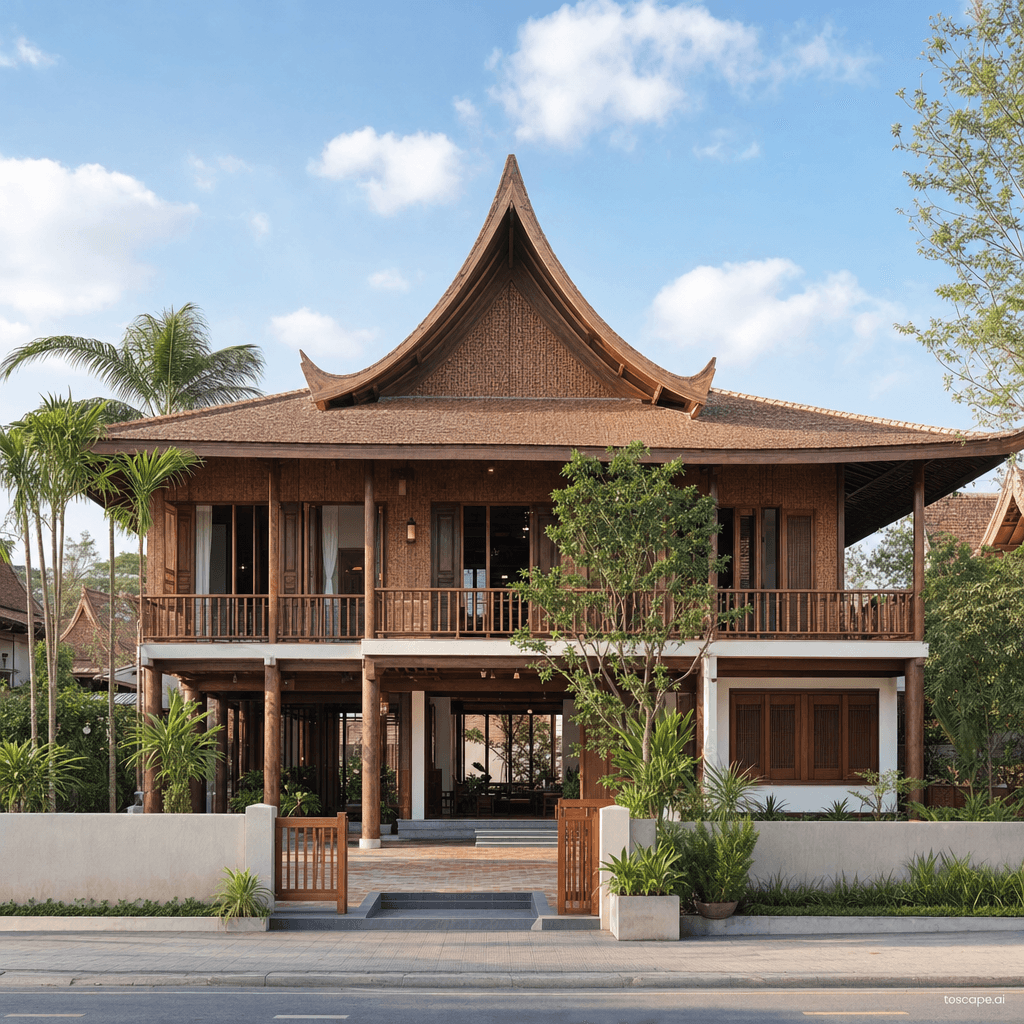
Northeastern Isan — characteristic facade composition, Northeast Thailand (Isan).
Context Snapshot
Northeast Thailand (Isan) — Ubon Ratchathani, Khon Kaen, Nakhon Ratchasima Tropical savanna (Aw) with extreme seasonal contrast — the defining driver of Isan architecture.
Contemporary Relevance
Northeastern Isan is useful today for residential, hospitality, civic, and place-branding work that needs Thailand-specific character grounded in local massing, material tone, climate response, and settlement logic rather than generic international styling.
Use this style in Toscape
Explore Northeastern Isan directly inside Toscape using the Facade Re-Style and Design Options workflows.
Open Northeastern Isan in the galleryFrequently asked questions
What is Northeastern Isan?
Northeastern Isan is a regional architectural identity from Thailand. Isan Wooden Stilt Houses, Rice Barns & Khmer-Lao Vernacular Fusion.
What materials define Northeastern Isan?
Mai phai (bamboo): the primary building material — various species: phai pa (forest bamboo — thick-walled, structural), phai liang (cultivated bamboo — thinner for wall weaving), phai ruak (for flooring). Bamboo ages from pale green-golden to warm honey-brown, eventually grey.
What is the Northeastern Isan color palette?
Warm earth, sandy beige, ochre, clay brown, and sun-softened mineral tones should dominate, with palm green or weathered timber as secondary accents. The palette should read as land-derived rather than polished or urban-generic.
Where does Northeastern Isan come from?
Northeast Thailand (Isan) — Ubon Ratchathani, Khon Kaen, Nakhon Ratchasima Tropical savanna (Aw) with extreme seasonal contrast — the defining driver of Isan architecture.
When should architects use Northeastern Isan?
Northeastern Isan is useful today for residential, hospitality, civic, and place-branding work that needs Thailand-specific character grounded in local massing, material tone, climate response, and settlement logic rather than generic international styling.
How do you render Northeastern Isan in Toscape?
Open Toscape on Windows, load your own photo, elevation, sketch, or CAD view, then apply the Northeastern Isan reference from the built-in style library. The Facade Re-Style and Design Options workflows keep your project geometry and camera while shifting materials, proportion, and detailing toward Northeastern Isan.