Northern Lanna
Thailand · Chiang Mai, Lamphun, Lampang, Phrae, Nan
Kalae Gable Finials, Teak Stilt Houses & Chiang Mai—Lamphun Tradition
Definition
Northern Lanna is a regional architectural identity from Thailand. Kalae Gable Finials, Teak Stilt Houses & Chiang Mai—Lamphun Tradition.
- Country
- Thailand
- Region
- Chiang Mai, Lamphun, Lampang, Phrae, Nan.
- Massing
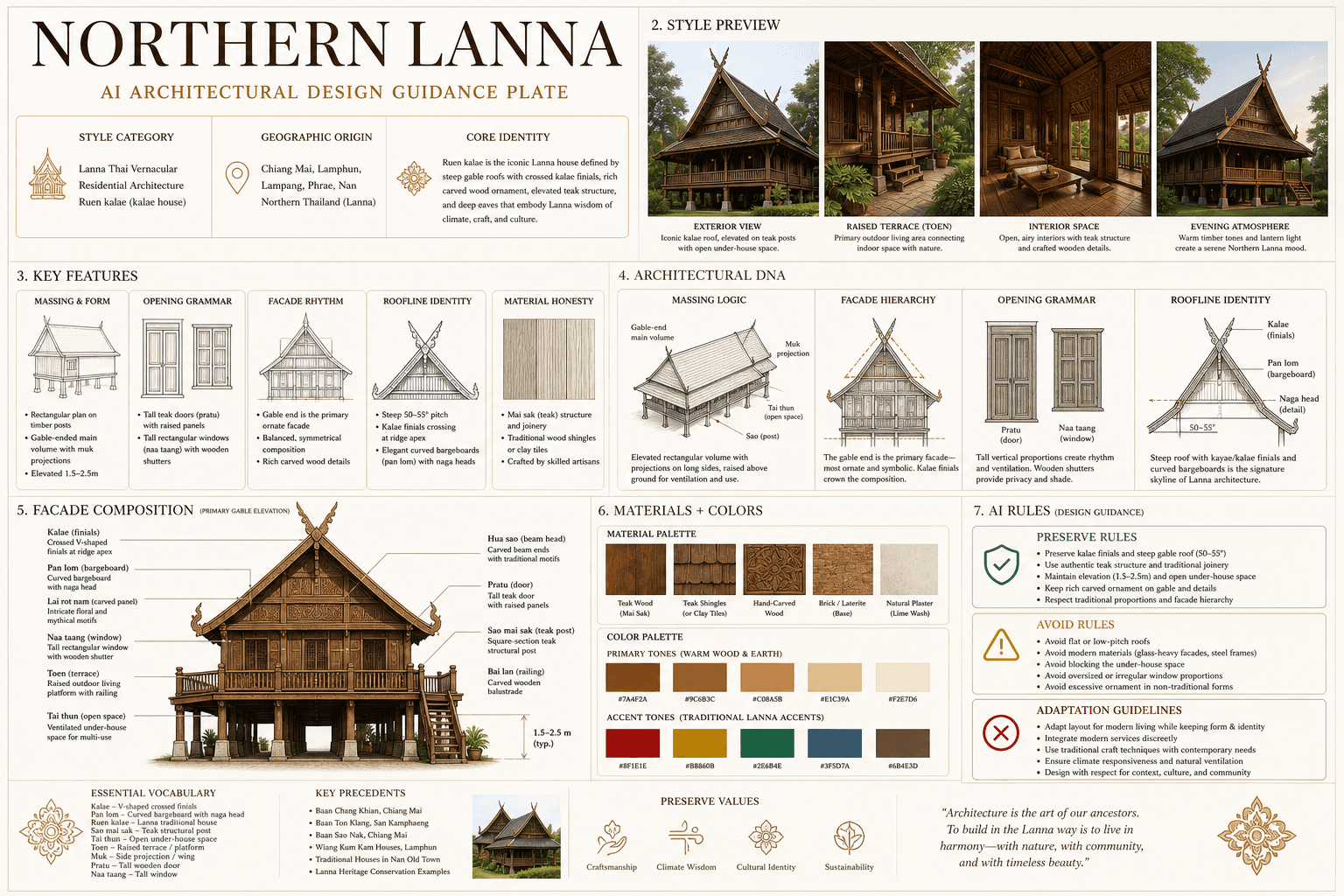
- Ruen kalae: rectangular plan elevated on timber posts (sao). Gable-ended main volume with muk projections on long sides creating complex multi-gable roofscape.
- Materials
- Mai sak (teak — Tectona grandis): THE Lanna building material — abundant native forests supplied the finest teak for centuries, golden-brown with distinctive dark grain.
- Palette
- White, cream, pale sand, warm timber, and shadow-driven dark metal accents define the palette.
- Climate response
- Tropical savanna (Aw) — warm year-round (20-35°C), distinct wet-dry seasons (monsoon May-October, 1,100mm), cool winter nights (December-February, to 10°C).
Overview
Northern Lanna is a regional architectural identity in Thailand. Chiang Mai, Lamphun, Lampang, Phrae, Nan — Lanna Thai vernacular. Ruen kalae (kalae house) — steep gable roofs with distinctive V-shaped carved finials (kalae) crossing at the ridge apex — the defining architectural symbol of Lanna Thai identity, elegantly curved bargeboards (pan lom) terminating in stylized naga heads, roof the dominant visual mass (50-55° pitch) with deep sweeping eaves, elevated teak stilt constru...
Visual DNA
Massing & Form
Ruen kalae: rectangular plan elevated on timber posts (sao). Gable-ended main volume with muk projections on long sides creating complex multi-gable roofscape.
Facade Language
Gable end is the primary facade — always the most ornate face. Kalae: the V-shaped crossed finials at gable peak, carved with floral scrolls, naga heads, or stylized bird forms.
Materials & Texture
Mai sak (teak — Tectona grandis): THE Lanna building material — abundant native forests supplied the finest teak for centuries, golden-brown with distinctive dark grain, naturally oily and durable, termite and weather resistant. Kalae and pan lom: carved from the finest teak — dense old-growth timber, deeply weathered...
Color Palette
White, cream, pale sand, warm timber, and shadow-driven dark metal accents define the palette. The facade should stay bright and climate-aware rather than heavy, gray, or over-saturated.
Ornament & Detail
Kalae: the supreme Lanna ornament — V-shaped crossed finials carved from teak, their surfaces covered with lai kranok (flame-like floral scrollwork), lai dok (flower motifs), stylized naga forms, and geometric patterns. The negative space created by the kalae intersection — a diamond or tear-drop shape — is as importan...
Climate Response
Tropical savanna (Aw) — warm year-round (20-35°C), distinct wet-dry seasons (monsoon May-October, 1,100mm), cool winter nights (December-February, to 10°C). Elevated floor: above wet-season ground moisture and flooding, captures cooling breezes.
Landscape & Ground
Chiang Mai, Lamphun, Lampang, Phrae, Nan — Lanna Thai vernacular. Tropical savanna (Aw) — warm year-round (20-35°C), distinct wet-dry seasons (monsoon May-October, 1,100mm), cool winter nights (December-February, to 10°C).
Reference elevation
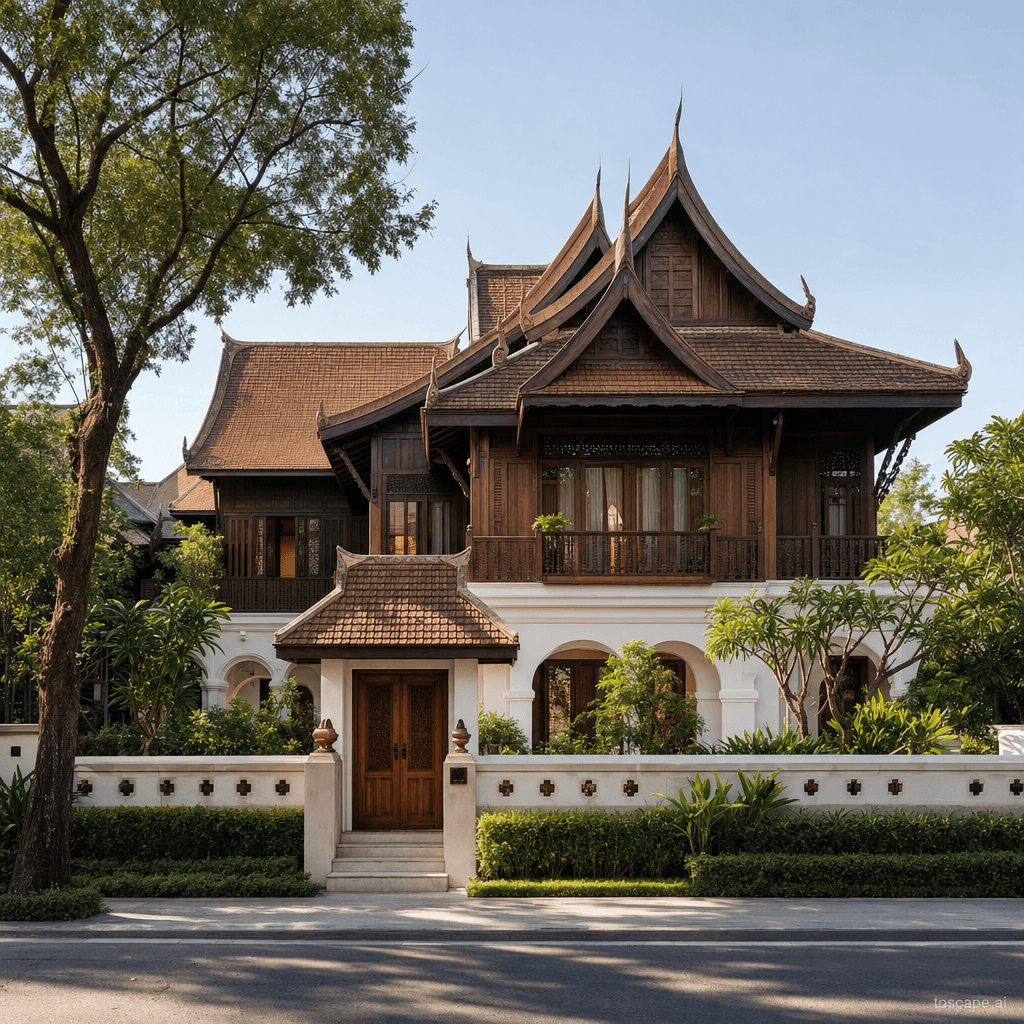
Northern Lanna — characteristic facade composition, Chiang Mai, Lamphun, Lampang, Phrae, Nan.
Context Snapshot
Chiang Mai, Lamphun, Lampang, Phrae, Nan — Lanna Thai vernacular Tropical savanna (Aw) — warm year-round (20-35°C), distinct wet-dry seasons (monsoon May-October, 1,100mm), cool winter nights (December-February, to 10°C).
Contemporary Relevance
Northern Lanna is useful today for residential, hospitality, civic, and place-branding work that needs Thailand-specific character grounded in local massing, material tone, climate response, and settlement logic rather than generic international styling.
Use this style in Toscape
Explore Northern Lanna directly inside Toscape using the Facade Re-Style and Design Options workflows.
Open Northern Lanna in the galleryFrequently asked questions
What is Northern Lanna?
Northern Lanna is a regional architectural identity from Thailand. Kalae Gable Finials, Teak Stilt Houses & Chiang Mai—Lamphun Tradition.
What materials define Northern Lanna?
Mai sak (teak — Tectona grandis): THE Lanna building material — abundant native forests supplied the finest teak for centuries, golden-brown with distinctive dark grain, naturally oily and durable, termite and weather resistant. Kalae and pan lom: carved from the finest teak — dense old-growth timber, deeply weathered.
What is the Northern Lanna color palette?
White, cream, pale sand, warm timber, and shadow-driven dark metal accents define the palette. The facade should stay bright and climate-aware rather than heavy, gray, or over-saturated.
Where does Northern Lanna come from?
Chiang Mai, Lamphun, Lampang, Phrae, Nan — Lanna Thai vernacular Tropical savanna (Aw) — warm year-round (20-35°C), distinct wet-dry seasons (monsoon May-October, 1,100mm), cool winter nights (December-February, to 10°C).
When should architects use Northern Lanna?
Northern Lanna is useful today for residential, hospitality, civic, and place-branding work that needs Thailand-specific character grounded in local massing, material tone, climate response, and settlement logic rather than generic international styling.
How do you render Northern Lanna in Toscape?
Open Toscape on Windows, load your own photo, elevation, sketch, or CAD view, then apply the Northern Lanna reference from the built-in style library. The Facade Re-Style and Design Options workflows keep your project geometry and camera while shifting materials, proportion, and detailing toward Northern Lanna.