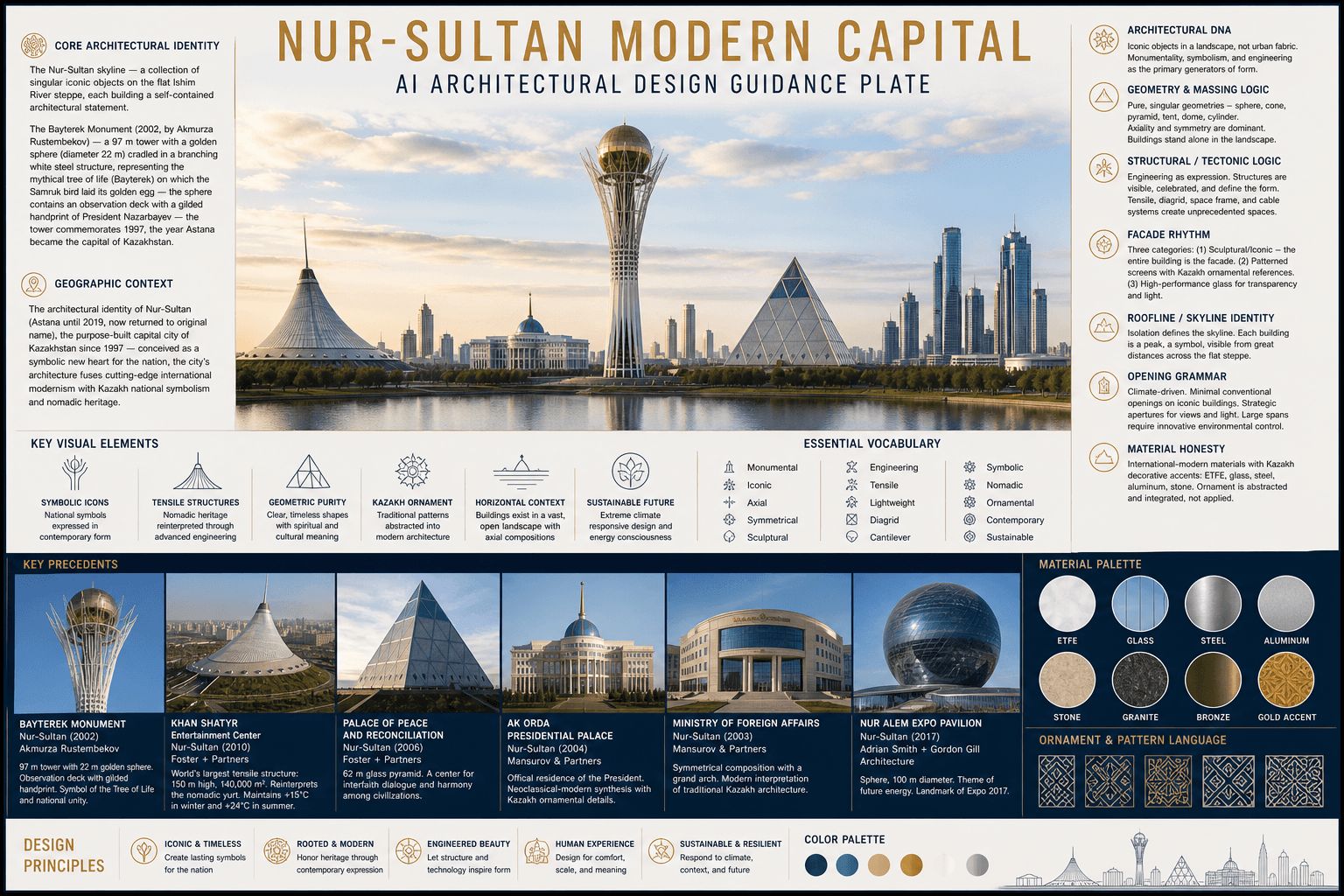
Nur-Sultan Modern Capital
Kazakhstan · architectural identity of Nur-Sultan (Astana until 2019, now returned to origina...
The futuristic capital of Kazakhstan on the Ishim Steppe — a 21st-century planned city where Nomadic heritage meets hypermodernism: Norman Foster's Khan Shatyr tent, the Bayterek m...
Definition
Nur-Sultan Modern Capital is a regional architectural identity from Kazakhstan. The futuristic capital of Kazakhstan on the Ishim Steppe — a 21st-century planned city where Nomadic heritage meets hypermodernism: Norman Foster's Khan Shatyr tent, the Bayterek m.
- Country
- Kazakhstan
- Region
- architectural identity of Nur-Sultan (Astana until 2019, now returned to origina.
- Massing
- Nur-Sultan is an anti-urban city in the traditional sense — rather than a continuous fabric of streets and blocks.
- Materials
- Nur-Sultan's materials are international-modern with Kazakh decorative accents: (1) ETFE (Ethylene Tetrafluoroethylene) — the transparent membrane of Khan Shatyr: three-layer pneumatic cushions.
- Palette
- White, cream, pale sand, warm timber, and shadow-driven dark metal accents define the palette.
- Climate response
- Nur-Sultan has the most extreme continental climate of any capital city: (1) Temperatures range from -40°C in winter to +40°C in summer — a 80°C annual.
Overview
Nur-Sultan Modern Capital is a regional architectural identity in Kazakhstan. The architectural identity of Nur-Sultan (Astana until 2019, now returned to original name), the purpose-built capital city of Kazakhstan since 1997 — conceived as a symbolic new heart for the nation, the city's architecture fuses cutting-edge international modernism with Kazakh national symbolism and the visual language of the steppe — the city was masterplanned by Kisho Kurokawa (of Metabolism fame) with a symbolic...
Visual DNA
Massing & Form
Nur-Sultan is an anti-urban city in the traditional sense — rather than a continuous fabric of streets and blocks, it is a collection of monumental objects placed on a tabula rasa of the steppe: (1) The Bayterek tower — a vertical shaft (white steel lattice) topped by a sphere (golden mirrored glass) — the height of 97...
Facade Language
Nur-Sultan facades fall into three categories: (1) The sculptural/iconic facade — Khan Shatyr and the Pyramid: the entire building is a single facade gesture — the ETFE tent is a continuous translucent skin, its pattern of triangular cushion panels creating a quilted surface that changes from opaque white to transparen...
Materials & Texture
Nur-Sultan's materials are international-modern with Kazakh decorative accents: (1) ETFE (Ethylene Tetrafluoroethylene) — the transparent membrane of Khan Shatyr: three-layer pneumatic cushions, lightweight (1% of glass weight), self-cleaning, UV-transparent — the material appears as a shimmering translucent white-blue...
Color Palette
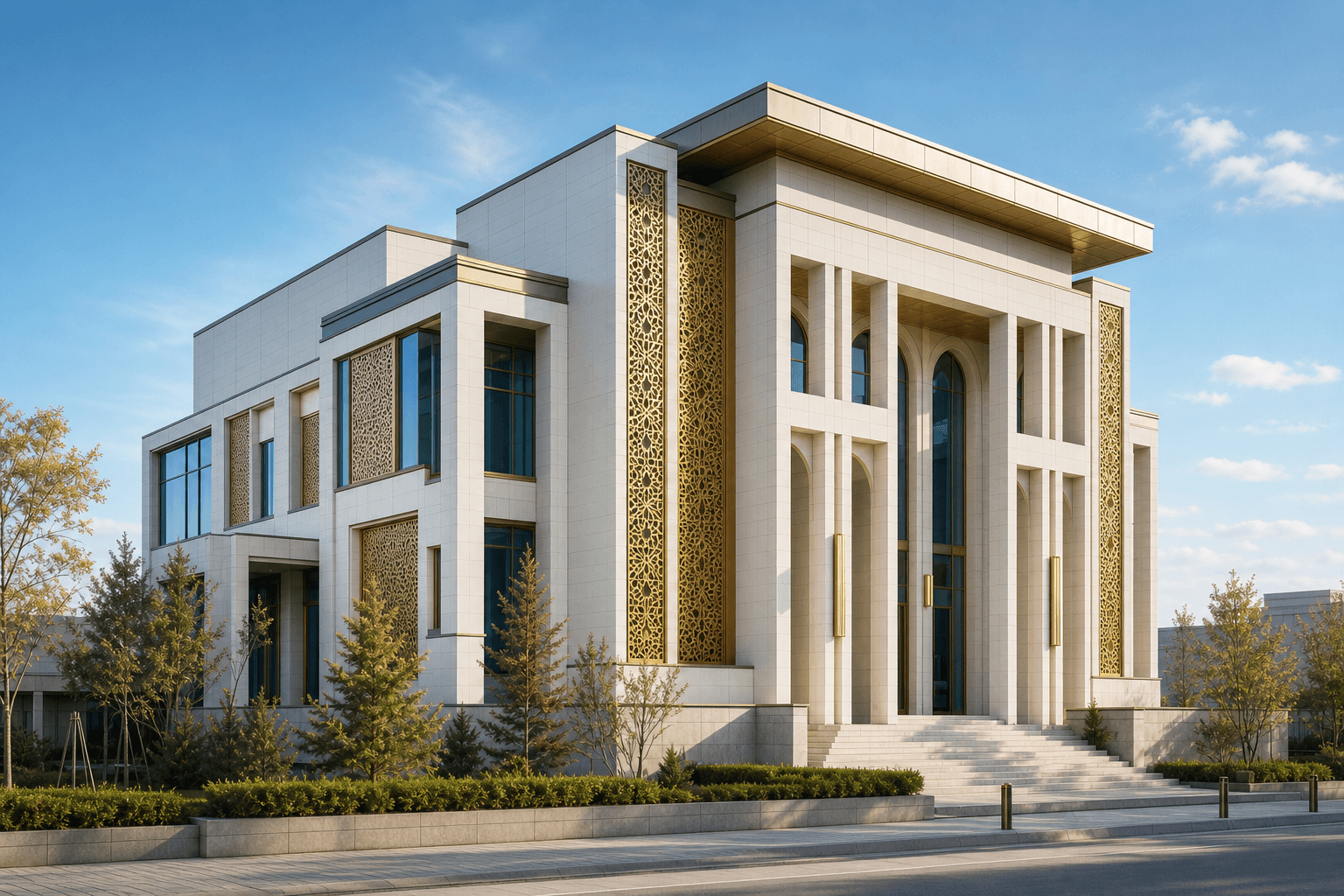
White, cream, pale sand, warm timber, and shadow-driven dark metal accents define the palette. The facade should stay bright and climate-aware rather than heavy, gray, or over-saturated.
Ornament & Detail
Nur-Sultan's ornament is the meeting point of Kazakh tradition and 21st-century modernism: (1) The shañyraq motif — the circular wooden crown of the yurt (kiiz üy) is the most ubiquitous Kazakh architectural symbol: it appears as the dome of Ak Orda, as decorative medallions on government facades, as the ceiling patter...
Climate Response
Nur-Sultan has the most extreme continental climate of any capital city: (1) Temperatures range from -40°C in winter to +40°C in summer — a 80°C annual range — the architecture must function in both extremes: Khan Shatyr's ETFE membrane maintains an interior microclimate (15–24°C) through passive solar gain and active...
Landscape & Ground
The architectural identity of Nur-Sultan (Astana until 2019, now returned to original name), the purpose-built capital city of Kazakhstan since 1997 — conceived as a symbolic new heart for the nation, the city's architecture fuses cutting-edge international modernism with Kazakh national symbolism and the visual langua...
Reference elevation
Nur-Sultan Modern Capital — characteristic facade composition, architectural identity of Nur-Sultan (Astana until 2019, now returned to origina....
Context Snapshot
The architectural identity of Nur-Sultan (Astana until 2019, now returned to original name), the purpose-built capital city of Kazakhstan since 1997 — conceived as a symbolic new heart for the nation... Nur-Sultan has the most extreme continental climate of any capital city: (1) Temperatures range from -40°C in winter to +40°C in summer — a 80°C annual range — the architecture must function in both extremes: Khan Shatyr...
Contemporary Relevance
Nur-Sultan Modern Capital is useful today for residential, hospitality, civic, and place-branding work that needs Kazakhstan-specific character grounded in local massing, material tone, climate response, and settlement logic rather than generic international styling.
Use this style in Toscape
Explore Nur-Sultan Modern Capital directly inside Toscape using the Facade Re-Style and Design Options workflows.
Open Nur-Sultan Modern Capital in the galleryFrequently asked questions
What is Nur-Sultan Modern Capital?
Nur-Sultan Modern Capital is a regional architectural identity from Kazakhstan. The futuristic capital of Kazakhstan on the Ishim Steppe — a 21st-century planned city where Nomadic heritage meets hypermodernism: Norman Foster's Khan Shatyr tent, the Bayterek m.
What materials define Nur-Sultan Modern Capital?
Nur-Sultan's materials are international-modern with Kazakh decorative accents: (1) ETFE (Ethylene Tetrafluoroethylene) — the transparent membrane of Khan Shatyr: three-layer pneumatic cushions, lightweight (1% of glass weight), self-cleaning, UV-transparent — the material appears as a shimmering translucent white-blue.
What is the Nur-Sultan Modern Capital color palette?
White, cream, pale sand, warm timber, and shadow-driven dark metal accents define the palette. The facade should stay bright and climate-aware rather than heavy, gray, or over-saturated.
Where does Nur-Sultan Modern Capital come from?
The architectural identity of Nur-Sultan (Astana until 2019, now returned to original name), the purpose-built capital city of Kazakhstan since 1997 — conceived as a symbolic new heart for the nation.
When should architects use Nur-Sultan Modern Capital?
Nur-Sultan Modern Capital is useful today for residential, hospitality, civic, and place-branding work that needs Kazakhstan-specific character grounded in local massing, material tone, climate response, and settlement logic rather than generic international styling.
How do you render Nur-Sultan Modern Capital in Toscape?
Open Toscape on Windows, load your own photo, elevation, sketch, or CAD view, then apply the Nur-Sultan Modern Capital reference from the built-in style library. The Facade Re-Style and Design Options workflows keep your project geometry and camera while shifting materials, proportion, and detailing toward Nur-Sultan Modern Capital.