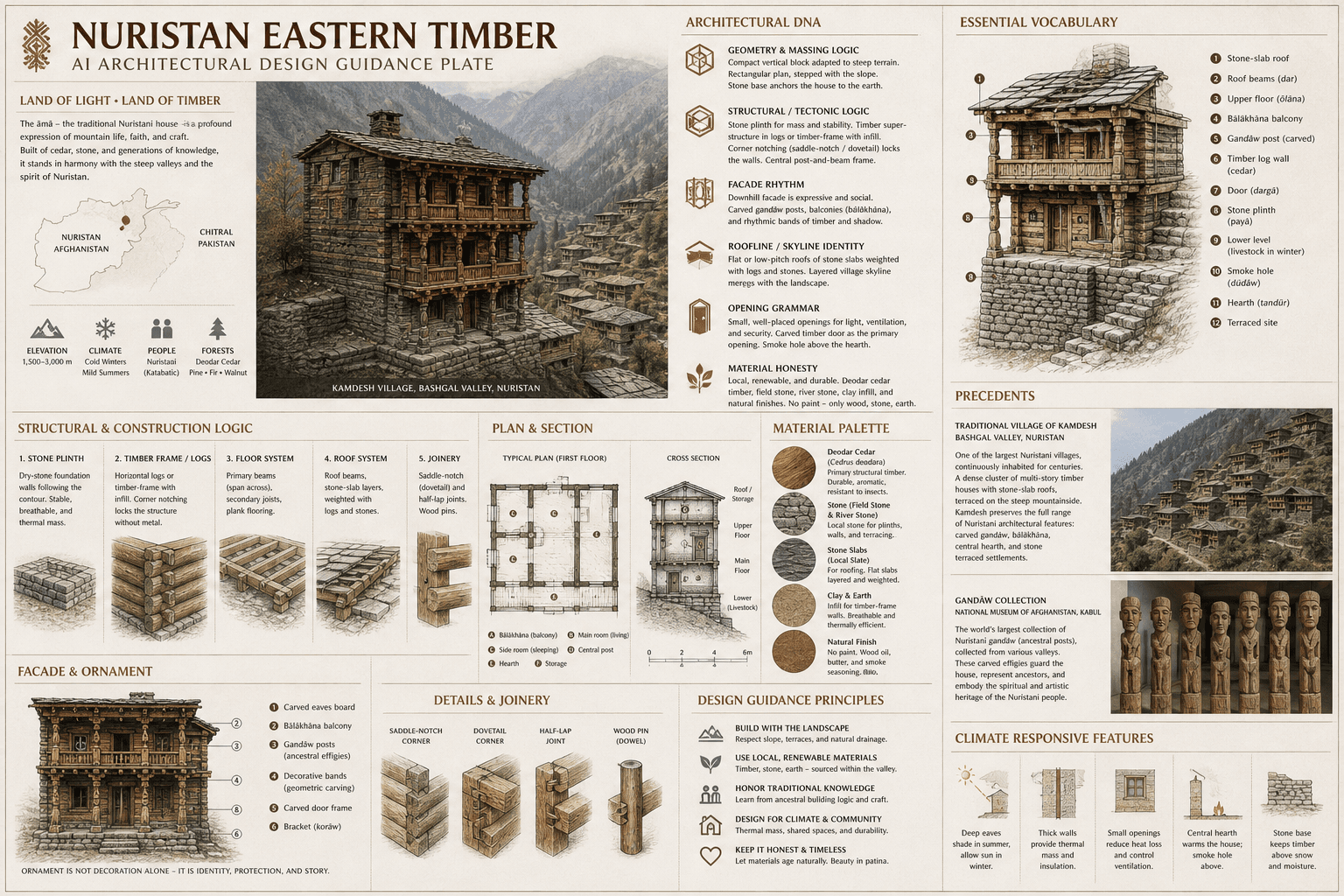
Nuristan Eastern Timber
Afghanistan · vernacular architecture of Nuristan (formerly Kafiristan
The isolated mountain valleys of Nuristan in the eastern Hindu Kush — a unique timber architecture of multi-story wooden houses with flat stone-laid roofs, richly carved ancestral...
Definition
Nuristan Eastern Timber is a regional architectural identity from Afghanistan. The isolated mountain valleys of Nuristan in the eastern Hindu Kush — a unique timber architecture of multi-story wooden houses with flat stone-laid roofs, richly carved ancestral.
- Country
- Afghanistan
- Region
- vernacular architecture of Nuristan (formerly Kafiristan.
- Massing
- The Nuristani house is a compact vertical timber block adapted to steep terrain: (1) The house plan is typically rectangular (5–8 m wide.
- Materials
- Nuristani materials are entirely forest-and-mountain sourced: (1) Deodar cedar (Cedrus deodara) — the primary timber: a large conifer (up to 50 m tall.
- Palette
- White, cream, pale sand, warm timber, and shadow-driven dark metal accents define the palette.
- Climate response
- Nuristan has a humid continental-mountain climate at 1,500–3,000 m: (1) Winter: -5°C to -20°C, heavy snowfall (2–5 m accumulation) — the house is adapted for winter.
Overview
Nuristan Eastern Timber is a regional architectural identity in Afghanistan. The vernacular architecture of Nuristan (formerly Kafiristan — "Land of the Infidels," renamed Nuristan — "Land of Light" — after conversion to Islam in 1895–96), a remote mountainous region in eastern Afghanistan bordering Pakistan's Chitral district — the Nuristani people (speakers of Nuristani languages, a distinct branch of Indo-Iranian) developed a unique timber architecture fundamentally different from the mud...
Visual DNA
Massing & Form
The Nuristani house is a compact vertical timber block adapted to steep terrain: (1) The house plan is typically rectangular (5–8 m wide, 8–15 m deep) — the plan is simple, typically two rooms per floor (a living room with central hearth and a storage/sleeping room) — the compact plan minimizes the cut-and-fill excavat...
Facade Language
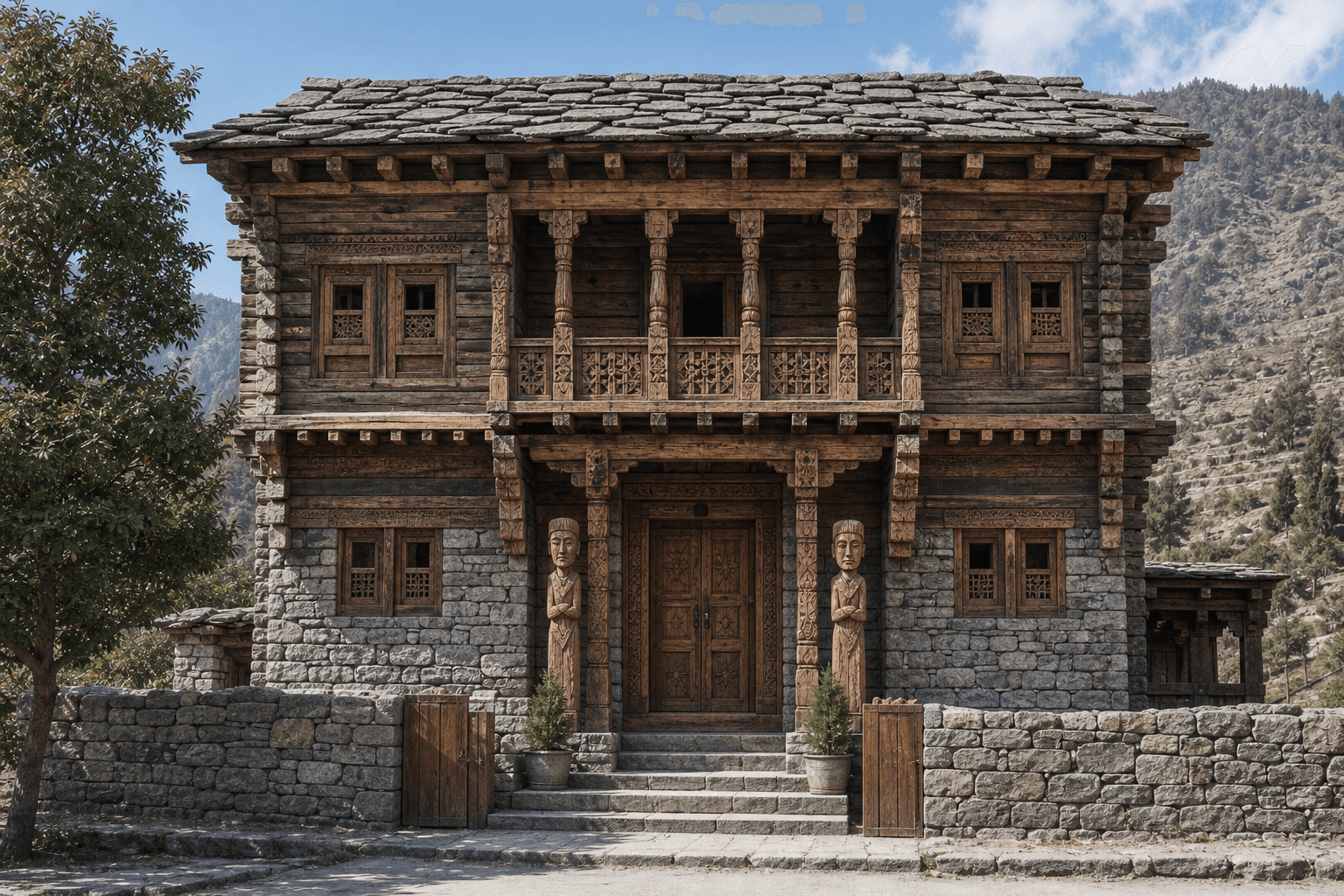
The Nuristani house facade is a composition of timber, shadow, and ornament: (1) The downhill (valley-facing) facade — the primary elevation: the stone plinth at the base → the timber log or plank wall of the lower floor with small window openings → the projecting balcony (bālākhāna) of the upper floor, supported by ca...
Materials & Texture
Nuristani materials are entirely forest-and-mountain sourced: (1) Deodar cedar (Cedrus deodara) — the primary timber: a large conifer (up to 50 m tall, 3 m diameter) native to the western Himalayas and Hindu Kush — the wood is aromatic, insect-resistant, and durable (lasting centuries without treatment) — the timber is...
Color Palette
White, cream, pale sand, warm timber, and shadow-driven dark metal accents define the palette. The facade should stay bright and climate-aware rather than heavy, gray, or over-saturated.
Ornament & Detail
Nuristani ornament is the visual language of a unique mountain culture: (1) Gandāw (ancestral effigy) — the supreme expression of Nuristani sculptural art: carved wooden posts representing ancestors, deities (in the pre-Islamic period), or honored community members — the figure is carved from a single deodar log: the h...
Climate Response
Nuristan has a humid continental-mountain climate at 1,500–3,000 m: (1) Winter: -5°C to -20°C, heavy snowfall (2–5 m accumulation) — the house is adapted for winter survival: the lower level (livestock) provides radiant heat rising through the timber floor; the central hearth burns continuously; the small windows minim...
Landscape & Ground
The vernacular architecture of Nuristan (formerly Kafiristan — "Land of the Infidels," renamed Nuristan — "Land of Light" — after conversion to Islam in 1895–96), a remote mountainous region in eastern Afghanistan bordering Pakistan's Chitral district — the Nuristani people (speakers of Nuristani languages, a distinct...
Reference elevation
Nuristan Eastern Timber — characteristic facade composition, vernacular architecture of Nuristan (formerly Kafiristan.
Context Snapshot
The vernacular architecture of Nuristan (formerly Kafiristan — "Land of the Infidels," renamed Nuristan — "Land of Light" — after conversion to Islam in 1895–96), a remote mountainous region in easter... Nuristan has a humid continental-mountain climate at 1,500–3,000 m: (1) Winter: -5°C to -20°C, heavy snowfall (2–5 m accumulation) — the house is adapted for winter survival: the lower level (livestock) provides radiant...
Contemporary Relevance
Nuristan Eastern Timber is useful today for residential, hospitality, civic, and place-branding work that needs Afghanistan-specific character grounded in local massing, material tone, climate response, and settlement logic rather than generic international styling.
Use this style in Toscape
Explore Nuristan Eastern Timber directly inside Toscape using the Facade Re-Style and Design Options workflows.
Open Nuristan Eastern Timber in the galleryFrequently asked questions
What is Nuristan Eastern Timber?
Nuristan Eastern Timber is a regional architectural identity from Afghanistan. The isolated mountain valleys of Nuristan in the eastern Hindu Kush — a unique timber architecture of multi-story wooden houses with flat stone-laid roofs, richly carved ancestral.
What materials define Nuristan Eastern Timber?
Nuristani materials are entirely forest-and-mountain sourced: (1) Deodar cedar (Cedrus deodara) — the primary timber: a large conifer (up to 50 m tall, 3 m diameter) native to the western Himalayas and Hindu Kush — the wood is aromatic, insect-resistant, and durable (lasting centuries without treatment) — the timber is.
What is the Nuristan Eastern Timber color palette?
White, cream, pale sand, warm timber, and shadow-driven dark metal accents define the palette. The facade should stay bright and climate-aware rather than heavy, gray, or over-saturated.
Where does Nuristan Eastern Timber come from?
The vernacular architecture of Nuristan (formerly Kafiristan — "Land of the Infidels," renamed Nuristan — "Land of Light" — after conversion to Islam in 1895–96), a remote mountainous region in easter.
When should architects use Nuristan Eastern Timber?
Nuristan Eastern Timber is useful today for residential, hospitality, civic, and place-branding work that needs Afghanistan-specific character grounded in local massing, material tone, climate response, and settlement logic rather than generic international styling.
How do you render Nuristan Eastern Timber in Toscape?
Open Toscape on Windows, load your own photo, elevation, sketch, or CAD view, then apply the Nuristan Eastern Timber reference from the built-in style library. The Facade Re-Style and Design Options workflows keep your project geometry and camera while shifting materials, proportion, and detailing toward Nuristan Eastern Timber.