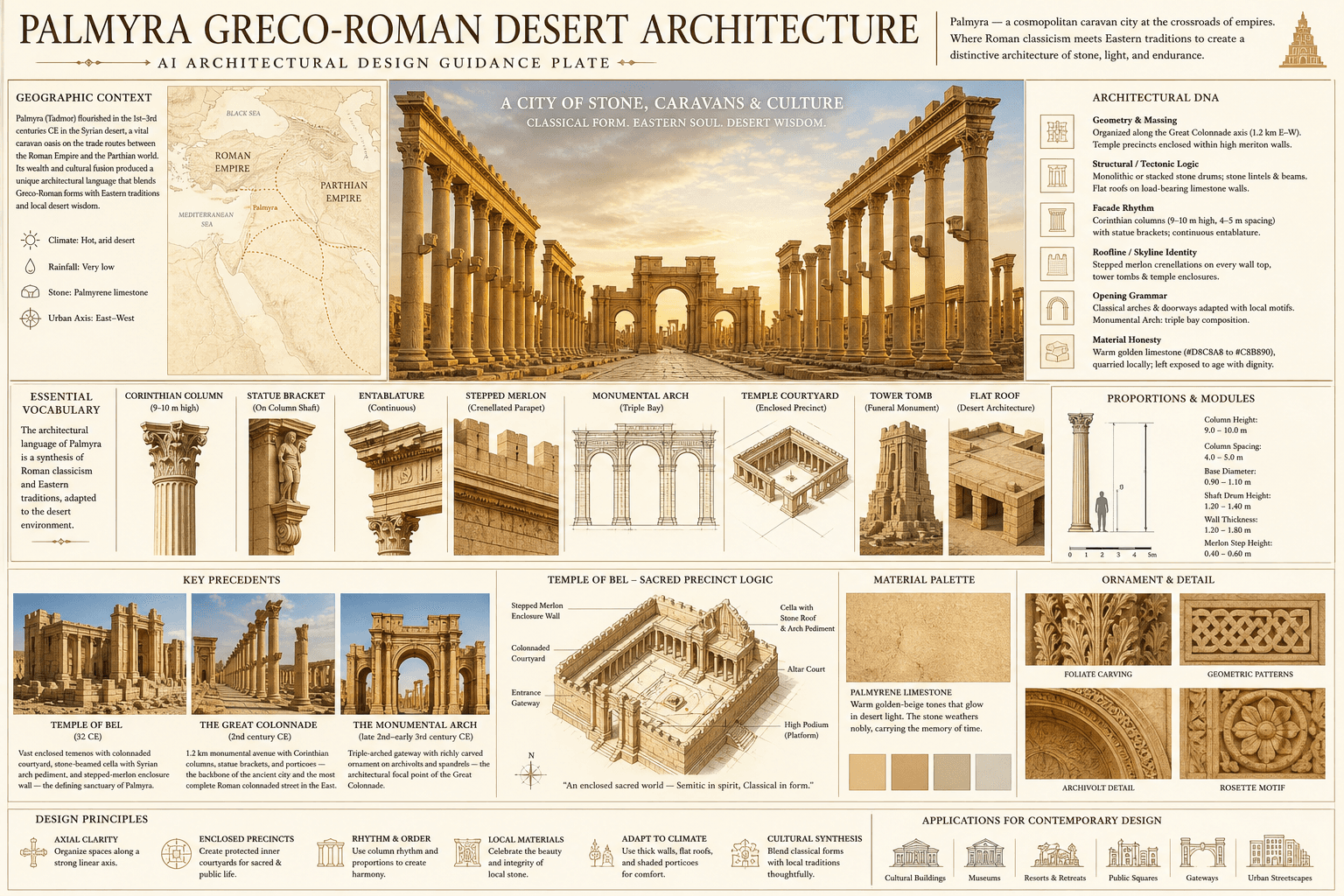
Palmyra Greco-Roman Desert
Syria · architecture of Palmyra (1st–3rd centuries CE)
The monumental architecture of Palmyra (Tadmur) — the ancient Syrian oasis city where Greco-Roman classical architecture fused with Eastern Semitic and Parthian traditions to creat...
Definition
Palmyra Greco-Roman Desert is a regional architectural identity from Syria. The monumental architecture of Palmyra (Tadmur) — the ancient Syrian oasis city where Greco-Roman classical architecture fused with Eastern Semitic and Parthian traditions to creat.
- Country
- Syria
- Region
- architecture of Palmyra (1st–3rd centuries CE).
- Massing
- Palmyra is organized along the Great Colonnade — a monumental straight axis oriented roughly east-west.
- Materials
- Palmyrene limestone — warm golden-beige (#D8C8A8 to #C8B890).
- Palette
- White, cream, pale sand, warm timber, and shadow-driven dark metal accents define the palette.
- Climate response
- Palmyra is a desert oasis — the city exists because of the Efqa spring.
Overview
Palmyra Greco-Roman Desert is a regional architectural identity in Syria. The architecture of Palmyra (1st–3rd centuries CE) — a wealthy caravan city at the crossroads of the Roman and Parthian empires, where the cosmopolitan culture produced a distinctive hybrid architecture: (1) The Great Colonnade — a 1.2 km long straight avenue lined with tall Corinthian columns (9–10 m high) of golden Palmyrene limestone, with projecting brackets (consoles) from the column shafts that once carried sta...
Visual DNA
Massing & Form
Palmyra is organized along the Great Colonnade — a monumental straight axis oriented roughly east-west, with the Temple of Bel at the eastern terminus and the Funerary Temple at the western end. The colonnade is flanked by porticoes (covered walkways behind the columns) with shops and public buildings.
Facade Language
The Great Colonnade facade is a rhythmic sequence of tall Corinthian columns (9–10 m high, spaced 4–5 m apart), each with a projecting console bracket about 2/3 of the way up the shaft — the brackets carried bronze statues of Palmyrene notables, creating a gallery of honorands along the street. Behind the columns, the...
Materials & Texture
Palmyrene limestone — warm golden-beige (#D8C8A8 to #C8B890), the same Eocene limestone as Aleppo — the stone was quarried from nearby hills and transported to the site — the stone weathers to a slightly darker gold (#B8A880), and in some exposed locations to a silvery grey (#C0C0B8). The stone is the material of colum...
Color Palette
White, cream, pale sand, warm timber, and shadow-driven dark metal accents define the palette. The facade should stay bright and climate-aware rather than heavy, gray, or over-saturated.
Ornament & Detail
Palmyrene ornament fuses classical and Eastern motifs: (1) The statue brackets (consoles) projecting from the Great Colonnade column shafts — each bracket carried a bronze statue of a Palmyrene citizen — the brackets are carved with palmettes, rosettes, and vine scrolls — the bracket program is uniquely Palmyrene. (2)...
Climate Response
Palmyra is a desert oasis — the city exists because of the Efqa spring, which provides water in the Syrian desert — the oasis creates a green island of date palms and gardens surrounded by the beige-gold desert. The climate is extreme desert: hot dry summers (40°C+), cold winters (near freezing at night), almost no rai...
Landscape & Ground
The architecture of Palmyra (1st–3rd centuries CE) — a wealthy caravan city at the crossroads of the Roman and Parthian empires, where the cosmopolitan culture produced a distinctive hybrid architecture: (1) The Great Colonnade — a 1.2 km long straight avenue lined with tall Corinthian columns (9–10 m high) of golden P...
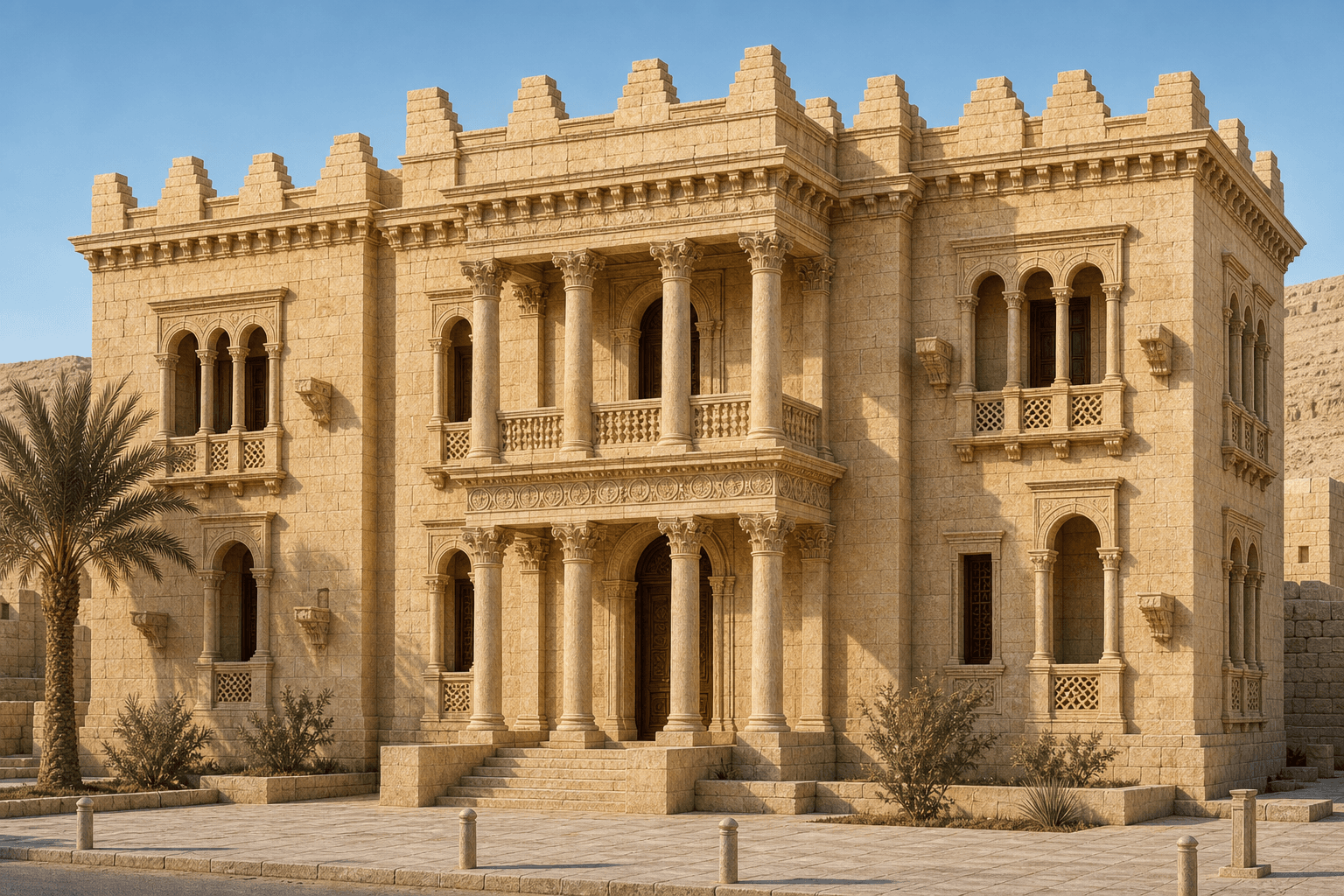
Reference elevation
Palmyra Greco-Roman Desert — characteristic facade composition, architecture of Palmyra (1st–3rd centuries CE).
Context Snapshot
The architecture of Palmyra (1st–3rd centuries CE) — a wealthy caravan city at the crossroads of the Roman and Parthian empires, where the cosmopolitan culture produced a distinctive hybrid architectu... Palmyra is a desert oasis — the city exists because of the Efqa spring, which provides water in the Syrian desert — the oasis creates a green island of date palms and gardens surrounded by the beige-gold desert.
Contemporary Relevance
Palmyra Greco-Roman Desert is useful today for residential, hospitality, civic, and place-branding work that needs Syria-specific character grounded in local massing, material tone, climate response, and settlement logic rather than generic international styling.
Use this style in Toscape
Explore Palmyra Greco-Roman Desert directly inside Toscape using the Facade Re-Style and Design Options workflows.
Open Palmyra Greco-Roman Desert in the galleryFrequently asked questions
What is Palmyra Greco-Roman Desert?
Palmyra Greco-Roman Desert is a regional architectural identity from Syria. The monumental architecture of Palmyra (Tadmur) — the ancient Syrian oasis city where Greco-Roman classical architecture fused with Eastern Semitic and Parthian traditions to creat.
What materials define Palmyra Greco-Roman Desert?
Palmyrene limestone — warm golden-beige (#D8C8A8 to #C8B890), the same Eocene limestone as Aleppo — the stone was quarried from nearby hills and transported to the site — the stone weathers to a slightly darker gold (#B8A880), and in some exposed locations to a silvery grey (#C0C0B8). The stone is the material of colum.
What is the Palmyra Greco-Roman Desert color palette?
White, cream, pale sand, warm timber, and shadow-driven dark metal accents define the palette. The facade should stay bright and climate-aware rather than heavy, gray, or over-saturated.
Where does Palmyra Greco-Roman Desert come from?
The architecture of Palmyra (1st–3rd centuries CE) — a wealthy caravan city at the crossroads of the Roman and Parthian empires, where the cosmopolitan culture produced a distinctive hybrid architectu.
When should architects use Palmyra Greco-Roman Desert?
Palmyra Greco-Roman Desert is useful today for residential, hospitality, civic, and place-branding work that needs Syria-specific character grounded in local massing, material tone, climate response, and settlement logic rather than generic international styling.
How do you render Palmyra Greco-Roman Desert in Toscape?
Open Toscape on Windows, load your own photo, elevation, sketch, or CAD view, then apply the Palmyra Greco-Roman Desert reference from the built-in style library. The Facade Re-Style and Design Options workflows keep your project geometry and camera while shifting materials, proportion, and detailing toward Palmyra Greco-Roman Desert.