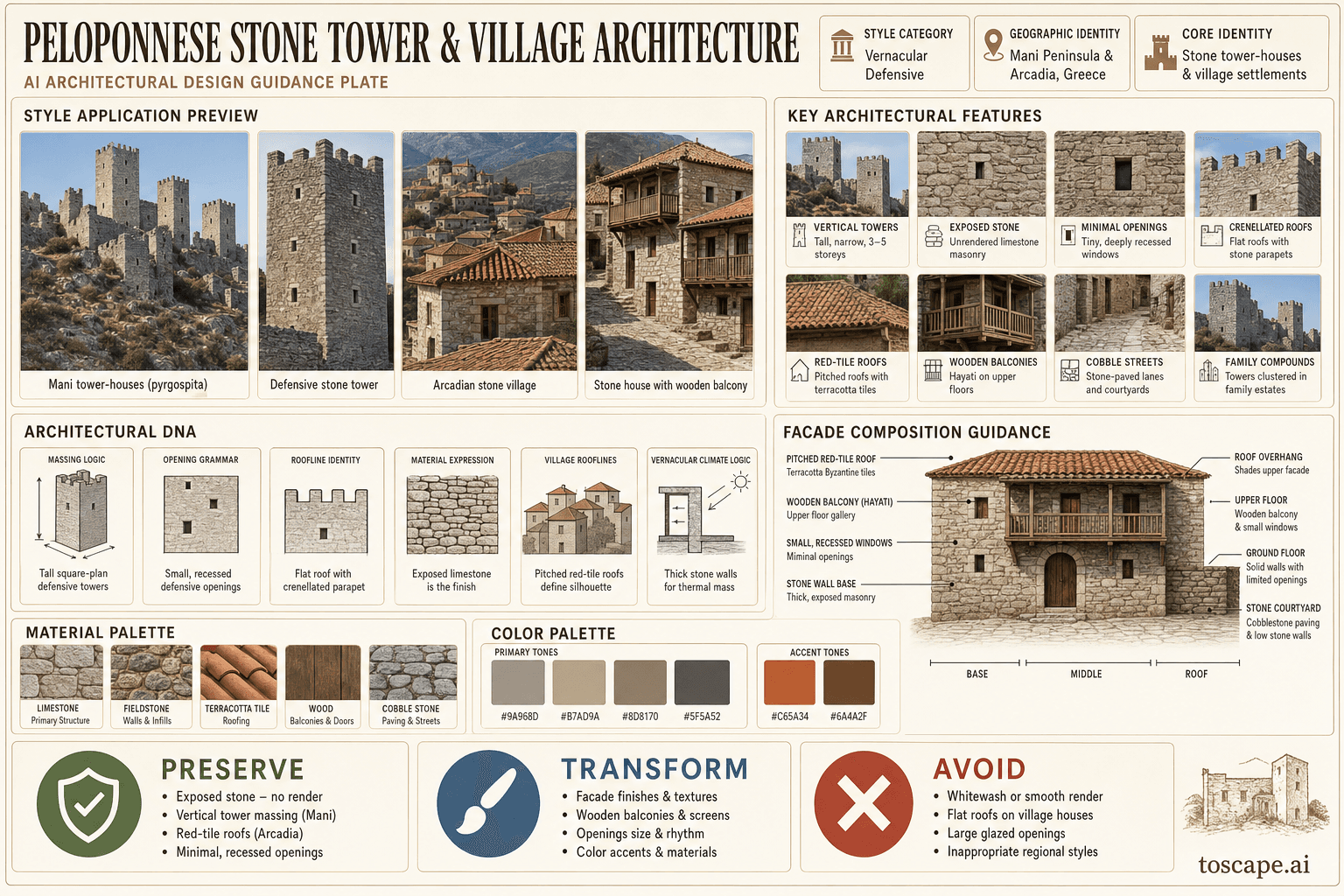
Peloponnese Stone Tower & Village
Greece · stone tower-house (pyrgospito) of the Mani Peninsula and the vernacular stone vi...
The Mani tower-houses and Arcadian stone villages — fortified clan architecture of southern Greece
Definition
Peloponnese Stone Tower & Village is a regional architectural identity from Greece. The Mani tower-houses and Arcadian stone villages — fortified clan architecture of southern Greece.
- Country
- Greece
- Region
- stone tower-house (pyrgospito) of the Mani Peninsula and the vernacular stone vi.
- Massing
- Tall, narrow, defensive stone tower-houses (3–5 storeys, 15–20 m) in the Mani — the "skyscrapers of the Middle Ages" — exposed grey limestone masonry (unrendered.
- Palette
- White, cream, pale sand, warm timber, and shadow-driven dark metal accents define the palette.
- Climate response
- The stone tower-house (pyrgospito) of the Mani Peninsula and the vernacular stone villages of Arcadia — the most distinctive mainland Greek vernacular architecture.
Try it free
Render your own project in this style
Upload one photo of your own project and Re-Render keeps the geometry and camera while carrying the Peloponnese Stone Tower & Village language into materials, proportion, and detail. Three free renders, no account needed.
Open Re-Render - freeOverview
Peloponnese Stone Tower & Village is a regional architectural identity in Greece. The stone tower-house (pyrgospito) of the Mani Peninsula and the vernacular stone villages of Arcadia — the most distinctive mainland Greek vernacular architecture, shaped by clan rivalry, limited resources, and the rugged Peloponnesian landscape. Tall, narrow, defensive stone tower-houses (3–5 storeys, 15–20 m) in the Mani — the "skyscrapers of the Middle Ages" — exposed grey limestone masonry (unrendered — contrast...
Visual DNA
Massing & Form
Tall, narrow, defensive stone tower-houses (3–5 storeys, 15–20 m) in the Mani — the "skyscrapers of the Middle Ages" — exposed grey limestone masonry (unrendered — contrasting with the whitewashed Cyclades) — flat roofs with crenellated parapets — tiny, deeply recessed windows — the stone village (choriò) of Arcadia wi...
Facade Language
Tall, narrow, defensive stone tower-houses (3–5 storeys, 15–20 m) in the Mani — the "skyscrapers of the Middle Ages" — exposed grey limestone masonry (unrendered — contrasting with the whitewashed Cyclades) — flat roofs with crenellated parapets — tiny, deeply recessed windows — the stone village (choriò) of Arcadia wi...
Materials & Texture
Tall, narrow, defensive stone tower-houses (3–5 storeys, 15–20 m) in the Mani — the "skyscrapers of the Middle Ages" — exposed grey limestone masonry (unrendered — contrasting with the whitewashed Cyclades) — flat roofs with crenellated parapets — tiny, deeply recessed windows — the stone village (choriò) of Arcadia wi...
Color Palette
White, cream, pale sand, warm timber, and shadow-driven dark metal accents define the palette. The facade should stay bright and climate-aware rather than heavy, gray, or over-saturated.
Ornament & Detail
Tall, narrow, defensive stone tower-houses (3–5 storeys, 15–20 m) in the Mani — the "skyscrapers of the Middle Ages" — exposed grey limestone masonry (unrendered — contrasting with the whitewashed Cyclades) — flat roofs with crenellated parapets — tiny, deeply recessed windows — the stone village (choriò) of Arcadia wi...
Climate Response
The stone tower-house (pyrgospito) of the Mani Peninsula and the vernacular stone villages of Arcadia — the most distinctive mainland Greek vernacular architecture, shaped by clan rivalry, limited resources, and the rugged Peloponnesian landscape
Landscape & Ground
The stone tower-house (pyrgospito) of the Mani Peninsula and the vernacular stone villages of Arcadia — the most distinctive mainland Greek vernacular architecture, shaped by clan rivalry, limited resources, and the rugged Peloponnesian landscape
Reference elevation
Peloponnese Stone Tower & Village — characteristic facade composition, stone tower-house (pyrgospito) of the Mani Peninsula and the vernacular stone vi....
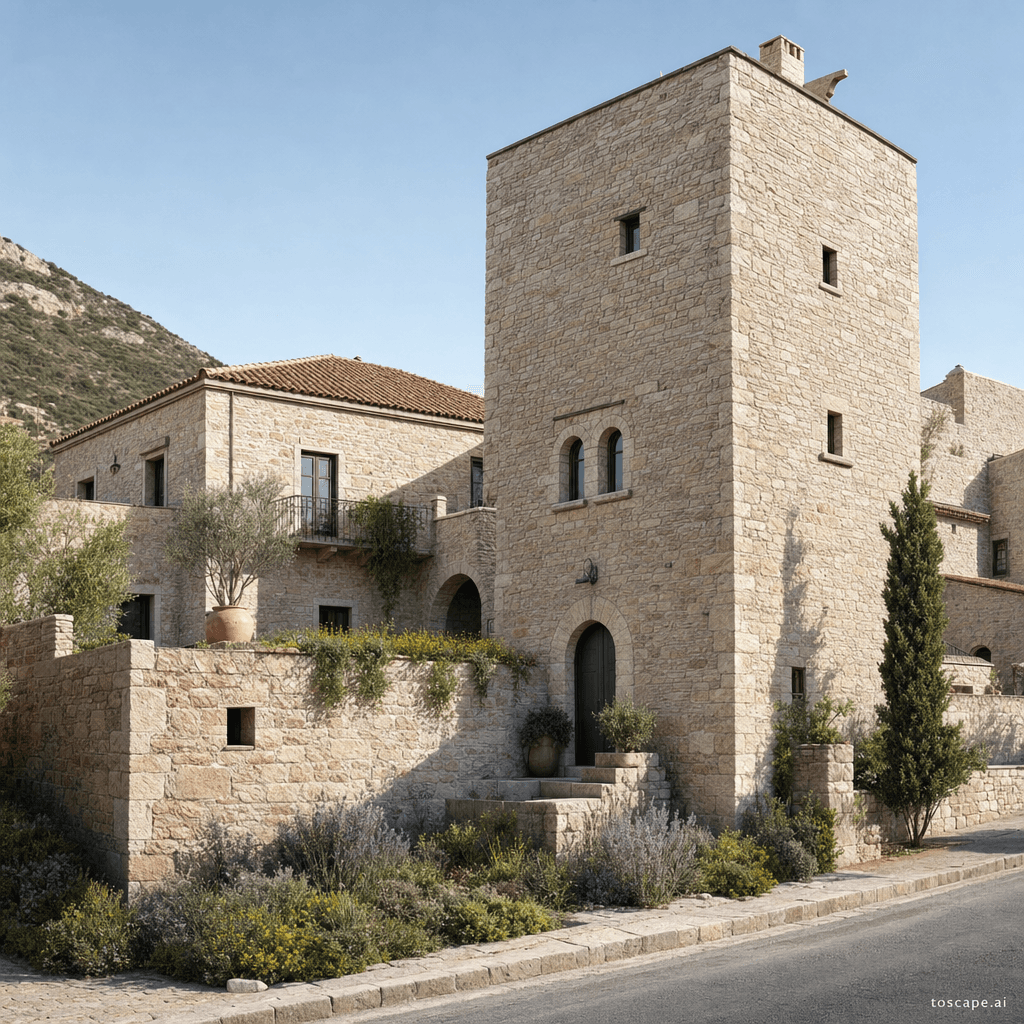
Context Snapshot
The stone tower-house (pyrgospito) of the Mani Peninsula and the vernacular stone villages of Arcadia — the most distinctive mainland Greek vernacular architecture, shaped by clan rivalry, limited res...
Contemporary Relevance
Peloponnese Stone Tower & Village is useful today for residential, hospitality, civic, and place-branding work that needs Greece-specific character grounded in local massing, material tone, climate response, and settlement logic rather than generic international styling.
Use this style in Toscape
Explore Peloponnese Stone Tower & Village directly inside Toscape using the Facade Re-Style and Design Options workflows.
Open Peloponnese Stone Tower & Village in the galleryFrequently asked questions
What is Peloponnese Stone Tower & Village?
Peloponnese Stone Tower & Village is a regional architectural identity from Greece. The Mani tower-houses and Arcadian stone villages — fortified clan architecture of southern Greece.
What materials define Peloponnese Stone Tower & Village?
Tall, narrow, defensive stone tower-houses (3–5 storeys, 15–20 m) in the Mani — the "skyscrapers of the Middle Ages" — exposed grey limestone masonry (unrendered — contrasting with the whitewashed Cyclades) — flat roofs with crenellated parapets — tiny, deeply recessed windows — the stone village (choriò) of Arcadia wi.
What is the Peloponnese Stone Tower & Village color palette?
White, cream, pale sand, warm timber, and shadow-driven dark metal accents define the palette. The facade should stay bright and climate-aware rather than heavy, gray, or over-saturated.
Where does Peloponnese Stone Tower & Village come from?
The stone tower-house (pyrgospito) of the Mani Peninsula and the vernacular stone villages of Arcadia — the most distinctive mainland Greek vernacular architecture, shaped by clan rivalry, limited res.
When should architects use Peloponnese Stone Tower & Village?
Peloponnese Stone Tower & Village is useful today for residential, hospitality, civic, and place-branding work that needs Greece-specific character grounded in local massing, material tone, climate response, and settlement logic rather than generic international styling.
How do you render Peloponnese Stone Tower & Village in Toscape?
Toscape renders your own photograph, elevation, sketch, or CAD view through the Peloponnese Stone Tower & Village reference. The Facade Re-Style and Design Options workflows keep the building's geometry and camera fixed while the surface language shifts toward Peloponnese Stone Tower & Village.
Other regional identities from Greece
- Santorini Volcanic CalderaThe earth-sheltered cave architecture of the Santorini caldera.
- Corfu Ionian Island VenetianThe Venetian-influenced urban architecture of the Ionian Islands — Italian Renaissance meets Greek island vernacular.
- Crete Venetian-Ottoman HybridThe layered island architecture of Crete — Minoan memory, Venetian fortification, Ottoman adaptation, and Aegean vernacular.
- Cyclades IslandsThe iconic whitewashed cubic architecture of the Aegean islands — Santorini, Mykonos, and the Cycladic archipelago.
- Epirus Zagori Stone Bridge & Mountain VillageThe Ottoman-influenced stone mansions of northwestern Greece — arched bridges, stone-slab roofs, and the Zagorochoria villages.
- Macedonian Urban BalkanThe Ottoman-influenced urban houses of Thessaloniki and northern Greece — Balkan timber-framed mansions and the "Ano.