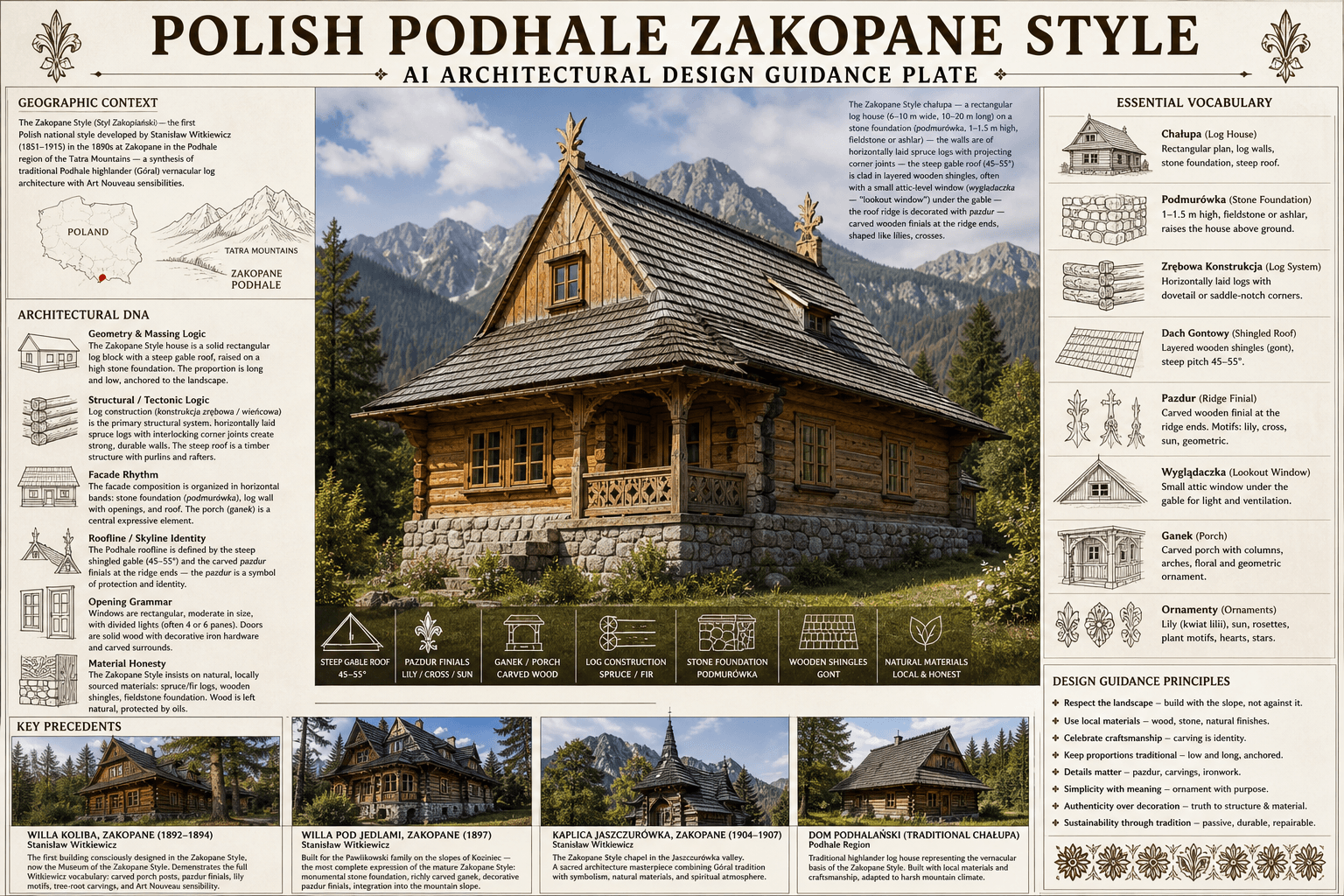
Polish Podhale Zakopane Style
Poland · Zakopane Style (Styl Zakopiański)
The Witkiewicz Zakopane Style — a highlander vernacular architecture of the Polish Tatra Mountains — log-built houses (chałupa góralska) with steep shingled roofs, richly carved wo...
Definition
Polish Podhale Zakopane Style is a regional architectural identity from Poland. The Witkiewicz Zakopane Style — a highlander vernacular architecture of the Polish Tatra Mountains — log-built houses (chałupa góralska) with steep shingled roofs, richly carved wo.
- Country
- Poland
- Region
- Zakopane Style (Styl Zakopiański).
- Massing
- The Zakopane Style house is a solid rectangular log block with a steep gable roof, raised on a high stone foundation.
- Materials
- The Zakopane Style insists on natural, locally sourced materials: (1) Spruce/fir (świerk/jodła) — the primary log and structural wood.
- Palette
- White, cream, pale sand, warm timber, and shadow-driven dark metal accents define the palette.
- Climate response
- The Podhale region of the Polish Tatras has a severe mountain climate: (1) Heavy winter snowfall (2–4 m annual accumulation) — the steep 45–55° roof pitch.
Overview
Polish Podhale Zakopane Style is a regional architectural identity in Poland. The Zakopane Style (Styl Zakopiański) — the first Polish national style developed by Stanisław Witkiewicz (1851–1915) in the 1890s at Zakopane in the Podhale region of the Tatra Mountains — a synthesis of traditional Podhale highlander (Góral) vernacular log architecture with Art Nouveau sensibilities — the style elevated vernacular building to a national architectural identity — the Podhale chałupa is a log house (s...
Visual DNA
Massing & Form
The Zakopane Style house is a solid rectangular log block with a steep gable roof, raised on a high stone foundation. The proportions favor width over depth — the house is a long rectangle, often with the gable facing the street and the porch running along the longer south side.
Facade Language
The facade composition of the Zakopane Style house is organized in clear horizontal bands: (1) The stone podmurówka — the solid stone base, darker in tone, with small cellar windows. (2) The log wall band — the main volume of the house, with regularly spaced windows (1–1.5 m wide, 1.2–1.8 m high), their carved wooden s...
Materials & Texture
The Zakopane Style insists on natural, locally sourced materials: (1) Spruce/fir (świerk/jodła) — the primary log and structural wood, silvering to a warm grey-brown with age — the logs are unstained, allowed to weather naturally. (2) Wooden shingles (gont) — split spruce shingles, silver-grey, creating a richly textur...
Color Palette
White, cream, pale sand, warm timber, and shadow-driven dark metal accents define the palette. The facade should stay bright and climate-aware rather than heavy, gray, or over-saturated.
Ornament & Detail
The carved ornament (snycerka) of the Zakopane Style is its most defining feature — codified by Witkiewicz from authentic Góral folk art: (1) The lily motif (leluja) — a stylized lily derived from the highlander shepherd's crook finial — carved on door lintels, beam ends, window surrounds, and the pazdur ridge finial....
Climate Response
The Podhale region of the Polish Tatras has a severe mountain climate: (1) Heavy winter snowfall (2–4 m annual accumulation) — the steep 45–55° roof pitch sheds snow; the house is raised on the podmurówka above snow level; the deep roof overhang keeps snow and rain away from the log walls. (2) Cold winters (-20°C to -3...
Landscape & Ground
The Zakopane Style (Styl Zakopiański) — the first Polish national style developed by Stanisław Witkiewicz (1851–1915) in the 1890s at Zakopane in the Podhale region of the Tatra Mountains — a synthesis of traditional Podhale highlander (Góral) vernacular log architecture with Art Nouveau sensibilities — the style eleva...
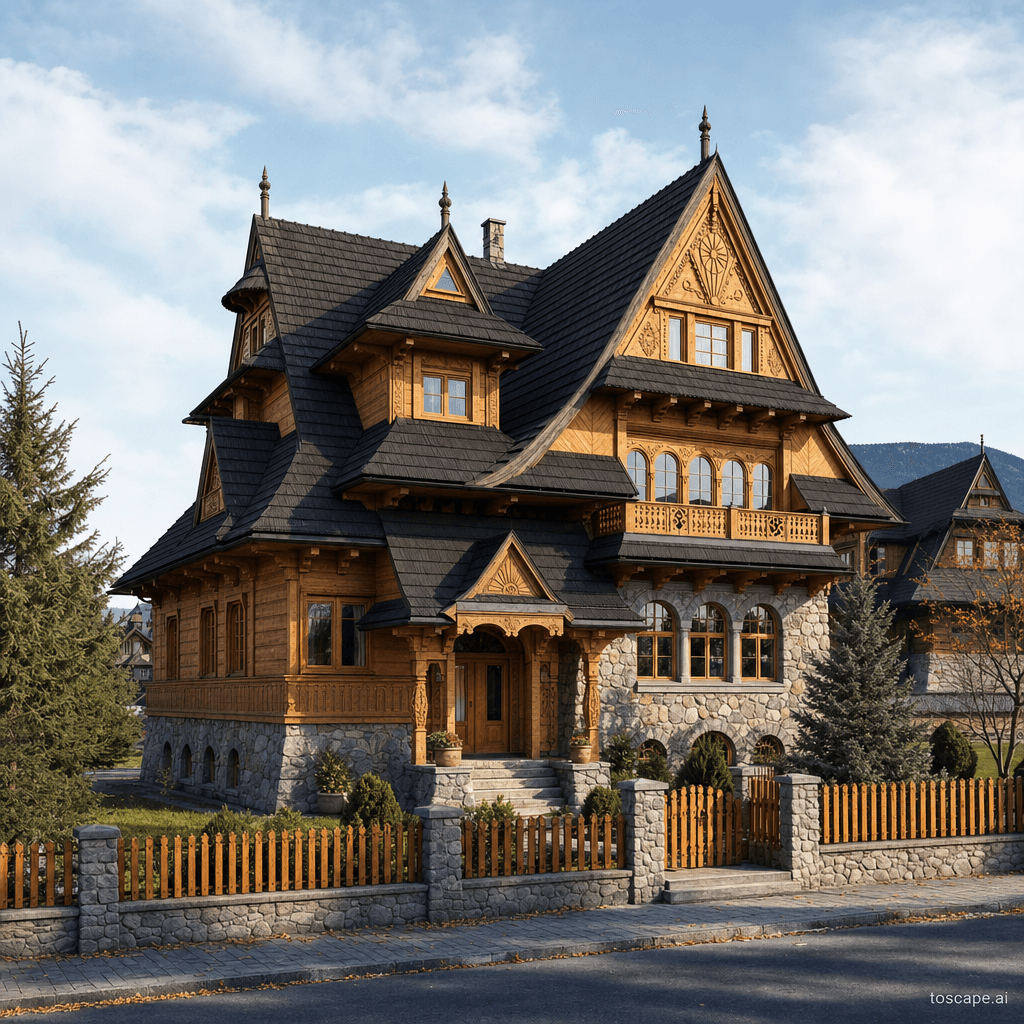
Reference elevation
Polish Podhale Zakopane Style — characteristic facade composition, Zakopane Style (Styl Zakopiański).
Context Snapshot
The Zakopane Style (Styl Zakopiański) — the first Polish national style developed by Stanisław Witkiewicz (1851–1915) in the 1890s at Zakopane in the Podhale region of the Tatra Mountains — a synthesi... The Podhale region of the Polish Tatras has a severe mountain climate: (1) Heavy winter snowfall (2–4 m annual accumulation) — the steep 45–55° roof pitch sheds snow; the house is raised on the podmurówka above snow leve...
Contemporary Relevance
Polish Podhale Zakopane Style is useful today for residential, hospitality, civic, and place-branding work that needs Poland-specific character grounded in local massing, material tone, climate response, and settlement logic rather than generic international styling.
Use this style in Toscape
Explore Polish Podhale Zakopane Style directly inside Toscape using the Facade Re-Style and Design Options workflows.
Open Polish Podhale Zakopane Style in the galleryFrequently asked questions
What is Polish Podhale Zakopane Style?
Polish Podhale Zakopane Style is a regional architectural identity from Poland. The Witkiewicz Zakopane Style — a highlander vernacular architecture of the Polish Tatra Mountains — log-built houses (chałupa góralska) with steep shingled roofs, richly carved wo.
What materials define Polish Podhale Zakopane Style?
The Zakopane Style insists on natural, locally sourced materials: (1) Spruce/fir (świerk/jodła) — the primary log and structural wood, silvering to a warm grey-brown with age — the logs are unstained, allowed to weather naturally. (2) Wooden shingles (gont) — split spruce shingles, silver-grey, creating a richly textur.
What is the Polish Podhale Zakopane Style color palette?
White, cream, pale sand, warm timber, and shadow-driven dark metal accents define the palette. The facade should stay bright and climate-aware rather than heavy, gray, or over-saturated.
Where does Polish Podhale Zakopane Style come from?
The Zakopane Style (Styl Zakopiański) — the first Polish national style developed by Stanisław Witkiewicz (1851–1915) in the 1890s at Zakopane in the Podhale region of the Tatra Mountains — a synthesi.
When should architects use Polish Podhale Zakopane Style?
Polish Podhale Zakopane Style is useful today for residential, hospitality, civic, and place-branding work that needs Poland-specific character grounded in local massing, material tone, climate response, and settlement logic rather than generic international styling.
How do you render Polish Podhale Zakopane Style in Toscape?
Open Toscape on Windows, load your own photo, elevation, sketch, or CAD view, then apply the Polish Podhale Zakopane Style reference from the built-in style library. The Facade Re-Style and Design Options workflows keep your project geometry and camera while shifting materials, proportion, and detailing toward Polish Podhale Zakopane Style.