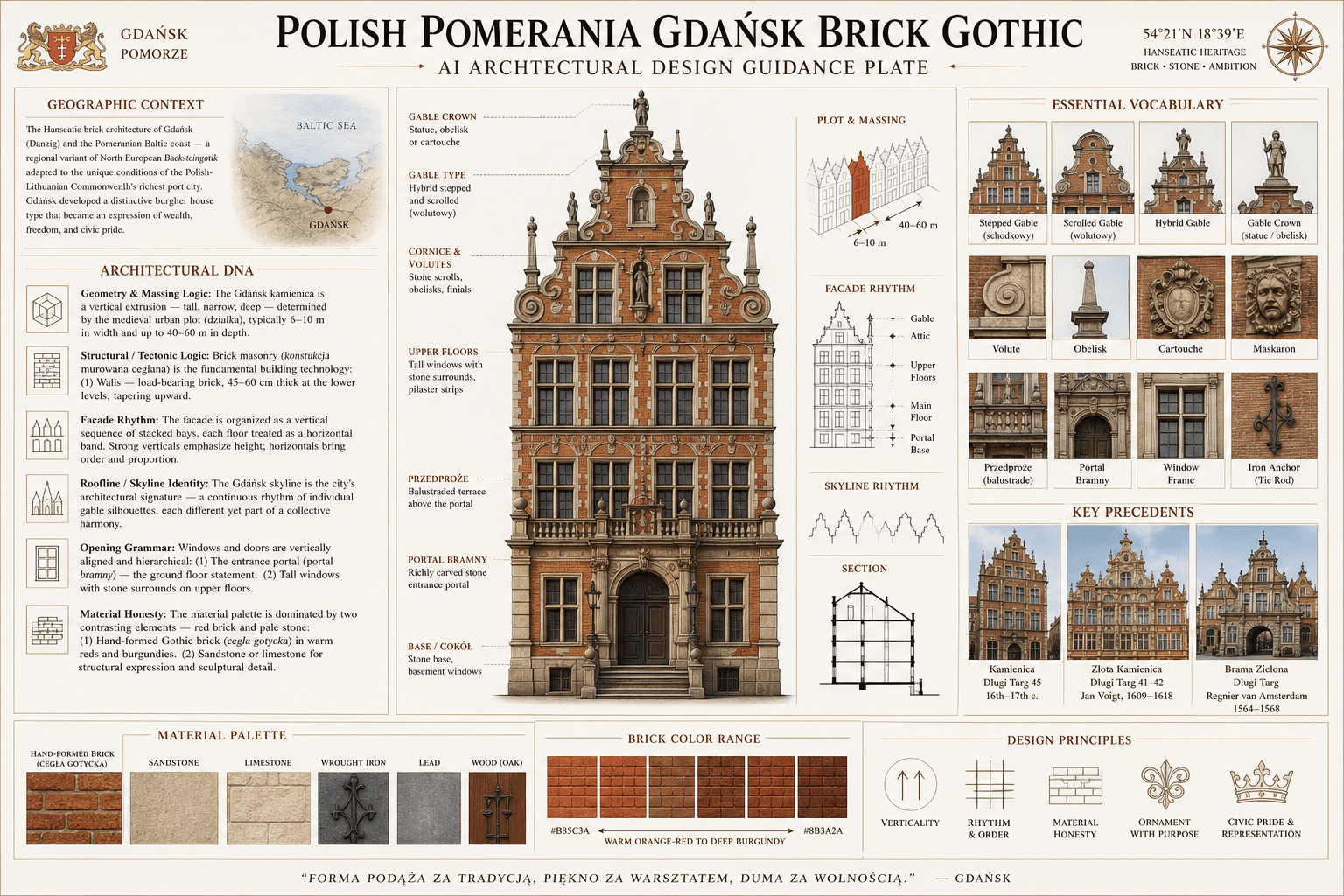
Polish Pomerania Gdańsk Brick Gothic
Poland · Hanseatic brick architecture of Gdańsk (Danzig) and the Pomeranian (Pomorze) Bal...
The Hanseatic Brick Gothic architecture of Gdańsk and the Pomeranian coast — tall narrow burgher houses (kamienice gdańskie) with stepped and scrolled gables, richly decorated faca...
Definition
Polish Pomerania Gdańsk Brick Gothic is a regional architectural identity from Poland. The Hanseatic Brick Gothic architecture of Gdańsk and the Pomeranian coast — tall narrow burgher houses (kamienice gdańskie) with stepped and scrolled gables, richly decorated faca.
- Country
- Poland
- Region
- Hanseatic brick architecture of Gdańsk (Danzig) and the Pomeranian (Pomorze) Bal.
- Massing
- The Gdańsk kamienica is a vertical extrusion — tall, narrow, deep — determined by the medieval urban plot (działka).
- Materials
- The material palette is dominated by two contrasting elements — red brick and pale stone: (1) Hand-formed Gothic brick (cegła gotycka) — the primary wall material.
- Palette
- White, cream, pale sand, warm timber, and shadow-driven dark metal accents define the palette.
- Climate response
- Gdańsk occupies the delta of the Motława River on the Baltic coast: (1) Maritime climate — mild winters (rarely below -10°C), cool summers, high humidity.
Overview
Polish Pomerania Gdańsk Brick Gothic is a regional architectural identity in Poland. The Hanseatic brick architecture of Gdańsk (Danzig) and the Pomeranian (Pomorze) Baltic coast — a regional variant of North European Backsteingotik (Brick Gothic) adapted to the unique conditions of the Polish-Lithuanian Commonwealth's richest port city — Gdańsk developed a distinctive burgher house typology: the kamienica (townhouse) is tall (3–5 stories), narrow (6–10 m wide facade), with an elaborate ornamental ga...
Visual DNA
Massing & Form
The Gdańsk kamienica is a vertical extrusion — tall, narrow, deep — determined by the medieval urban plot (działka), typically 6–10 m wide but 25–40 m deep. The street facade is the narrow gable end, the primary architectural face competing for attention.
Facade Language
The Gdańsk kamienica facade is organized as a vertical sequence of stacked bays, each floor treated as a horizontal band: (1) Ground floor — the most architecturally elaborated level: the przedproże terrace (stone platform, 1–1.5 m high, with ornate stone balustrade and steps), and the portal bramny (arched entrance do...
Materials & Texture
The material palette is dominated by two contrasting elements — red brick and pale stone: (1) Hand-formed Gothic brick (cegła gotycka) — the primary wall material, color ranging from warm terracotta-orange to deep burgundy-brown depending on the clay source and firing (#B85C3A to #8B3A2A) — the brick surface is unrende...
Color Palette
White, cream, pale sand, warm timber, and shadow-driven dark metal accents define the palette. The facade should stay bright and climate-aware rather than heavy, gray, or over-saturated.
Ornament & Detail
The Gdańsk ornament is a fusion of Gothic structure with Renaissance and Baroque detail: (1) The brick blind arcade (blenda arkadowa) — the fundamental ornamental module of the gable — vertical recessed panels with arched heads, separated by brick pilaster strips (lizeny), creating a rhythmic vertical articulation. (2)...
Climate Response
Gdańsk occupies the delta of the Motława River on the Baltic coast: (1) Maritime climate — mild winters (rarely below -10°C), cool summers, high humidity, strong sea winds — the tall narrow townhouses minimize wind exposure at ground level; the steep roof sheds rain and occasional snow; the unrendered brick withstands...
Landscape & Ground
The Hanseatic brick architecture of Gdańsk (Danzig) and the Pomeranian (Pomorze) Baltic coast — a regional variant of North European Backsteingotik (Brick Gothic) adapted to the unique conditions of the Polish-Lithuanian Commonwealth's richest port city — Gdańsk developed a distinctive burgher house typology: the kamie...
Reference elevation
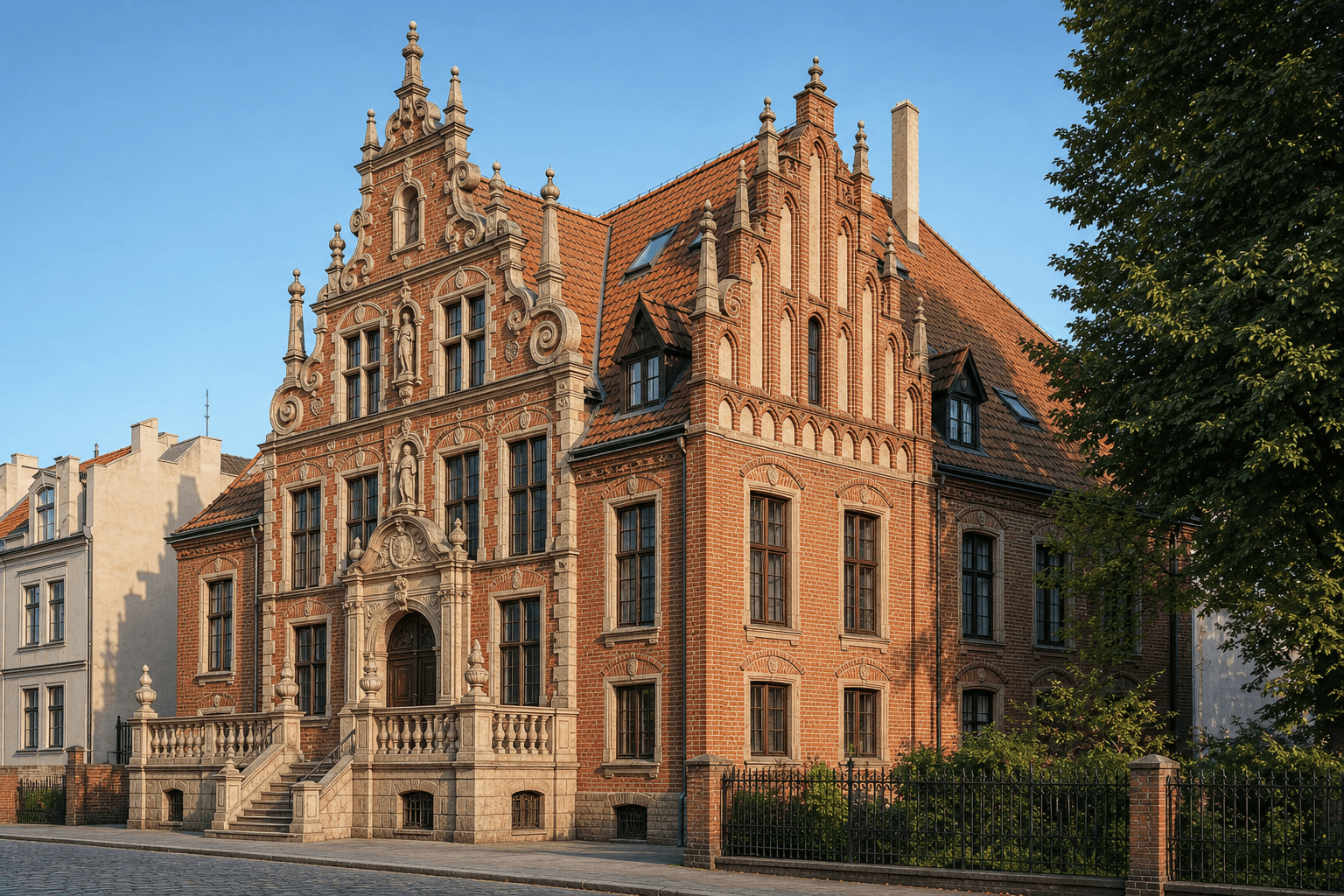
Polish Pomerania Gdańsk Brick Gothic — characteristic facade composition, Hanseatic brick architecture of Gdańsk (Danzig) and the Pomeranian (Pomorze) Bal....
Context Snapshot
The Hanseatic brick architecture of Gdańsk (Danzig) and the Pomeranian (Pomorze) Baltic coast — a regional variant of North European Backsteingotik (Brick Gothic) adapted to the unique conditions of t... Gdańsk occupies the delta of the Motława River on the Baltic coast: (1) Maritime climate — mild winters (rarely below -10°C), cool summers, high humidity, strong sea winds — the tall narrow townhouses minimize wind expos...
Contemporary Relevance
Polish Pomerania Gdańsk Brick Gothic is useful today for residential, hospitality, civic, and place-branding work that needs Poland-specific character grounded in local massing, material tone, climate response, and settlement logic rather than generic international styling.
Use this style in Toscape
Explore Polish Pomerania Gdańsk Brick Gothic directly inside Toscape using the Facade Re-Style and Design Options workflows.
Open Polish Pomerania Gdańsk Brick Gothic in the galleryFrequently asked questions
What is Polish Pomerania Gdańsk Brick Gothic?
Polish Pomerania Gdańsk Brick Gothic is a regional architectural identity from Poland. The Hanseatic Brick Gothic architecture of Gdańsk and the Pomeranian coast — tall narrow burgher houses (kamienice gdańskie) with stepped and scrolled gables, richly decorated faca.
What materials define Polish Pomerania Gdańsk Brick Gothic?
The material palette is dominated by two contrasting elements — red brick and pale stone: (1) Hand-formed Gothic brick (cegła gotycka) — the primary wall material, color ranging from warm terracotta-orange to deep burgundy-brown depending on the clay source and firing (#B85C3A to #8B3A2A) — the brick surface is unrende.
What is the Polish Pomerania Gdańsk Brick Gothic color palette?
White, cream, pale sand, warm timber, and shadow-driven dark metal accents define the palette. The facade should stay bright and climate-aware rather than heavy, gray, or over-saturated.
Where does Polish Pomerania Gdańsk Brick Gothic come from?
The Hanseatic brick architecture of Gdańsk (Danzig) and the Pomeranian (Pomorze) Baltic coast — a regional variant of North European Backsteingotik (Brick Gothic) adapted to the unique conditions of t.
When should architects use Polish Pomerania Gdańsk Brick Gothic?
Polish Pomerania Gdańsk Brick Gothic is useful today for residential, hospitality, civic, and place-branding work that needs Poland-specific character grounded in local massing, material tone, climate response, and settlement logic rather than generic international styling.
How do you render Polish Pomerania Gdańsk Brick Gothic in Toscape?
Open Toscape on Windows, load your own photo, elevation, sketch, or CAD view, then apply the Polish Pomerania Gdańsk Brick Gothic reference from the built-in style library. The Facade Re-Style and Design Options workflows keep your project geometry and camera while shifting materials, proportion, and detailing toward Polish Pomerania Gdańsk Brick Gothic.