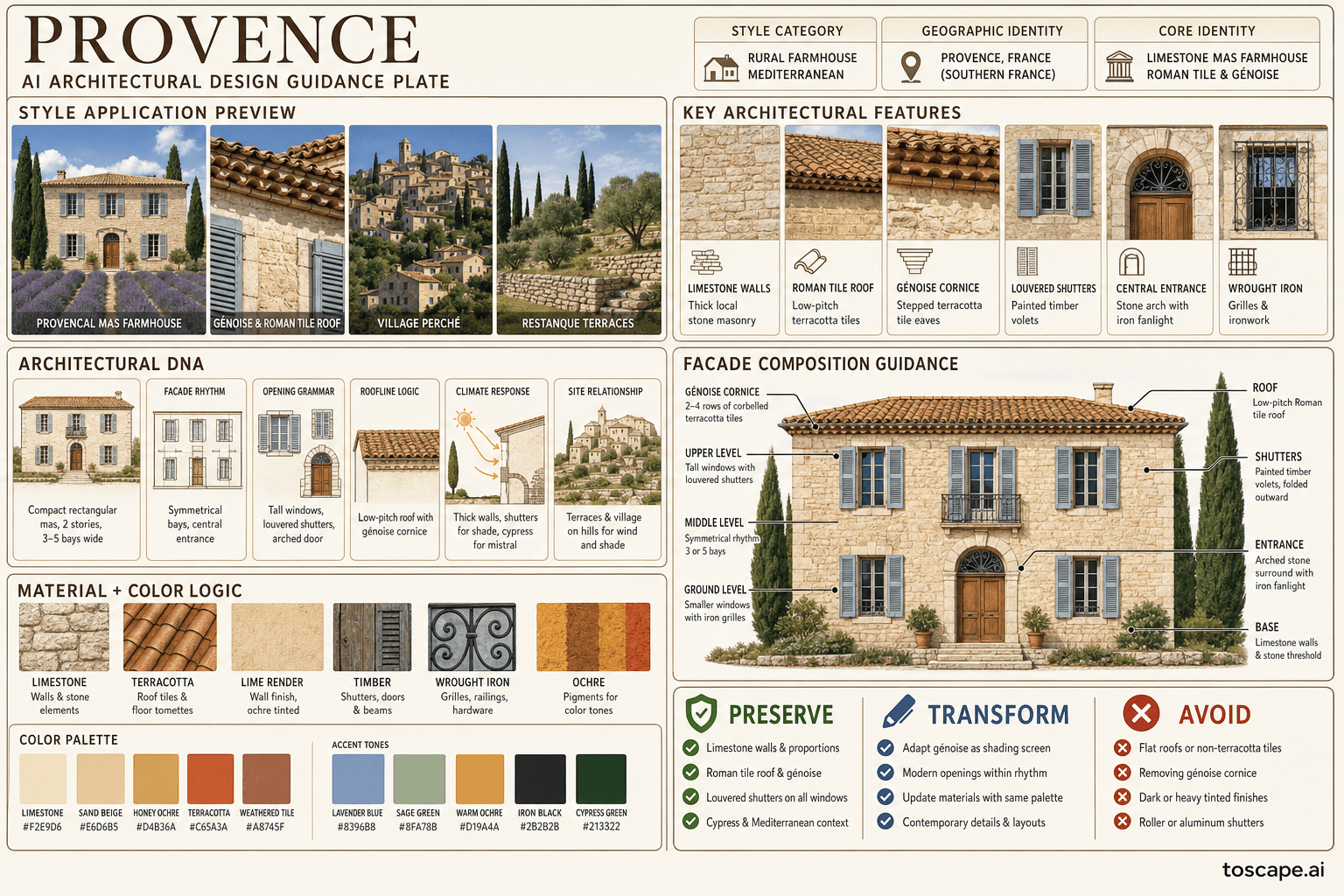
Provence
France · Provence region (Bouches-du-Rhône, Vaucluse, Alpes-de-Haute-Provence, Var)
Provençal Mas, Roman Tile & Limestone-Ochre Mediterranean Identity
Definition
Provence is a regional architectural identity from France. Provençal Mas, Roman Tile & Limestone-Ochre Mediterranean Identity.
- Country
- France
- Region
- Provence region (Bouches-du-Rhône, Vaucluse, Alpes-de-Haute-Provence, Var).
- Massing
- Compact rectangular plan (mas): single depth, 2 stories, 3-5 bays wide, oriented south for solar gain. Flat or shallow-pitch (25-30°) roof with Roman tile.
- Materials
- Pierre calcaire (limestone): cream-white to pale golden-beige — walls, quoins, voussoirs, paving. Pierre de Rognes/Pierre du Midi: fine-grained, warm honey patina.
- Palette
- White, cream, pale sand, warm timber, and shadow-driven dark metal accents define the palette.
- Climate response
- Mediterranean: hot dry summers, mild winters, mistral wind (northwesterly, cold, strong, 120+ days/year). Thick limestone walls: thermal mass, cool interior in summer.
Overview
Provence is a regional architectural identity in France. Provence region (Bouches-du-Rhône, Vaucluse, Alpes-de-Haute-Provence, Var) — limestone mas farmhouse architecture. Pale cream-grey limestone (pierre du Midi / pierre de Rognes) block walls with exposed or rendered finish, shallow-pitch Roman terracotta canal tile roofs (tuile canal), génoise corbelled tile eaves cornice, painted louvered shutters (volets) in faded blue-grey, lavender-green, or ochre, symmetrical thre...
Visual DNA
Massing & Form
Compact rectangular plan (mas): single depth, 2 stories, 3-5 bays wide, oriented south for solar gain. Flat or shallow-pitch (25-30°) roof with Roman tile.
Facade Language
Regular symmetrical bay rhythm: 3 or 5 bays evenly spaced, central entrance door. Exposed stone or cream lime render (crépi à la chaux) tinted with local ochre pigments.
Materials & Texture
Pierre calcaire (limestone): cream-white to pale golden-beige — walls, quoins, voussoirs, paving. Pierre de Rognes/Pierre du Midi: fine-grained, warm honey patina.
Color Palette
White, cream, pale sand, warm timber, and shadow-driven dark metal accents define the palette. The facade should stay bright and climate-aware rather than heavy, gray, or over-saturated.
Ornament & Detail
Génoise cornice: the primary ornament — simple, tectonic, anti-flamboyant. 2-4 rows of terracotta canal tiles stepped out from wall, each row projecting 5-8cm.
Climate Response
Mediterranean: hot dry summers, mild winters, mistral wind (northwesterly, cold, strong, 120+ days/year). Thick limestone walls: thermal mass, cool interior in summer.
Landscape & Ground
Provence region (Bouches-du-Rhône, Vaucluse, Alpes-de-Haute-Provence, Var) — limestone mas farmhouse architecture. Mediterranean: hot dry summers, mild winters, mistral wind (northwesterly, cold, strong, 120+ days/year).
Reference elevation
Provence — characteristic facade composition, Provence region (Bouches-du-Rhône, Vaucluse, Alpes-de-Haute-Provence, Var).
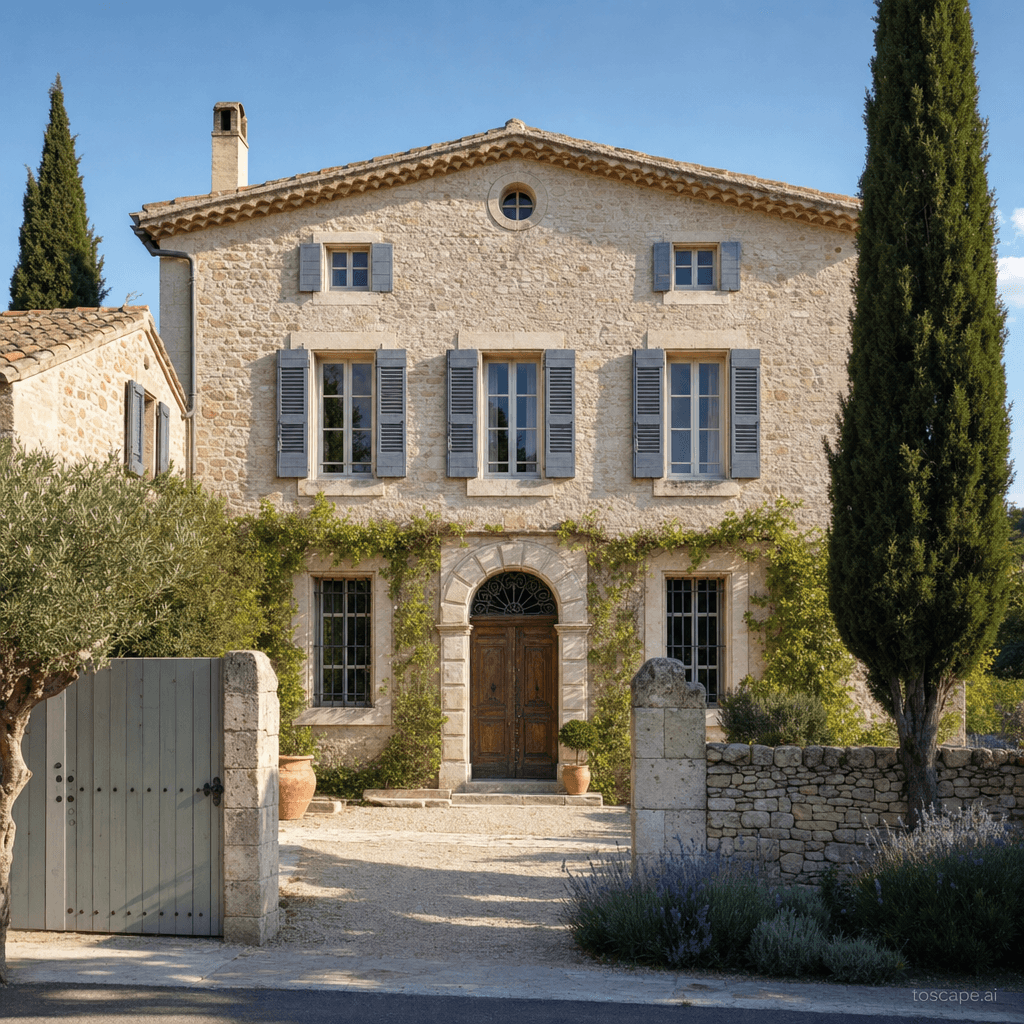
Context Snapshot
Provence region (Bouches-du-Rhône, Vaucluse, Alpes-de-Haute-Provence, Var) — limestone mas farmhouse architecture Mediterranean: hot dry summers, mild winters, mistral wind (northwesterly, cold, strong, 120+ days/year).
Contemporary Relevance
Provence is useful today for residential, hospitality, civic, and place-branding work that needs France-specific character grounded in local massing, material tone, climate response, and settlement logic rather than generic international styling.
Use this style in Toscape
Explore Provence directly inside Toscape using the Facade Re-Style and Design Options workflows.
Open Provence in the galleryFrequently asked questions
What is Provence?
Provence is a regional architectural identity from France. Provençal Mas, Roman Tile & Limestone-Ochre Mediterranean Identity.
What materials define Provence?
Pierre calcaire (limestone): cream-white to pale golden-beige — walls, quoins, voussoirs, paving. Pierre de Rognes/Pierre du Midi: fine-grained, warm honey patina.
What is the Provence color palette?
White, cream, pale sand, warm timber, and shadow-driven dark metal accents define the palette. The facade should stay bright and climate-aware rather than heavy, gray, or over-saturated.
Where does Provence come from?
Provence region (Bouches-du-Rhône, Vaucluse, Alpes-de-Haute-Provence, Var) — limestone mas farmhouse architecture Mediterranean: hot dry summers, mild winters, mistral wind (northwesterly, cold, strong, 120+ days/year).
When should architects use Provence?
Provence is useful today for residential, hospitality, civic, and place-branding work that needs France-specific character grounded in local massing, material tone, climate response, and settlement logic rather than generic international styling.
How do you render Provence in Toscape?
Open Toscape on Windows, load your own photo, elevation, sketch, or CAD view, then apply the Provence reference from the built-in style library. The Facade Re-Style and Design Options workflows keep your project geometry and camera while shifting materials, proportion, and detailing toward Provence.