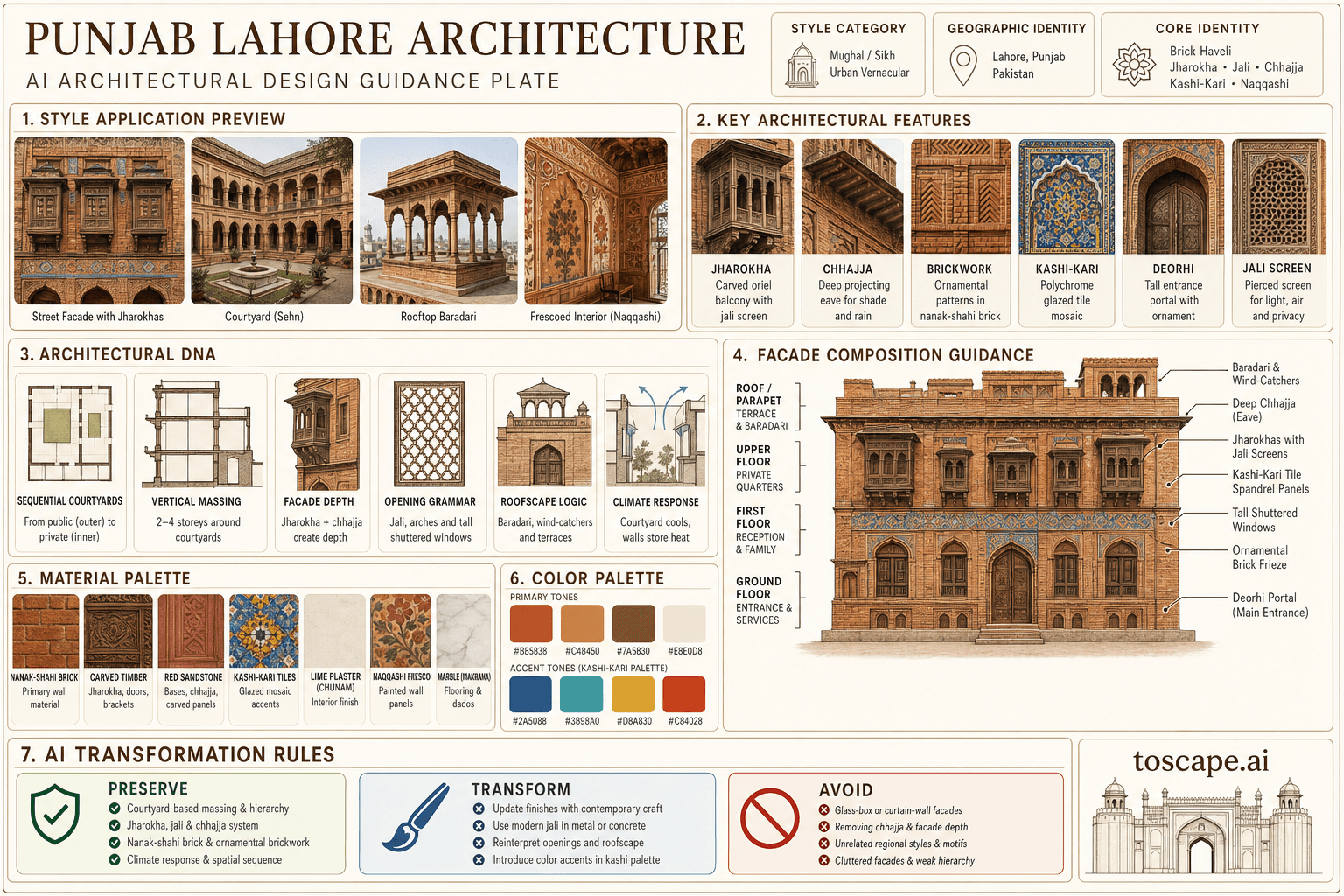
Punjab Lahore
Pakistan · domestic and monumental architecture of the Punjab region centered on Lahore
The brick haveli and Mughal courtyard mansion of the Punjab plain — ornamental brickwork, carved timber balconies, frescoed interiors, and the enduring Mughal-Sikh-British synthesi...
Definition
Punjab Lahore is a regional architectural identity from Pakistan. The brick haveli and Mughal courtyard mansion of the Punjab plain — ornamental brickwork, carved timber balconies, frescoed interiors, and the enduring Mughal-Sikh-British synthesi.
- Country
- Pakistan
- Region
- domestic and monumental architecture of the Punjab region centered on Lahore.
- Massing
- The Lahori haveli is a rectilinear urban volume — 12–25 m wide × 15–40 m deep — organized around one to three sequential courtyards (sehns) increasing.
- Materials
- Nanak-shahi brick — small-format, warm terracotta-red to deep ochre — the primary structural and ornamental material Lime mortar and plaster — the binding and finishing material.
- Palette
- White, cream, pale sand, warm timber, and shadow-driven dark metal accents define the palette.
- Climate response
- Lahore's semi-arid subtropical climate — scorching summers (38–48°C), mild winters (5–18°C, occasional frost), monsoon rainfall (July-August.
Overview
Punjab Lahore is a regional architectural identity in Pakistan. Traditional domestic and monumental architecture of the Punjab region centered on Lahore — the Mughal courtyard haveli (urban mansion), the Sikh-period townhouse, and the British colonial bungalow adaptation. Defined by the distinctive Lahori brick (nanak-shahi brick), ornamental brickwork and tile mosaic (kashi-kari), elaborately carved timber elements (jharokha balconies, doors, brackets), frescoed walls (naqqashi)...
Visual DNA
Massing & Form
The Lahori haveli is a rectilinear urban volume — 12–25 m wide × 15–40 m deep — organized around one to three sequential courtyards (sehns) increasing in privacy from street to innermost court. Two to four storeys: ground floor for service, storage, and animals; first floor (piano nobile) for formal reception (diwan-kh...
Facade Language
The Lahori haveli street facade is characterized by vertical layering and controlled depth: Ground floor: Solid brick wall with minimal openings — the entrance portal (deorhi) is the primary articulation. The deorhi is a tall, recessed archway framed by ornamental brickwork or carved stone, leading to a bent-axis entra...
Materials & Texture
Nanak-shahi brick — small-format, warm terracotta-red to deep ochre — the primary structural and ornamental material Lime mortar and plaster — the binding and finishing material — white to cream, often polished to a marble-like sheen (chunam) on interior walls Carved timber (shisham / sheesham, deodar cedar, teak) — fo...
Color Palette
White, cream, pale sand, warm timber, and shadow-driven dark metal accents define the palette. The facade should stay bright and climate-aware rather than heavy, gray, or over-saturated.
Ornament & Detail
Lahore's ornament is among the richest in South Asian architecture — a synthesis of five traditions: (1) Brick ornament — geometric patterns formed by the brickwork itself (diaper, dog-tooth, recessed panels). (2) Kashi-kari tile mosaic — floral arabesques, geometric interlace, and calligraphic panels in brilliant poly...
Climate Response
Lahore's semi-arid subtropical climate — scorching summers (38–48°C), mild winters (5–18°C, occasional frost), monsoon rainfall (July-August, 400–600 mm) — generates sophisticated climatic responses: (1) The courtyard (sehn) as climate engine — the central open court with fountain and planting creates a microclimate 5–...
Landscape & Ground
Traditional domestic and monumental architecture of the Punjab region centered on Lahore — the Mughal courtyard haveli (urban mansion), the Sikh-period townhouse, and the British colonial bungalow adaptation. Defined by the distinctive Lahori brick (nanak-shahi brick), ornamental brickwork and tile mosaic (kashi-kari)...
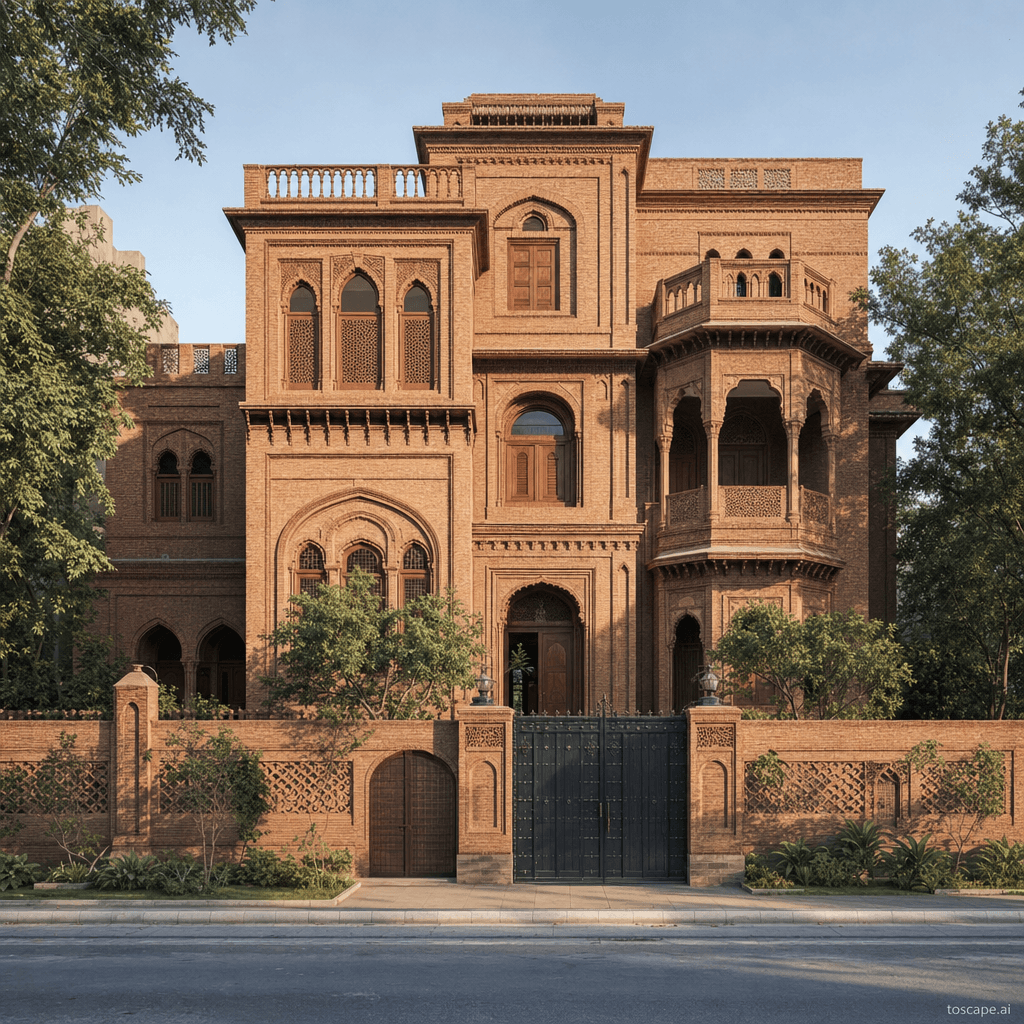
Reference elevation
Punjab Lahore — characteristic facade composition, domestic and monumental architecture of the Punjab region centered on Lahore.
Context Snapshot
Traditional domestic and monumental architecture of the Punjab region centered on Lahore — the Mughal courtyard haveli (urban mansion), the Sikh-period townhouse, and the British colonial bungalow ada... Lahore's semi-arid subtropical climate — scorching summers (38–48°C), mild winters (5–18°C, occasional frost), monsoon rainfall (July-August, 400–600 mm) — generates sophisticated climatic responses: (1) The courtyard (s...
Contemporary Relevance
Punjab Lahore is useful today for residential, hospitality, civic, and place-branding work that needs Pakistan-specific character grounded in local massing, material tone, climate response, and settlement logic rather than generic international styling.
Use this style in Toscape
Explore Punjab Lahore directly inside Toscape using the Facade Re-Style and Design Options workflows.
Open Punjab Lahore in the galleryFrequently asked questions
What is Punjab Lahore?
Punjab Lahore is a regional architectural identity from Pakistan. The brick haveli and Mughal courtyard mansion of the Punjab plain — ornamental brickwork, carved timber balconies, frescoed interiors, and the enduring Mughal-Sikh-British synthesi.
What materials define Punjab Lahore?
Nanak-shahi brick — small-format, warm terracotta-red to deep ochre — the primary structural and ornamental material Lime mortar and plaster — the binding and finishing material — white to cream, often polished to a marble-like sheen (chunam) on interior walls Carved timber (shisham / sheesham, deodar cedar, teak) — fo.
What is the Punjab Lahore color palette?
White, cream, pale sand, warm timber, and shadow-driven dark metal accents define the palette. The facade should stay bright and climate-aware rather than heavy, gray, or over-saturated.
Where does Punjab Lahore come from?
Traditional domestic and monumental architecture of the Punjab region centered on Lahore — the Mughal courtyard haveli (urban mansion), the Sikh-period townhouse, and the British colonial bungalow ada... Lahore's semi-arid subtropical climate — scorching summers (38–48°C), mild winters (5–18°C, occasional frost), monsoon rainfall (July-August, 400–600 mm) — generates sophisticated climatic responses: (1) The courtyard (s.
When should architects use Punjab Lahore?
Punjab Lahore is useful today for residential, hospitality, civic, and place-branding work that needs Pakistan-specific character grounded in local massing, material tone, climate response, and settlement logic rather than generic international styling.
How do you render Punjab Lahore in Toscape?
Open Toscape on Windows, load your own photo, elevation, sketch, or CAD view, then apply the Punjab Lahore reference from the built-in style library. The Facade Re-Style and Design Options workflows keep your project geometry and camera while shifting materials, proportion, and detailing toward Punjab Lahore.