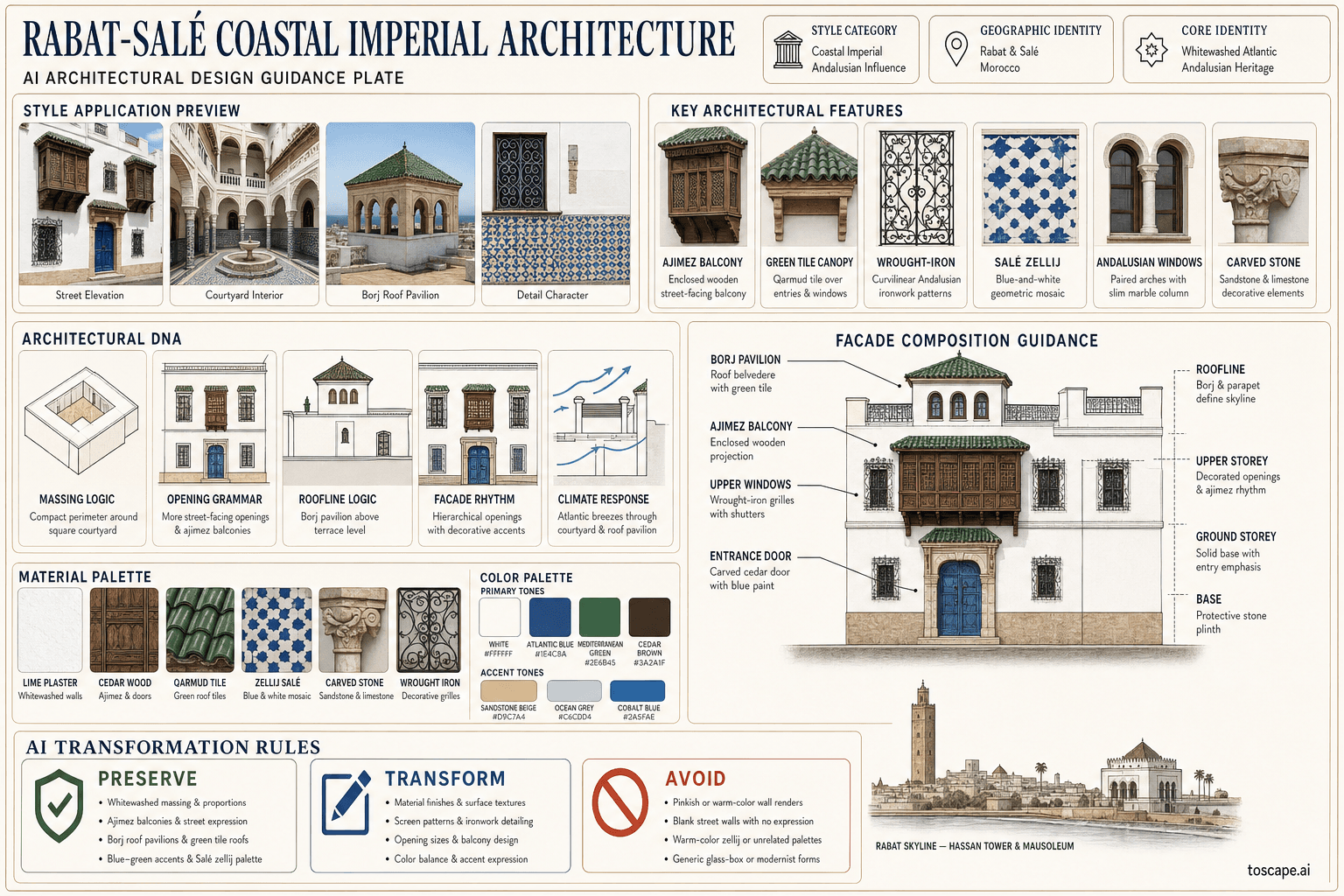
Rabat-Salé Coastal Imperial
Morocco · domestic architecture of Rabat and Salé
The Atlantic-coast administrative capital — whitewashed, orderly, Andalusian-refugee influenced
Definition
Rabat-Salé Coastal Imperial is a regional architectural identity from Morocco. The Atlantic-coast administrative capital — whitewashed, orderly, Andalusian-refugee influenced.
- Country
- Morocco
- Region
- domestic architecture of Rabat and Salé.
- Massing
- Rabati/Slaoui houses maintain the courtyard typology but with significantly greater openness to the exterior — the Andalusian influence relaxed the strict interiority of the inland medinas.
- Materials
- Bright white lime wash — the dominant exterior finish Salé blue-and-white zellij: A distinctive palette — cobalt blue, white, and light grey.
- Palette
- White, cream, pale sand, warm timber, and shadow-driven dark metal accents define the palette.
- Climate response
- The Atlantic climate moderates the inland extremes — Rabat has milder summers (25–30°C) and warmer winters (8–15°C), with high humidity and regular ocean breezes.
Overview
Rabat-Salé Coastal Imperial is a regional architectural identity in Morocco. Traditional domestic architecture of Rabat and Salé — the Atlantic-coast twin cities, with Rabat as the modern administrative capital and Salé as the older medina. The region where Andalusian Muslim and Jewish refugees (expelled from Spain, 1492–1609) profoundly shaped the architectural culture.
Visual DNA
Massing & Form
Rabati/Slaoui houses maintain the courtyard typology but with significantly greater openness to the exterior — the Andalusian influence relaxed the strict interiority of the inland medinas. Plot regularity: Plots are wider, squarer, and more regular than the deep, narrow Fassi plots — typically 12–18 m × 15–25 m .
Facade Language
The Rabati street elevation is the most articulated of any Moroccan medina: Ajimez balconies: Projecting enclosed wooden balconies (mashrabiya boxes) with turned-wood screens and a small tiled canopy roof — providing women with a protected view of the street. The ajimez read as decorated wooden cubes projecting from th...
Materials & Texture
Bright white lime wash — the dominant exterior finish Salé blue-and-white zellij: A distinctive palette — cobalt blue, white, and light grey, with minimal use of other colors. The patterns are strongly geometric (eight-pointed star) with a "cool" Mediterranean feel Carved sandstone and limestone: For decorative archite...
Color Palette
White, cream, pale sand, warm timber, and shadow-driven dark metal accents define the palette. The facade should stay bright and climate-aware rather than heavy, gray, or over-saturated.
Ornament & Detail
Salé zellij is renowned as the finest in Morocco — "zellij Slaoui" — with a particularly precise geometric cutting technique and the distinctive blue-and-white palette. The quality of zellij in Salé rivals that of Fès, but the color palette is cooler and more restrained — reflecting the Atlantic light and Andalusian ae...
Climate Response
The Atlantic climate moderates the inland extremes — Rabat has milder summers (25–30°C) and warmer winters (8–15°C), with high humidity and regular ocean breezes. The architectural response is: (a) less thermal mass required — slightly thinner walls than Marrakech; (b) more external openings — the ajimez balconies and...
Landscape & Ground
Traditional domestic architecture of Rabat and Salé — the Atlantic-coast twin cities, with Rabat as the modern administrative capital and Salé as the older medina. The region where Andalusian Muslim and Jewish refugees (expelled from Spain, 1492–1609) profoundly shaped the architectural culture.
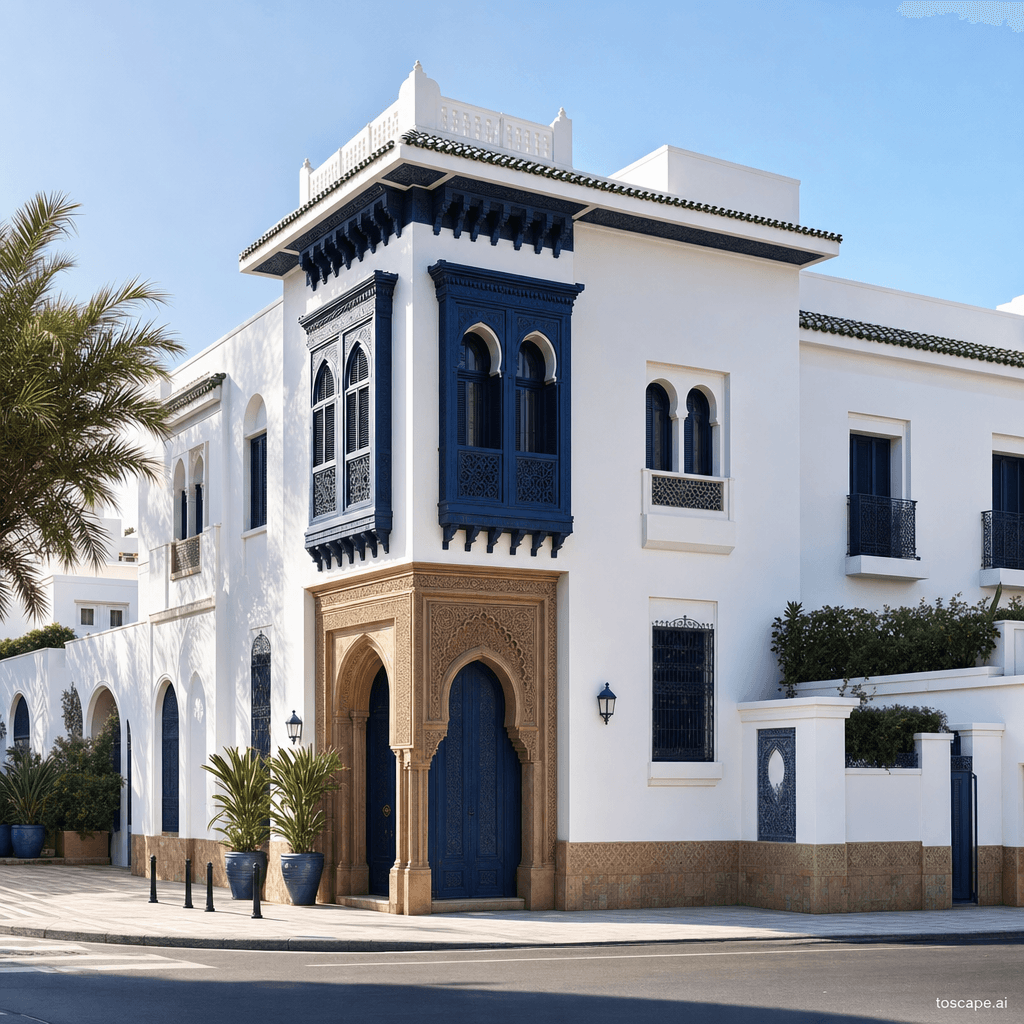
Reference elevation
Rabat-Salé Coastal Imperial — characteristic facade composition, domestic architecture of Rabat and Salé.
Context Snapshot
Traditional domestic architecture of Rabat and Salé — the Atlantic-coast twin cities, with Rabat as the modern administrative capital and Salé as the older medina. The Atlantic climate moderates the inland extremes — Rabat has milder summers (25–30°C) and warmer winters (8–15°C), with high humidity and regular ocean breezes.
Contemporary Relevance
Rabat-Salé Coastal Imperial is useful today for residential, hospitality, civic, and place-branding work that needs Morocco-specific character grounded in local massing, material tone, climate response, and settlement logic rather than generic international styling.
Use this style in Toscape
Explore Rabat-Salé Coastal Imperial directly inside Toscape using the Facade Re-Style and Design Options workflows.
Open Rabat-Salé Coastal Imperial in the galleryFrequently asked questions
What is Rabat-Salé Coastal Imperial?
Rabat-Salé Coastal Imperial is a regional architectural identity from Morocco. The Atlantic-coast administrative capital — whitewashed, orderly, Andalusian-refugee influenced.
What materials define Rabat-Salé Coastal Imperial?
Bright white lime wash — the dominant exterior finish Salé blue-and-white zellij: A distinctive palette — cobalt blue, white, and light grey, with minimal use of other colors. The patterns are strongly geometric (eight-pointed star) with a "cool" Mediterranean feel Carved sandstone and limestone: For decorative archite.
What is the Rabat-Salé Coastal Imperial color palette?
White, cream, pale sand, warm timber, and shadow-driven dark metal accents define the palette. The facade should stay bright and climate-aware rather than heavy, gray, or over-saturated.
Where does Rabat-Salé Coastal Imperial come from?
Traditional domestic architecture of Rabat and Salé — the Atlantic-coast twin cities, with Rabat as the modern administrative capital and Salé as the older medina. The Atlantic climate moderates the inland extremes — Rabat has milder summers (25–30°C) and warmer winters (8–15°C), with high humidity and regular ocean breezes.
When should architects use Rabat-Salé Coastal Imperial?
Rabat-Salé Coastal Imperial is useful today for residential, hospitality, civic, and place-branding work that needs Morocco-specific character grounded in local massing, material tone, climate response, and settlement logic rather than generic international styling.
How do you render Rabat-Salé Coastal Imperial in Toscape?
Open Toscape on Windows, load your own photo, elevation, sketch, or CAD view, then apply the Rabat-Salé Coastal Imperial reference from the built-in style library. The Facade Re-Style and Design Options workflows keep your project geometry and camera while shifting materials, proportion, and detailing toward Rabat-Salé Coastal Imperial.