
Rajasthan Haveli
India · Rajasthani haveli
Sandstone Courtyard Mansions, Jharokha Balconies & Fresco-Painted Facades
Definition
Rajasthan Haveli is a regional architectural identity from India. Sandstone Courtyard Mansions, Jharokha Balconies & Fresco-Painted Facades.
- Country
- India
- Region
- Rajasthani haveli
- Massing
- Courtyard-centered: 2-4 story rectangular block around central chowk (courtyard). Narrow frontage on street (one window bay), deep plan extending 3-5x width.
- Materials
- Regional sandstone: golden yellow (Jaisalmer), pink (Jaipur/Bikaner), red (Dholpur). Timber: teak, rohida, sheesham.
- Palette
- White, cream, pale sand, warm timber, and shadow-driven dark metal accents define the palette.
- Climate response
- Extreme desert: hot dry summers, cool winters, sandstorms. Courtyard as thermal chimney — stack effect draws air through jali-screened rooms.
Overview
Rajasthan Haveli is a regional architectural identity in India. Rajasthani haveli architecture — merchant courtyard mansions of Shekhawati, Jaisalmer golden stone, fresco narratives. Sandstone jali screens, overhanging enclosed jharokha balconies, domed chhatri pavilions, interior courtyards with painted walls, regional stone color variation (golden Jaisalmer, pink Jaipur, blue Jodhpur)
Visual DNA
Massing & Form
Courtyard-centered: 2-4 story rectangular block around central chowk (courtyard). Narrow frontage on street (one window bay), deep plan extending 3-5x width.
Facade Language
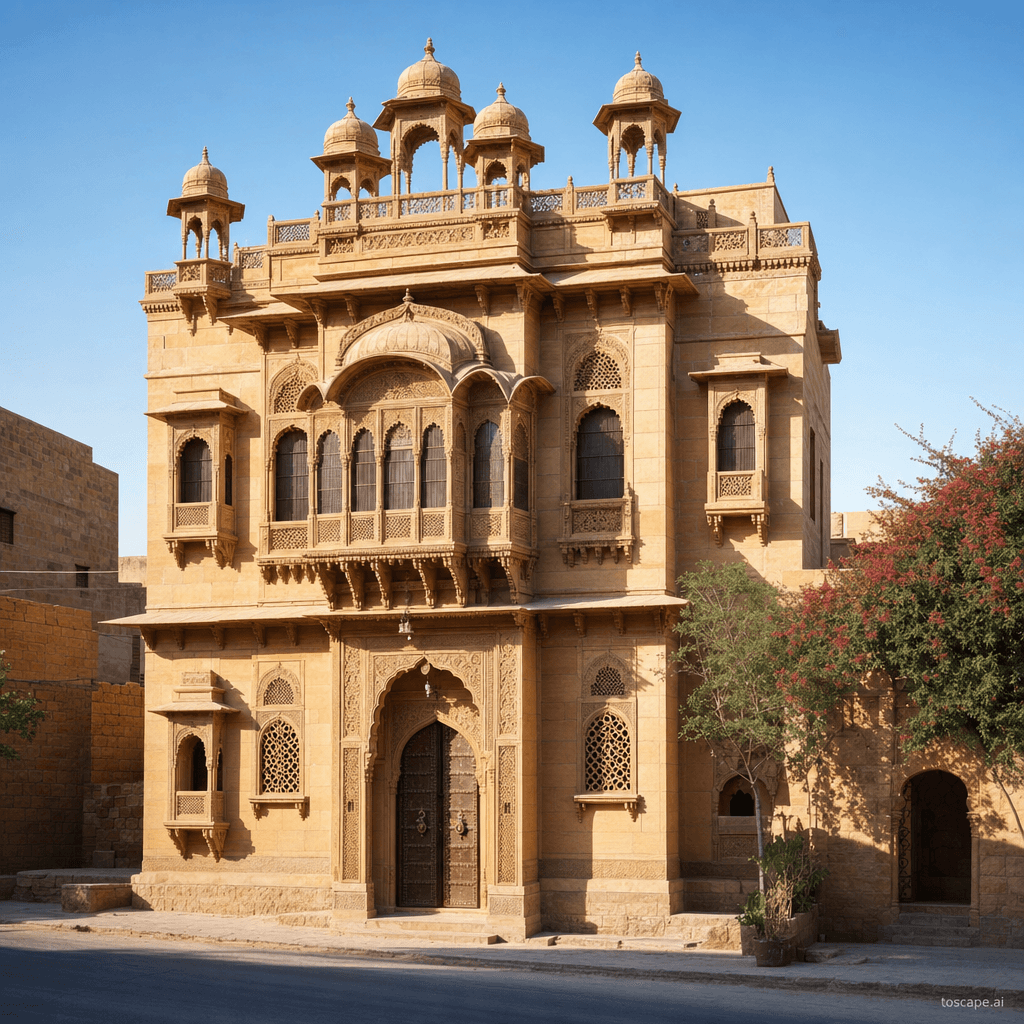
Narrow street facade — often single window bay wide, 3-4 stories tall. Gokhra (street-facing projecting window) at upper levels.
Materials & Texture
Regional sandstone: golden yellow (Jaisalmer), pink (Jaipur/Bikaner), red (Dholpur). Timber: teak, rohida, sheesham.
Color Palette
White, cream, pale sand, warm timber, and shadow-driven dark metal accents define the palette. The facade should stay bright and climate-aware rather than heavy, gray, or over-saturated.
Ornament & Detail
Fresco painting on courtyard walls: mythological, historical, and daily-life narratives in Shekhawati. Carved sandstone: jali geometric/islamic patterns, jharokha brackets (peacock, elephant motifs), door frames with Ganesha patti.
Climate Response
Extreme desert: hot dry summers, cool winters, sandstorms. Courtyard as thermal chimney — stack effect draws air through jali-screened rooms.
Landscape & Ground
Rajasthani haveli architecture — merchant courtyard mansions of Shekhawati, Jaisalmer golden stone, fresco narratives. Extreme desert: hot dry summers, cool winters, sandstorms.
Reference elevation
Rajasthan Haveli — characteristic facade composition, Rajasthani haveli.
Context Snapshot
Rajasthani haveli architecture — merchant courtyard mansions of Shekhawati, Jaisalmer golden stone, fresco narratives Extreme desert: hot dry summers, cool winters, sandstorms.
Contemporary Relevance
Rajasthan Haveli is useful today for residential, hospitality, civic, and place-branding work that needs India-specific character grounded in local massing, material tone, climate response, and settlement logic rather than generic international styling.
Use this style in Toscape
Explore Rajasthan Haveli directly inside Toscape using the Facade Re-Style and Design Options workflows.
Open Rajasthan Haveli in the galleryFrequently asked questions
What is Rajasthan Haveli?
Rajasthan Haveli is a regional architectural identity from India. Sandstone Courtyard Mansions, Jharokha Balconies & Fresco-Painted Facades.
What materials define Rajasthan Haveli?
Regional sandstone: golden yellow (Jaisalmer), pink (Jaipur/Bikaner), red (Dholpur). Timber: teak, rohida, sheesham.
What is the Rajasthan Haveli color palette?
White, cream, pale sand, warm timber, and shadow-driven dark metal accents define the palette. The facade should stay bright and climate-aware rather than heavy, gray, or over-saturated.
Where does Rajasthan Haveli come from?
Rajasthani haveli architecture — merchant courtyard mansions of Shekhawati, Jaisalmer golden stone, fresco narratives Extreme desert: hot dry summers, cool winters, sandstorms.
When should architects use Rajasthan Haveli?
Rajasthan Haveli is useful today for residential, hospitality, civic, and place-branding work that needs India-specific character grounded in local massing, material tone, climate response, and settlement logic rather than generic international styling.
How do you render Rajasthan Haveli in Toscape?
Open Toscape on Windows, load your own photo, elevation, sketch, or CAD view, then apply the Rajasthan Haveli reference from the built-in style library. The Facade Re-Style and Design Options workflows keep your project geometry and camera while shifting materials, proportion, and detailing toward Rajasthan Haveli.