Red Sea Coastal
Egypt · coastal architecture of the Egyptian Red Sea region
The coral-stone maritime vernacular of the Egyptian Red Sea coast — historic port architecture of Suez, Hurghada, and the African Red Sea littoral
Definition
Red Sea Coastal is a regional architectural identity from Egypt. The coral-stone maritime vernacular of the Egyptian Red Sea coast — historic port architecture of Suez, Hurghada, and the African Red Sea littoral.
- Country
- Egypt
- Region
- coastal architecture of the Egyptian Red Sea region.
- Massing
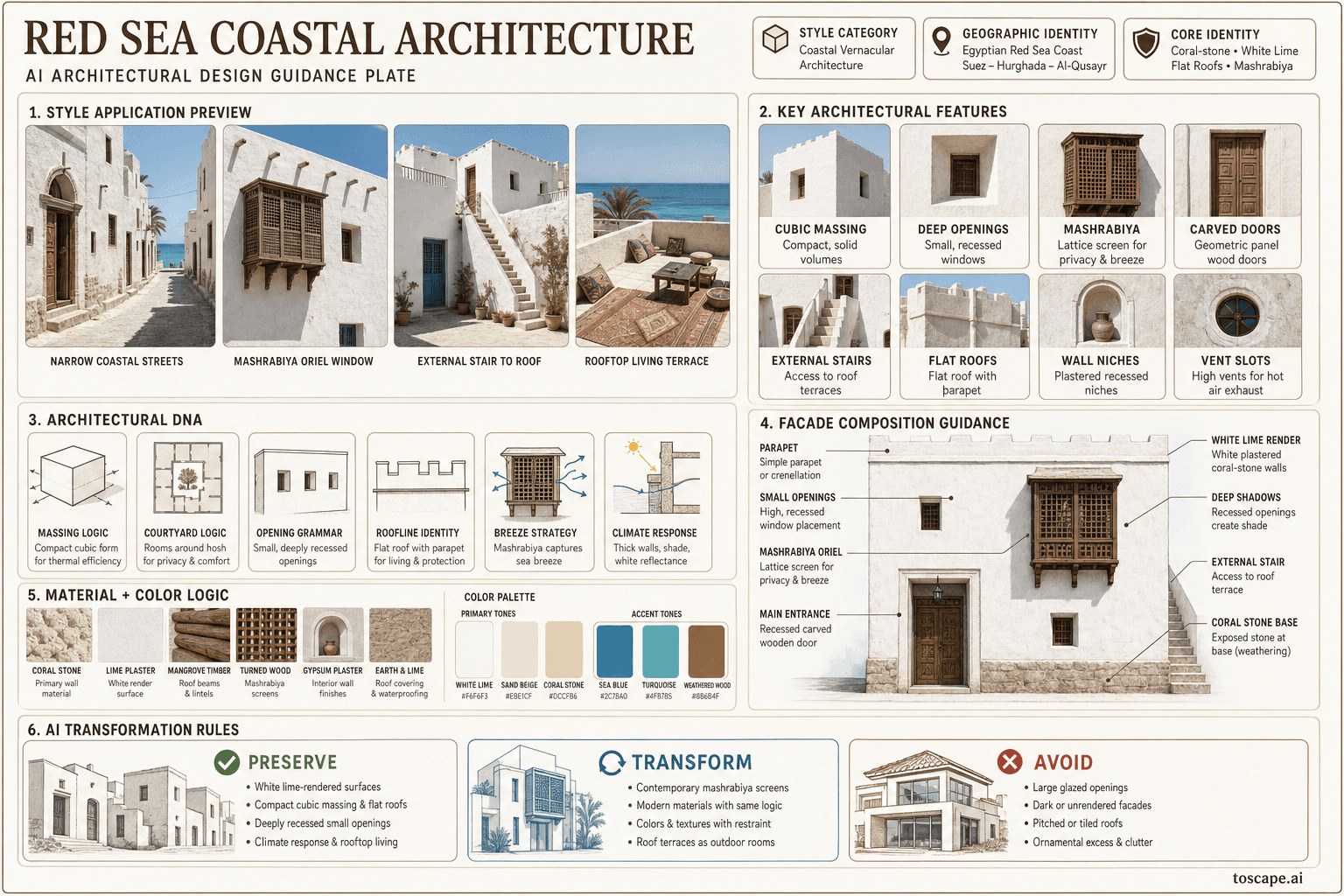
- The Red Sea coastal house is a compact rectangular volume — typically 5–8 m wide × 6–12 m deep — single-storey or two-storey.
- Materials
- Coral stone (hajar manqabi) — the primary wall material, lightweight, insulating, local Lime plaster (nura) — white lime render for all external surfaces Mangrove timber (shura).
- Palette
- White, cream, pale sand, warm timber, and shadow-driven dark metal accents define the palette.
- Climate response
- The Red Sea coastal climate — extreme heat and humidity — dictates the architectural response: (1) Thermal mass + insulation — thick coral-stone walls provide thermal.
Overview
Red Sea Coastal is a regional architectural identity in Egypt. Traditional coastal architecture of the Egyptian Red Sea region — a distinctive maritime vernacular defined by coral-stone (coral rag) construction, flat-roofed cubic volumes, whitewashed exteriors, and an architectural character shaped by Red Sea trade, fishing economies, and the extreme hot-humid coastal climate. Coral stone (al-hajar al-manqabi) construction — white lime-rendered cubic volumes — flat roofs with pa...
Visual DNA
Massing & Form
The Red Sea coastal house is a compact rectangular volume — typically 5–8 m wide × 6–12 m deep — single-storey or two-storey. The plan is simple: two to four rooms arranged along a central corridor or around a small internal courtyard (hosh).
Facade Language
The Red Sea facade is characterized by simplicity and climate-driven solidity: White render: All external walls are coated with white lime plaster (nura) — the defining surface treatment. The white coating reflects solar radiation, protects the porous coral stone from erosion, and unifies the diverse coral block sizes.
Materials & Texture
Coral stone (hajar manqabi) — the primary wall material, lightweight, insulating, local Lime plaster (nura) — white lime render for all external surfaces Mangrove timber (shura) — imported from the southern Red Sea for roof beams and lintels Palm trunks — local alternative to mangrove for roof beams Turned wood (kharat...
Color Palette
White, cream, pale sand, warm timber, and shadow-driven dark metal accents define the palette. The facade should stay bright and climate-aware rather than heavy, gray, or over-saturated.
Ornament & Detail
The Red Sea architectural ornament is minimal and functional rather than decorative: (1) Carved wooden doors — geometric panel patterns, sometimes with metal studs (derived from the Islamic Cairene tradition), (2) Mashrabiya lattice — the geometric screen is simultaneously ornament and functional climate device, (3) gy...
Climate Response
The Red Sea coastal climate — extreme heat and humidity — dictates the architectural response: (1) Thermal mass + insulation — thick coral-stone walls provide thermal lag while the porous structure allows some moisture vapor migration (breathing wall). (2) Minimum solar exposure — small, deep-set windows limit solar he...
Landscape & Ground
Traditional coastal architecture of the Egyptian Red Sea region — a distinctive maritime vernacular defined by coral-stone (coral rag) construction, flat-roofed cubic volumes, whitewashed exteriors, and an architectural character shaped by Red Sea trade, fishing economies, and the extreme hot-humid coastal climate. The...
Reference elevation
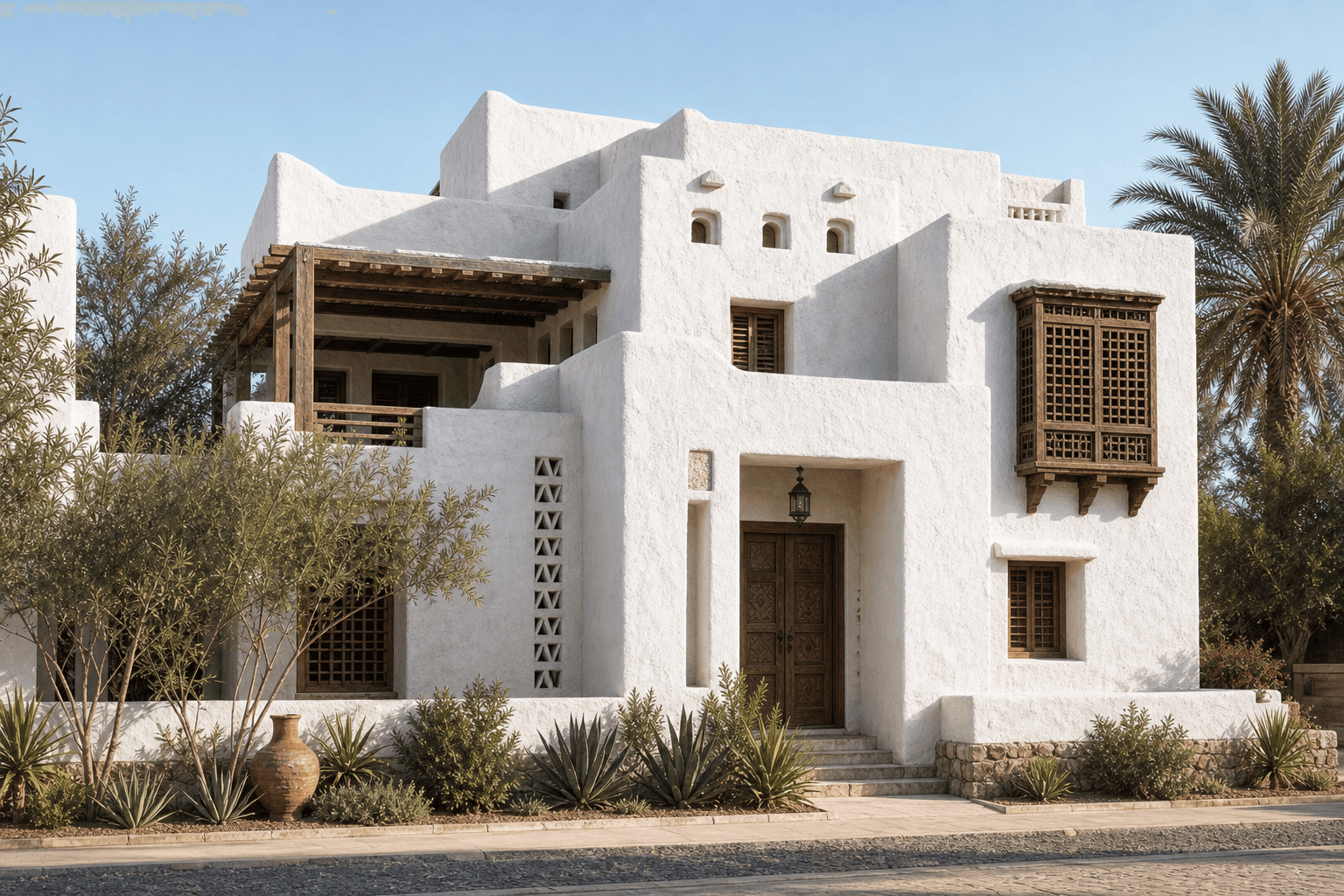
Red Sea Coastal — characteristic facade composition, coastal architecture of the Egyptian Red Sea region.
Context Snapshot
Traditional coastal architecture of the Egyptian Red Sea region — a distinctive maritime vernacular defined by coral-stone (coral rag) construction, flat-roofed cubic volumes, whitewashed exteriors, a... The Red Sea coastal climate — extreme heat and humidity — dictates the architectural response: (1) Thermal mass + insulation — thick coral-stone walls provide thermal lag while the porous structure allows some moisture v...
Contemporary Relevance
Red Sea Coastal is useful today for residential, hospitality, civic, and place-branding work that needs Egypt-specific character grounded in local massing, material tone, climate response, and settlement logic rather than generic international styling.
Use this style in Toscape
Explore Red Sea Coastal directly inside Toscape using the Facade Re-Style and Design Options workflows.
Open Red Sea Coastal in the galleryFrequently asked questions
What is Red Sea Coastal?
Red Sea Coastal is a regional architectural identity from Egypt. The coral-stone maritime vernacular of the Egyptian Red Sea coast — historic port architecture of Suez, Hurghada, and the African Red Sea littoral.
What materials define Red Sea Coastal?
Coral stone (hajar manqabi) — the primary wall material, lightweight, insulating, local Lime plaster (nura) — white lime render for all external surfaces Mangrove timber (shura) — imported from the southern Red Sea for roof beams and lintels Palm trunks — local alternative to mangrove for roof beams Turned wood (kharat.
What is the Red Sea Coastal color palette?
White, cream, pale sand, warm timber, and shadow-driven dark metal accents define the palette. The facade should stay bright and climate-aware rather than heavy, gray, or over-saturated.
Where does Red Sea Coastal come from?
Traditional coastal architecture of the Egyptian Red Sea region — a distinctive maritime vernacular defined by coral-stone (coral rag) construction, flat-roofed cubic volumes.
When should architects use Red Sea Coastal?
Red Sea Coastal is useful today for residential, hospitality, civic, and place-branding work that needs Egypt-specific character grounded in local massing, material tone, climate response, and settlement logic rather than generic international styling.
How do you render Red Sea Coastal in Toscape?
Open Toscape on Windows, load your own photo, elevation, sketch, or CAD view, then apply the Red Sea Coastal reference from the built-in style library. The Facade Re-Style and Design Options workflows keep your project geometry and camera while shifting materials, proportion, and detailing toward Red Sea Coastal.