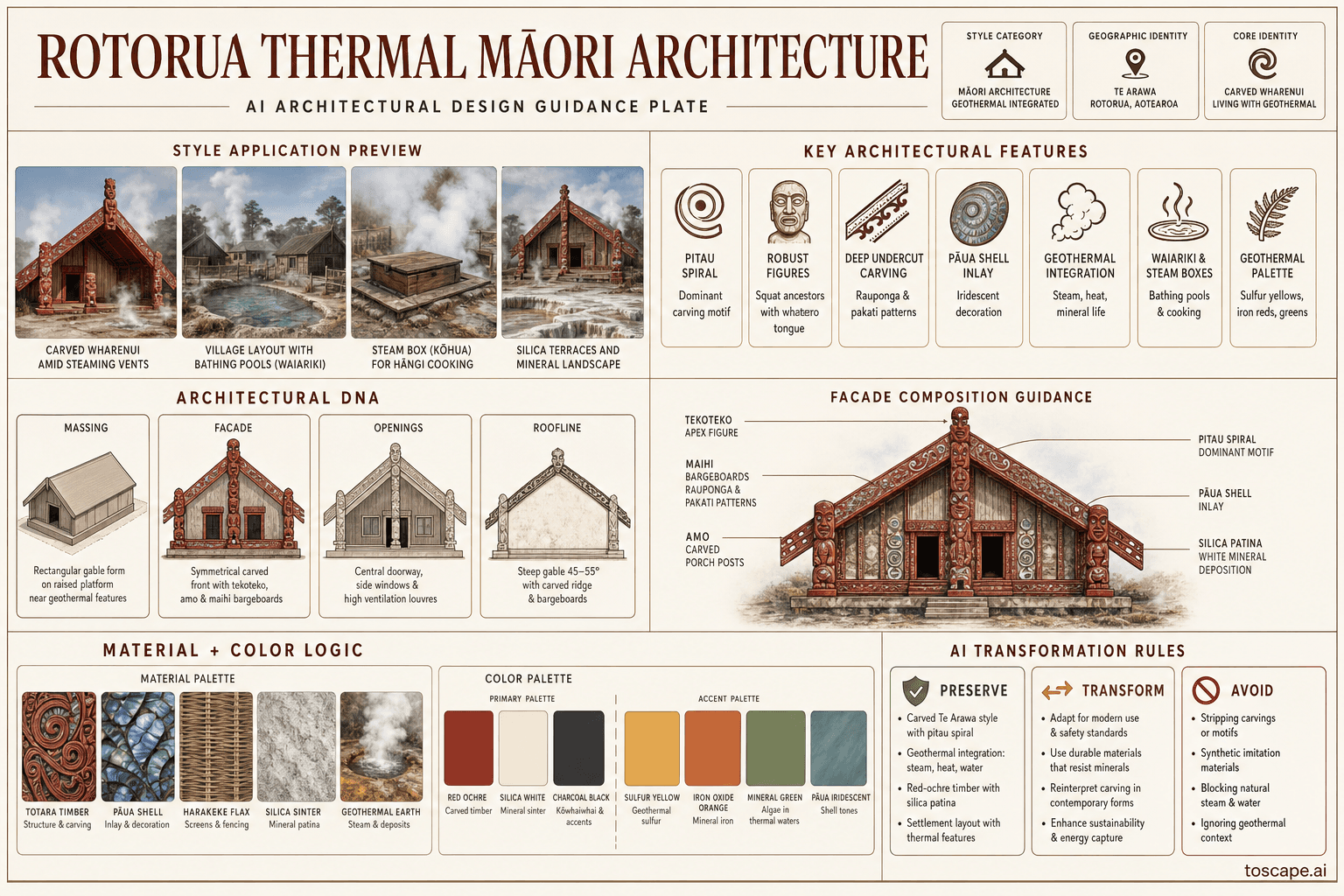
Rotorua Thermal Māori
New Zealand · architectural identity of Rotorua's geothermal Māori settlements
Te Arawa lakeside geothermal settlements — where carved wharenui stand among steaming vents, silica terraces, and boiling springs, the architecture of Te Whakarewarewa and Ohinemut...
Definition
Rotorua Thermal Māori is a regional architectural identity from New Zealand. Te Arawa lakeside geothermal settlements — where carved wharenui stand among steaming vents, silica terraces, and boiling springs, the architecture of Te Whakarewarewa and Ohinemut.
- Country
- New Zealand
- Region
- architectural identity of Rotorua's geothermal Māori settlements.
- Massing
- The wharenui at Rotorua follow the same rectangular gable-roofed typology (10–30 m long, 6–10 m wide, 45–55° roof pitch) as all Māori meeting houses.
- Materials
- The palette combines Māori traditional materials with geothermal minerals: (1) Totara timber — the primary carving and structural wood.
- Palette
- White, cream, pale sand, warm timber, and shadow-driven dark metal accents define the palette.
- Climate response
- The Rotorua geothermal field (the Taupō Volcanic Zone) provides: (1) Geothermal heating — the ground temperature is elevated year-round (20–100°C at surface in active areas).
Overview
Rotorua Thermal Māori is a regional architectural identity in New Zealand. The architectural identity of Rotorua's geothermal Māori settlements — particularly Whakarewarewa (Te Whakarewarewatangaoteopetauaawahiao) and Ohinemutu villages on the shores of Lake Rotorua, where the Te Arawa iwi have lived for centuries among geothermal hot springs, steam vents, boiling mud pools, and silica terraces — the wharenui are of the carved Te Arawa style (notable for deeply undercut relief, robust figur...
Visual DNA
Massing & Form
The wharenui at Rotorua follow the same rectangular gable-roofed typology (10–30 m long, 6–10 m wide, 45–55° roof pitch) as all Māori meeting houses, but their siting is geothermal: they stand on ground that is geothermally heated, often on platforms built over or adjacent to thermal features. The marae ātea may includ...
Facade Language
The Te Arawa carving style defines the facade: (1) The tekoteko (apex figure) is robust and deeply carved, with the pitau (fern-frond spiral) as the dominant motif, and exaggerated protruding tongue (whetero). (2) The maihi bargeboards are carved with deeply undercut rauponga (notched ridge) and pakati (dog-tooth) patt...
Materials & Texture
The palette combines Māori traditional materials with geothermal minerals: (1) Totara timber — the primary carving and structural wood, developing a white silica patina over years of geothermal exposure. (2) Red ochre (kōkōwai) — the dominant pigment, but in Rotorua it weathers differently: geothermal moisture and mine...
Color Palette
White, cream, pale sand, warm timber, and shadow-driven dark metal accents define the palette. The facade should stay bright and climate-aware rather than heavy, gray, or over-saturated.
Ornament & Detail
The Te Arawa carving tradition is distinguished by: (1) Deeply undercut relief — carvings project boldly from the timber surface, creating strong shadow lines that the steam-filled light dramatizes. (2) The pitau spiral — the dominant motif, a stylized unfolding fern frond representing growth and new life.
Climate Response
The Rotorua geothermal field (the Taupō Volcanic Zone) provides: (1) Geothermal heating — the ground temperature is elevated year-round (20–100°C at surface in active areas), warming building foundations and interiors naturally — the wharenui interior is warmer than other regions. (2) Constant humidity — steam creates...
Landscape & Ground
The architectural identity of Rotorua's geothermal Māori settlements — particularly Whakarewarewa (Te Whakarewarewatangaoteopetauaawahiao) and Ohinemutu villages on the shores of Lake Rotorua, where the Te Arawa iwi have lived for centuries among geothermal hot springs, steam vents, boiling mud pools, and silica terrac...
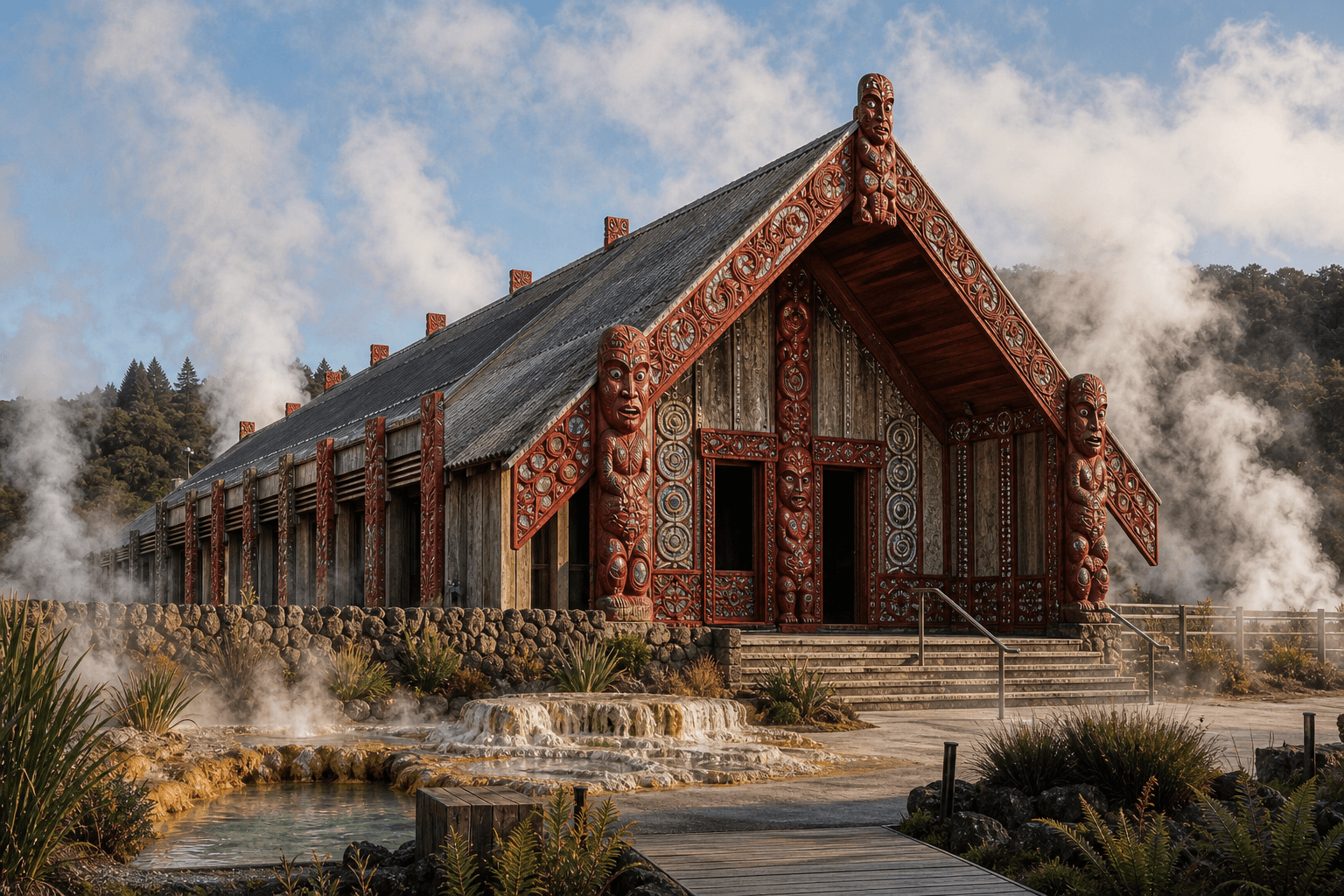
Reference elevation
Rotorua Thermal Māori — characteristic facade composition, architectural identity of Rotorua's geothermal Māori settlements.
Context Snapshot
The architectural identity of Rotorua's geothermal Māori settlements — particularly Whakarewarewa (Te Whakarewarewatangaoteopetauaawahiao) and Ohinemutu villages on the shores of Lake Rotorua, where t... The Rotorua geothermal field (the Taupō Volcanic Zone) provides: (1) Geothermal heating — the ground temperature is elevated year-round (20–100°C at surface in active areas), warming building foundations and interiors na...
Contemporary Relevance
Rotorua Thermal Māori is useful today for residential, hospitality, civic, and place-branding work that needs New Zealand-specific character grounded in local massing, material tone, climate response, and settlement logic rather than generic international styling.
Use this style in Toscape
Explore Rotorua Thermal Māori directly inside Toscape using the Facade Re-Style and Design Options workflows.
Open Rotorua Thermal Māori in the galleryFrequently asked questions
What is Rotorua Thermal Māori?
Rotorua Thermal Māori is a regional architectural identity from New Zealand. Te Arawa lakeside geothermal settlements — where carved wharenui stand among steaming vents, silica terraces, and boiling springs, the architecture of Te Whakarewarewa and Ohinemut.
What materials define Rotorua Thermal Māori?
The palette combines Māori traditional materials with geothermal minerals: (1) Totara timber — the primary carving and structural wood, developing a white silica patina over years of geothermal exposure. (2) Red ochre (kōkōwai) — the dominant pigment, but in Rotorua it weathers differently: geothermal moisture and mine.
What is the Rotorua Thermal Māori color palette?
White, cream, pale sand, warm timber, and shadow-driven dark metal accents define the palette. The facade should stay bright and climate-aware rather than heavy, gray, or over-saturated.
Where does Rotorua Thermal Māori come from?
The architectural identity of Rotorua's geothermal Māori settlements — particularly Whakarewarewa (Te Whakarewarewatangaoteopetauaawahiao) and Ohinemutu villages on the shores of Lake Rotorua, where t... The Rotorua geothermal field (the Taupō Volcanic Zone) provides: (1) Geothermal heating — the ground temperature is elevated year-round (20–100°C at surface in active areas), warming building foundations and interiors na.
When should architects use Rotorua Thermal Māori?
Rotorua Thermal Māori is useful today for residential, hospitality, civic, and place-branding work that needs New Zealand-specific character grounded in local massing, material tone, climate response, and settlement logic rather than generic international styling.
How do you render Rotorua Thermal Māori in Toscape?
Open Toscape on Windows, load your own photo, elevation, sketch, or CAD view, then apply the Rotorua Thermal Māori reference from the built-in style library. The Facade Re-Style and Design Options workflows keep your project geometry and camera while shifting materials, proportion, and detailing toward Rotorua Thermal Māori.