Dutch Rotterdam Modern Brick Expressionism
Netherlands · Amsterdam School (Amsterdamse School) brick architecture of Rotterdam and the Ne...
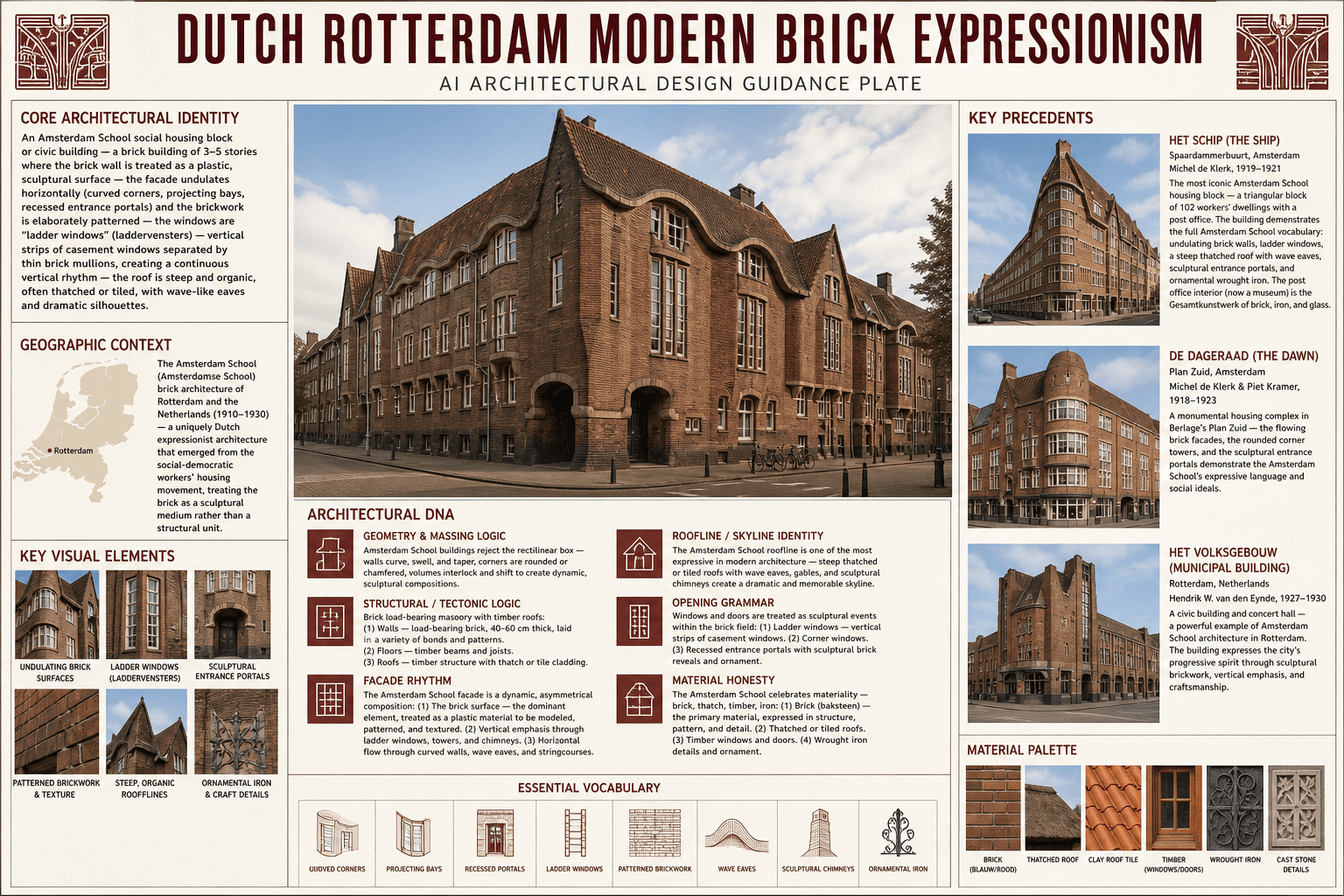
The Rotterdam Brick Expressionism and Amsterdam School architecture — a distinctive early 20th-century Dutch architectural movement characterized by sculptural brickwork (expressio...
Definition
Dutch Rotterdam Modern Brick Expressionism is a regional architectural identity from Netherlands. The Rotterdam Brick Expressionism and Amsterdam School architecture — a distinctive early 20th-century Dutch architectural movement characterized by sculptural brickwork (expressio.
- Country
- Netherlands
- Region
- Amsterdam School (Amsterdamse School) brick architecture of Rotterdam and the Ne.
- Massing
- Amsterdam School buildings reject the rectilinear box — walls curve, swell, and taper, corners are rounded or chamfered, and the massing is organic and expressive.
- Materials
- The Amsterdam School celebrates materiality — brick, thatch, timber, iron: (1) Brick (baksteen) — the primary material.
- Palette
- White, cream, pale sand, warm timber, and shadow-driven dark metal accents define the palette.
- Climate response
- The Amsterdam School emerged from the Dutch social housing movement (Woningwet, 1901) and the specific urban conditions of the Netherlands: (1) Dutch climate — mild.
Overview
Dutch Rotterdam Modern Brick Expressionism is a regional architectural identity in Netherlands. The Amsterdam School (Amsterdamse School) brick architecture of Rotterdam and the Netherlands (1910–1930) — a uniquely Dutch expressionist architecture that emerged from the social-democratic workers' housing movement, treating the brick as a sculptural medium rather than a structural unit — the Amsterdam School transformed the brick wall from a flat plane into a flowing, organic surface, using specially shaped brick...
Visual DNA
Massing & Form
Amsterdam School buildings reject the rectilinear box — walls curve, swell, and taper, corners are rounded or chamfered, and the massing is organic and expressive. A typical housing block is 3–5 stories with a steep roof, the facade treated as a continuous sculptural surface.
Facade Language
The Amsterdam School facade is a dynamic, asymmetrical composition: (1) The brick surface — the dominant element, treated as a plastic, sculptural field — the brickwork flows around corners, swells outward for bay windows, and recesses for entrance portals — the wall is not a flat background but an active, expressive s...
Materials & Texture
The Amsterdam School celebrates materiality — brick, thatch, timber, iron: (1) Brick (baksteen) — the primary material, in a range of warm colors from orange-red (#C07040) through deep burgundy (#7A3B2A) to plum-brown (#5B2A3A) — the bricks are often slightly irregular in shape and color, creating a lively surface — th...
Color Palette
White, cream, pale sand, warm timber, and shadow-driven dark metal accents define the palette. The facade should stay bright and climate-aware rather than heavy, gray, or over-saturated.
Ornament & Detail
Amsterdam School ornament is structural ornament — the brick IS the ornament: (1) Brick patterning — the fundamental ornamental device: basket-weave bond, zigzag patterns, diamond diapering, projecting headers creating a knobby texture, recessed panels, and corbelled drip courses — every brick surface is a composition....
Climate Response
The Amsterdam School emerged from the Dutch social housing movement (Woningwet, 1901) and the specific urban conditions of the Netherlands: (1) Dutch climate — mild, damp, with frequent rain — the steep roof sheds rain; the deep window reveals protect the windows; the projecting brick cornices and drip courses direct w...
Landscape & Ground
The Amsterdam School (Amsterdamse School) brick architecture of Rotterdam and the Netherlands (1910–1930) — a uniquely Dutch expressionist architecture that emerged from the social-democratic workers' housing movement, treating the brick as a sculptural medium rather than a structural unit — the Amsterdam School transf...
Reference elevation
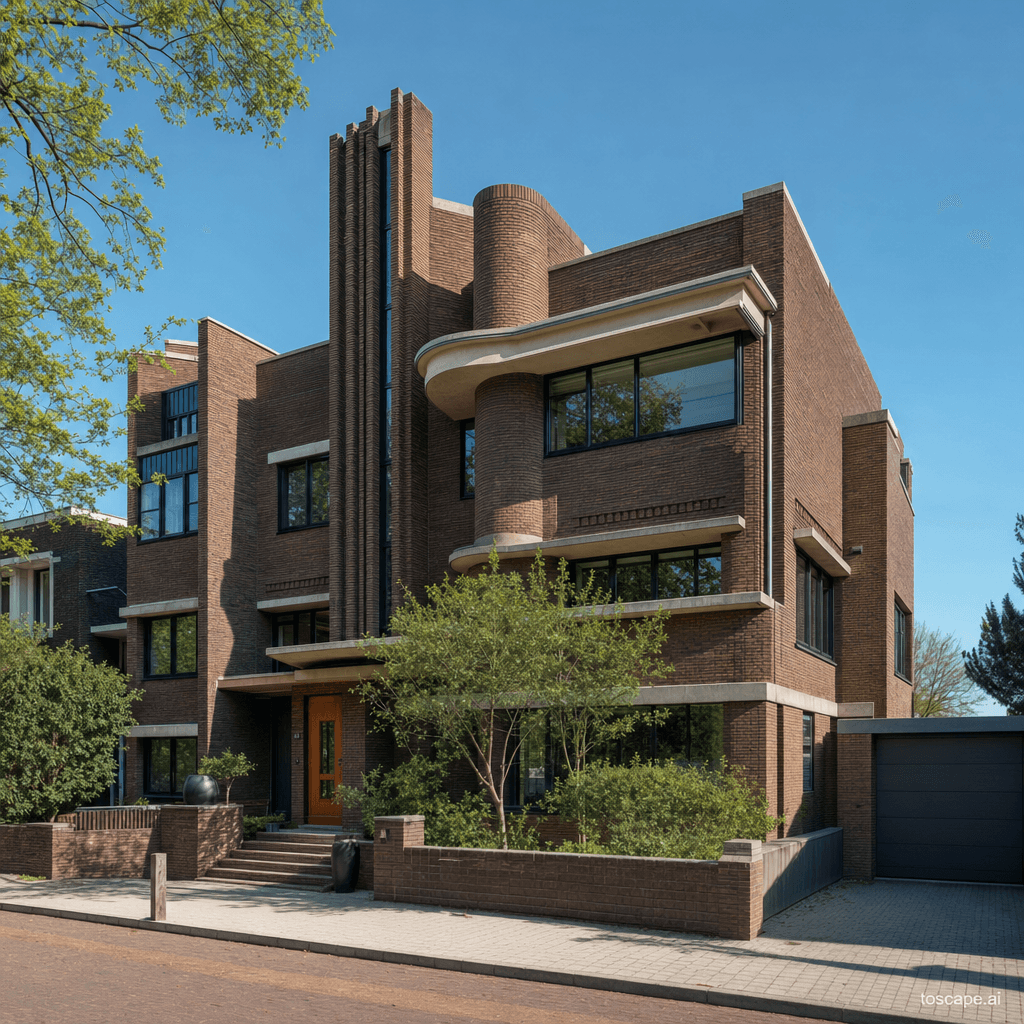
Dutch Rotterdam Modern Brick Expressionism — characteristic facade composition, Amsterdam School (Amsterdamse School) brick architecture of Rotterdam and the Ne....
Context Snapshot
The Amsterdam School (Amsterdamse School) brick architecture of Rotterdam and the Netherlands (1910–1930) — a uniquely Dutch expressionist architecture that emerged from the social-democratic workers'... The Amsterdam School emerged from the Dutch social housing movement (Woningwet, 1901) and the specific urban conditions of the Netherlands: (1) Dutch climate — mild, damp, with frequent rain — the steep roof sheds rain...
Contemporary Relevance
Dutch Rotterdam Modern Brick Expressionism is useful today for residential, hospitality, civic, and place-branding work that needs Netherlands-specific character grounded in local massing, material tone, climate response, and settlement logic rather than generic international styling.
Use this style in Toscape
Explore Dutch Rotterdam Modern Brick Expressionism directly inside Toscape using the Facade Re-Style and Design Options workflows.
Open Dutch Rotterdam Modern Brick Expressionism in the galleryFrequently asked questions
What is Dutch Rotterdam Modern Brick Expressionism?
Dutch Rotterdam Modern Brick Expressionism is a regional architectural identity from Netherlands. The Rotterdam Brick Expressionism and Amsterdam School architecture — a distinctive early 20th-century Dutch architectural movement characterized by sculptural brickwork (expressio.
What materials define Dutch Rotterdam Modern Brick Expressionism?
The Amsterdam School celebrates materiality — brick, thatch, timber, iron: (1) Brick (baksteen) — the primary material, in a range of warm colors from orange-red (#C07040) through deep burgundy (#7A3B2A) to plum-brown (#5B2A3A) — the bricks are often slightly irregular in shape and color, creating a lively surface — th.
What is the Dutch Rotterdam Modern Brick Expressionism color palette?
White, cream, pale sand, warm timber, and shadow-driven dark metal accents define the palette. The facade should stay bright and climate-aware rather than heavy, gray, or over-saturated.
Where does Dutch Rotterdam Modern Brick Expressionism come from?
The Amsterdam School (Amsterdamse School) brick architecture of Rotterdam and the Netherlands (1910–1930) — a uniquely Dutch expressionist architecture that emerged from the social-democratic workers'... The Amsterdam School emerged from the Dutch social housing movement (Woningwet, 1901) and the specific urban conditions of the Netherlands: (1) Dutch climate — mild, damp, with frequent rain — the steep roof sheds rain.
When should architects use Dutch Rotterdam Modern Brick Expressionism?
Dutch Rotterdam Modern Brick Expressionism is useful today for residential, hospitality, civic, and place-branding work that needs Netherlands-specific character grounded in local massing, material tone, climate response, and settlement logic rather than generic international styling.
How do you render Dutch Rotterdam Modern Brick Expressionism in Toscape?
Open Toscape on Windows, load your own photo, elevation, sketch, or CAD view, then apply the Dutch Rotterdam Modern Brick Expressionism reference from the built-in style library. The Facade Re-Style and Design Options workflows keep your project geometry and camera while shifting materials, proportion, and detailing toward Dutch Rotterdam Modern Brick Expressionism.