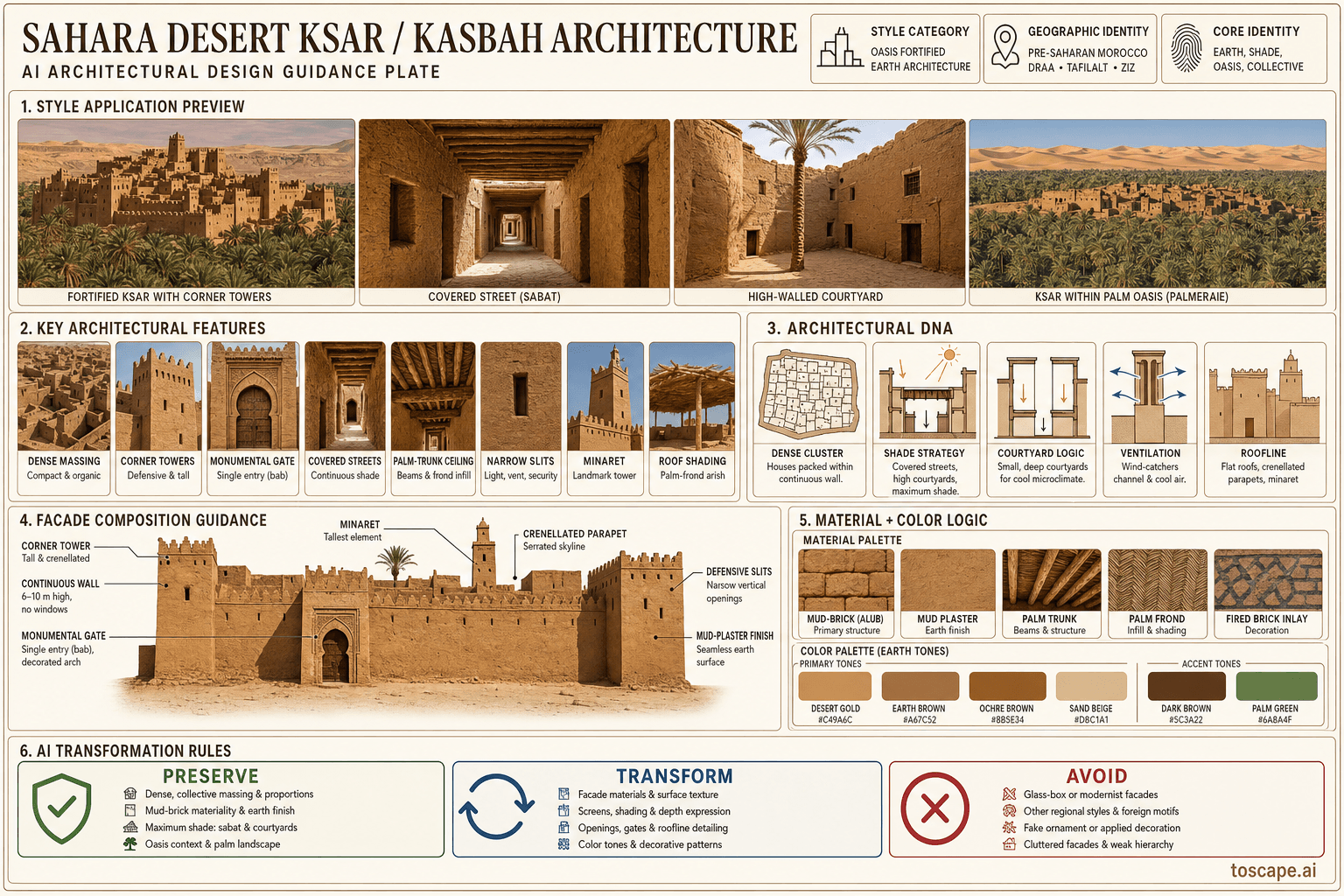
Sahara Desert Ksar / Kasbah
Morocco · ksar (fortified village) and kasbah architecture of Morocco's pre-Saharan oases
The oasis fortified village and desert-edge earth architecture of pre-Saharan Morocco
Definition
Sahara Desert Ksar / Kasbah is a regional architectural identity from Morocco. The oasis fortified village and desert-edge earth architecture of pre-Saharan Morocco.
- Country
- Morocco
- Region
- ksar (fortified village) and kasbah architecture of Morocco's pre-Saharan oases.
- Massing
- The Sahara ksar is a dense, compact, organic settlement — houses packed tightly together within a continuous defensive wall.
- Materials
- The Sahara palette is monochromatic gold-brown: Mud-brick and mud plaster — uniform warm brown-gold (RGB ~190,150,110) — the entire visual world Palm trunk and frond.
- Palette
- Warm earth, sandy beige, ochre, clay brown, and sun-softened mineral tones should dominate, with palm green or weathered timber as secondary accents.
- Climate response
- The Sahara climate (summer 45°C+, winter 5–15°C, extreme diurnal range, near-zero rainfall, sand-laden winds) drives the most extreme passive design in Morocco: Maximum shade: Covered streets.
Overview
Sahara Desert Ksar / Kasbah is a regional architectural identity in Morocco. The ksar (fortified village) and kasbah architecture of Morocco's pre-Saharan oases — the Draa Valley, Tafilalt, Ziz Valley, and the Erg Chebbi dune-edge settlements — where earth architecture reaches its most extreme climatic expression. Compact, clustered ksar (fortified village) of attached earth-brick houses within a continuous defensive wall — mud-brick (adobe) rather than rammed earth (pisé) in the southern oas...
Visual DNA
Massing & Form
The Sahara ksar is a dense, compact, organic settlement — houses packed tightly together within a continuous defensive wall, creating a unified brown-gold mass that reads as a single architectural entity emerging from the desert floor. Ksar vs.
Facade Language
The ksar exterior is a continuous defensive wall with minimal articulation: Continuous earth wall: The ksar perimeter reads as a single, continuous earth wall 6–10 m high, punctuated by defensive corner towers with crenellations. Individual houses are not legible from the exterior — the collective identity dominates ov...
Materials & Texture
The Sahara palette is monochromatic gold-brown: Mud-brick and mud plaster — uniform warm brown-gold (RGB ~190,150,110) — the entire visual world Palm trunk and frond — warm brown, textured — ceilings, beams, shade structures Dark brown brick inlay — slightly darker fired brick for decorative patterns on gates, towers...
Color Palette
Warm earth, sandy beige, ochre, clay brown, and sun-softened mineral tones should dominate, with palm green or weathered timber as secondary accents. The palette should read as land-derived rather than polished or urban-generic.
Ornament & Detail
Sahara ornament follows the Berber geometric language but in a more restrained, desert-adapted form: Geometric brick inlay on gates and minarets — zigzag, diamond, and chevron patterns identical to the Atlas tacherift Blind arcades on the minaret — the sole architectural decoration on the ksar exterior Simple plaster r...
Climate Response
The Sahara climate (summer 45°C+, winter 5–15°C, extreme diurnal range, near-zero rainfall, sand-laden winds) drives the most extreme passive design in Morocco: Maximum shade: Covered streets, high-walled courtyards, palm-frond roof shading — every outdoor space is shaded Thermal mass + night flushing: The thick mud-br...
Landscape & Ground
The ksar (fortified village) and kasbah architecture of Morocco's pre-Saharan oases — the Draa Valley, Tafilalt, Ziz Valley, and the Erg Chebbi dune-edge settlements — where earth architecture reaches its most extreme climatic expression. The Sahara climate (summer 45°C+, winter 5–15°C, extreme diurnal range, near-zero...
Reference elevation
Sahara Desert Ksar / Kasbah — characteristic facade composition, ksar (fortified village) and kasbah architecture of Morocco's pre-Saharan oases.
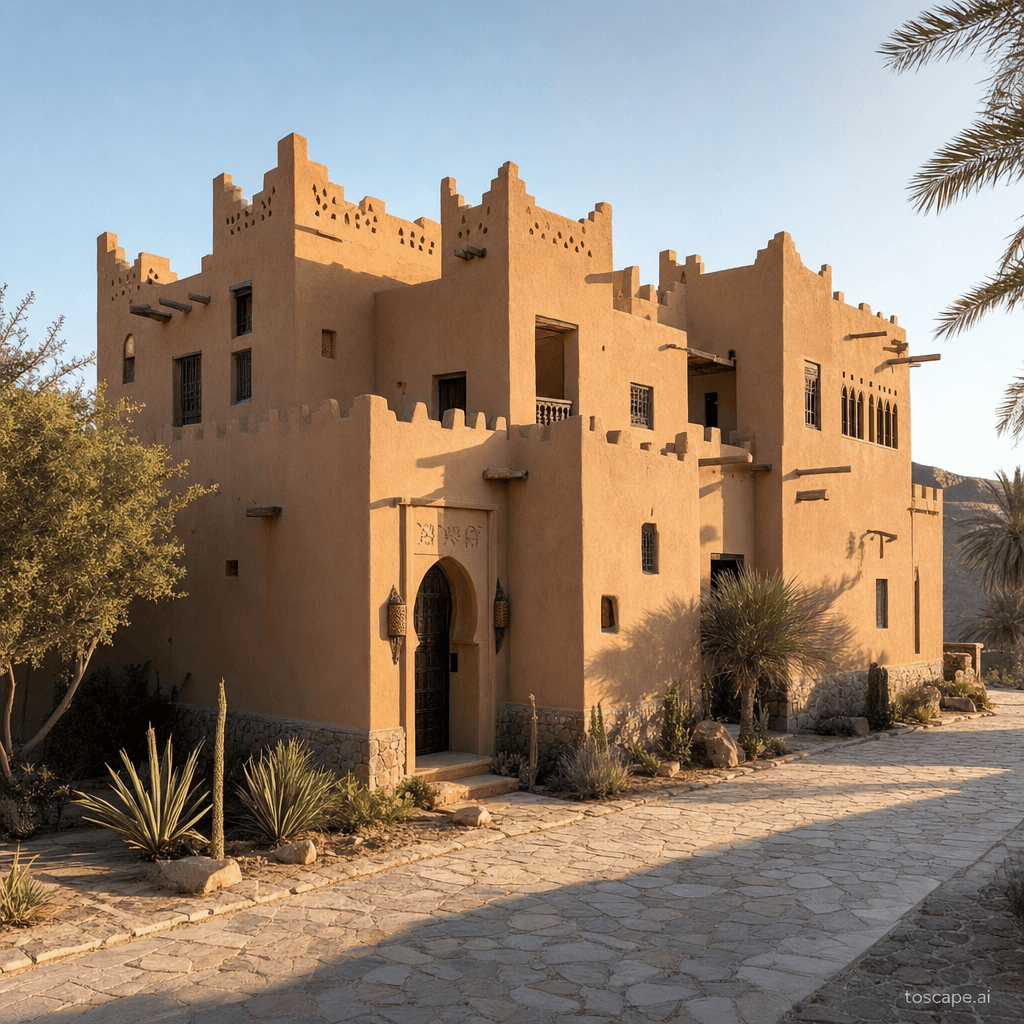
Context Snapshot
The ksar (fortified village) and kasbah architecture of Morocco's pre-Saharan oases — the Draa Valley, Tafilalt, Ziz Valley, and the Erg Chebbi dune-edge settlements — where earth architecture reaches... The Sahara climate (summer 45°C+, winter 5–15°C, extreme diurnal range, near-zero rainfall, sand-laden winds) drives the most extreme passive design in Morocco: Maximum shade: Covered streets, high-walled courtyards, pal...
Contemporary Relevance
Sahara Desert Ksar / Kasbah is useful today for residential, hospitality, civic, and place-branding work that needs Morocco-specific character grounded in local massing, material tone, climate response, and settlement logic rather than generic international styling.
Use this style in Toscape
Explore Sahara Desert Ksar / Kasbah directly inside Toscape using the Facade Re-Style and Design Options workflows.
Open Sahara Desert Ksar / Kasbah in the galleryFrequently asked questions
What is Sahara Desert Ksar / Kasbah?
Sahara Desert Ksar / Kasbah is a regional architectural identity from Morocco. The oasis fortified village and desert-edge earth architecture of pre-Saharan Morocco.
What materials define Sahara Desert Ksar / Kasbah?
The Sahara palette is monochromatic gold-brown: Mud-brick and mud plaster — uniform warm brown-gold (RGB ~190,150,110) — the entire visual world Palm trunk and frond — warm brown, textured — ceilings, beams, shade structures Dark brown brick inlay — slightly darker fired brick for decorative patterns on gates, towers.
What is the Sahara Desert Ksar / Kasbah color palette?
Warm earth, sandy beige, ochre, clay brown, and sun-softened mineral tones should dominate, with palm green or weathered timber as secondary accents. The palette should read as land-derived rather than polished or urban-generic.
Where does Sahara Desert Ksar / Kasbah come from?
The ksar (fortified village) and kasbah architecture of Morocco's pre-Saharan oases — the Draa Valley, Tafilalt, Ziz Valley, and the Erg Chebbi dune-edge settlements — where earth architecture reaches... The Sahara climate (summer 45°C+, winter 5–15°C, extreme diurnal range, near-zero rainfall, sand-laden winds) drives the most extreme passive design in Morocco: Maximum shade: Covered streets, high-walled courtyards, pal.
When should architects use Sahara Desert Ksar / Kasbah?
Sahara Desert Ksar / Kasbah is useful today for residential, hospitality, civic, and place-branding work that needs Morocco-specific character grounded in local massing, material tone, climate response, and settlement logic rather than generic international styling.
How do you render Sahara Desert Ksar / Kasbah in Toscape?
Open Toscape on Windows, load your own photo, elevation, sketch, or CAD view, then apply the Sahara Desert Ksar / Kasbah reference from the built-in style library. The Facade Re-Style and Design Options workflows keep your project geometry and camera while shifting materials, proportion, and detailing toward Sahara Desert Ksar / Kasbah.