Santiago Central Valley
Chile · architectural identity of Chile's Central Valley (Santiago to the Bío-Bío River)
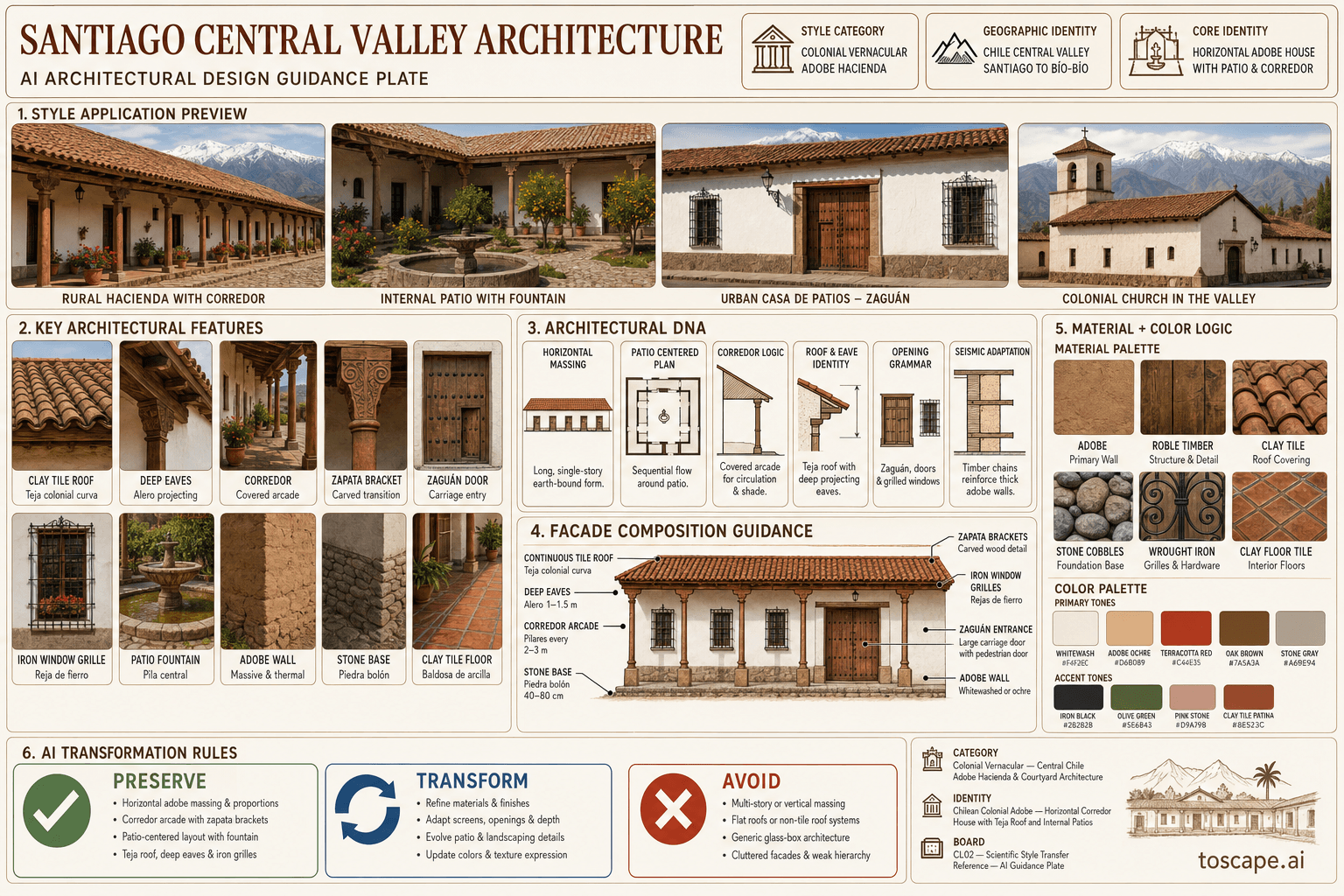
The adobe hacienda and colonial courtyard house of Chile's Central Valley — the casa patronal with its continuous adobe facade, clay tile roof, and internal patios, the architectur...
Definition
Santiago Central Valley is a regional architectural identity from Chile. The adobe hacienda and colonial courtyard house of Chile's Central Valley — the casa patronal with its continuous adobe facade, clay tile roof, and internal patios, the architectur.
- Country
- Chile
- Region
- architectural identity of Chile's Central Valley (Santiago to the Bío-Bío River).
- Massing
- The Chilean adobe house is emphatically horizontal — long and low, typically single-story, stretching along the street or across the countryside.
- Materials
- The palette is earth-and-timber: (1) Adobe — the Central Valley's clay soils, sun-dried into bricks, left natural (warm ochre to pale brown) or whitewashed (cal).
- Palette
- White, cream, pale sand, warm timber, and shadow-driven dark metal accents define the palette.
- Climate response
- The Central Valley has a Mediterranean climate (hot dry summers, cool wet winters, 400–800 mm annual rainfall).
Overview
Santiago Central Valley is a regional architectural identity in Chile. The architectural identity of Chile's Central Valley (Santiago to the Bío-Bío River) — the casa de campo / fundo (rural hacienda house) and its urban counterpart, the casa de patios (courtyard townhouse), both defined by continuous adobe walls, Spanish colonial clay tile roofs (teja colonial curva), a strong horizontal facade language with deep projecting eaves (alero), and the spatial organization around one or more...
Visual DNA
Massing & Form
The Chilean adobe house is emphatically horizontal — long and low, typically single-story, stretching along the street or across the countryside. Rural haciendas (fundos) can extend 50–100 m in length.
Facade Language
The facade is a long horizontal adobe wall, whitewashed or left in natural ochre tones, under a continuous red tile roof. The deep projecting eave (alero, 1–1.5 m) casts a strong shadow line across the upper wall.
Materials & Texture
The palette is earth-and-timber: (1) Adobe — the Central Valley's clay soils, sun-dried into bricks, left natural (warm ochre to pale brown) or whitewashed (cal). (2) Roble (Nothofagus obliqua) — the Chilean oak, dense and durable, for roof timbers, pillars, brackets, doors, and structural reinforcement.
Color Palette
White, cream, pale sand, warm timber, and shadow-driven dark metal accents define the palette. The facade should stay bright and climate-aware rather than heavy, gray, or over-saturated.
Ornament & Detail
Chilean colonial ornament is concentrated at structural transitions: (1) The zapata — the carved wooden bracket/capital at the top of the pilares, transitioning from post to beam — often carved with simple scroll or geometric patterns, the most characteristic Chilean colonial detail. (2) Window grilles (rejas) — wrough...
Climate Response
The Central Valley has a Mediterranean climate (hot dry summers, cool wet winters, 400–800 mm annual rainfall). The adobe architecture is well-adapted: (1) Thick adobe walls provide thermal mass — cool in summer, retaining warmth in winter.
Landscape & Ground
The architectural identity of Chile's Central Valley (Santiago to the Bío-Bío River) — the casa de campo / fundo (rural hacienda house) and its urban counterpart, the casa de patios (courtyard townhouse), both defined by continuous adobe walls, Spanish colonial clay tile roofs (teja colonial curva), a strong horizontal...
Reference elevation
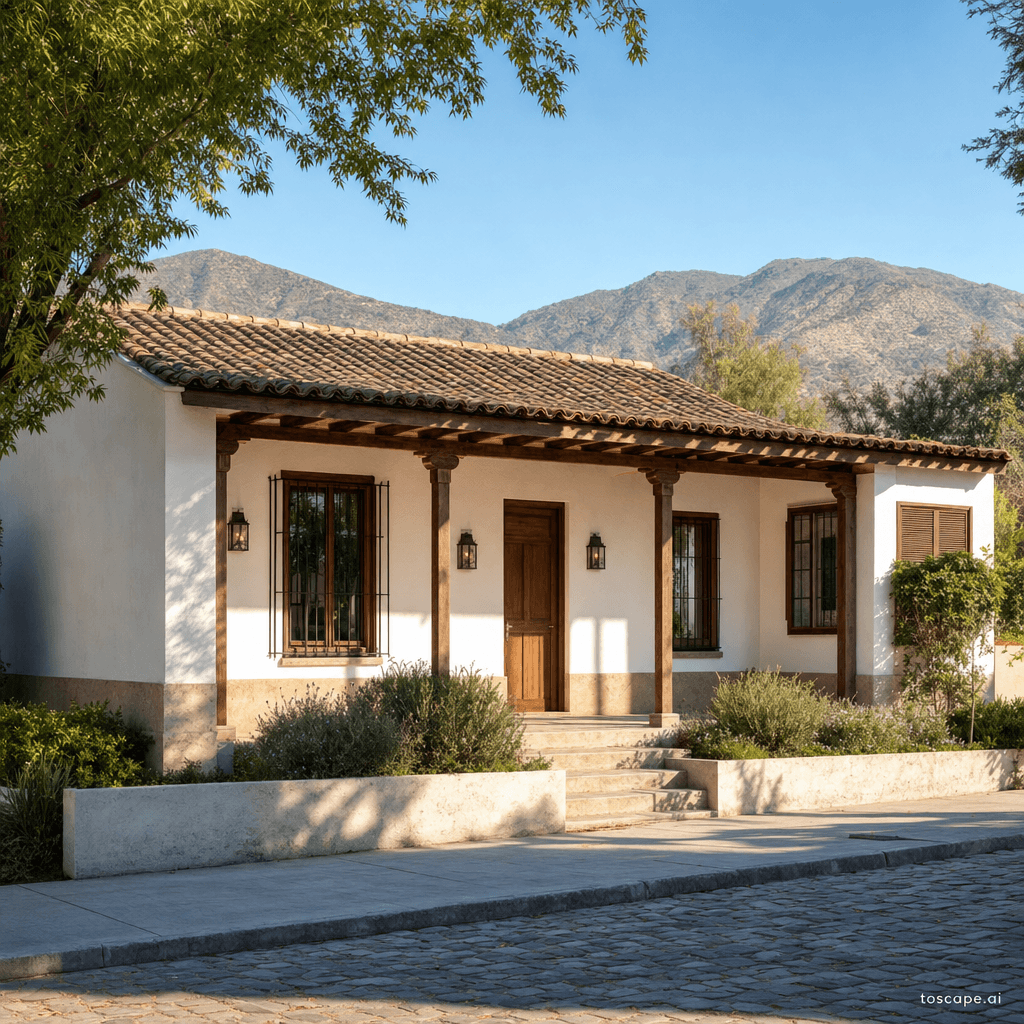
Santiago Central Valley — characteristic facade composition, architectural identity of Chile's Central Valley (Santiago to the Bío-Bío River).
Context Snapshot
The architectural identity of Chile's Central Valley (Santiago to the Bío-Bío River) — the casa de campo / fundo (rural hacienda house) and its urban counterpart, the casa de patios (courtyard townhou... The Central Valley has a Mediterranean climate (hot dry summers, cool wet winters, 400–800 mm annual rainfall).
Contemporary Relevance
Santiago Central Valley is useful today for residential, hospitality, civic, and place-branding work that needs Chile-specific character grounded in local massing, material tone, climate response, and settlement logic rather than generic international styling.
Use this style in Toscape
Explore Santiago Central Valley directly inside Toscape using the Facade Re-Style and Design Options workflows.
Open Santiago Central Valley in the galleryFrequently asked questions
What is Santiago Central Valley?
Santiago Central Valley is a regional architectural identity from Chile. The adobe hacienda and colonial courtyard house of Chile's Central Valley — the casa patronal with its continuous adobe facade, clay tile roof, and internal patios, the architectur.
What materials define Santiago Central Valley?
The palette is earth-and-timber: (1) Adobe — the Central Valley's clay soils, sun-dried into bricks, left natural (warm ochre to pale brown) or whitewashed (cal). (2) Roble (Nothofagus obliqua) — the Chilean oak, dense and durable, for roof timbers, pillars, brackets, doors, and structural reinforcement.
What is the Santiago Central Valley color palette?
White, cream, pale sand, warm timber, and shadow-driven dark metal accents define the palette. The facade should stay bright and climate-aware rather than heavy, gray, or over-saturated.
Where does Santiago Central Valley come from?
The architectural identity of Chile's Central Valley (Santiago to the Bío-Bío River) — the casa de campo / fundo (rural hacienda house) and its urban counterpart, the casa de patios (courtyard townhou... The Central Valley has a Mediterranean climate (hot dry summers, cool wet winters, 400–800 mm annual rainfall).
When should architects use Santiago Central Valley?
Santiago Central Valley is useful today for residential, hospitality, civic, and place-branding work that needs Chile-specific character grounded in local massing, material tone, climate response, and settlement logic rather than generic international styling.
How do you render Santiago Central Valley in Toscape?
Open Toscape on Windows, load your own photo, elevation, sketch, or CAD view, then apply the Santiago Central Valley reference from the built-in style library. The Facade Re-Style and Design Options workflows keep your project geometry and camera while shifting materials, proportion, and detailing toward Santiago Central Valley.