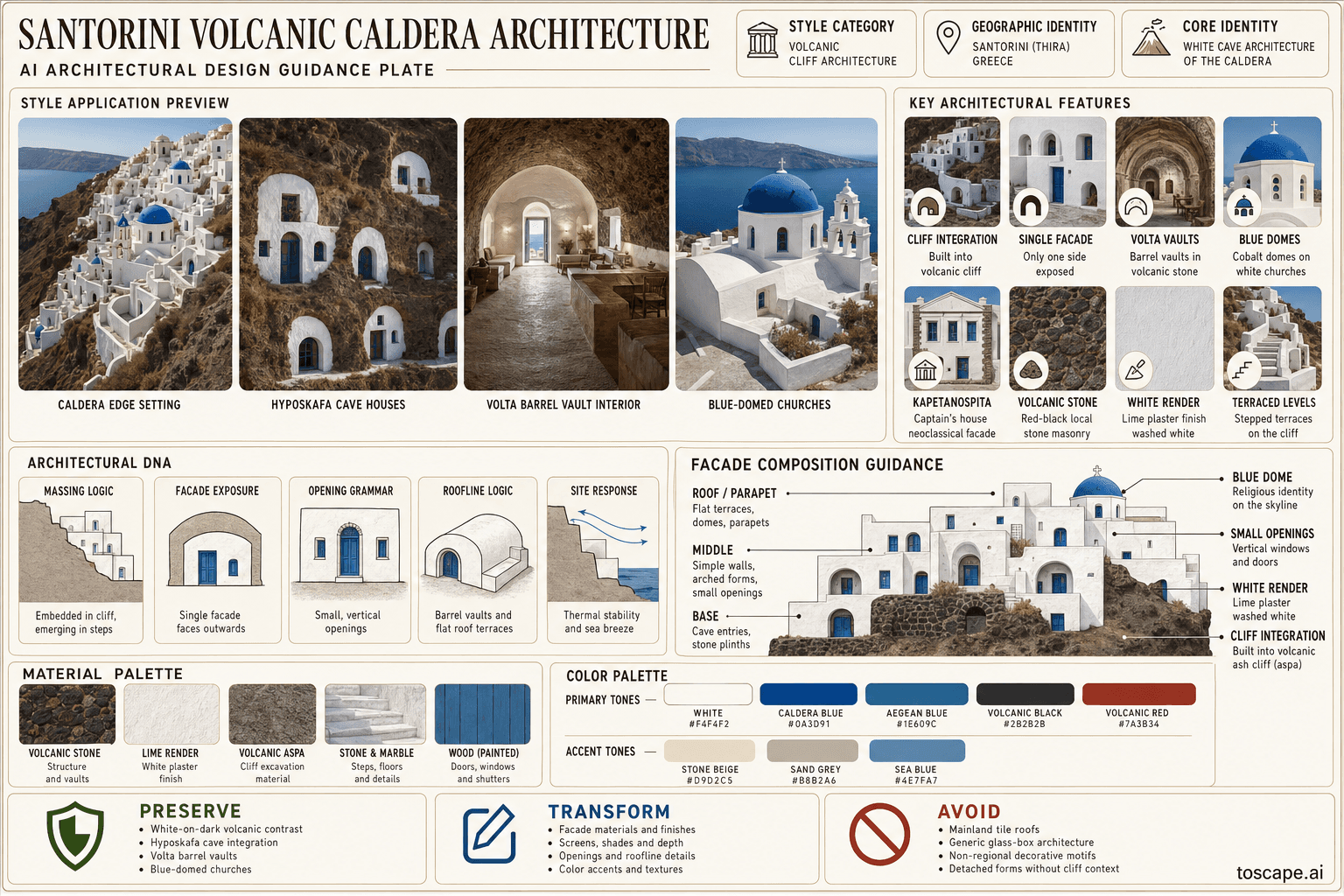
Santorini Volcanic Caldera
Greece · distinctive volcanic architecture of Santorini (Thira)
The earth-sheltered cave architecture of the Santorini caldera
Definition
Santorini Volcanic Caldera is a regional architectural identity from Greece. The earth-sheltered cave architecture of the Santorini caldera.
- Country
- Greece
- Region
- distinctive volcanic architecture of Santorini (Thira).
- Massing
- Pure white rendered cubic volumes emerging from dark volcanic cliff — hyposkafa (cave houses) with single exposed facades — barrel-vaulted ceilings (volta) — blue-domed churches.
- Palette
- White, cream, pale sand, warm timber, and shadow-driven dark metal accents define the palette.
- Climate response
- The distinctive volcanic architecture of Santorini (Thira) — hyposkafa cave houses carved into the volcanic ash cliff, volta barrel vaults in local volcanic stone.
Try it free
Render your own project in this style
Upload one photo of your own project and Re-Render keeps the geometry and camera while carrying the Santorini Volcanic Caldera language into materials, proportion, and detail. Three free renders, no account needed.
Open Re-Render - freeOverview
Santorini Volcanic Caldera is a regional architectural identity in Greece. The distinctive volcanic architecture of Santorini (Thira) — hyposkafa cave houses carved into the volcanic ash cliff, volta barrel vaults in local volcanic stone, and kapetanospita captain's houses. Pure white rendered cubic volumes emerging from dark volcanic cliff — hyposkafa (cave houses) with single exposed facades — barrel-vaulted ceilings (volta) — blue-domed churches on the caldera edge — the most dramatic ar...
Visual DNA
Massing & Form
Pure white rendered cubic volumes emerging from dark volcanic cliff — hyposkafa (cave houses) with single exposed facades — barrel-vaulted ceilings (volta) — blue-domed churches on the caldera edge — the most dramatic architectural site in the Mediterranean
Facade Language
Pure white rendered cubic volumes emerging from dark volcanic cliff — hyposkafa (cave houses) with single exposed facades — barrel-vaulted ceilings (volta) — blue-domed churches on the caldera edge — the most dramatic architectural site in the Mediterranean
Materials & Texture
Pure white rendered cubic volumes emerging from dark volcanic cliff — hyposkafa (cave houses) with single exposed facades — barrel-vaulted ceilings (volta) — blue-domed churches on the caldera edge — the most dramatic architectural site in the Mediterranean
Color Palette
White, cream, pale sand, warm timber, and shadow-driven dark metal accents define the palette. The facade should stay bright and climate-aware rather than heavy, gray, or over-saturated.
Ornament & Detail
Pure white rendered cubic volumes emerging from dark volcanic cliff — hyposkafa (cave houses) with single exposed facades — barrel-vaulted ceilings (volta) — blue-domed churches on the caldera edge — the most dramatic architectural site in the Mediterranean
Climate Response
The distinctive volcanic architecture of Santorini (Thira) — hyposkafa cave houses carved into the volcanic ash cliff, volta barrel vaults in local volcanic stone, and kapetanospita captain's houses
Landscape & Ground
The distinctive volcanic architecture of Santorini (Thira) — hyposkafa cave houses carved into the volcanic ash cliff, volta barrel vaults in local volcanic stone, and kapetanospita captain's houses
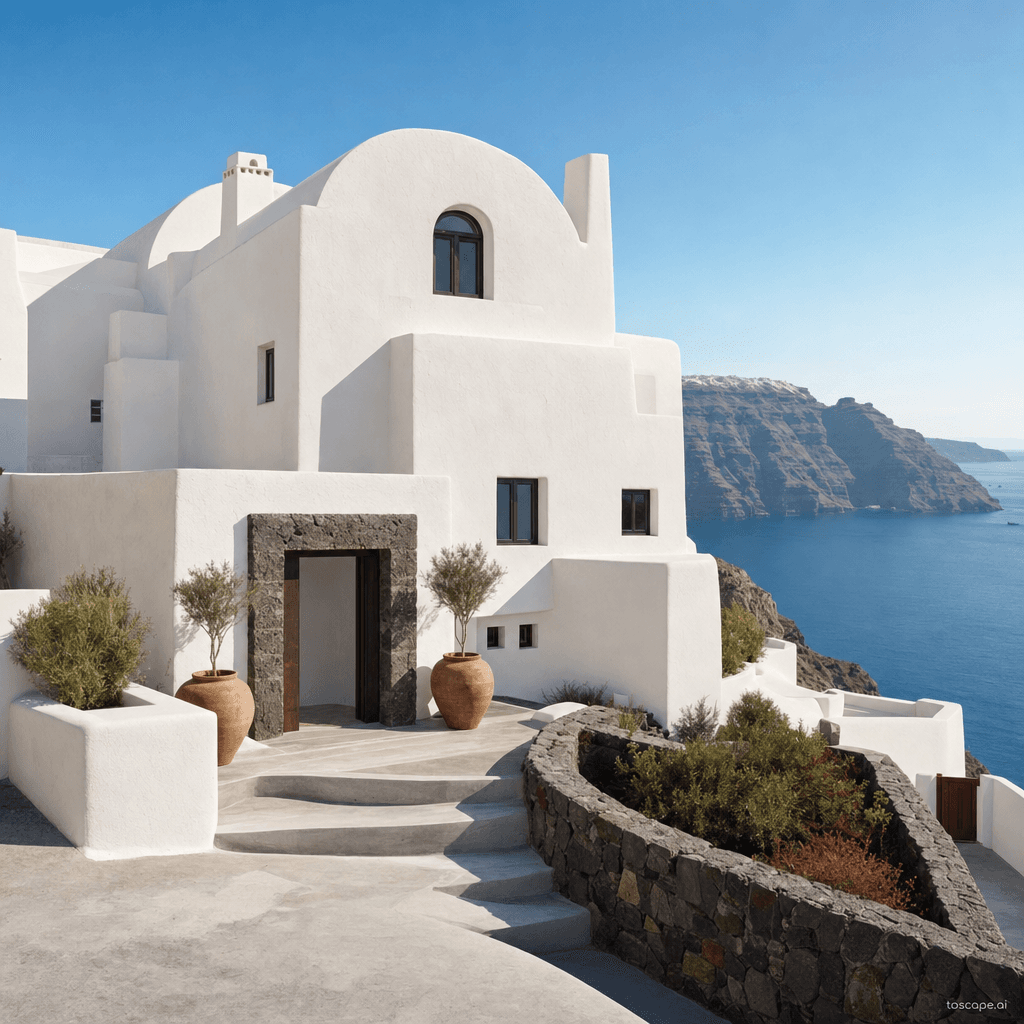
Reference elevation
Santorini Volcanic Caldera — characteristic facade composition, distinctive volcanic architecture of Santorini (Thira).
Context Snapshot
The distinctive volcanic architecture of Santorini (Thira) — hyposkafa cave houses carved into the volcanic ash cliff, volta barrel vaults in local volcanic stone, and kapetanospita captain's houses
Contemporary Relevance
Santorini Volcanic Caldera is useful today for residential, hospitality, civic, and place-branding work that needs Greece-specific character grounded in local massing, material tone, climate response, and settlement logic rather than generic international styling.
Use this style in Toscape
Explore Santorini Volcanic Caldera directly inside Toscape using the Facade Re-Style and Design Options workflows.
Open Santorini Volcanic Caldera in the galleryFrequently asked questions
What is Santorini Volcanic Caldera?
Santorini Volcanic Caldera is a regional architectural identity from Greece. The earth-sheltered cave architecture of the Santorini caldera.
What materials define Santorini Volcanic Caldera?
Pure white rendered cubic volumes emerging from dark volcanic cliff — hyposkafa (cave houses) with single exposed facades — barrel-vaulted ceilings (volta) — blue-domed churches on the caldera edge — the most dramatic architectural site in the Mediterranean.
What is the Santorini Volcanic Caldera color palette?
White, cream, pale sand, warm timber, and shadow-driven dark metal accents define the palette. The facade should stay bright and climate-aware rather than heavy, gray, or over-saturated.
Where does Santorini Volcanic Caldera come from?
The distinctive volcanic architecture of Santorini (Thira) — hyposkafa cave houses carved into the volcanic ash cliff, volta barrel vaults in local volcanic stone, and kapetanospita captain's houses.
When should architects use Santorini Volcanic Caldera?
Santorini Volcanic Caldera is useful today for residential, hospitality, civic, and place-branding work that needs Greece-specific character grounded in local massing, material tone, climate response, and settlement logic rather than generic international styling.
How do you render Santorini Volcanic Caldera in Toscape?
In Toscape, pick the Santorini Volcanic Caldera reference from the style library and run it over your own image - a site photo, elevation, sketch, or CAD view. The Facade Re-Style and Design Options workflows hold the geometry and camera of the project and move materials, proportion, and detailing toward Santorini Volcanic Caldera.
Other regional identities from Greece
- Crete Venetian-Ottoman HybridThe layered island architecture of Crete — Minoan memory, Venetian fortification, Ottoman adaptation, and Aegean vernacular.
- Cyclades IslandsThe iconic whitewashed cubic architecture of the Aegean islands — Santorini, Mykonos, and the Cycladic archipelago.
- Epirus Zagori Stone Bridge & Mountain VillageThe Ottoman-influenced stone mansions of northwestern Greece — arched bridges, stone-slab roofs, and the Zagorochoria villages.
- Macedonian Urban BalkanThe Ottoman-influenced urban houses of Thessaloniki and northern Greece — Balkan timber-framed mansions and the "Ano.
- Peloponnese Stone Tower & VillageThe Mani tower-houses and Arcadian stone villages — fortified clan architecture of southern Greece.
- Corfu Ionian Island VenetianThe Venetian-influenced urban architecture of the Ionian Islands — Italian Renaissance meets Greek island vernacular.