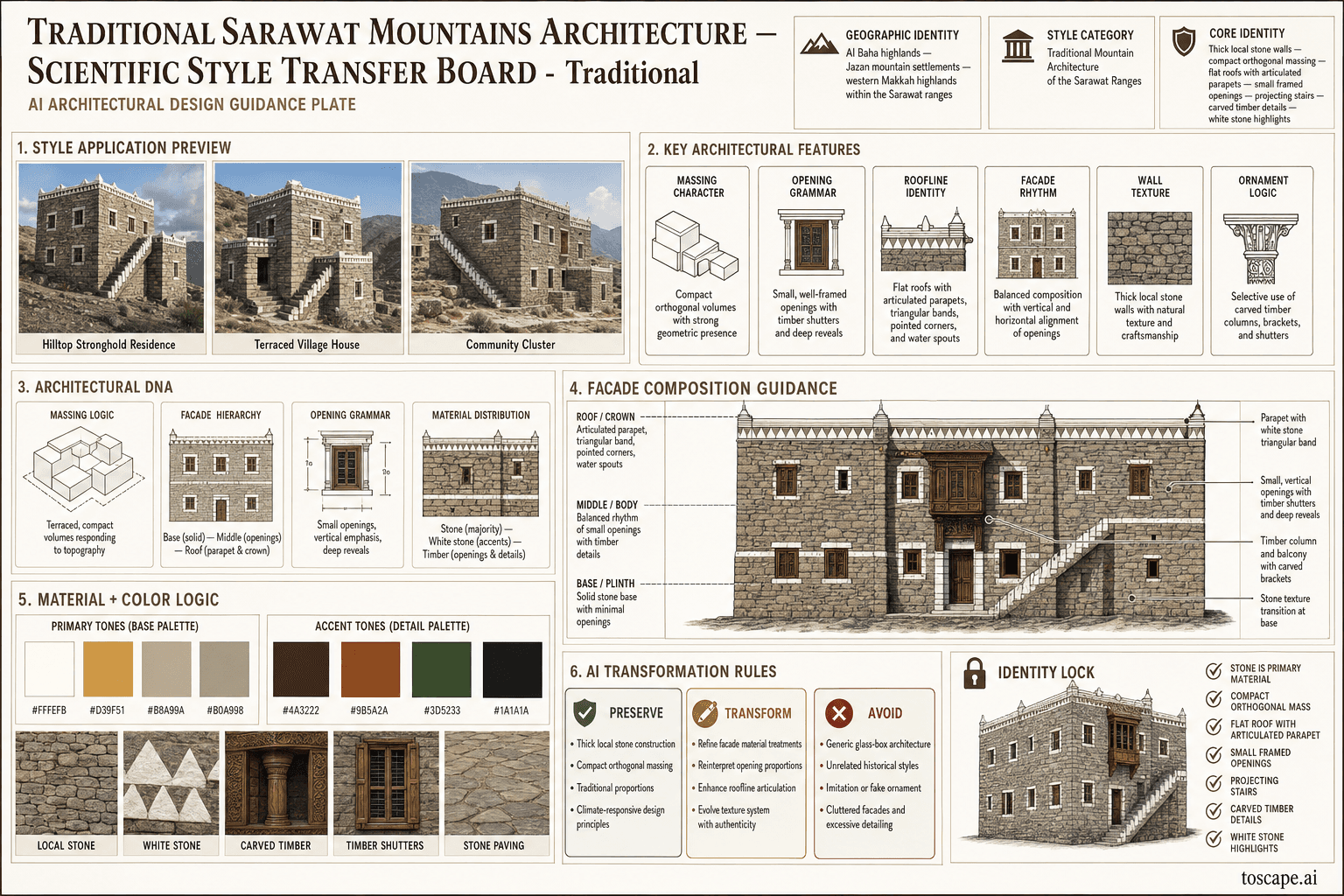
Sarawat Mountains Traditional
Saudi Arabia · Sarawat Mountains
The thick stone terrace-bound highland vernacular of the Sarawat escarpment, pre-20th century CE
Definition
Sarawat Mountains Traditional is a regional architectural identity from Saudi Arabia. The thick stone terrace-bound highland vernacular of the Sarawat escarpment, pre-20th century CE.
- Country
- Saudi Arabia
- Region
- Sarawat Mountains
- Massing
- Sarawat Mountains Traditional architecture is compact, heavy, and topography-led.
- Materials
- Traditional Sarawat architecture depends on local stone as the primary body material.
- Palette
- Stone greys, lime white, sun-aged timber, and selective mineral accents shape the palette.
- Climate response
- Buildings belong to steep slopes, agricultural terraces, courtyards, and narrow passages. The architecture should respond to privacy, wind, rainfall, shade, and defensive siting .
Overview
Sarawat Mountains Traditional is a Saudi architectural identity rooted in Sarawat Mountains. Sarawat Mountains Architecture (one of 19 Saudi Architecture Characters Map styles). Al Baha highlands — Jazan mountain settlements — western Makkah highlands within the Sarawat ranges.
Visual DNA
Massing & Form
Sarawat Mountains Traditional architecture is compact, heavy, and topography-led. Building groups are composed of strong geometric masses, usually arranged as horizontal volumes on highlands and terraces, with occasional vertical tower elements balancing the skyline .
Facade Language
Facade rhythm comes from low void-to-solid ratios, informal but locally symmetrical window groupings, external stair placement, and the bipartite reading of a grounded lower portion with a more punctured upper zone . Openings follow interior use more than rigid facade grids — this is vernacular asymmetry within a compo...
Materials & Texture
Traditional Sarawat architecture depends on local stone as the primary body material. White stone (quartz-like highlights), timber, and occasional plaster are used to reinforce edges, parapets, frames, and decorative bands .
Color Palette
Stone greys, lime white, sun-aged timber, and selective mineral accents shape the palette. Highland and escarpment identities can carry stronger painted or stratified contrast, but the wall mass should still feel geologic and rooted in terrain.
Ornament & Detail
This is a crafted vernacular, not ornamental excess. Decoration is concentrated in parapet bands, triangular stone patterns, carved timber columns, shutters, and selected door surrounds.
Climate Response
Buildings belong to steep slopes, agricultural terraces, courtyards, and narrow passages. The architecture should respond to privacy, wind, rainfall, shade, and defensive siting .
Landscape & Ground
Al Baha highlands — Jazan mountain settlements — western Makkah highlands within the Sarawat ranges. Buildings belong to steep slopes, agricultural terraces, courtyards, and narrow passages.
Reference elevation
Sarawat Mountains Traditional — characteristic facade composition, Sarawat Mountains.
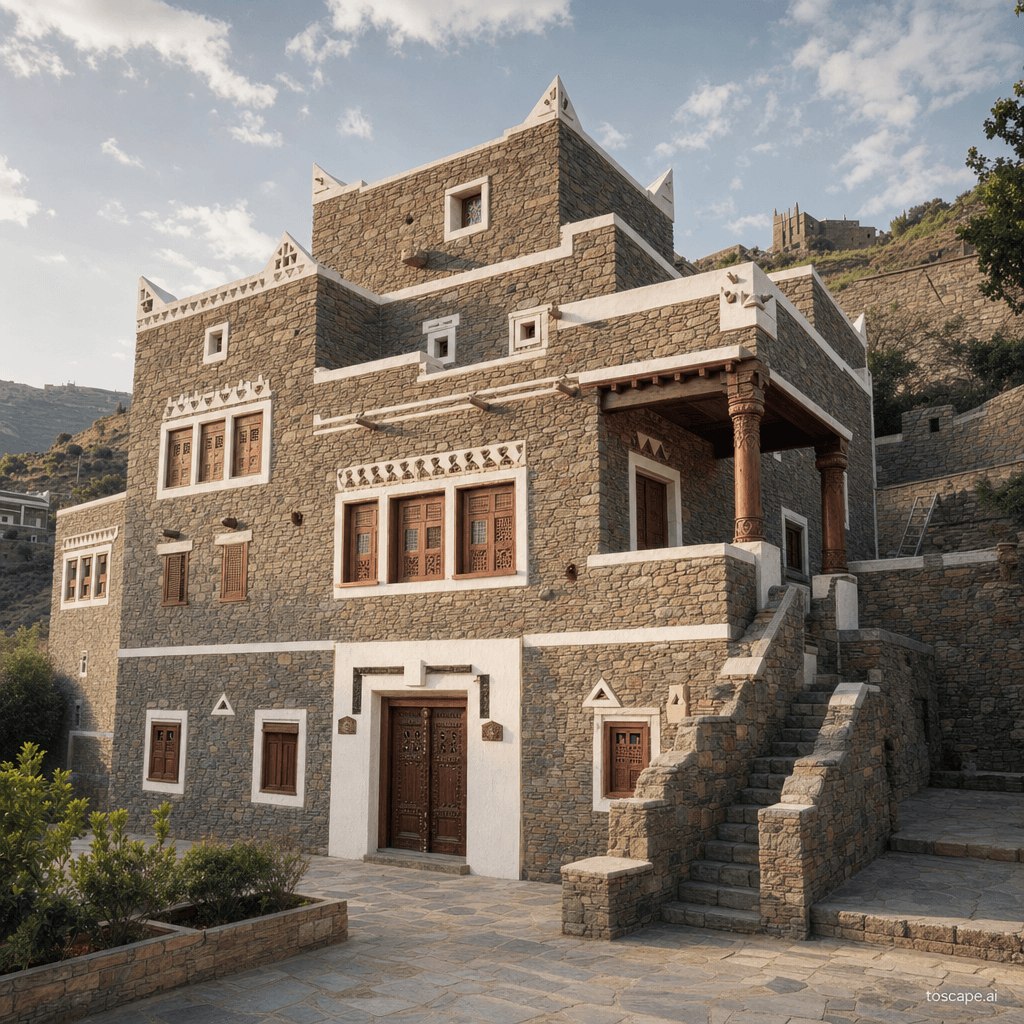
Context Snapshot
Historic highland stone architecture of the Sarawat Mountains — compact orthogonal settlements, terrace-bound farm buildings, clustered hilltop villages, and defensive towers Sarawat Mountains Architecture (one of 19 Saudi Architecture Characters Map styles) Al Baha highlands — Jazan mountain settlements — western Makkah highlands within the Sarawat ranges
Contemporary Relevance
Sarawat Mountains Traditional operates as the heritage reference layer for Sarawat Mountains and is most useful today in conservation work, cultural tourism districts, and accurate AI rendering direction. Its value in current practice comes from preserving proportion, material hierarchy, and climate logic without flattening them into generic nostalgia.
Use this style in Toscape
Explore Sarawat Mountains Traditional directly inside Toscape using the Facade Re-Style and Design Options workflows.
Open Sarawat Mountains Traditional in the galleryFrequently asked questions
What is Sarawat Mountains Traditional?
Sarawat Mountains Traditional is a regional architectural identity from Saudi Arabia. The thick stone terrace-bound highland vernacular of the Sarawat escarpment, pre-20th century CE.
What materials define Sarawat Mountains Traditional?
Traditional Sarawat architecture depends on local stone as the primary body material. White stone (quartz-like highlights), timber, and occasional plaster are used to reinforce edges, parapets, frames, and decorative bands .
What is the Sarawat Mountains Traditional color palette?
Stone greys, lime white, sun-aged timber, and selective mineral accents shape the palette. Highland and escarpment identities can carry stronger painted or stratified contrast, but the wall mass should still feel geologic and rooted in terrain.
Where does Sarawat Mountains Traditional come from?
Historic highland stone architecture of the Sarawat Mountains — compact orthogonal settlements, terrace-bound farm buildings, clustered hilltop villages, and defensive towers Sarawat Mountains Architecture (one of 19 Saudi Architecture Characters Map styles) Al Baha highlands — Jazan mountain settlements — western Makkah highlands within the Sarawat ranges.
When should architects use Sarawat Mountains Traditional?
Sarawat Mountains Traditional operates as the heritage reference layer for Sarawat Mountains and is most useful today in conservation work, cultural tourism districts, and accurate AI rendering direction. Its value in current practice comes from preserving proportion, material hierarchy, and climate logic without flattening them into generic nostalgia.
How do you render Sarawat Mountains Traditional in Toscape?
Open Toscape on Windows, load your own photo, elevation, sketch, or CAD view, then apply the Sarawat Mountains Traditional reference from the built-in style library. The Facade Re-Style and Design Options workflows keep your project geometry and camera while shifting materials, proportion, and detailing toward Sarawat Mountains Traditional.