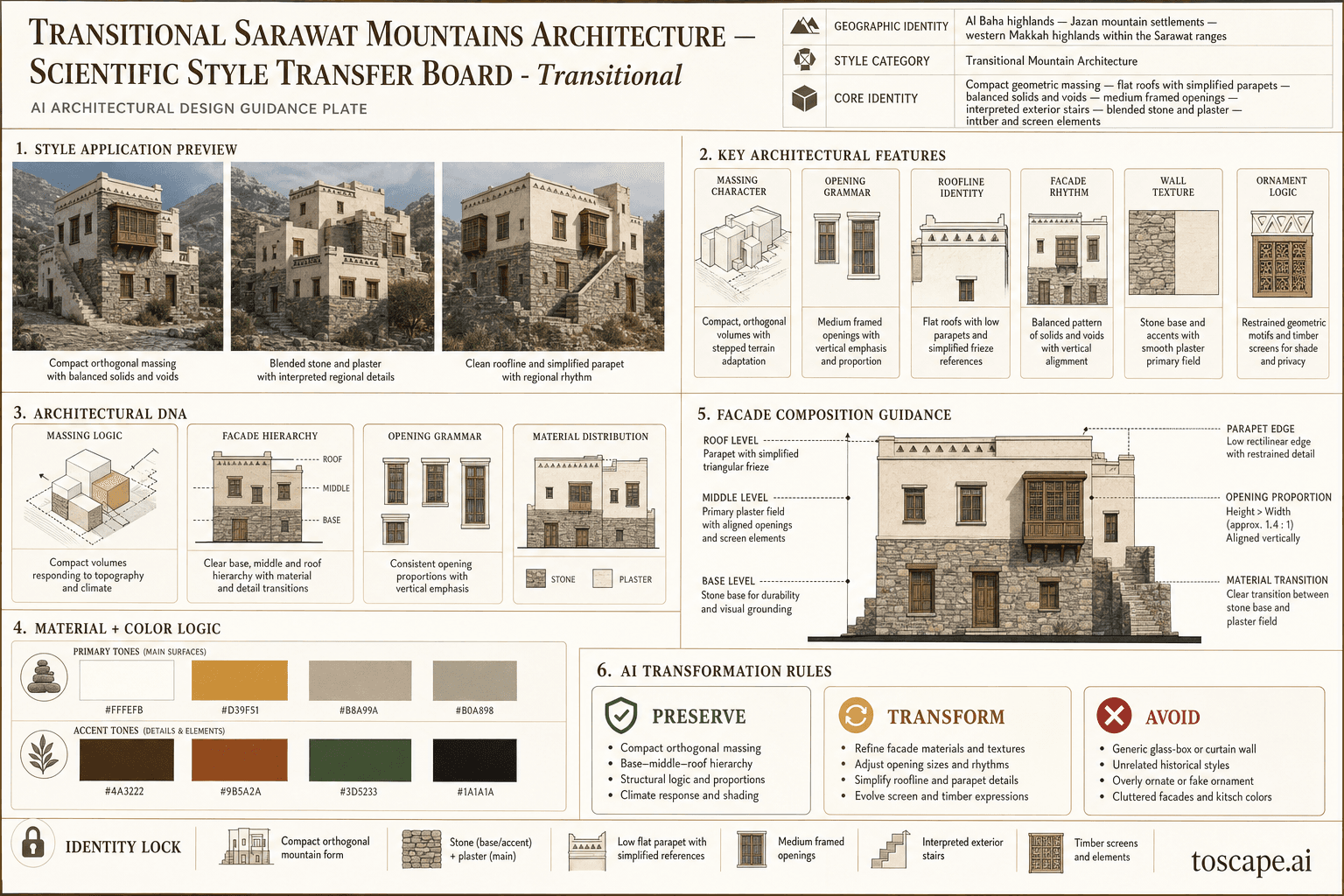
Sarawat Mountains Transitional
Saudi Arabia · Sarawat Mountains
The simplified stone-and-plaster mountain vernacular adapted for contemporary living, mid-late 20th century CE
Definition
Sarawat Mountains Transitional is a regional architectural identity from Saudi Arabia. The simplified stone-and-plaster mountain vernacular adapted for contemporary living, mid-late 20th century CE.
- Country
- Saudi Arabia
- Region
- Sarawat Mountains
- Massing
- Sarawat Mountains Transitional architecture keeps the compact, orthogonal strength of the vernacular while smoothing it into a more contemporary, livable composition.
- Materials
- Material blending is allowed, but fakery is not.
- Palette
- Stone greys, lime white, sun-aged timber, and selective mineral accents shape the palette.
- Climate response
- The building should still respect steep terrain, privacy, shaded thresholds, and open-space hierarchy.
Overview
Sarawat Mountains Transitional is a Saudi architectural identity rooted in Sarawat Mountains. Sarawat highland stone architecture translated into simplified, more permeable, and more daylight-capable building form. Al Baha highlands — Jazan mountain settlements — western Makkah highlands within the Sarawat ranges.
Visual DNA
Massing & Form
Sarawat Mountains Transitional architecture keeps the compact, orthogonal strength of the vernacular while smoothing it into a more contemporary, livable composition. Building massing should remain balanced between horizontal volumes and occasional vertical accents, with flat roofs and stepped levels responding to terr...
Facade Language
Facade rhythm comes from localized symmetry, balanced asymmetry, vertical and horizontal articulation, and the controlled use of recessed openings, shutters, screens, and surface patterning . The base should stay grounded, while the overall facade becomes slightly more permeable than the traditional model.
Materials & Texture
Material blending is allowed, but fakery is not. Stone should still feel structural or at least visually primary, while plaster, colored concrete, timber, terrazzo, and low-reflectivity glass help modernize the expression.
Color Palette
Stone greys, lime white, sun-aged timber, and selective mineral accents shape the palette. Highland and escarpment identities can carry stronger painted or stratified contrast, but the wall mass should still feel geologic and rooted in terrain.
Ornament & Detail
Transitional Sarawat design simplifies traditional detail. Patterning should be interpreted rather than copied and usually concentrated in parapets, shutters, screens, doors, and selected facade panels.
Climate Response
The building should still respect steep terrain, privacy, shaded thresholds, and open-space hierarchy. Courtyards, patios, terraces, and recessed openings should work as environmental devices, not just visual references .
Landscape & Ground
Al Baha highlands — Jazan mountain settlements — western Makkah highlands within the Sarawat ranges. The building should still respect steep terrain, privacy, shaded thresholds, and open-space hierarchy.
Reference elevation
Sarawat Mountains Transitional — characteristic facade composition, Sarawat Mountains.
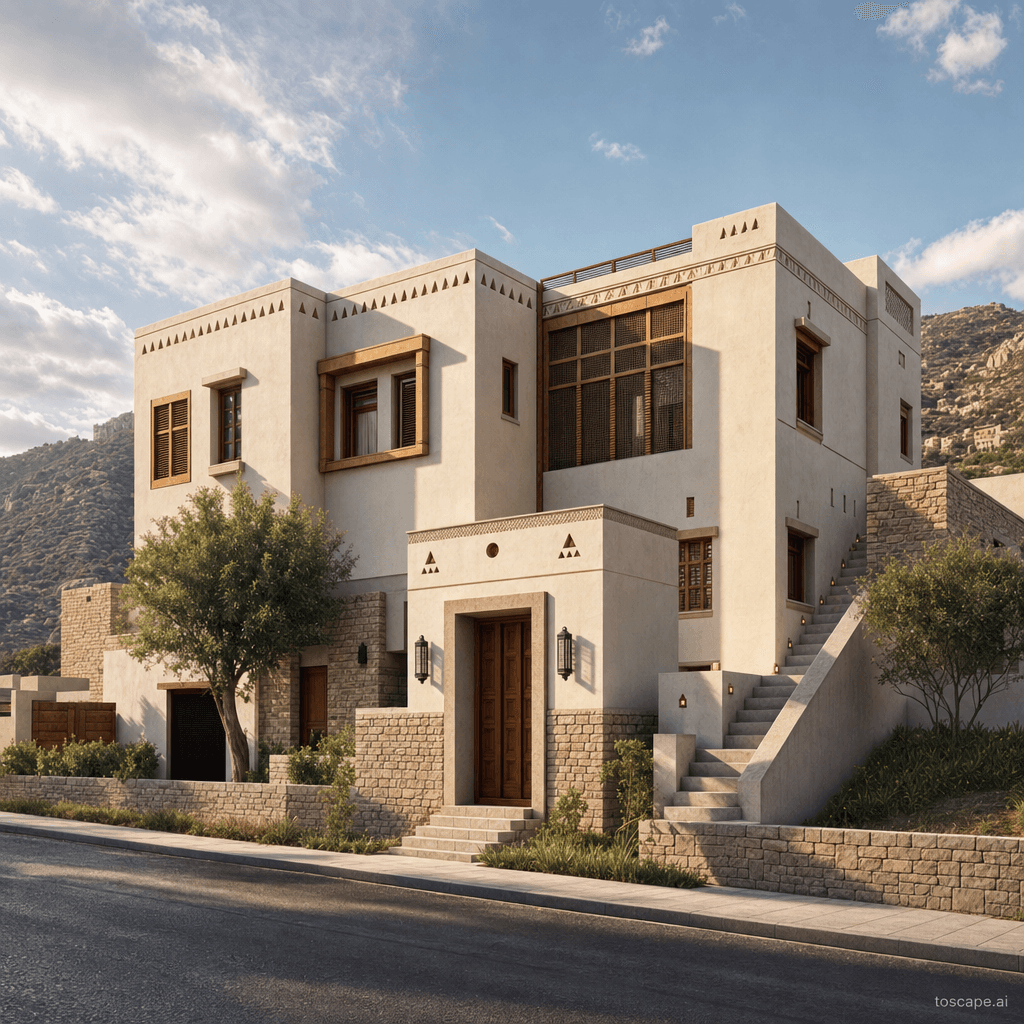
Context Snapshot
Transitional reinterpretation of Sarawat mountain vernacular for contemporary living — simplified craft, increased daylight, balanced materials Sarawat highland stone architecture translated into simplified, more permeable, and more daylight-capable building form Al Baha highlands — Jazan mountain settlements — western Makkah highlands within the Sarawat ranges
Contemporary Relevance
Sarawat Mountains Transitional is the bridge between conservation and current construction across Sarawat Mountains, allowing contemporary programs to keep regional identity legible while using modern structure, services, and envelope systems. It is the most practical mode for streetscapes that need to feel rooted without becoming literal replicas.
Use this style in Toscape
Explore Sarawat Mountains Transitional directly inside Toscape using the Facade Re-Style and Design Options workflows.
Open Sarawat Mountains Transitional in the galleryFrequently asked questions
What is Sarawat Mountains Transitional?
Sarawat Mountains Transitional is a regional architectural identity from Saudi Arabia. The simplified stone-and-plaster mountain vernacular adapted for contemporary living, mid-late 20th century CE.
What materials define Sarawat Mountains Transitional?
Material blending is allowed, but fakery is not. Stone should still feel structural or at least visually primary, while plaster, colored concrete, timber, terrazzo, and low-reflectivity glass help modernize the expression.
What is the Sarawat Mountains Transitional color palette?
Stone greys, lime white, sun-aged timber, and selective mineral accents shape the palette. Highland and escarpment identities can carry stronger painted or stratified contrast, but the wall mass should still feel geologic and rooted in terrain.
Where does Sarawat Mountains Transitional come from?
Transitional reinterpretation of Sarawat mountain vernacular for contemporary living — simplified craft, increased daylight, balanced materials Sarawat highland stone architecture translated into simplified, more permeable, and more daylight-capable building form Al Baha highlands — Jazan mountain settlements — western Makkah highlands within the Sarawat ranges.
When should architects use Sarawat Mountains Transitional?
Sarawat Mountains Transitional is the bridge between conservation and current construction across Sarawat Mountains, allowing contemporary programs to keep regional identity legible while using modern structure, services, and envelope systems. It is the most practical mode for streetscapes that need to feel rooted without becoming literal replicas.
How do you render Sarawat Mountains Transitional in Toscape?
Open Toscape on Windows, load your own photo, elevation, sketch, or CAD view, then apply the Sarawat Mountains Transitional reference from the built-in style library. The Facade Re-Style and Design Options workflows keep your project geometry and camera while shifting materials, proportion, and detailing toward Sarawat Mountains Transitional.