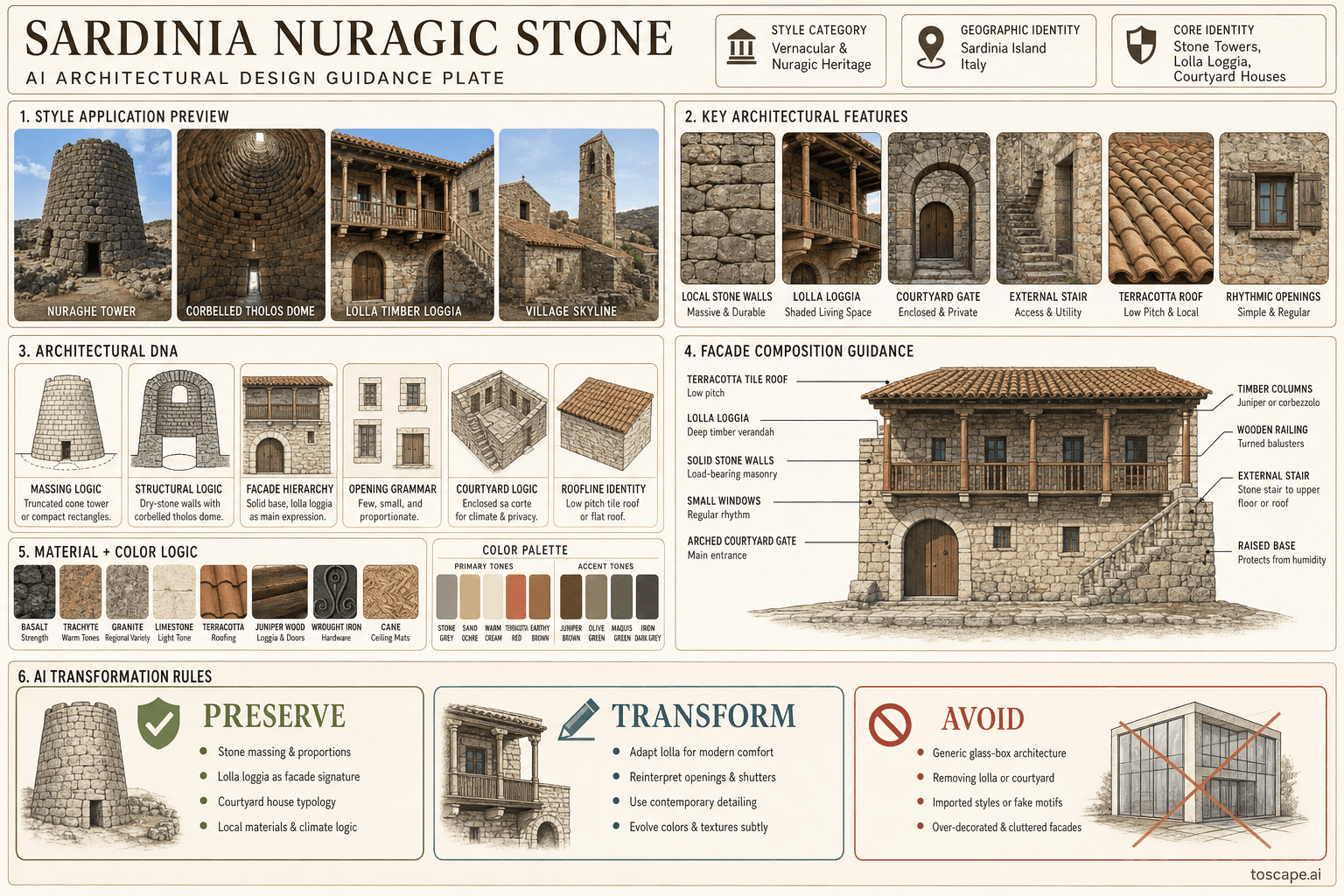
Sardinia Nuragic Stone
Italy · Sardinian vernacular
Bronze Age Nuraghi Towers, Corbezzolo Timber Shepherds' Huts & Mediterranean Island Stone
Definition
Sardinia Nuragic Stone is a regional architectural identity from Italy. Bronze Age Nuraghi Towers, Corbezzolo Timber Shepherds' Huts & Mediterranean Island Stone.
- Country
- Italy
- Region
- Sardinian vernacular
- Massing
- Nuraghi: truncated cone tower, circular plan, dry-stone corbelled interior dome (tholos), 2-3 stories internally, single entrance. Multi-tower complexes (Su Nuraxi): central mast tower with surrounding bastions.
- Materials
- Local stone (basalt — dark, trachyte — ochre/grey, granite — pink-grey, limestone — white-cream) — walls, nuraghi.
- Palette
- White, cream, pale sand, warm timber, and shadow-driven dark metal accents define the palette.
- Climate response
- Mediterranean island: hot dry summers, mild winters, strong mistral winds. Thick stone walls for thermal mass and wind protection.
Overview
Sardinia Nuragic Stone is a regional architectural identity in Italy. Sardinian vernacular — Nuragic Bronze Age stone towers and traditional shepherd architecture. Nuraghi: truncated-cone dry-stone towers with corbelled tholos interiors (1500-500 BCE).
Visual DNA
Massing & Form
Nuraghi: truncated cone tower, circular plan, dry-stone corbelled interior dome (tholos), 2-3 stories internally, single entrance. Multi-tower complexes (Su Nuraxi): central mast tower with surrounding bastions.
Facade Language
Nuragic tower: massive tapered basalt wall, minimal openings, single low entrance. Vernacular house: stone walls with rhythmic windows, projecting timber balcony loggia (sa lolla) — the primary facade element, supported on stone corbels.
Materials & Texture
Local stone (basalt — dark, trachyte — ochre/grey, granite — pink-grey, limestone — white-cream) — walls, nuraghi. Juniper (ginepro) and corbezzolo (strawberry tree) timber — loggia columns, beams, doors — dense, durable local hardwoods.
Color Palette
White, cream, pale sand, warm timber, and shadow-driven dark metal accents define the palette. The facade should stay bright and climate-aware rather than heavy, gray, or over-saturated.
Ornament & Detail
Nuragic: minimal ornament — the megalithic stone construction IS the expression. Vernacular: carved stone corbels supporting loggia, timber turnery on loggia columns, wrought iron balcony railing.
Climate Response
Mediterranean island: hot dry summers, mild winters, strong mistral winds. Thick stone walls for thermal mass and wind protection.
Landscape & Ground
Sardinian vernacular — Nuragic Bronze Age stone towers and traditional shepherd architecture. Mediterranean island: hot dry summers, mild winters, strong mistral winds.
Reference elevation
Sardinia Nuragic Stone — characteristic facade composition, Sardinian vernacular.
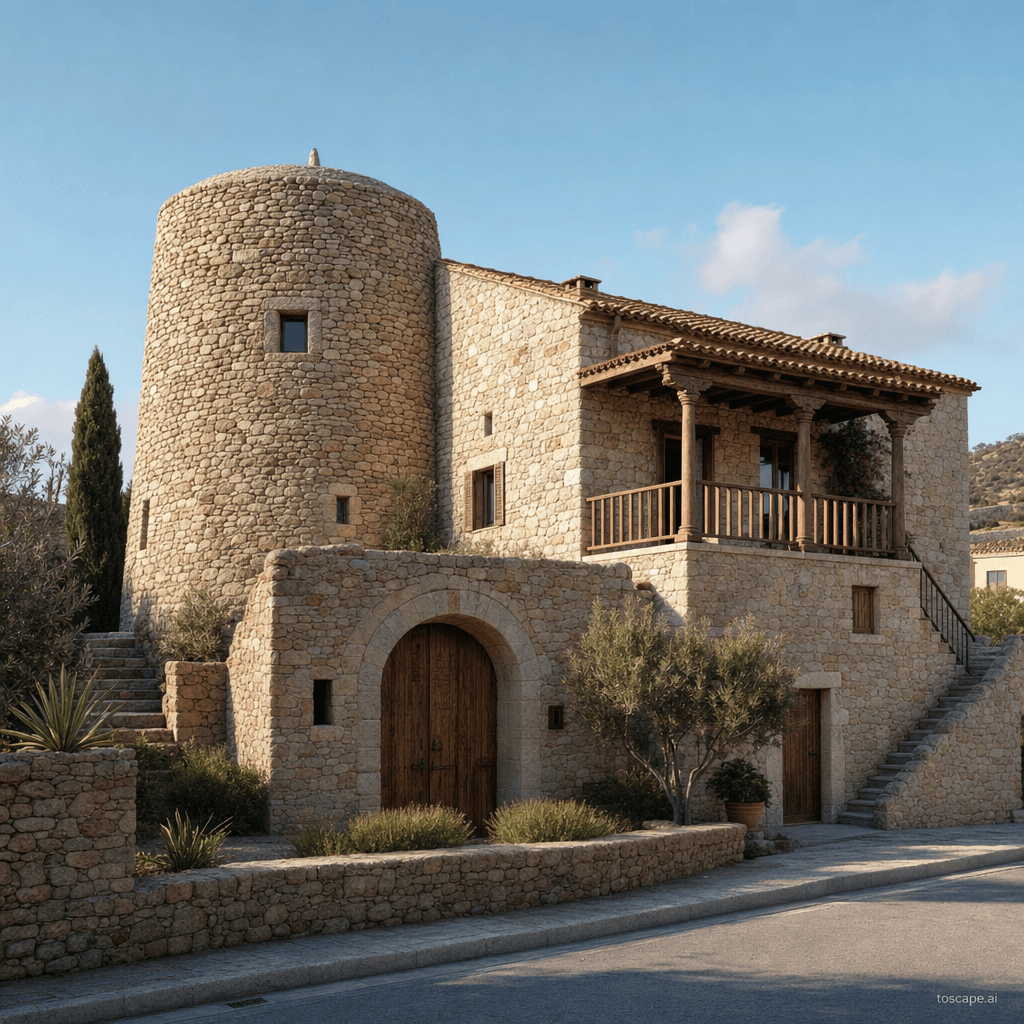
Context Snapshot
Sardinian vernacular — Nuragic Bronze Age stone towers and traditional shepherd architecture Mediterranean island: hot dry summers, mild winters, strong mistral winds.
Contemporary Relevance
Sardinia Nuragic Stone is useful today for residential, hospitality, civic, and place-branding work that needs Italy-specific character grounded in local massing, material tone, climate response, and settlement logic rather than generic international styling.
Use this style in Toscape
Explore Sardinia Nuragic Stone directly inside Toscape using the Facade Re-Style and Design Options workflows.
Open Sardinia Nuragic Stone in the galleryFrequently asked questions
What is Sardinia Nuragic Stone?
Sardinia Nuragic Stone is a regional architectural identity from Italy. Bronze Age Nuraghi Towers, Corbezzolo Timber Shepherds' Huts & Mediterranean Island Stone.
What materials define Sardinia Nuragic Stone?
Local stone (basalt — dark, trachyte — ochre/grey, granite — pink-grey, limestone — white-cream) — walls, nuraghi. Juniper (ginepro) and corbezzolo (strawberry tree) timber — loggia columns, beams, doors — dense, durable local hardwoods.
What is the Sardinia Nuragic Stone color palette?
White, cream, pale sand, warm timber, and shadow-driven dark metal accents define the palette. The facade should stay bright and climate-aware rather than heavy, gray, or over-saturated.
Where does Sardinia Nuragic Stone come from?
Sardinian vernacular — Nuragic Bronze Age stone towers and traditional shepherd architecture Mediterranean island: hot dry summers, mild winters, strong mistral winds.
When should architects use Sardinia Nuragic Stone?
Sardinia Nuragic Stone is useful today for residential, hospitality, civic, and place-branding work that needs Italy-specific character grounded in local massing, material tone, climate response, and settlement logic rather than generic international styling.
How do you render Sardinia Nuragic Stone in Toscape?
Open Toscape on Windows, load your own photo, elevation, sketch, or CAD view, then apply the Sardinia Nuragic Stone reference from the built-in style library. The Facade Re-Style and Design Options workflows keep your project geometry and camera while shifting materials, proportion, and detailing toward Sardinia Nuragic Stone.