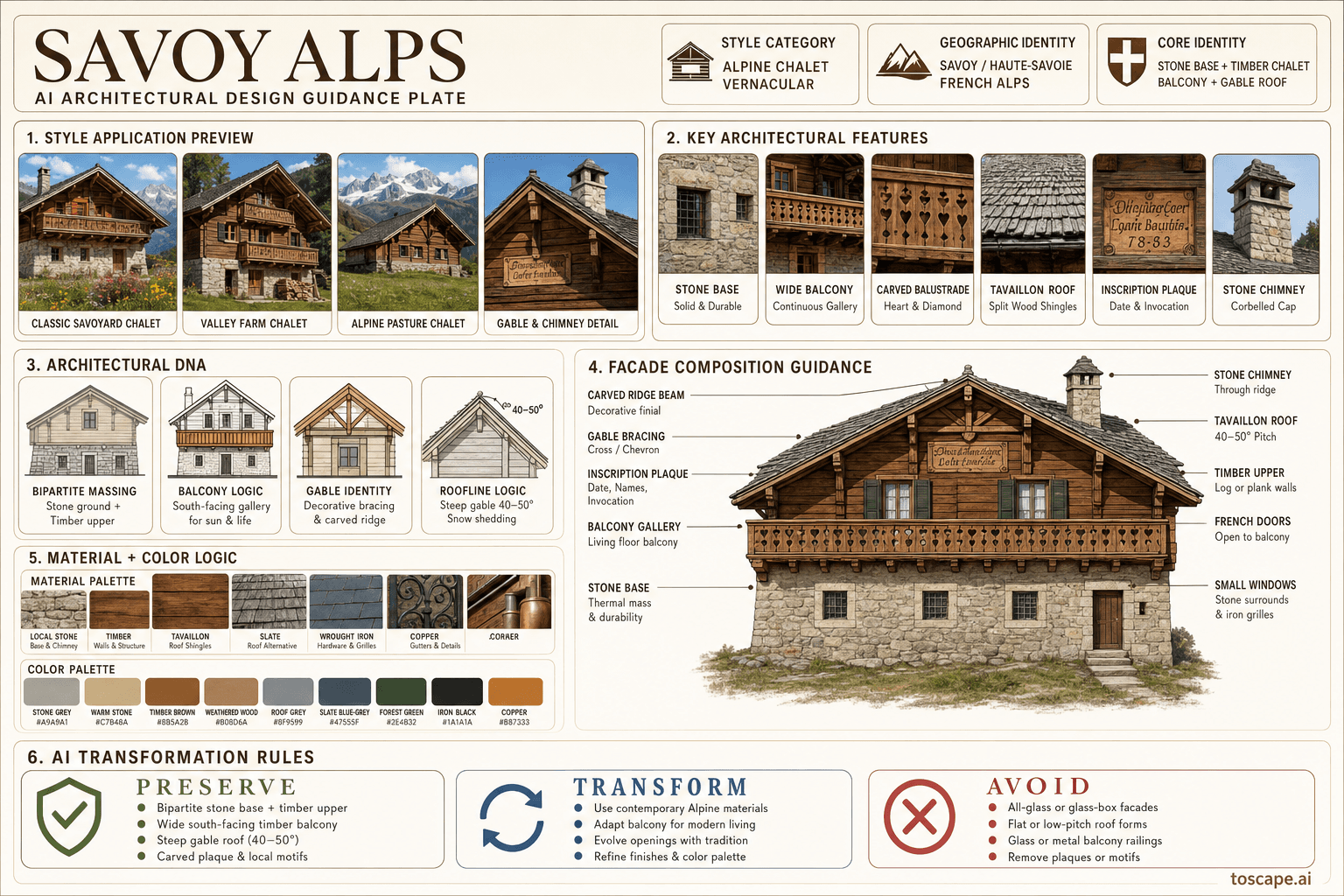
Savoy Alps
France · Savoy region / Savoie and Haute-Savoie
Savoyard Chalet, Stone-Base Timber & Alpine Snow-Country Vernacular
Definition
Savoy Alps is a regional architectural identity from France. Savoyard Chalet, Stone-Base Timber & Alpine Snow-Country Vernacular.
- Country
- France
- Region
- Savoy region / Savoie and Haute-Savoie.
- Massing
- Rectangular plan oriented perpendicular to slope contour for drainage and sun. 2-3 stories: stone ground floor (cave/étable — cellar/stable), timber living floor above, attic/loft under roof.
- Materials
- Pierre du pays (local stone): grey limestone, brown schist, or moraine boulders — ground floor, chimney, foundation.
- Palette
- Warm earth, sandy beige, ochre, clay brown, and sun-softened mineral tones should dominate, with palm green or weathered timber as secondary accents.
- Climate response
- Alpine continental: long cold snowy winters, short warm summers, high UV at altitude, significant thermal variation.
Overview
Savoy Alps is a regional architectural identity in France. Savoy region / Savoie and Haute-Savoie — Alpine chalet (chalet savoyard) architecture. Solid stone ground floor (solin en pierre) with timber log or plank upper floor (madrier/blockbau), wide projecting timber balconies (balcon/galerie) with carved or sawn balustrades, broad gable roof (toit à deux pans) at medium-steep pitch (40-50°) in slate (ardoise) or wooden shingles (tavaillons/ancelles), timber gable with deco...
Visual DNA
Massing & Form
Rectangular plan oriented perpendicular to slope contour for drainage and sun. 2-3 stories: stone ground floor (cave/étable — cellar/stable), timber living floor above, attic/loft under roof.
Facade Language
Clear bipartite division: stone base (50% height) — massive, solid, small window openings; timber upper (50%) — warm brown log or plank walls with projecting balcony. Balcony (galerie/balcon): continuous at living floor level, with carved or sawn timber balustrade (garde-corps en bois découpé) — repeating geometric or...
Materials & Texture
Pierre du pays (local stone): grey limestone, brown schist, or moraine boulders — ground floor, chimney, foundation. Épicéa/mélèze (spruce/larch): the primary Alpine timber — upper walls (madriers), balcony structure, roof shingles (tavaillons en épicéa fendu — split spruce), structural members.
Color Palette
Warm earth, sandy beige, ochre, clay brown, and sun-softened mineral tones should dominate, with palm green or weathered timber as secondary accents. The palette should read as land-derived rather than polished or urban-generic.
Ornament & Detail
Carved timber plaques (planches gravées): mounted on facade or balcony rail, bearing date of construction, names of owner and spouse, religious invocation ("Dieu protège cette maison" — God protect this house), Sacred Heart, cross, or chalice motifs — the primary identity and dating marker. Balcony balustrade: sawn or...
Climate Response
Alpine continental: long cold snowy winters, short warm summers, high UV at altitude, significant thermal variation. Stone ground floor: thermal mass for stable and storage, snow-contact resistant, fireproof for hearth.
Landscape & Ground
Savoy region / Savoie and Haute-Savoie — Alpine chalet (chalet savoyard) architecture. Alpine continental: long cold snowy winters, short warm summers, high UV at altitude, significant thermal variation.
Reference elevation
Savoy Alps — characteristic facade composition, Savoy region / Savoie and Haute-Savoie.
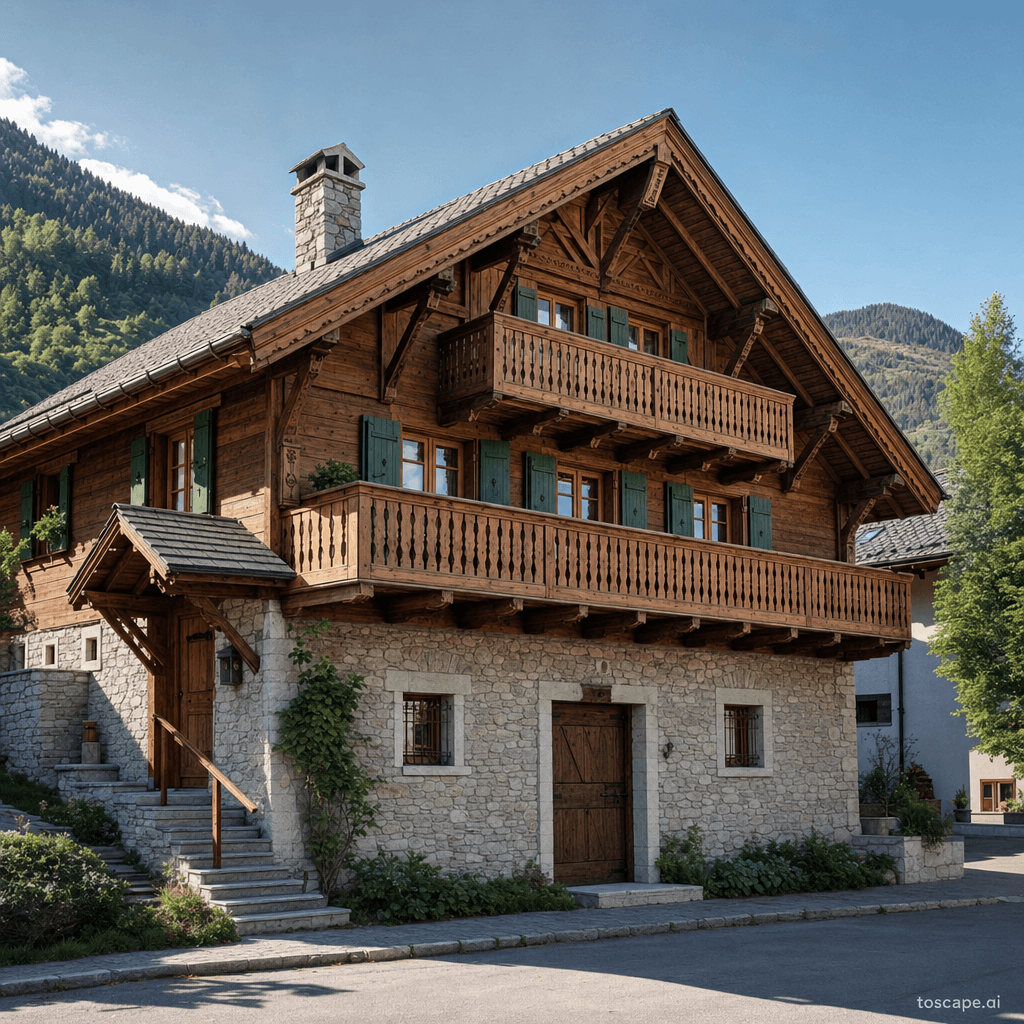
Context Snapshot
Savoy region / Savoie and Haute-Savoie — Alpine chalet (chalet savoyard) architecture Alpine continental: long cold snowy winters, short warm summers, high UV at altitude, significant thermal variation.
Contemporary Relevance
Savoy Alps is useful today for residential, hospitality, civic, and place-branding work that needs France-specific character grounded in local massing, material tone, climate response, and settlement logic rather than generic international styling.
Use this style in Toscape
Explore Savoy Alps directly inside Toscape using the Facade Re-Style and Design Options workflows.
Open Savoy Alps in the galleryFrequently asked questions
What is Savoy Alps?
Savoy Alps is a regional architectural identity from France. Savoyard Chalet, Stone-Base Timber & Alpine Snow-Country Vernacular.
What materials define Savoy Alps?
Pierre du pays (local stone): grey limestone, brown schist, or moraine boulders — ground floor, chimney, foundation. Épicéa/mélèze (spruce/larch): the primary Alpine timber — upper walls (madriers), balcony structure, roof shingles (tavaillons en épicéa fendu — split spruce), structural members.
What is the Savoy Alps color palette?
Warm earth, sandy beige, ochre, clay brown, and sun-softened mineral tones should dominate, with palm green or weathered timber as secondary accents. The palette should read as land-derived rather than polished or urban-generic.
Where does Savoy Alps come from?
Savoy region / Savoie and Haute-Savoie — Alpine chalet (chalet savoyard) architecture Alpine continental: long cold snowy winters, short warm summers, high UV at altitude, significant thermal variation.
When should architects use Savoy Alps?
Savoy Alps is useful today for residential, hospitality, civic, and place-branding work that needs France-specific character grounded in local massing, material tone, climate response, and settlement logic rather than generic international styling.
How do you render Savoy Alps in Toscape?
Open Toscape on Windows, load your own photo, elevation, sketch, or CAD view, then apply the Savoy Alps reference from the built-in style library. The Facade Re-Style and Design Options workflows keep your project geometry and camera while shifting materials, proportion, and detailing toward Savoy Alps.