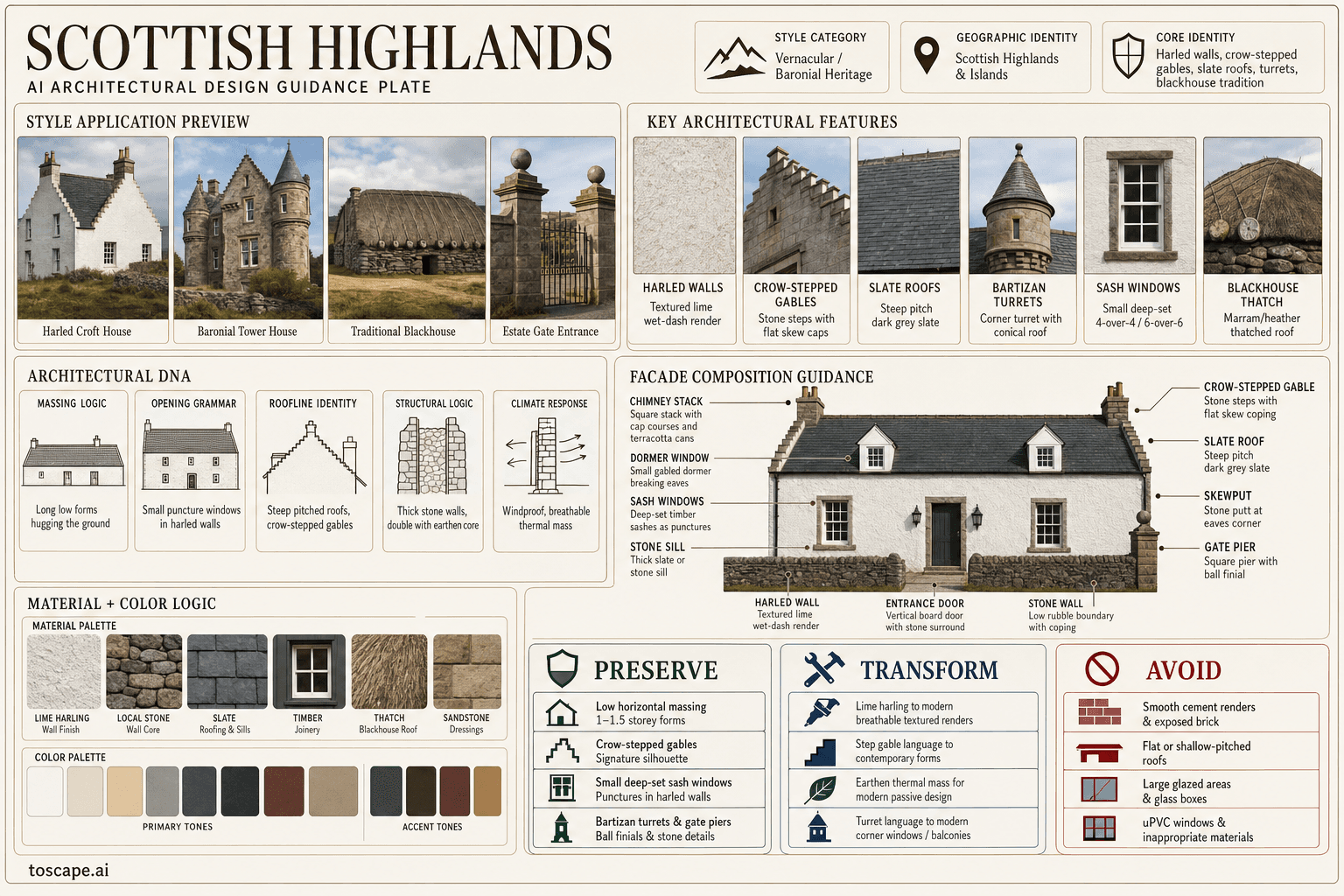
Scottish Highlands
United Kingdom · Scottish Highlands & Islands
Highland Vernacular — Harled Rubble, Crow-Stepped Gables & Blackhouse Tradition
Definition
Scottish Highlands is a regional architectural identity from United Kingdom. Highland Vernacular — Harled Rubble, Crow-Stepped Gables & Blackhouse Tradition.
- Country
- United Kingdom
- Region
- Scottish Highlands & Islands.
- Massing
- Low horizontal massing — the Highland building tradition is strongly horizontal, with buildings stretching long and low rather than rising vertically.
- Materials
- Local Highland stone: Lewisian gneiss (grey-pink-banded, extremely ancient — 3 billion years), Torridonian sandstone (dark red-brown, purple-grey), Caithness flagstone (dark grey, thinly bedded, easily split).
- Palette
- White, cream, pale sand, warm timber, and shadow-driven dark metal accents define the palette.
- Climate response
- North Atlantic maritime/montane — cool summers, mild but very wet winters, extreme wind exposure (gales common year-round), high rainfall (1500-3000mm).
Overview
Scottish Highlands is a regional architectural identity in United Kingdom. Scottish Highlands & Islands — vernacular croft houses, blackhouses, tower houses, and baronial revival architecture. Harled (wet-dash lime render over random rubble stone) walls in white, cream, or ochre colour-wash — the dominant Highland wall treatment unifying disparate stone types beneath a protective textured skin, steep pitched dark grey Ballachulish or Caithness slate roofs (or heather thatch on blackhouses)...
Visual DNA
Massing & Form
Low horizontal massing — the Highland building tradition is strongly horizontal, with buildings stretching long and low rather than rising vertically. Blackhouses and croft houses: long narrow rectangles (byre-dwelling unit), typically one-room depth (5-6 metres), with humans at one end and animals at the other under a...
Facade Language
The harled Highland facade is unified and restrained: the continuous textured render in cream or white creates a monolithic surface, with small window punctures arranged irregularly. Symmetry is not a priority — windows are placed where needed, often close to corners.
Materials & Texture
Local Highland stone: Lewisian gneiss (grey-pink-banded, extremely ancient — 3 billion years), Torridonian sandstone (dark red-brown, purple-grey), Caithness flagstone (dark grey, thinly bedded, easily split), Moine schist (silvery-grey), granite (Aberdeen and Ross of Mull — pale grey to pink). Lime harling: the quinte...
Color Palette
White, cream, pale sand, warm timber, and shadow-driven dark metal accents define the palette. The facade should stay bright and climate-aware rather than heavy, gray, or over-saturated.
Ornament & Detail
Highland ornament is tectonic, baronial, or Celtic in inspiration: crow-stepped gables — the rhythmic stone steps are both functional (access to roof for maintenance) and ornamental, conically-roofed bartizan turrets with stone-slab conical roof and ball finial — the Scottish baronial turret, carved stone armorial pane...
Climate Response
North Atlantic maritime/montane — cool summers, mild but very wet winters, extreme wind exposure (gales common year-round), high rainfall (1500-3000mm). Low massing: buildings hug the ground to reduce wind load and heat loss.
Landscape & Ground
Scottish Highlands & Islands — vernacular croft houses, blackhouses, tower houses, and baronial revival architecture. North Atlantic maritime/montane — cool summers, mild but very wet winters, extreme wind exposure (gales common year-round), high rainfall (1500-3000mm).
Reference elevation
Scottish Highlands — characteristic facade composition, Scottish Highlands & Islands.
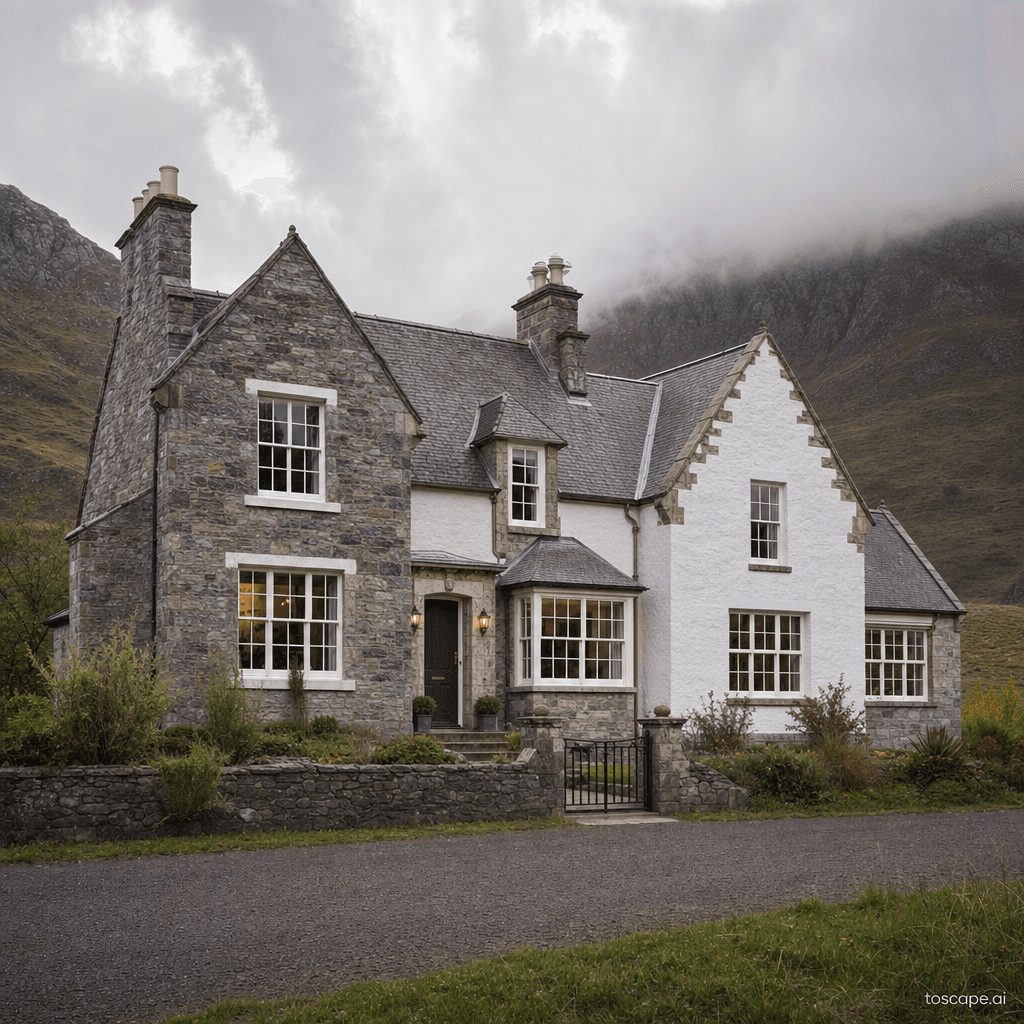
Context Snapshot
Scottish Highlands & Islands — vernacular croft houses, blackhouses, tower houses, and baronial revival architecture North Atlantic maritime/montane — cool summers, mild but very wet winters, extreme wind exposure (gales common year-round), high rainfall (1500-3000mm).
Contemporary Relevance
Scottish Highlands is useful today for residential, hospitality, civic, and place-branding work that needs United Kingdom-specific character grounded in local massing, material tone, climate response, and settlement logic rather than generic international styling.
Use this style in Toscape
Explore Scottish Highlands directly inside Toscape using the Facade Re-Style and Design Options workflows.
Open Scottish Highlands in the galleryFrequently asked questions
What is Scottish Highlands?
Scottish Highlands is a regional architectural identity from United Kingdom. Highland Vernacular — Harled Rubble, Crow-Stepped Gables & Blackhouse Tradition.
What materials define Scottish Highlands?
Local Highland stone: Lewisian gneiss (grey-pink-banded, extremely ancient — 3 billion years), Torridonian sandstone (dark red-brown, purple-grey), Caithness flagstone (dark grey, thinly bedded, easily split), Moine schist (silvery-grey), granite (Aberdeen and Ross of Mull — pale grey to pink). Lime harling: the quinte.
What is the Scottish Highlands color palette?
White, cream, pale sand, warm timber, and shadow-driven dark metal accents define the palette. The facade should stay bright and climate-aware rather than heavy, gray, or over-saturated.
Where does Scottish Highlands come from?
Scottish Highlands & Islands — vernacular croft houses, blackhouses, tower houses, and baronial revival architecture North Atlantic maritime/montane — cool summers, mild but very wet winters, extreme wind exposure (gales common year-round), high rainfall (1500-3000mm).
When should architects use Scottish Highlands?
Scottish Highlands is useful today for residential, hospitality, civic, and place-branding work that needs United Kingdom-specific character grounded in local massing, material tone, climate response, and settlement logic rather than generic international styling.
How do you render Scottish Highlands in Toscape?
Open Toscape on Windows, load your own photo, elevation, sketch, or CAD view, then apply the Scottish Highlands reference from the built-in style library. The Facade Re-Style and Design Options workflows keep your project geometry and camera while shifting materials, proportion, and detailing toward Scottish Highlands.