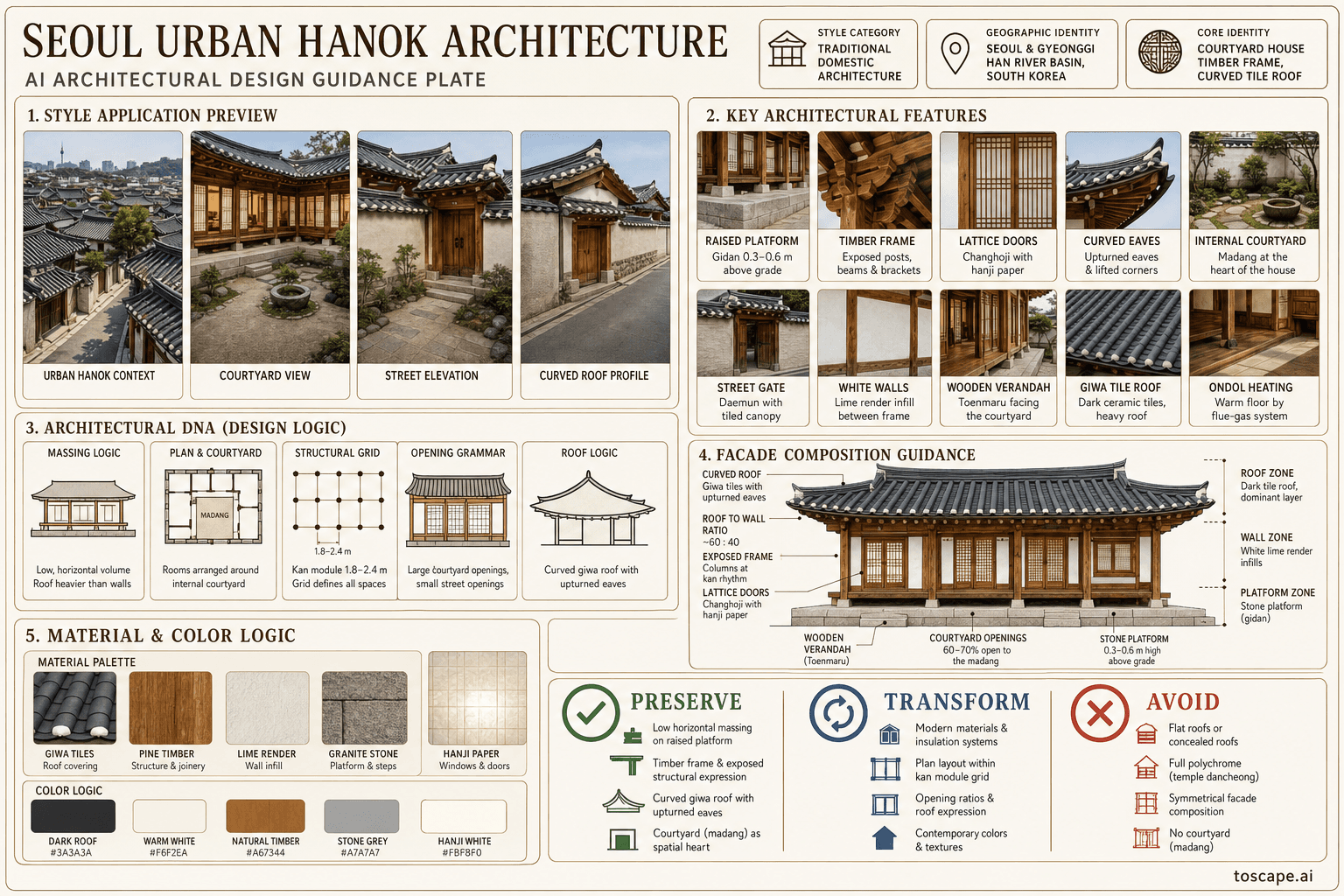
Seoul Urban Hanok
South Korea · hanok domestic architecture of Seoul and the Gyeonggi central region
The traditional Korean courtyard house of the central capital region, Joseon dynasty to present
Definition
Seoul Urban Hanok is a regional architectural identity from South Korea. The traditional Korean courtyard house of the central capital region, Joseon dynasty to present.
- Country
- South Korea
- Region
- hanok domestic architecture of Seoul and the Gyeonggi central region.
- Massing
- The Seoul urban hanok is a single-storey, single-building-width timber structure organized on a modular grid system (kan).
- Materials
- All traditional hanok materials are locally sourced, climate-responsive, and expressed honestly — the material IS the finish.
- Palette
- White, cream, pale sand, warm timber, and shadow-driven dark metal accents define the palette.
- Climate response
- The Seoul climate presents extreme seasonal contrasts: summer is hot and humid (monsoon July–August, temperatures 25–35°C, humidity 70–90%); winter is cold and dry (December–February.
Overview
Seoul Urban Hanok is a regional architectural identity in South Korea. Urban hanok domestic architecture of Seoul and the Gyeonggi central region — the compact courtyard house typology adapted for dense city living, maintained through the Act on Value Enhancement of Hanok (2014–present). Timber post-and-beam structural frame (gigong) on a raised stone platform (gidan) — curved giwa ceramic tile roof with pronounced upward-sweeping eaves (cheoma) — exposed wooden structural members stain...
Visual DNA
Massing & Form
The Seoul urban hanok is a single-storey, single-building-width timber structure organized on a modular grid system (kan). The kan module — defined as the bay spacing between two structural columns — ranges from approximately 1.8 m to 2.4 m wide, and the total building footprint is typically organized as a 3-kan × 2-ka...
Facade Language
The hanok facade is governed by structural rhythm — the column spacing (kan module) determines all facade composition. The facade reads as a regular colonnade of exposed timber columns with infill panels between them.
Materials & Texture
All traditional hanok materials are locally sourced, climate-responsive, and expressed honestly — the material IS the finish. No concealment, no applied surface treatments beyond protective oils or lime render.
Color Palette
White, cream, pale sand, warm timber, and shadow-driven dark metal accents define the palette. The facade should stay bright and climate-aware rather than heavy, gray, or over-saturated.
Ornament & Detail
Hanok ornament is tectonic, not applied — structure IS ornament. The decorative expression arises from the refinement of structural joinery and the aesthetic quality of natural materials.
Climate Response
The Seoul climate presents extreme seasonal contrasts: summer is hot and humid (monsoon July–August, temperatures 25–35°C, humidity 70–90%); winter is cold and dry (December–February, temperatures −15 to 5°C, low humidity, prevailing northwesterly winds from Siberia) . The hanok responds to this challenging climate thr...
Landscape & Ground
Urban hanok domestic architecture of Seoul and the Gyeonggi central region — the compact courtyard house typology adapted for dense city living, maintained through the Act on Value Enhancement of Hanok (2014–present). The Seoul climate presents extreme seasonal contrasts: summer is hot and humid (monsoon July–August, t...
Reference elevation
Seoul Urban Hanok — characteristic facade composition, hanok domestic architecture of Seoul and the Gyeonggi central region.
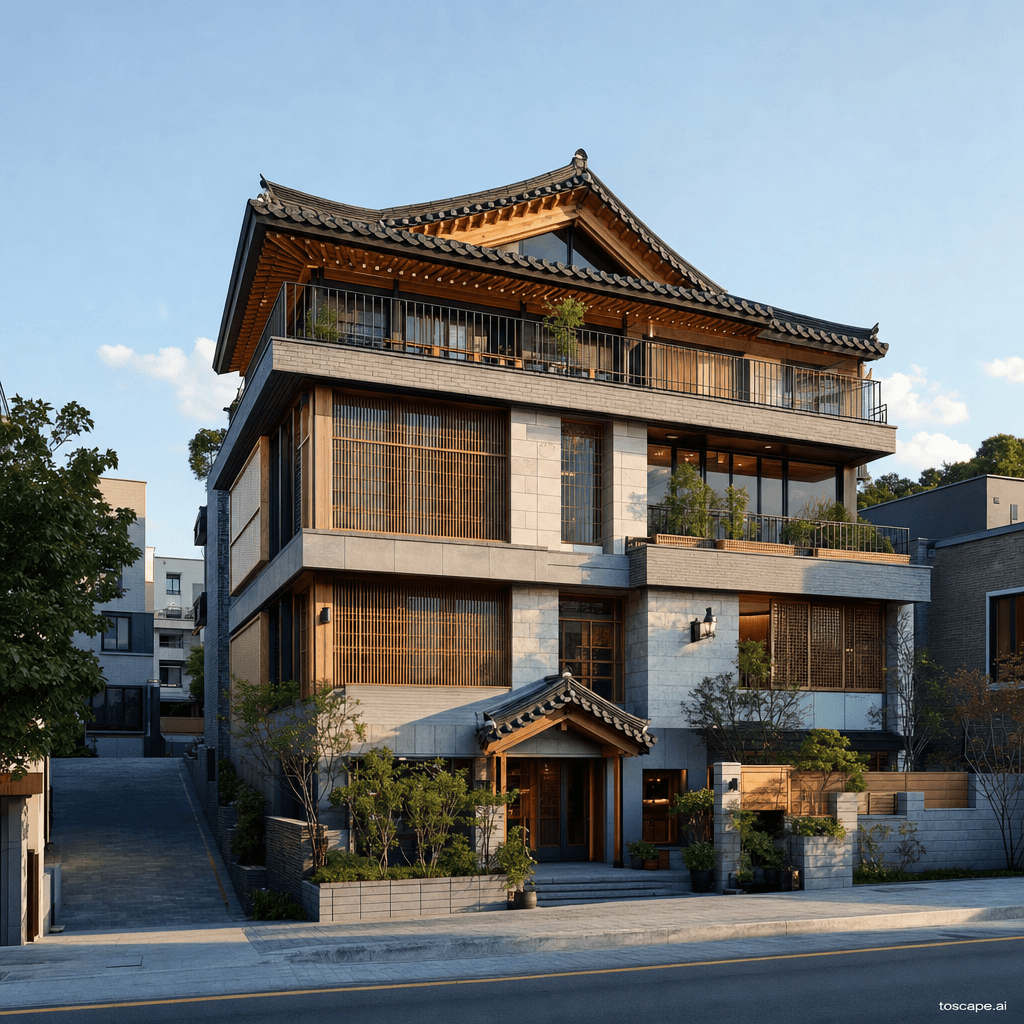
Context Snapshot
Urban hanok domestic architecture of Seoul and the Gyeonggi central region — the compact courtyard house typology adapted for dense city living, maintained through the Act on Value Enhancement of Hano... The Seoul climate presents extreme seasonal contrasts: summer is hot and humid (monsoon July–August, temperatures 25–35°C, humidity 70–90%); winter is cold and dry (December–February, temperatures −15 to 5°C, low humidit...
Contemporary Relevance
Seoul Urban Hanok is useful today for residential, hospitality, civic, and place-branding work that needs South Korea-specific character grounded in local massing, material tone, climate response, and settlement logic rather than generic international styling.
Use this style in Toscape
Explore Seoul Urban Hanok directly inside Toscape using the Facade Re-Style and Design Options workflows.
Open Seoul Urban Hanok in the galleryFrequently asked questions
What is Seoul Urban Hanok?
Seoul Urban Hanok is a regional architectural identity from South Korea. The traditional Korean courtyard house of the central capital region, Joseon dynasty to present.
What materials define Seoul Urban Hanok?
All traditional hanok materials are locally sourced, climate-responsive, and expressed honestly — the material IS the finish. No concealment, no applied surface treatments beyond protective oils or lime render.
What is the Seoul Urban Hanok color palette?
White, cream, pale sand, warm timber, and shadow-driven dark metal accents define the palette. The facade should stay bright and climate-aware rather than heavy, gray, or over-saturated.
Where does Seoul Urban Hanok come from?
Urban hanok domestic architecture of Seoul and the Gyeonggi central region — the compact courtyard house typology adapted for dense city living, maintained through the Act on Value Enhancement of Hano.
When should architects use Seoul Urban Hanok?
Seoul Urban Hanok is useful today for residential, hospitality, civic, and place-branding work that needs South Korea-specific character grounded in local massing, material tone, climate response, and settlement logic rather than generic international styling.
How do you render Seoul Urban Hanok in Toscape?
Open Toscape on Windows, load your own photo, elevation, sketch, or CAD view, then apply the Seoul Urban Hanok reference from the built-in style library. The Facade Re-Style and Design Options workflows keep your project geometry and camera while shifting materials, proportion, and detailing toward Seoul Urban Hanok.