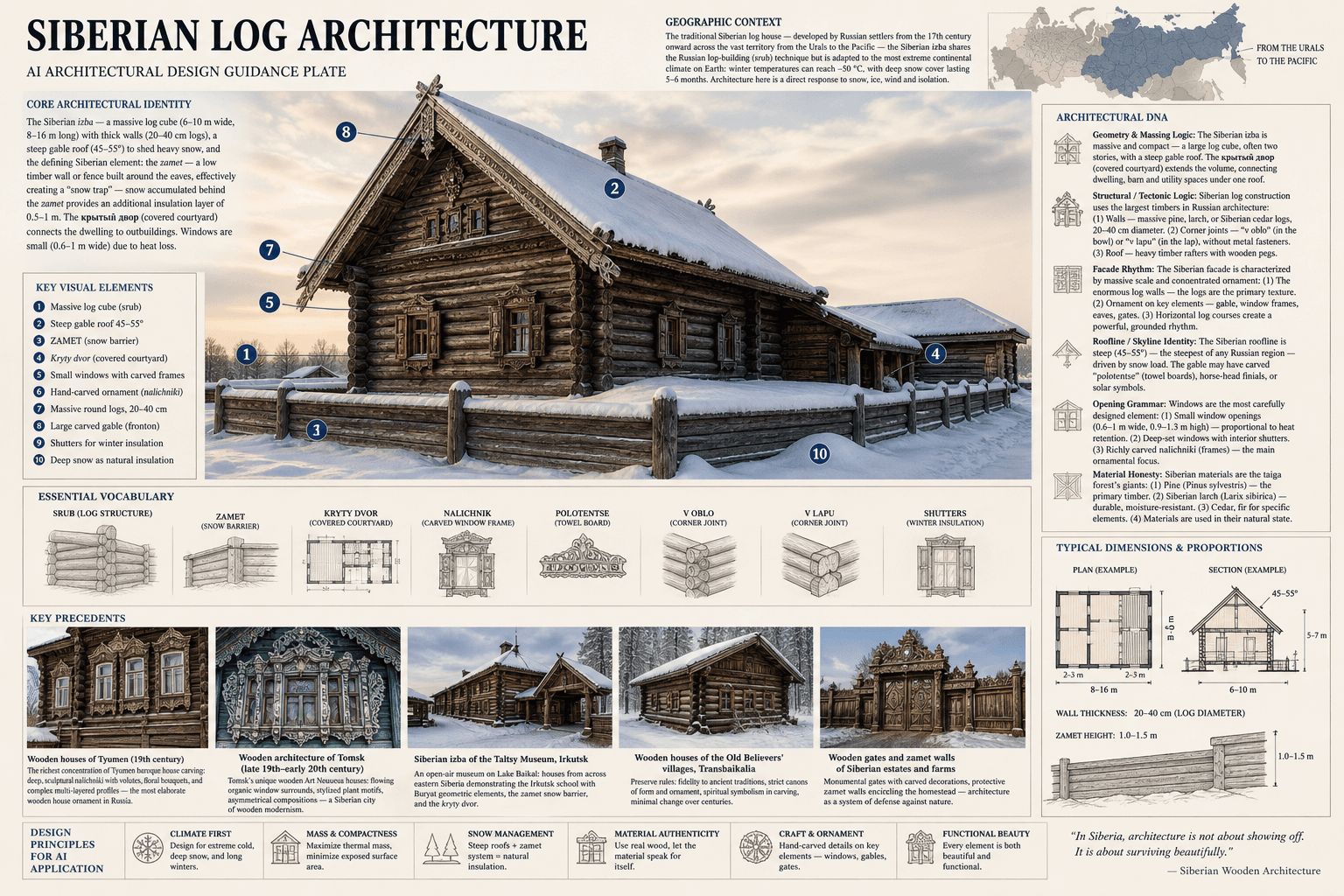
Siberian Log
Russia · traditional Siberian log house
The massive log houses of Siberia — built to survive temperatures of -50°C, the Siberian izba is the most robust expression of Russian log-building: enormous pine and larch logs, d...
Definition
Siberian Log is a regional architectural identity from Russia. The massive log houses of Siberia — built to survive temperatures of -50°C, the Siberian izba is the most robust expression of Russian log-building: enormous pine and larch logs, d.
- Country
- Russia
- Region
- traditional Siberian log house.
- Massing
- The Siberian izba is massive and compact — a large log cube, often two stories, with a steep gable roof.
- Materials
- Siberian materials are the taiga forest's giants: (1) Pine (Pinus sylvestris) — the primary timber.
- Palette
- White, cream, pale sand, warm timber, and shadow-driven dark metal accents define the palette.
- Climate response
- Siberia defines the extreme climate architecture: (1) Winter -40 to -55°C, snow depth 0.
Overview
Siberian Log is a regional architectural identity in Russia. The traditional Siberian log house — developed by Russian settlers from the 17th century onward across the vast territory from the Urals to the Pacific — the Siberian izba shares the Russian log-building (srub) technique but is adapted to the most extreme continental climate on Earth: winter temperatures to -50°C, permafrost, and deep snow — the Siberian house is characterized by massive log walls (20–40 cm diameter)...
Visual DNA
Massing & Form
The Siberian izba is massive and compact — a large log cube, often two stories, with a steep gable roof. The крытый двор extends the building into an L-shaped or U-shaped compound, covering 200–500 m².
Facade Language
The Siberian facade is characterized by massive scale and concentrated ornament: (1) The enormous log walls — the logs are thicker and the wall texture is more monumental than European Russian izba. (2) Tiny windows — proportionally smaller than central Russian houses, due to heat conservation — each window is a precio...
Materials & Texture
Siberian materials are the taiga forest's giants: (1) Pine (Pinus sylvestris) — the primary timber. (2) Siberian larch (Larix sibirica) — harder, more durable, more rot-resistant than pine — used for foundation logs and lower walls.
Color Palette
White, cream, pale sand, warm timber, and shadow-driven dark metal accents define the palette. The facade should stay bright and climate-aware rather than heavy, gray, or over-saturated.
Ornament & Detail
Siberian house carving developed into several distinct regional schools: (1) Tyumen baroque — the most elaborate: deep, multi-layered carving on nalichniki, with volutes, scrolls, floral bouquets, and complex silhouettes — three-dimensional and sculptural. (2) Tomsk Art Nouveau — influenced by the city's wooden archite...
Climate Response
Siberia defines the extreme climate architecture: (1) Winter -40 to -55°C, snow depth 0.5–2 m — the zamet traps insulating snow; the крытый двор allows movement without exposure; the double windows minimize heat loss. (2) Permafrost — in the far north and east, houses are built on piles with ventilated under-floor spac...
Landscape & Ground
The traditional Siberian log house — developed by Russian settlers from the 17th century onward across the vast territory from the Urals to the Pacific — the Siberian izba shares the Russian log-building (srub) technique but is adapted to the most extreme continental climate on Earth: winter temperatures to -50°C, perm...
Reference elevation
Siberian Log — characteristic facade composition, traditional Siberian log house.
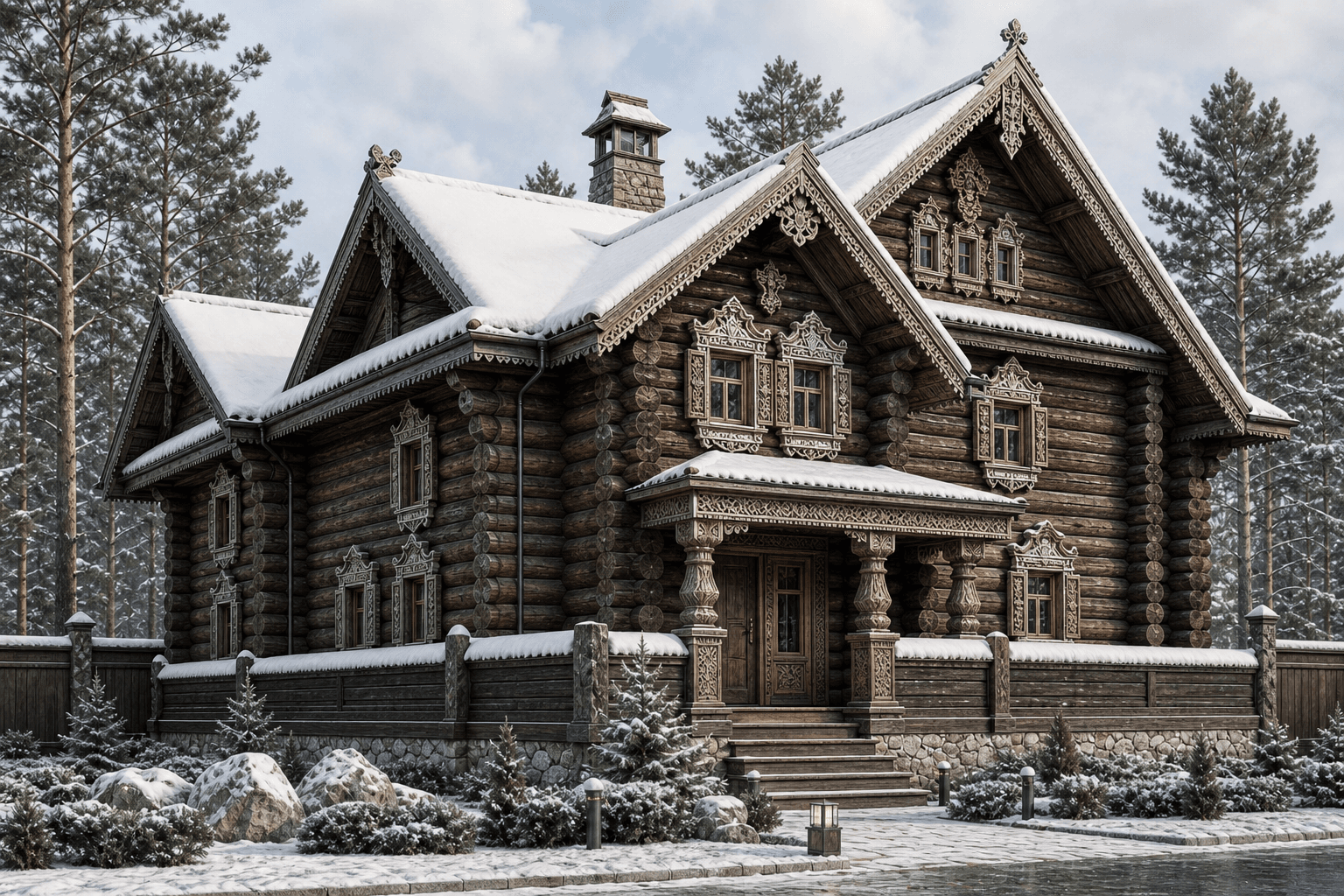
Context Snapshot
The traditional Siberian log house — developed by Russian settlers from the 17th century onward across the vast territory from the Urals to the Pacific — the Siberian izba shares the Russian log-build... Siberia defines the extreme climate architecture: (1) Winter -40 to -55°C, snow depth 0.5–2 m — the zamet traps insulating snow; the крытый двор allows movement without exposure; the double windows minimize heat loss.
Contemporary Relevance
Siberian Log is useful today for residential, hospitality, civic, and place-branding work that needs Russia-specific character grounded in local massing, material tone, climate response, and settlement logic rather than generic international styling.
Use this style in Toscape
Explore Siberian Log directly inside Toscape using the Facade Re-Style and Design Options workflows.
Open Siberian Log in the galleryFrequently asked questions
What is Siberian Log?
Siberian Log is a regional architectural identity from Russia. The massive log houses of Siberia — built to survive temperatures of -50°C, the Siberian izba is the most robust expression of Russian log-building: enormous pine and larch logs, d.
What materials define Siberian Log?
Siberian materials are the taiga forest's giants: (1) Pine (Pinus sylvestris) — the primary timber. (2) Siberian larch (Larix sibirica) — harder, more durable, more rot-resistant than pine — used for foundation logs and lower walls.
What is the Siberian Log color palette?
White, cream, pale sand, warm timber, and shadow-driven dark metal accents define the palette. The facade should stay bright and climate-aware rather than heavy, gray, or over-saturated.
Where does Siberian Log come from?
The traditional Siberian log house — developed by Russian settlers from the 17th century onward across the vast territory from the Urals to the Pacific — the Siberian izba shares the Russian log-build... Siberia defines the extreme climate architecture: (1) Winter -40 to -55°C, snow depth 0.
When should architects use Siberian Log?
Siberian Log is useful today for residential, hospitality, civic, and place-branding work that needs Russia-specific character grounded in local massing, material tone, climate response, and settlement logic rather than generic international styling.
How do you render Siberian Log in Toscape?
Open Toscape on Windows, load your own photo, elevation, sketch, or CAD view, then apply the Siberian Log reference from the built-in style library. The Facade Re-Style and Design Options workflows keep your project geometry and camera while shifting materials, proportion, and detailing toward Siberian Log.