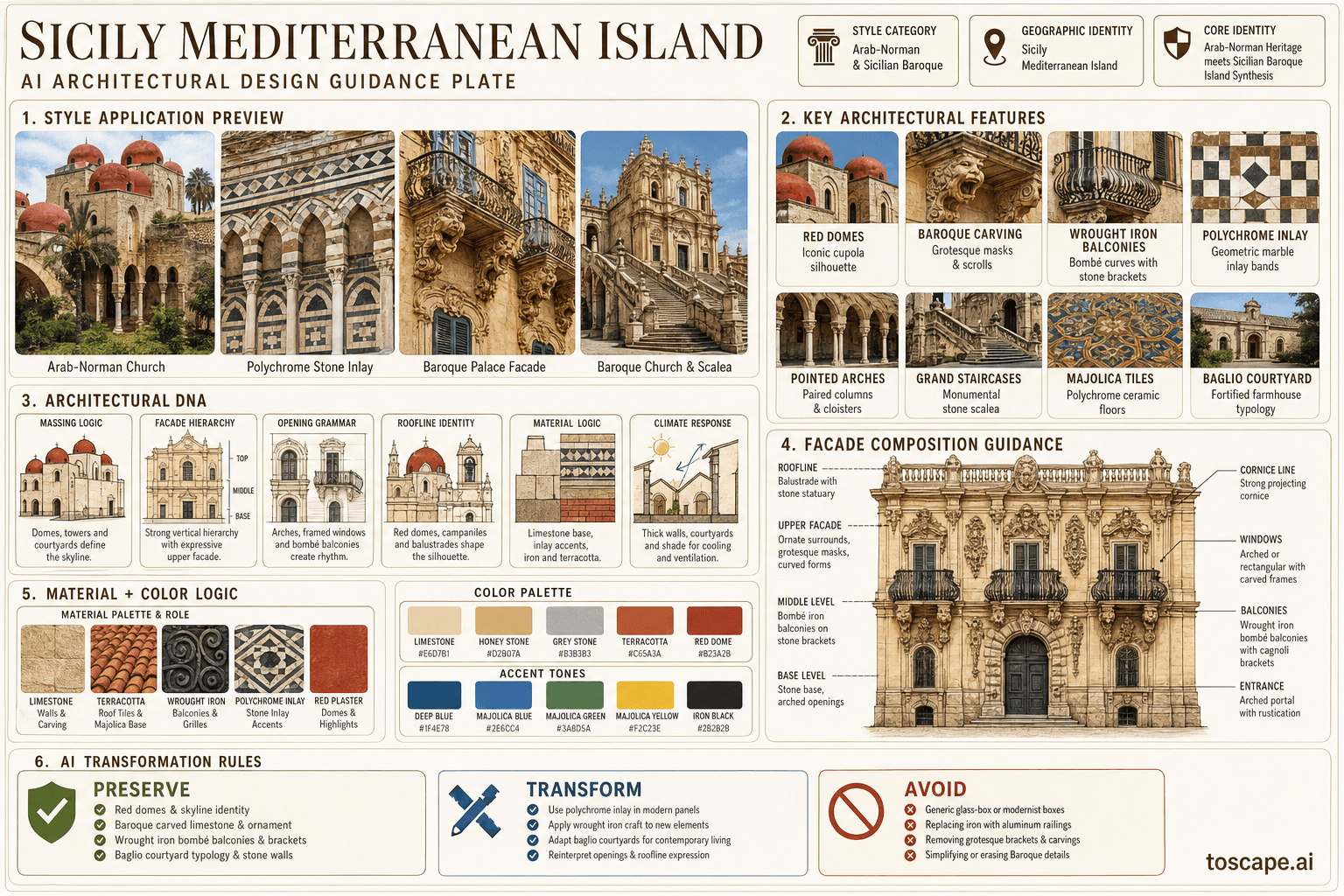
Sicily Mediterranean Island
Italy · Sicilian architectural identity
Arabic-Norman Syncretic, Baroque Stone Balconies & Mediterranean Island Synthesis
Definition
Sicily Mediterranean Island is a regional architectural identity from Italy. Arabic-Norman Syncretic, Baroque Stone Balconies & Mediterranean Island Synthesis.
- Country
- Italy
- Region
- Sicilian architectural identity
- Massing
- Arabic-Norman: Central domed churches with red hemispherical cupolas (San Giovanni degli Eremiti, Palermo Cathedral), cloister courtyards with paired columns, Palatine Chapel.
- Materials
- Local limestone (tufo calcareo — golden-cream, Comiso limestone — warm honey, Ragusa stone — grey-white) — walls and carving. Volcanic basalt (Etna stone) — paving, contrast.
- Palette
- White, cream, pale sand, warm timber, and shadow-driven dark metal accents define the palette.
- Climate response
- Mediterranean island: hot dry summers, mild winters, sirocco wind from Africa. Thick limestone walls for thermal mass.
Overview
Sicily Mediterranean Island is a regional architectural identity in Italy. Sicilian architectural identity — the layered synthesis of Greek, Arabic, Norman, Baroque, and Spanish influences on a Mediterranean island crossroads. Arabic-Norman Palermo (UNESCO): polychrome stone inlay (intarsio marmoreo), red domes, pointed arches, geometric ornament.
Visual DNA
Massing & Form
Arabic-Norman: Central domed churches with red hemispherical cupolas (San Giovanni degli Eremiti, Palermo Cathedral), cloister courtyards with paired columns, Palatine Chapel. Baroque: dynamic curved facades, convex/concave undulating walls, oval plans, grand external staircases (scalea), church domes dominating town s...
Facade Language
Arabic-Norman: polychrome stone geometric inlay bands, blind arcades, pointed arches, red dome silhouette. Baroque: dynamic facades — concave/convex curves, rhythmic pilasters, exuberantly carved window surrounds with grotesque masks and scrolls, wrought iron balconies with bombé (curved) railings filling the upper fac...
Materials & Texture
Local limestone (tufo calcareo — golden-cream, Comiso limestone — warm honey, Ragusa stone — grey-white) — walls and carving. Volcanic basalt (Etna stone) — paving, contrast.
Color Palette
White, cream, pale sand, warm timber, and shadow-driven dark metal accents define the palette. The facade should stay bright and climate-aware rather than heavy, gray, or over-saturated.
Ornament & Detail
Arabic-Norman: geometric polychrome stone inlay, arabesque and kufic-like decoration, wooden muqarnas ceilings (Palatine Chapel), mosaic (mosaico). Baroque: carved limestone explosion — grotesque masks (mascheroni), putti, floral swags, scroll brackets, twisted Solomonic columns.
Climate Response
Mediterranean island: hot dry summers, mild winters, sirocco wind from Africa. Thick limestone walls for thermal mass.
Landscape & Ground
Sicilian architectural identity — the layered synthesis of Greek, Arabic, Norman, Baroque, and Spanish influences on a Mediterranean island crossroads. Mediterranean island: hot dry summers, mild winters, sirocco wind from Africa.
Reference elevation
Sicily Mediterranean Island — characteristic facade composition, Sicilian architectural identity.
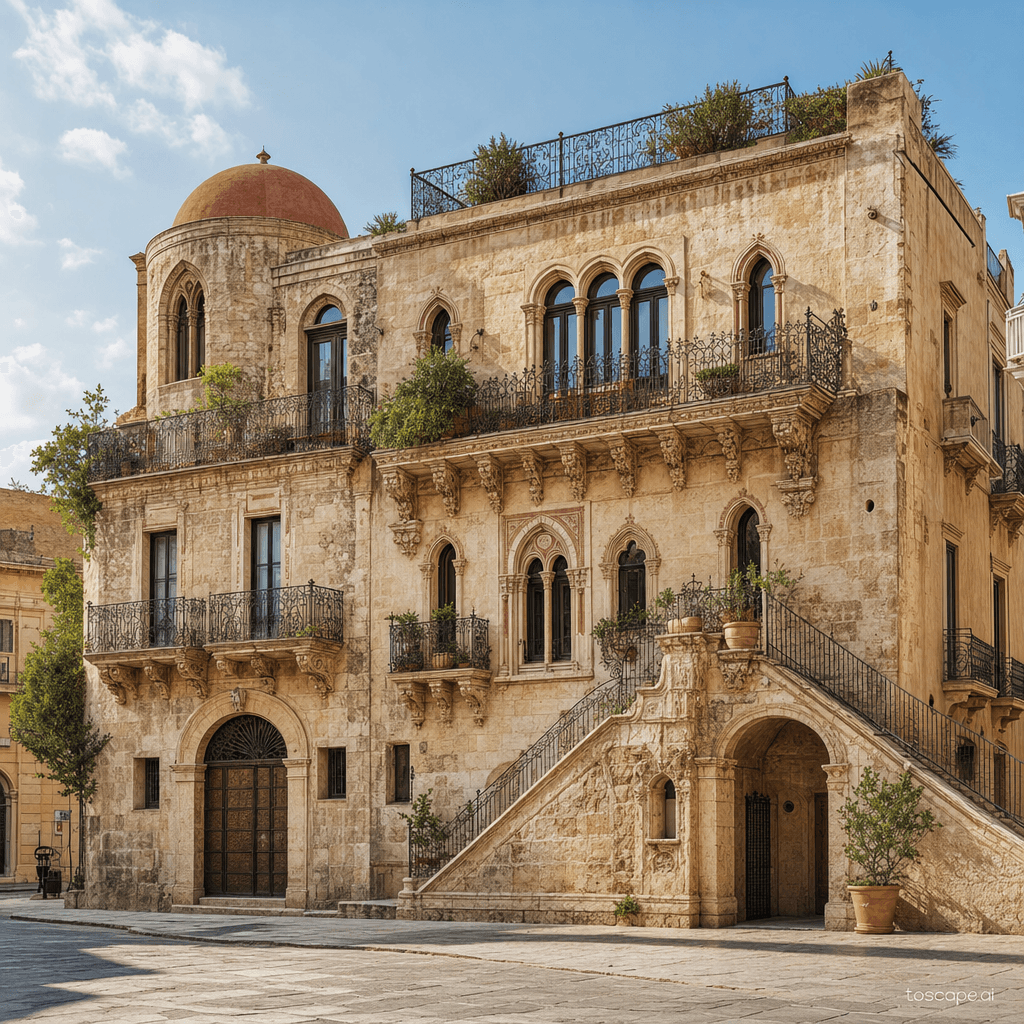
Context Snapshot
Sicilian architectural identity — the layered synthesis of Greek, Arabic, Norman, Baroque, and Spanish influences on a Mediterranean island crossroads Mediterranean island: hot dry summers, mild winters, sirocco wind from Africa.
Contemporary Relevance
Sicily Mediterranean Island is useful today for residential, hospitality, civic, and place-branding work that needs Italy-specific character grounded in local massing, material tone, climate response, and settlement logic rather than generic international styling.
Use this style in Toscape
Explore Sicily Mediterranean Island directly inside Toscape using the Facade Re-Style and Design Options workflows.
Open Sicily Mediterranean Island in the galleryFrequently asked questions
What is Sicily Mediterranean Island?
Sicily Mediterranean Island is a regional architectural identity from Italy. Arabic-Norman Syncretic, Baroque Stone Balconies & Mediterranean Island Synthesis.
What materials define Sicily Mediterranean Island?
Local limestone (tufo calcareo — golden-cream, Comiso limestone — warm honey, Ragusa stone — grey-white) — walls and carving. Volcanic basalt (Etna stone) — paving, contrast.
What is the Sicily Mediterranean Island color palette?
White, cream, pale sand, warm timber, and shadow-driven dark metal accents define the palette. The facade should stay bright and climate-aware rather than heavy, gray, or over-saturated.
Where does Sicily Mediterranean Island come from?
Sicilian architectural identity — the layered synthesis of Greek, Arabic, Norman, Baroque, and Spanish influences on a Mediterranean island crossroads Mediterranean island: hot dry summers, mild winters, sirocco wind from Africa.
When should architects use Sicily Mediterranean Island?
Sicily Mediterranean Island is useful today for residential, hospitality, civic, and place-branding work that needs Italy-specific character grounded in local massing, material tone, climate response, and settlement logic rather than generic international styling.
How do you render Sicily Mediterranean Island in Toscape?
Open Toscape on Windows, load your own photo, elevation, sketch, or CAD view, then apply the Sicily Mediterranean Island reference from the built-in style library. The Facade Re-Style and Design Options workflows keep your project geometry and camera while shifting materials, proportion, and detailing toward Sicily Mediterranean Island.