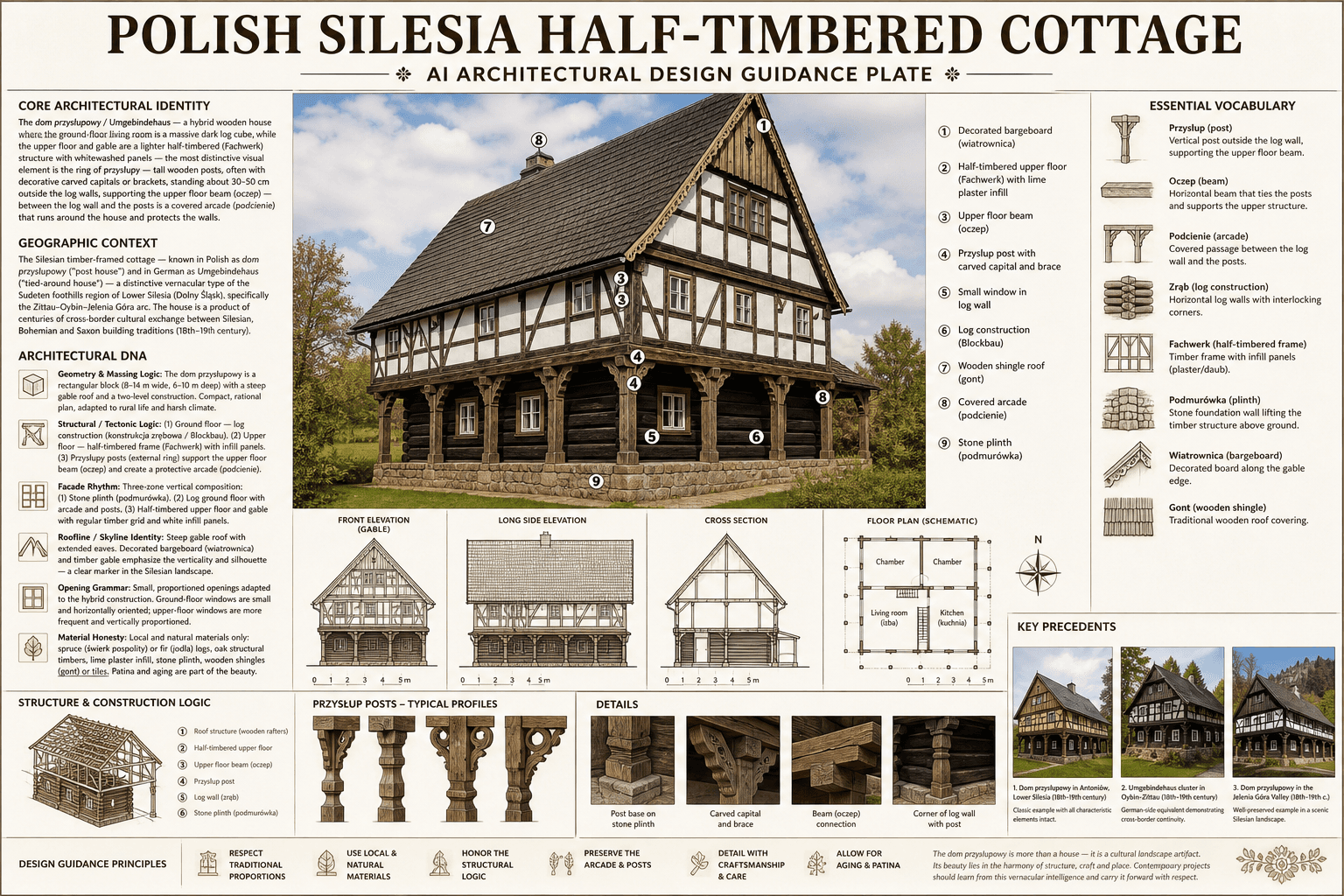
Polish Silesia Half-Timbered Cottage
Poland · Silesian timber-framed cottage
The Silesian timber-framed cottage (dom przysłupowy / Umgebindehaus) of Lower Silesia — a unique hybrid construction combining log walls (zrębowa) with half-timbered upper floors (...
Definition
Polish Silesia Half-Timbered Cottage is a regional architectural identity from Poland. The Silesian timber-framed cottage (dom przysłupowy / Umgebindehaus) of Lower Silesia — a unique hybrid construction combining log walls (zrębowa) with half-timbered upper floors (.
- Country
- Poland
- Region
- Silesian timber-framed cottage
- Massing
- The dom przysłupowy is a rectangular block (8–14 m wide, 6–10 m deep) with a steep gable roof and a two-level construction that reads as two.
- Materials
- Materials are entirely local and natural: (1) Logs — spruce (świerk pospolity / Picea abies) or fir (jodła / Abies alba).
- Palette
- White, cream, pale sand, warm timber, and shadow-driven dark metal accents define the palette.
- Climate response
- The Sudeten foothills have a transitional mountain climate: (1) Cold winters with heavy snow — the log ground floor provides excellent thermal insulation.
Overview
Polish Silesia Half-Timbered Cottage is a regional architectural identity in Poland. The Silesian timber-framed cottage — known in Polish as dom przysłupowy ("post house") and in German as Umgebindehaus ("tied-around house") — a distinctive vernacular type of the Sudeten foothills region of Lower Silesia (Dolny Śląsk), specifically the Zittau-Oybin-Jelenia Góra arc — the house is a hybrid of two construction traditions: (1) the ground-floor log room (izba zrębowa) — a massive log-built core (spruce o...
Visual DNA
Massing & Form
The dom przysłupowy is a rectangular block (8–14 m wide, 6–10 m deep) with a steep gable roof and a two-level construction that reads as two distinct architectural zones: a solid, dark, earth-bound ground floor (the log izba), and a lighter, more open upper floor (the Fachwerk storey) that appears to float above the po...
Facade Language
The facade (gable or long side) is organized as a three-zone vertical composition: (1) The stone plinth (podmurówka) — low fieldstone foundation, 0.5–1 m high, with small cellar windows — the visual base. (2) Ground floor — the dark log cube, with small windows (0.8–1 m wide) cut into the logs, their simple timber surr...
Materials & Texture
Materials are entirely local and natural: (1) Logs — spruce (świerk pospolity / Picea abies) or fir (jodła / Abies alba), the logs silvering to a dark brown-grey with age — the logs are unadorned, the caulking (moss or oakum) visible as pale lines between logs. (2) Timber frame — spruce or pine for the posts, beams, st...
Color Palette
White, cream, pale sand, warm timber, and shadow-driven dark metal accents define the palette. The facade should stay bright and climate-aware rather than heavy, gray, or over-saturated.
Ornament & Detail
The ornament is concentrated in the timber framing and the carved wooden elements: (1) The przysłupy — the posts are often chamfered (ścięte) or carved with simple geometric patterns — the post capitals may have a carved bracket or a molded transition to the beam — in more elaborate examples, the post has a turned prof...
Climate Response
The Sudeten foothills have a transitional mountain climate: (1) Cold winters with heavy snow — the log ground floor provides excellent thermal insulation; the steep roof sheds snow; the covered podcienie allows circulation around the house in snow and rain; the tile stove (piec kaflowy) is the thermal heart of the izba...
Landscape & Ground
The Silesian timber-framed cottage — known in Polish as dom przysłupowy ("post house") and in German as Umgebindehaus ("tied-around house") — a distinctive vernacular type of the Sudeten foothills region of Lower Silesia (Dolny Śląsk), specifically the Zittau-Oybin-Jelenia Góra arc — the house is a hybrid of two constr...
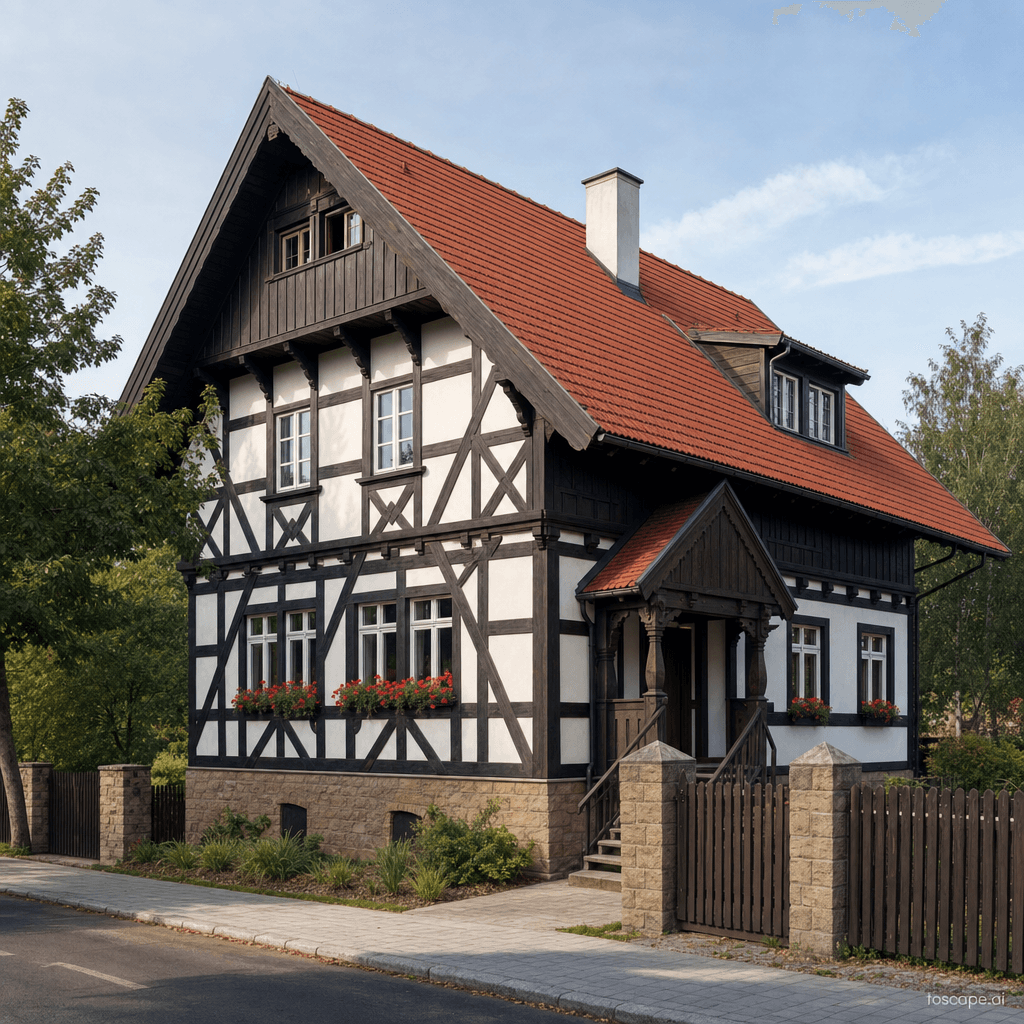
Reference elevation
Polish Silesia Half-Timbered Cottage — characteristic facade composition, Silesian timber-framed cottage.
Context Snapshot
The Silesian timber-framed cottage — known in Polish as dom przysłupowy ("post house") and in German as Umgebindehaus ("tied-around house") — a distinctive vernacular type of the Sudeten foothills reg... The Sudeten foothills have a transitional mountain climate: (1) Cold winters with heavy snow — the log ground floor provides excellent thermal insulation; the steep roof sheds snow; the covered podcienie allows circulati...
Contemporary Relevance
Polish Silesia Half-Timbered Cottage is useful today for residential, hospitality, civic, and place-branding work that needs Poland-specific character grounded in local massing, material tone, climate response, and settlement logic rather than generic international styling.
Use this style in Toscape
Explore Polish Silesia Half-Timbered Cottage directly inside Toscape using the Facade Re-Style and Design Options workflows.
Open Polish Silesia Half-Timbered Cottage in the galleryFrequently asked questions
What is Polish Silesia Half-Timbered Cottage?
Polish Silesia Half-Timbered Cottage is a regional architectural identity from Poland. The Silesian timber-framed cottage (dom przysłupowy / Umgebindehaus) of Lower Silesia — a unique hybrid construction combining log walls (zrębowa) with half-timbered upper floors (.
What materials define Polish Silesia Half-Timbered Cottage?
Materials are entirely local and natural: (1) Logs — spruce (świerk pospolity / Picea abies) or fir (jodła / Abies alba), the logs silvering to a dark brown-grey with age — the logs are unadorned, the caulking (moss or oakum) visible as pale lines between logs. (2) Timber frame — spruce or pine for the posts, beams, st.
What is the Polish Silesia Half-Timbered Cottage color palette?
White, cream, pale sand, warm timber, and shadow-driven dark metal accents define the palette. The facade should stay bright and climate-aware rather than heavy, gray, or over-saturated.
Where does Polish Silesia Half-Timbered Cottage come from?
The Silesian timber-framed cottage — known in Polish as dom przysłupowy ("post house") and in German as Umgebindehaus ("tied-around house") — a distinctive vernacular type of the Sudeten foothills reg.
When should architects use Polish Silesia Half-Timbered Cottage?
Polish Silesia Half-Timbered Cottage is useful today for residential, hospitality, civic, and place-branding work that needs Poland-specific character grounded in local massing, material tone, climate response, and settlement logic rather than generic international styling.
How do you render Polish Silesia Half-Timbered Cottage in Toscape?
Open Toscape on Windows, load your own photo, elevation, sketch, or CAD view, then apply the Polish Silesia Half-Timbered Cottage reference from the built-in style library. The Facade Re-Style and Design Options workflows keep your project geometry and camera while shifting materials, proportion, and detailing toward Polish Silesia Half-Timbered Cottage.