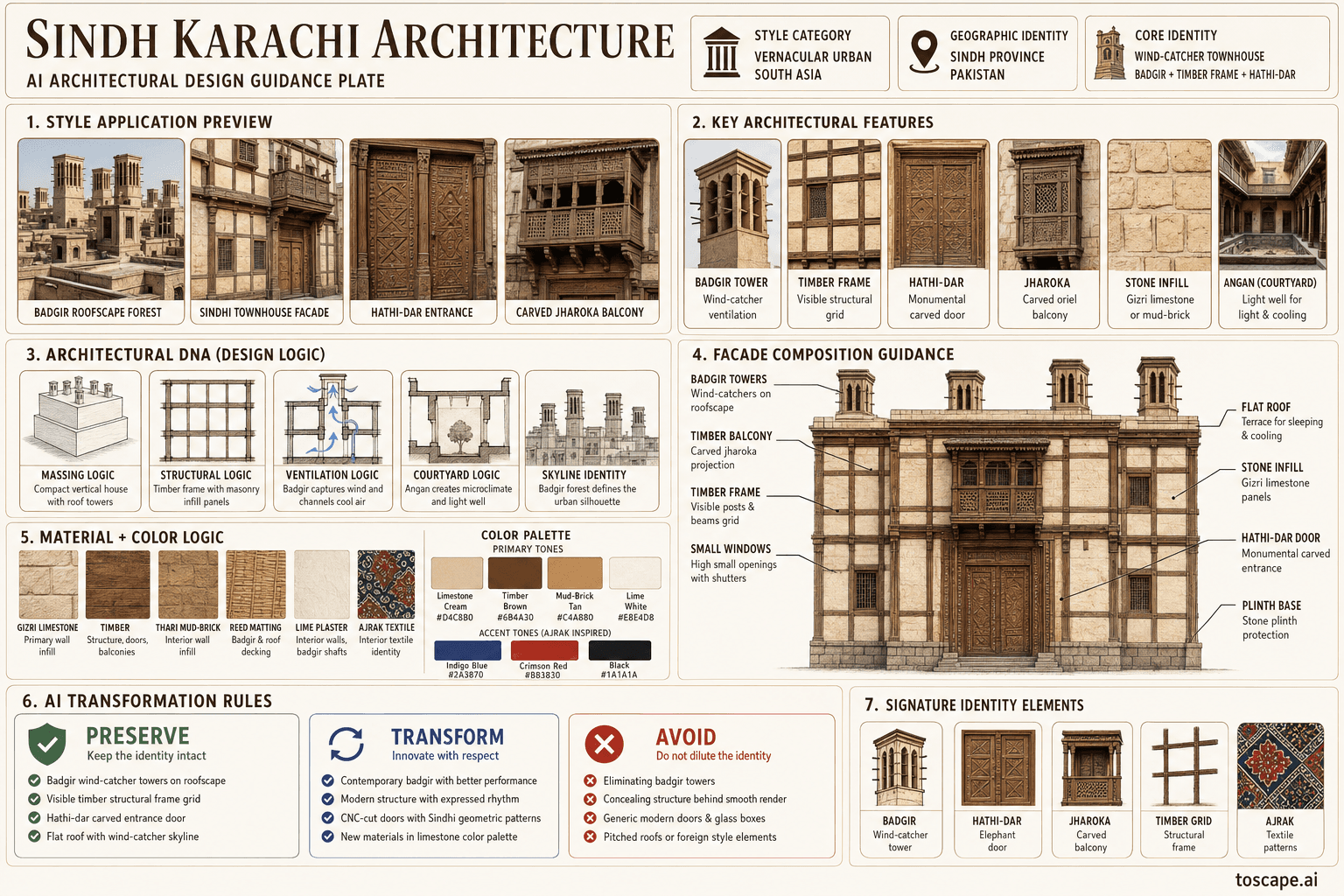
Sindh Karachi
Pakistan · domestic architecture of Sindh province, centered on the historic quarters of Ka...
The wind-catcher and stone architecture of the Indus delta — Badgir wind towers, limestone-and-wood townhouses, and the cooling architecture of Sindh's coastal and desert settlemen...
Definition
Sindh Karachi is a regional architectural identity from Pakistan. The wind-catcher and stone architecture of the Indus delta — Badgir wind towers, limestone-and-wood townhouses, and the cooling architecture of Sindh's coastal and desert settlemen.
- Country
- Pakistan
- Region
- domestic architecture of Sindh province, centered on the historic quarters of Ka.
- Massing
- The Sindhi townhouse is a compact vertical volume — 8–14 m wide × 8–18 m deep — two to three storeys with flat roof.
- Materials
- Gizri limestone — pale cream to warm beige — the primary masonry material of coastal Sindh — quarried from the Gizri hills near Karachi Thari mud-brick.
- Palette
- White, cream, pale sand, warm timber, and shadow-driven dark metal accents define the palette.
- Climate response
- Sindh's climate — extremely hot and humid coastal conditions (Karachi: 32–38°C summer, 70–80% humidity; interior Sindh: 45–50°C.
Overview
Sindh Karachi is a regional architectural identity in Pakistan. Traditional domestic architecture of Sindh province, centered on the historic quarters of Karachi and the Makli-Thatta region — defined by the distinctive Sindhi badgir (wind-catcher tower), timber-framed construction with limestone or mud-brick infill, elaborately carved wooden doors and balconies, and the profound climate-responsive architecture of the Indus delta and Thar Desert margins. The Sindhi badgir — a squa...
Visual DNA
Massing & Form
The Sindhi townhouse is a compact vertical volume — 8–14 m wide × 8–18 m deep — two to three storeys with flat roof. The plan is courtyard-centered (chowk) but the Sindhi urban density often compresses this to a light well (angan).
Facade Language
The Sindhi facade is organized by the visible timber structural grid: Timber frame expressed: Vertical posts and horizontal beams create a visible grid — the structural logic IS the facade composition. The timber grid bays (2.5–4.0 m wide × 2.5–3.5 m high) are infilled with stone or brick masonry.
Materials & Texture
Gizri limestone — pale cream to warm beige — the primary masonry material of coastal Sindh — quarried from the Gizri hills near Karachi Thari mud-brick — warm tan — the masonry material of the interior Thar Desert region Timber (sheesham / tali / neem) — for structural frame, badgir towers, doors, windows, balconies —...
Color Palette
White, cream, pale sand, warm timber, and shadow-driven dark metal accents define the palette. The facade should stay bright and climate-aware rather than heavy, gray, or over-saturated.
Ornament & Detail
Sindhi ornament is characterized by bold geometry and the dominance of timber carving: (1) Door carving — the hathi-dar is the primary ornamental canvas: geometric interlace (hexagonal grids, eight-point stars, concentric squares), floral borders, and occasional peacock and elephant motifs. (2) Jharoka balcony carving...
Climate Response
Sindh's climate — extremely hot and humid coastal conditions (Karachi: 32–38°C summer, 70–80% humidity; interior Sindh: 45–50°C, dry) — drives the architecture: (1) The badgir — the most important climate device. Wind-catchers capture the prevailing south-west monsoon breeze, accelerate it through the constricted shaft...
Landscape & Ground
Traditional domestic architecture of Sindh province, centered on the historic quarters of Karachi and the Makli-Thatta region — defined by the distinctive Sindhi badgir (wind-catcher tower), timber-framed construction with limestone or mud-brick infill, elaborately carved wooden doors and balconies, and the profound cl...
Reference elevation
Sindh Karachi — characteristic facade composition, domestic architecture of Sindh province, centered on the historic quarters of Ka....
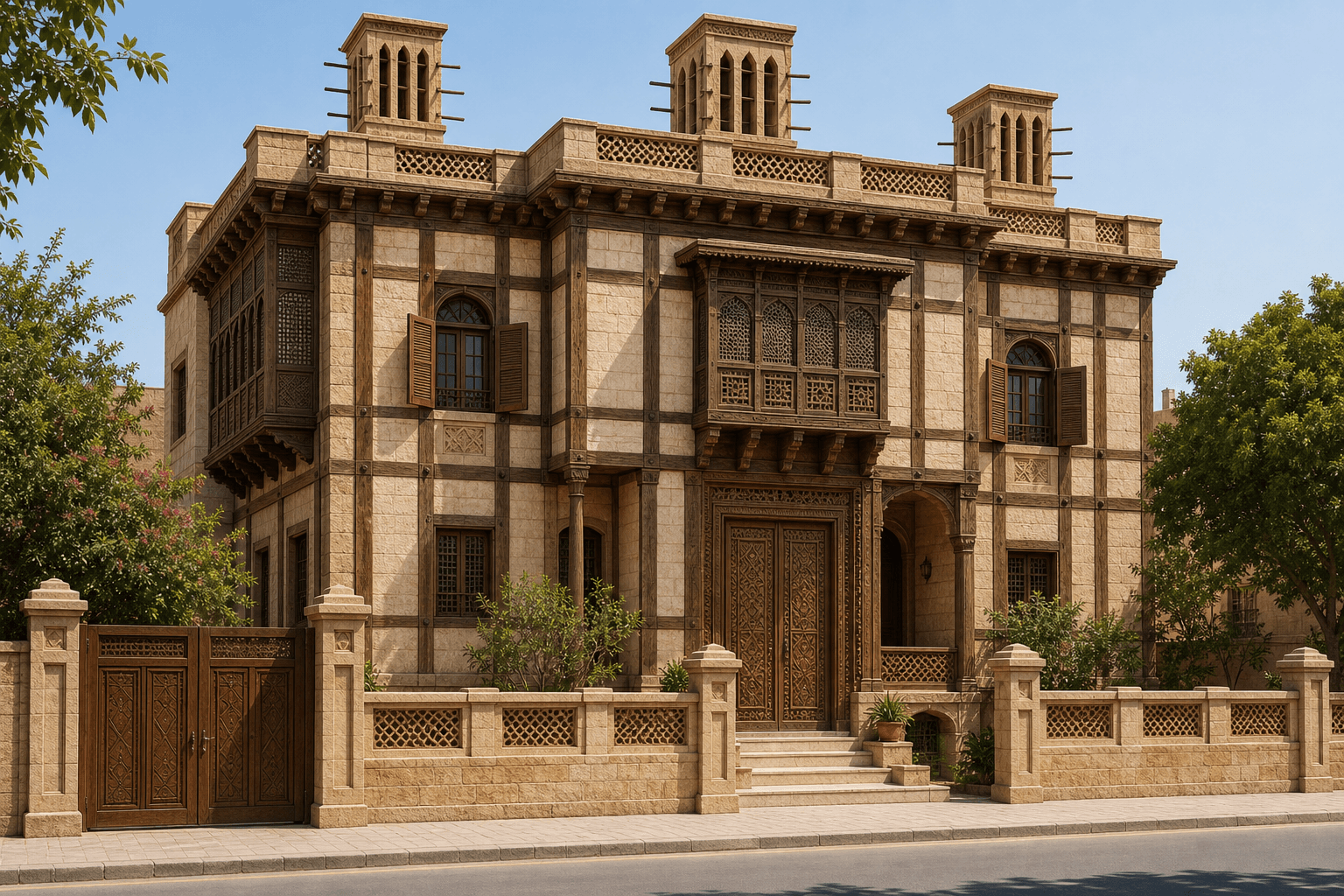
Context Snapshot
Traditional domestic architecture of Sindh province, centered on the historic quarters of Karachi and the Makli-Thatta region — defined by the distinctive Sindhi badgir (wind-catcher tower), timber-fr... Sindh's climate — extremely hot and humid coastal conditions (Karachi: 32–38°C summer, 70–80% humidity; interior Sindh: 45–50°C, dry) — drives the architecture: (1) The badgir — the most important climate device.
Contemporary Relevance
Sindh Karachi is useful today for residential, hospitality, civic, and place-branding work that needs Pakistan-specific character grounded in local massing, material tone, climate response, and settlement logic rather than generic international styling.
Use this style in Toscape
Explore Sindh Karachi directly inside Toscape using the Facade Re-Style and Design Options workflows.
Open Sindh Karachi in the galleryFrequently asked questions
What is Sindh Karachi?
Sindh Karachi is a regional architectural identity from Pakistan. The wind-catcher and stone architecture of the Indus delta — Badgir wind towers, limestone-and-wood townhouses, and the cooling architecture of Sindh's coastal and desert settlemen.
What materials define Sindh Karachi?
Gizri limestone — pale cream to warm beige — the primary masonry material of coastal Sindh — quarried from the Gizri hills near Karachi Thari mud-brick — warm tan — the masonry material of the interior Thar Desert region Timber (sheesham / tali / neem) — for structural frame, badgir towers, doors, windows, balconies.
What is the Sindh Karachi color palette?
White, cream, pale sand, warm timber, and shadow-driven dark metal accents define the palette. The facade should stay bright and climate-aware rather than heavy, gray, or over-saturated.
Where does Sindh Karachi come from?
Traditional domestic architecture of Sindh province, centered on the historic quarters of Karachi and the Makli-Thatta region — defined by the distinctive Sindhi badgir (wind-catcher tower), timber-fr... Sindh's climate — extremely hot and humid coastal conditions (Karachi: 32–38°C summer, 70–80% humidity; interior Sindh: 45–50°C, dry) — drives the architecture: (1) The badgir — the most important climate device.
When should architects use Sindh Karachi?
Sindh Karachi is useful today for residential, hospitality, civic, and place-branding work that needs Pakistan-specific character grounded in local massing, material tone, climate response, and settlement logic rather than generic international styling.
How do you render Sindh Karachi in Toscape?
Open Toscape on Windows, load your own photo, elevation, sketch, or CAD view, then apply the Sindh Karachi reference from the built-in style library. The Facade Re-Style and Design Options workflows keep your project geometry and camera while shifting materials, proportion, and detailing toward Sindh Karachi.