Sousse Sahel Coastal
Tunisia · coastal architecture of the Tunisian Sahel region
The ribat fortress and coastal merchant architecture of the Tunisian Sahel — Sousse, Monastir, and the maritime architectural identity of the central Tunisian coast
Definition
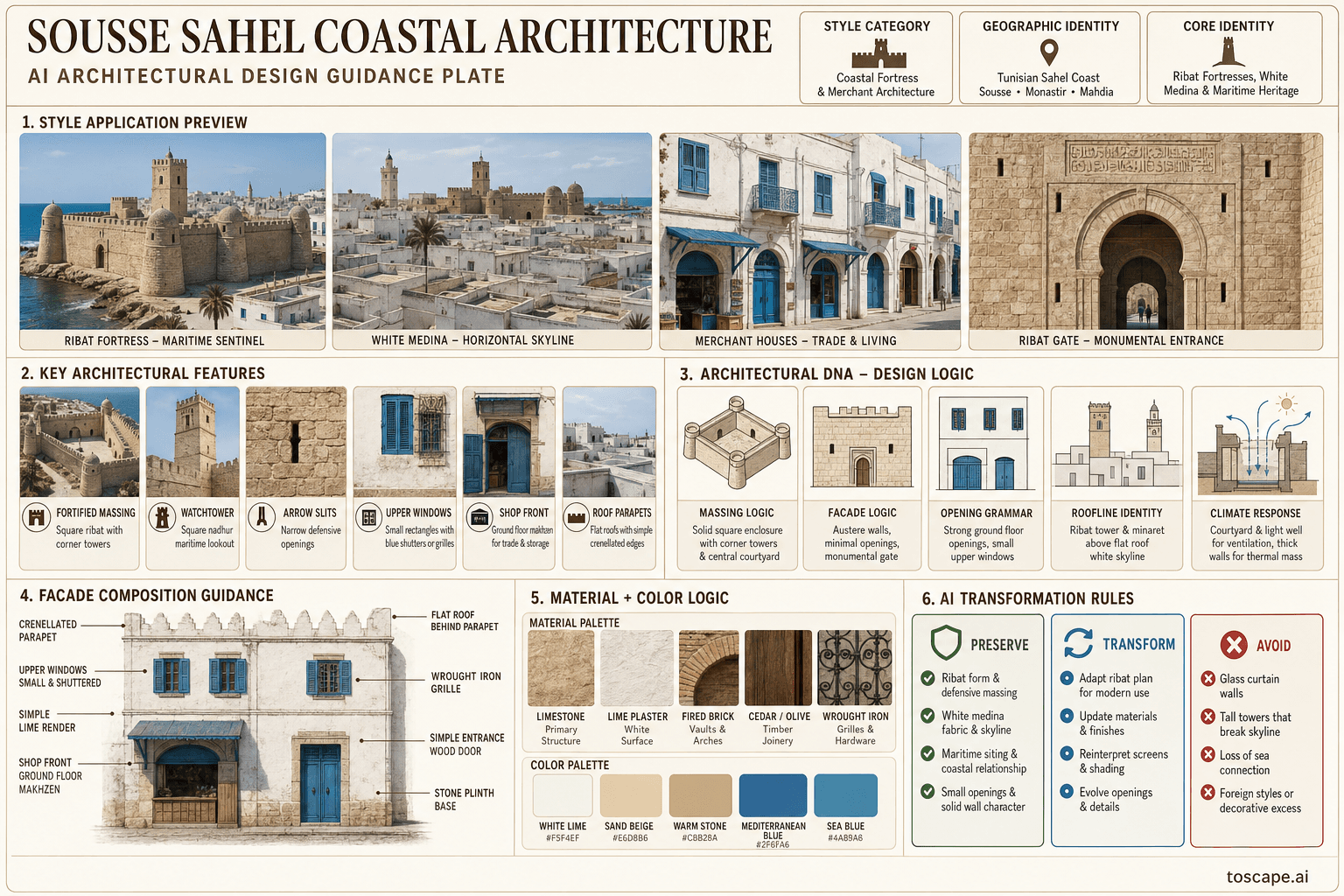
Sousse Sahel Coastal is a regional architectural identity from Tunisia. The ribat fortress and coastal merchant architecture of the Tunisian Sahel — Sousse, Monastir, and the maritime architectural identity of the central Tunisian coast.
- Country
- Tunisia
- Region
- coastal architecture of the Tunisian Sahel region.
- Massing
- The Sousse/Sahel coastal house is a rectangular two-storey volume — 5–8 m wide × 8–14 m deep — similar to the Tunis medina dar but often.
- Materials
- Limestone — primary wall material.
- Palette
- White, cream, pale sand, warm timber, and shadow-driven dark metal accents define the palette.
- Climate response
- The ribat typology embodies the Sahel's dual identity: (1) Coastal defense — the ribat's siting on the Mediterranean shore, with the watchtower providing maritime surveillance.
Overview
Sousse Sahel Coastal is a regional architectural identity in Tunisia. Traditional coastal architecture of the Tunisian Sahel region — the historic Mediterranean port cities of Sousse, Monastir, and Mahdia, defined by the ribat (fortified monastery-fortress) typology, whitewashed cubic forms, coastal merchant houses, and an architectural character shaped by Aghlabid, Fatimid, and Mediterranean maritime culture. The ribat — a square fortified enclosure with circular corner towers and a c...
Visual DNA
Massing & Form
The Sousse/Sahel coastal house is a rectangular two-storey volume — 5–8 m wide × 8–14 m deep — similar to the Tunis medina dar but often simpler in plan and ornament. The ground floor typically houses a shop or storage space (makhzen) facing the street — a functional response to the maritime trading economy.
Facade Language
The Sahel coastal facade is characterized by simplicity and maritime functionality: Ribat facade: Massive, solid stone walls — the exterior is deliberately austere and fortress-like. Minimal openings — narrow arrow-slit windows (meurtrières) for defense.
Materials & Texture
Limestone — primary wall material, quarried locally Lime plaster — white or cream render Fired brick — for vaults and arches in ribat construction Cedar and olive timber — for ceilings, doors, and window frames Wrought iron — for window grilles and gate hardware
Color Palette
White, cream, pale sand, warm timber, and shadow-driven dark metal accents define the palette. The facade should stay bright and climate-aware rather than heavy, gray, or over-saturated.
Ornament & Detail
Aghlabid and Fatimid architectural ornament is concentrated at key points: (1) Carved stone inscriptions — Quranic verses in Kufic script on ribat gates and mosque entrances, (2) carved stone capitals — simplified Corinthian and composite forms on ribat columns, (3) geometric brick patterns — decorative brickwork in ar...
Climate Response
The ribat typology embodies the Sahel's dual identity: (1) Coastal defense — the ribat's siting on the Mediterranean shore, with the watchtower providing maritime surveillance, is the architectural expression of the region's medieval role as the frontline of Islamic-Byzantine maritime conflict. (2) Thermal mass — thick...
Landscape & Ground
Traditional coastal architecture of the Tunisian Sahel region — the historic Mediterranean port cities of Sousse, Monastir, and Mahdia, defined by the ribat (fortified monastery-fortress) typology, whitewashed cubic forms, coastal merchant houses, and an architectural character shaped by Aghlabid, Fatimid, and Mediterr...
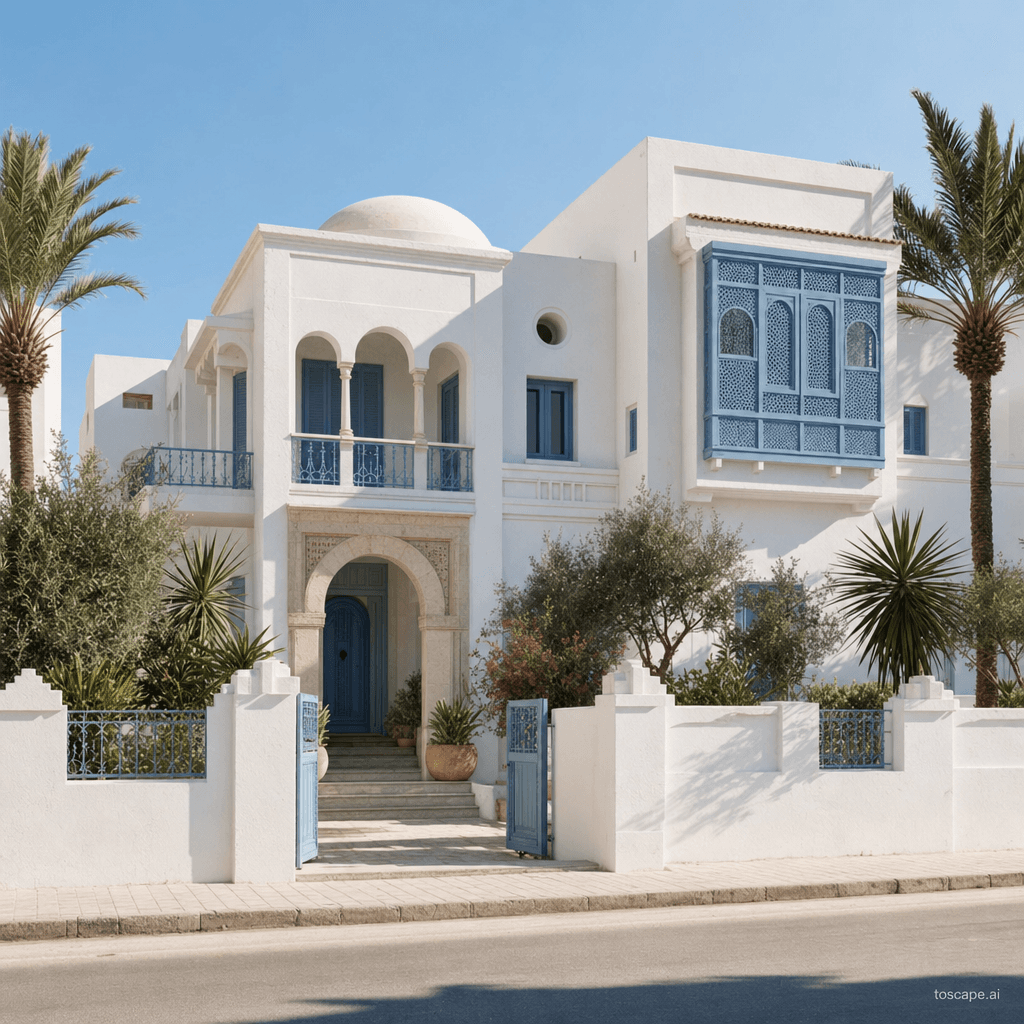
Reference elevation
Sousse Sahel Coastal — characteristic facade composition, coastal architecture of the Tunisian Sahel region.
Context Snapshot
Traditional coastal architecture of the Tunisian Sahel region — the historic Mediterranean port cities of Sousse, Monastir, and Mahdia, defined by the ribat (fortified monastery-fortress) typology, wh... The ribat typology embodies the Sahel's dual identity: (1) Coastal defense — the ribat's siting on the Mediterranean shore, with the watchtower providing maritime surveillance, is the architectural expression of the regi...
Contemporary Relevance
Sousse Sahel Coastal is useful today for residential, hospitality, civic, and place-branding work that needs Tunisia-specific character grounded in local massing, material tone, climate response, and settlement logic rather than generic international styling.
Use this style in Toscape
Explore Sousse Sahel Coastal directly inside Toscape using the Facade Re-Style and Design Options workflows.
Open Sousse Sahel Coastal in the galleryFrequently asked questions
What is Sousse Sahel Coastal?
Sousse Sahel Coastal is a regional architectural identity from Tunisia. The ribat fortress and coastal merchant architecture of the Tunisian Sahel — Sousse, Monastir, and the maritime architectural identity of the central Tunisian coast.
What materials define Sousse Sahel Coastal?
Limestone — primary wall material, quarried locally Lime plaster — white or cream render Fired brick — for vaults and arches in ribat construction Cedar and olive timber — for ceilings, doors, and window frames Wrought iron — for window grilles and gate hardware.
What is the Sousse Sahel Coastal color palette?
White, cream, pale sand, warm timber, and shadow-driven dark metal accents define the palette. The facade should stay bright and climate-aware rather than heavy, gray, or over-saturated.
Where does Sousse Sahel Coastal come from?
Traditional coastal architecture of the Tunisian Sahel region — the historic Mediterranean port cities of Sousse, Monastir, and Mahdia, defined by the ribat (fortified monastery-fortress) typology, wh... The ribat typology embodies the Sahel's dual identity: (1) Coastal defense — the ribat's siting on the Mediterranean shore, with the watchtower providing maritime surveillance, is the architectural expression of the regi.
When should architects use Sousse Sahel Coastal?
Sousse Sahel Coastal is useful today for residential, hospitality, civic, and place-branding work that needs Tunisia-specific character grounded in local massing, material tone, climate response, and settlement logic rather than generic international styling.
How do you render Sousse Sahel Coastal in Toscape?
Open Toscape on Windows, load your own photo, elevation, sketch, or CAD view, then apply the Sousse Sahel Coastal reference from the built-in style library. The Facade Re-Style and Design Options workflows keep your project geometry and camera while shifting materials, proportion, and detailing toward Sousse Sahel Coastal.