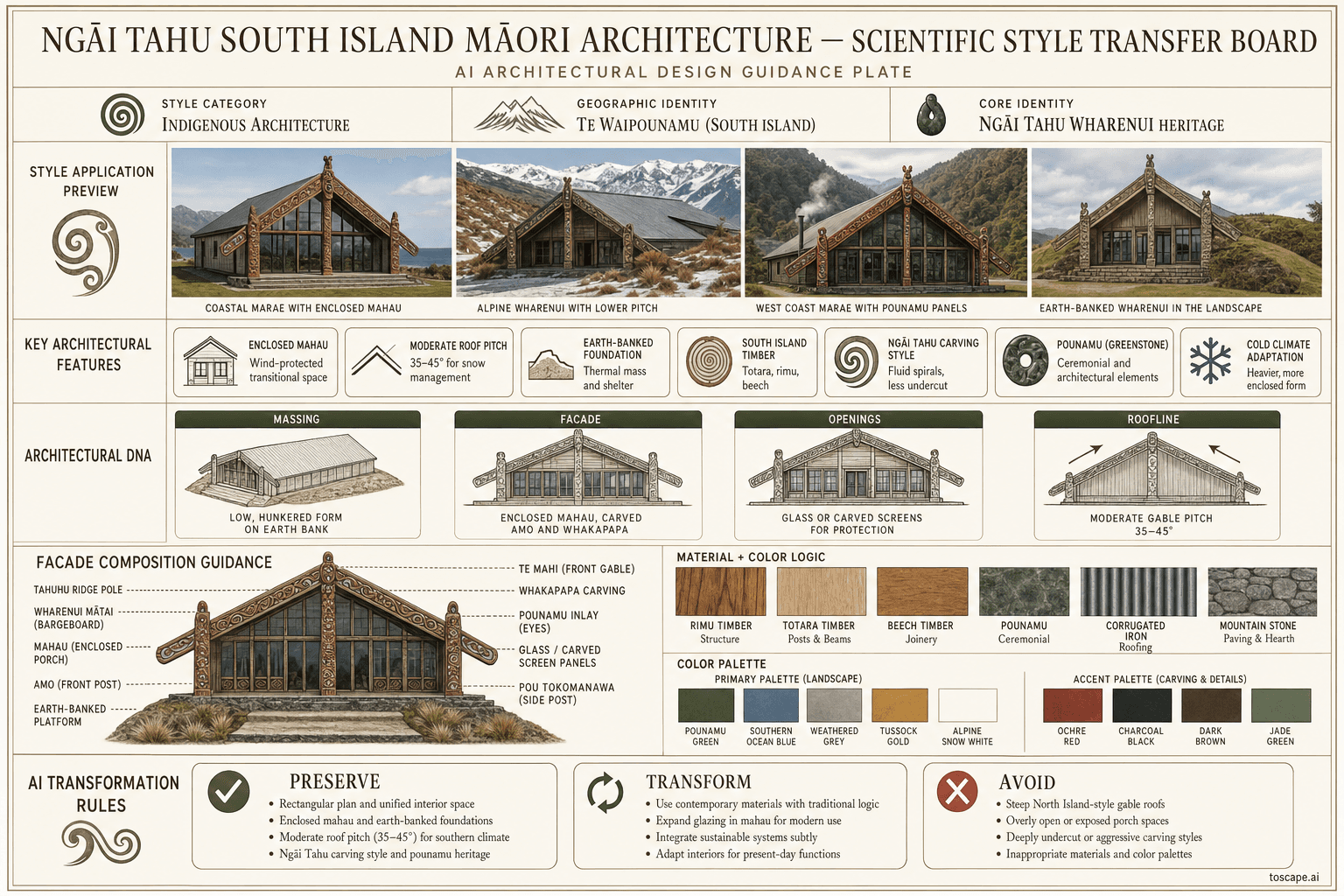
Ngāi Tahu South Island Māori
New Zealand · architectural identity of Ngāi Tahu (Kāi Tahu) marae and wharenui across Te Waip...
The southern marae of Te Waipounamu — where the descendants of the great migration adapt the ancestral wharenui form to the colder, harsher climate of the South Island, incorporati...
Definition
Ngāi Tahu South Island Māori is a regional architectural identity from New Zealand. The southern marae of Te Waipounamu — where the descendants of the great migration adapt the ancestral wharenui form to the colder, harsher climate of the South Island, incorporati.
- Country
- New Zealand
- Region
- architectural identity of Ngāi Tahu (Kāi Tahu) marae and wharenui across Te Waip.
- Massing
- The Ngāi Tahu wharenui shares the same rectangular plan as all Māori meeting houses, but the massing is lower and more hunkered — the building sits.
- Materials
- The southern material palette: (1) Rimu (Dacrydium cupressinum) — the primary southern structural timber.
- Palette
- White, cream, pale sand, warm timber, and shadow-driven dark metal accents define the palette.
- Climate response
- The South Island climate is colder, windier, and more variable than the North Island: (1) Winter temperatures: 0–10°C.
Overview
Ngāi Tahu South Island Māori is a regional architectural identity in New Zealand. The architectural identity of Ngāi Tahu (Kāi Tahu) marae and wharenui across Te Waipounamu (the South Island of Aotearoa New Zealand) — from Kaikōura in the north to Murihiku (Southland) in the deep south, from the West Coast pounamu rivers to the Otago Peninsula — the wharenui maintains the ancestral form (rectangular gable-roofed post-and-beam meeting house) but the southern climate (snow-bearing winters, lower ave...
Visual DNA
Massing & Form
The Ngāi Tahu wharenui shares the same rectangular plan as all Māori meeting houses, but the massing is lower and more hunkered — the building sits closer to the ground, with earth-banked foundations (a traditional southern technique for thermal mass and wind protection). In the alpine interior (the Southern Lakes, Mac...
Facade Language
The Ngāi Tahu facade is characterized by: (1) The enclosed mahau — the porch area between the amo posts is screened with glass or carved timber panels, creating a protected entry that still reads the ancestor's face but with a practical southern modesty — the tekoteko is still at the apex, the maihi bargeboards still e...
Materials & Texture
The southern material palette: (1) Rimu (Dacrydium cupressinum) — the primary southern structural timber, with a rich reddish-brown heartwood that darkens with age — used for framing, wall linings, and carving in regions where totara is scarce. (2) Totara — still the preferred carving timber, but used more sparingly in...
Color Palette
White, cream, pale sand, warm timber, and shadow-driven dark metal accents define the palette. The facade should stay bright and climate-aware rather than heavy, gray, or over-saturated.
Ornament & Detail
The Ngāi Tahu carving and decorative tradition is distinctive: (1) The southern koru — the spiral is looser, more fluid, less tightly wound than northern kōwhaiwhai — it reads as the unfolding of new life in a harsh climate, more organic and less geometric. (2) The pītau-a-Tāne (double spiral) — two spirals interlockin...
Climate Response
The South Island climate is colder, windier, and more variable than the North Island: (1) Winter temperatures: 0–10°C, with snow at elevation — wharenui foundations are earth-banked for thermal mass, and modern marae are insulated and double-glazed. (2) Wind — prevailing westerlies and cold southerlies drive the enclos...
Landscape & Ground
The architectural identity of Ngāi Tahu (Kāi Tahu) marae and wharenui across Te Waipounamu (the South Island of Aotearoa New Zealand) — from Kaikōura in the north to Murihiku (Southland) in the deep south, from the West Coast pounamu rivers to the Otago Peninsula — the wharenui maintains the ancestral form (rectangular...
Reference elevation
Ngāi Tahu South Island Māori — characteristic facade composition, architectural identity of Ngāi Tahu (Kāi Tahu) marae and wharenui across Te Waip....
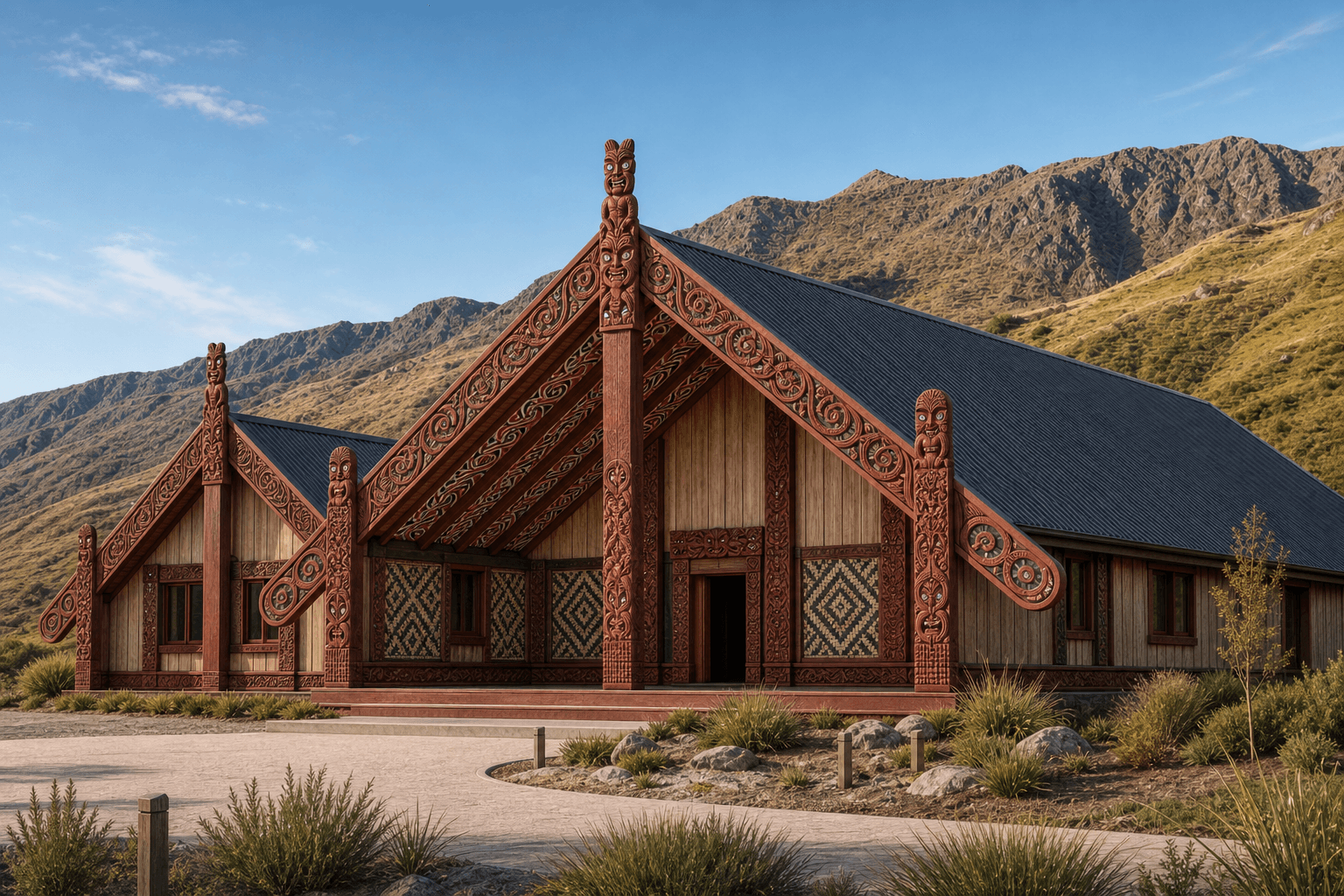
Context Snapshot
The architectural identity of Ngāi Tahu (Kāi Tahu) marae and wharenui across Te Waipounamu (the South Island of Aotearoa New Zealand) — from Kaikōura in the north to Murihiku (Southland) in the deep s... The South Island climate is colder, windier, and more variable than the North Island: (1) Winter temperatures: 0–10°C, with snow at elevation — wharenui foundations are earth-banked for thermal mass, and modern marae are...
Contemporary Relevance
Ngāi Tahu South Island Māori is useful today for residential, hospitality, civic, and place-branding work that needs New Zealand-specific character grounded in local massing, material tone, climate response, and settlement logic rather than generic international styling.
Use this style in Toscape
Explore Ngāi Tahu South Island Māori directly inside Toscape using the Facade Re-Style and Design Options workflows.
Open Ngāi Tahu South Island Māori in the galleryFrequently asked questions
What is Ngāi Tahu South Island Māori?
Ngāi Tahu South Island Māori is a regional architectural identity from New Zealand. The southern marae of Te Waipounamu — where the descendants of the great migration adapt the ancestral wharenui form to the colder, harsher climate of the South Island, incorporati.
What materials define Ngāi Tahu South Island Māori?
The southern material palette: (1) Rimu (Dacrydium cupressinum) — the primary southern structural timber, with a rich reddish-brown heartwood that darkens with age — used for framing, wall linings, and carving in regions where totara is scarce. (2) Totara — still the preferred carving timber.
What is the Ngāi Tahu South Island Māori color palette?
White, cream, pale sand, warm timber, and shadow-driven dark metal accents define the palette. The facade should stay bright and climate-aware rather than heavy, gray, or over-saturated.
Where does Ngāi Tahu South Island Māori come from?
The architectural identity of Ngāi Tahu (Kāi Tahu) marae and wharenui across Te Waipounamu (the South Island of Aotearoa New Zealand) — from Kaikōura in the north to Murihiku (Southland) in the deep s.
When should architects use Ngāi Tahu South Island Māori?
Ngāi Tahu South Island Māori is useful today for residential, hospitality, civic, and place-branding work that needs New Zealand-specific character grounded in local massing, material tone, climate response, and settlement logic rather than generic international styling.
How do you render Ngāi Tahu South Island Māori in Toscape?
Open Toscape on Windows, load your own photo, elevation, sketch, or CAD view, then apply the Ngāi Tahu South Island Māori reference from the built-in style library. The Facade Re-Style and Design Options workflows keep your project geometry and camera while shifting materials, proportion, and detailing toward Ngāi Tahu South Island Māori.