Irish Southeast Medieval & Vernacular
Ireland · southeast of Ireland (counties Kilkenny, Waterford, Wexford, Tipperary, Carlow)
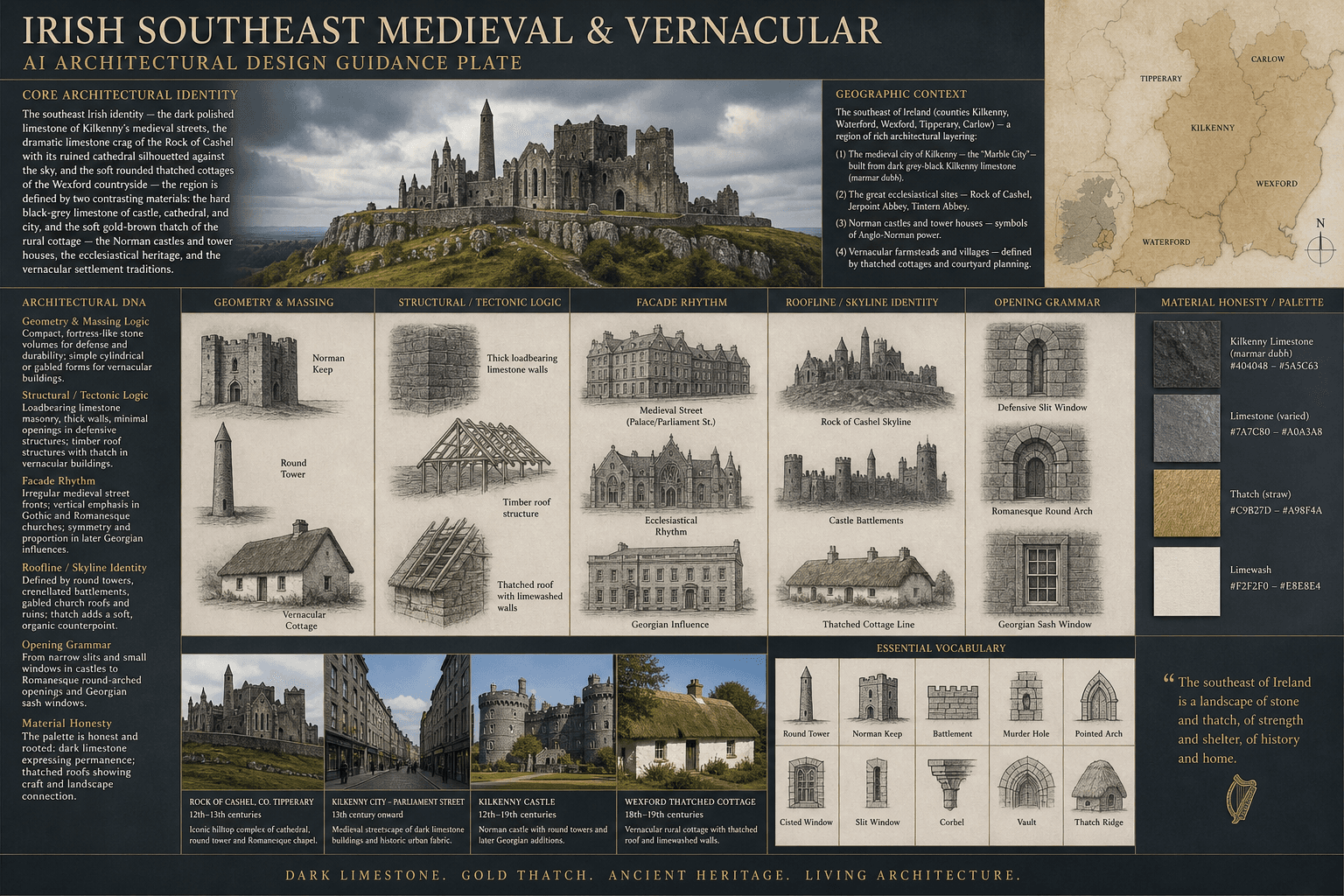
The architectural landscape of southeast Ireland — from the medieval "Marble City" of Kilkenny with its dark Kilkenny limestone (marmar dubh — black marble) buildings, to the Norma...
Definition
Irish Southeast Medieval & Vernacular is a regional architectural identity from Ireland. The architectural landscape of southeast Ireland — from the medieval "Marble City" of Kilkenny with its dark Kilkenny limestone (marmar dubh — black marble) buildings, to the Norma.
- Country
- Ireland
- Region
- southeast of Ireland (counties Kilkenny, Waterford, Wexford, Tipperary, Carlow).
- Massing
- The southeast presents contrasting geometries: (1) The Norman castle/tower house — a massive, compact stone block, square or rectangular.
- Materials
- The southeast palette is dark stone and gold thatch: (1) Kilkenny limestone (marmar dubh) — dark grey to black (#404048 to #2A2A30).
- Palette
- White, cream, pale sand, warm timber, and shadow-driven dark metal accents define the palette.
- Climate response
- The southeast has a slightly drier, sunnier climate than the west: (1) The southeast receives Ireland's highest sunshine hours and lowest rainfall — this makes it.
Overview
Irish Southeast Medieval & Vernacular is a regional architectural identity in Ireland. The southeast of Ireland (counties Kilkenny, Waterford, Wexford, Tipperary, Carlow) — a region of rich architectural layering: (1) The medieval city of Kilkenny — the "Marble City" — built from dark grey-black Kilkenny limestone (a Carboniferous limestone containing fossils, which takes a dark polish, hence "marble") — the city's medieval streets are lined with stone buildings, from the 13th-century St. Canice's Cath...
Visual DNA
Massing & Form
The southeast presents contrasting geometries: (1) The Norman castle/tower house — a massive, compact stone block, square or rectangular, with thick battered walls (2–3 m at base, tapering upward) — the massing is powerful, weighty, and defensive — circular flanking towers on the corners of larger castles (Kilkenny Cas...
Facade Language
The southeast streetscape and standing architecture: (1) Kilkenny's medieval street (Parliament Street, High Street) — a narrow street lined with stone buildings of varying heights (2–4 stories), the dark limestone giving the street a somber, dignified character — the facades are irregular (medieval, not Georgian-plann...
Materials & Texture
The southeast palette is dark stone and gold thatch: (1) Kilkenny limestone (marmar dubh) — dark grey to black (#404048 to #2A2A30), with visible fossil inclusions — the stone weathers to a lighter grey on exposed surfaces but retains its dark character — the polished "marble" is deep black (#1A1A20) with white fossil...
Color Palette
White, cream, pale sand, warm timber, and shadow-driven dark metal accents define the palette. The facade should stay bright and climate-aware rather than heavy, gray, or over-saturated.
Ornament & Detail
Southeast ornament is carved in stone: (1) Round tower doorway — the entrance to the Cashel round tower features a carved stone tympanum (the semi-circular area above the door) — Romanesque carving with zigzag (chevron) ornament and a carved figure (possibly a centaur or a bishop). (2) Stone carving at the Rock of Cash...
Climate Response
The southeast has a slightly drier, sunnier climate than the west: (1) The southeast receives Ireland's highest sunshine hours and lowest rainfall — this makes it Ireland's most productive agricultural region (the "sunny southeast") — the drier climate supported the development of large arable farms and the wealth that...
Landscape & Ground
The southeast of Ireland (counties Kilkenny, Waterford, Wexford, Tipperary, Carlow) — a region of rich architectural layering: (1) The medieval city of Kilkenny — the "Marble City" — built from dark grey-black Kilkenny limestone (a Carboniferous limestone containing fossils, which takes a dark polish, hence "marble") —...
Reference elevation
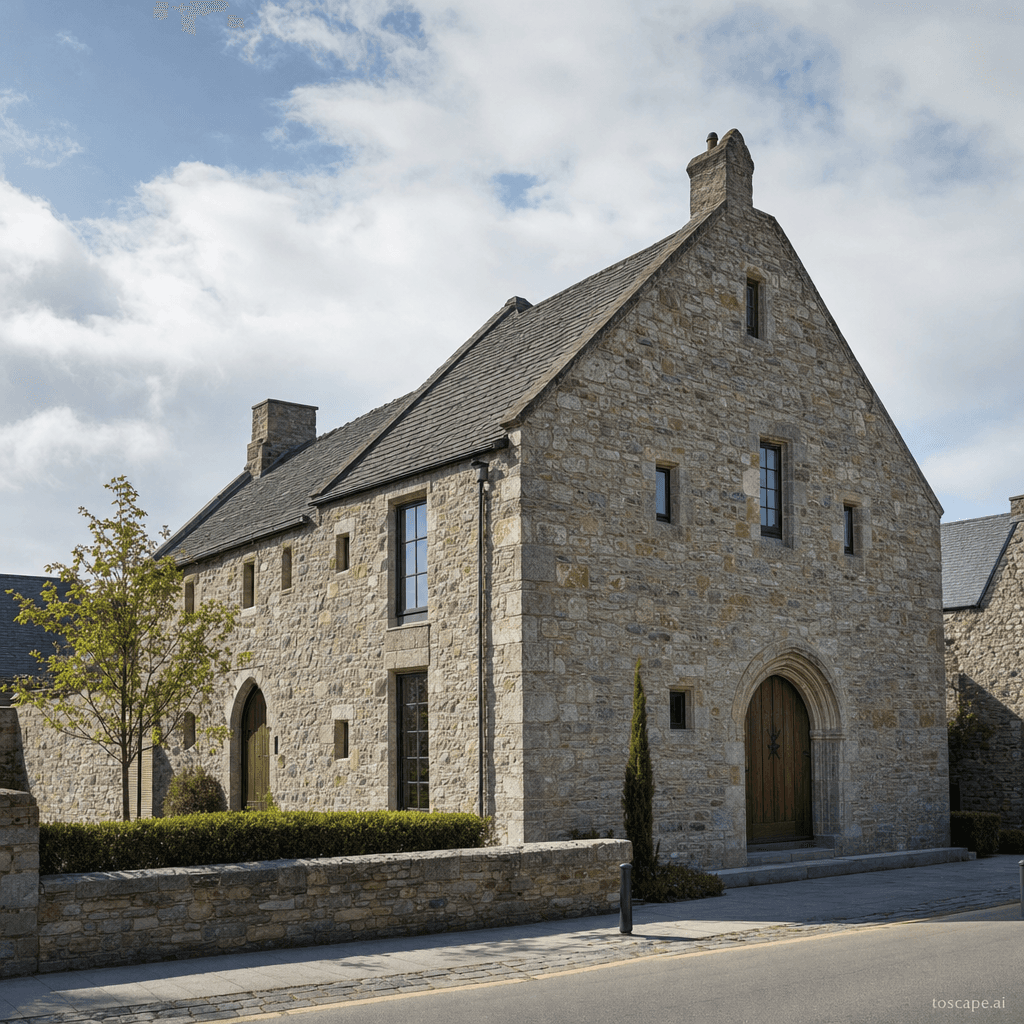
Irish Southeast Medieval & Vernacular — characteristic facade composition, southeast of Ireland (counties Kilkenny, Waterford, Wexford, Tipperary, Carlow).
Context Snapshot
The southeast of Ireland (counties Kilkenny, Waterford, Wexford, Tipperary, Carlow) — a region of rich architectural layering: (1) The medieval city of Kilkenny — the "Marble City" — built from dark g... The southeast has a slightly drier, sunnier climate than the west: (1) The southeast receives Ireland's highest sunshine hours and lowest rainfall — this makes it Ireland's most productive agricultural region (the "sunny...
Contemporary Relevance
Irish Southeast Medieval & Vernacular is useful today for residential, hospitality, civic, and place-branding work that needs Ireland-specific character grounded in local massing, material tone, climate response, and settlement logic rather than generic international styling.
Use this style in Toscape
Explore Irish Southeast Medieval & Vernacular directly inside Toscape using the Facade Re-Style and Design Options workflows.
Open Irish Southeast Medieval & Vernacular in the galleryFrequently asked questions
What is Irish Southeast Medieval & Vernacular?
Irish Southeast Medieval & Vernacular is a regional architectural identity from Ireland. The architectural landscape of southeast Ireland — from the medieval "Marble City" of Kilkenny with its dark Kilkenny limestone (marmar dubh — black marble) buildings, to the Norma.
What materials define Irish Southeast Medieval & Vernacular?
The southeast palette is dark stone and gold thatch: (1) Kilkenny limestone (marmar dubh) — dark grey to black (#404048 to #2A2A30), with visible fossil inclusions — the stone weathers to a lighter grey on exposed surfaces but retains its dark character — the polished "marble" is deep black (#1A1A20) with white fossil.
What is the Irish Southeast Medieval & Vernacular color palette?
White, cream, pale sand, warm timber, and shadow-driven dark metal accents define the palette. The facade should stay bright and climate-aware rather than heavy, gray, or over-saturated.
Where does Irish Southeast Medieval & Vernacular come from?
The southeast of Ireland (counties Kilkenny, Waterford, Wexford, Tipperary, Carlow) — a region of rich architectural layering: (1) The medieval city of Kilkenny — the "Marble City" — built from dark g.
When should architects use Irish Southeast Medieval & Vernacular?
Irish Southeast Medieval & Vernacular is useful today for residential, hospitality, civic, and place-branding work that needs Ireland-specific character grounded in local massing, material tone, climate response, and settlement logic rather than generic international styling.
How do you render Irish Southeast Medieval & Vernacular in Toscape?
Open Toscape on Windows, load your own photo, elevation, sketch, or CAD view, then apply the Irish Southeast Medieval & Vernacular reference from the built-in style library. The Facade Re-Style and Design Options workflows keep your project geometry and camera while shifting materials, proportion, and detailing toward Irish Southeast Medieval & Vernacular.