Southern
Thailand · Southern Thailand
Malay-Stilt Houses, Sino-Portuguese Shophouses & Andaman Coastal Vernacular
Definition
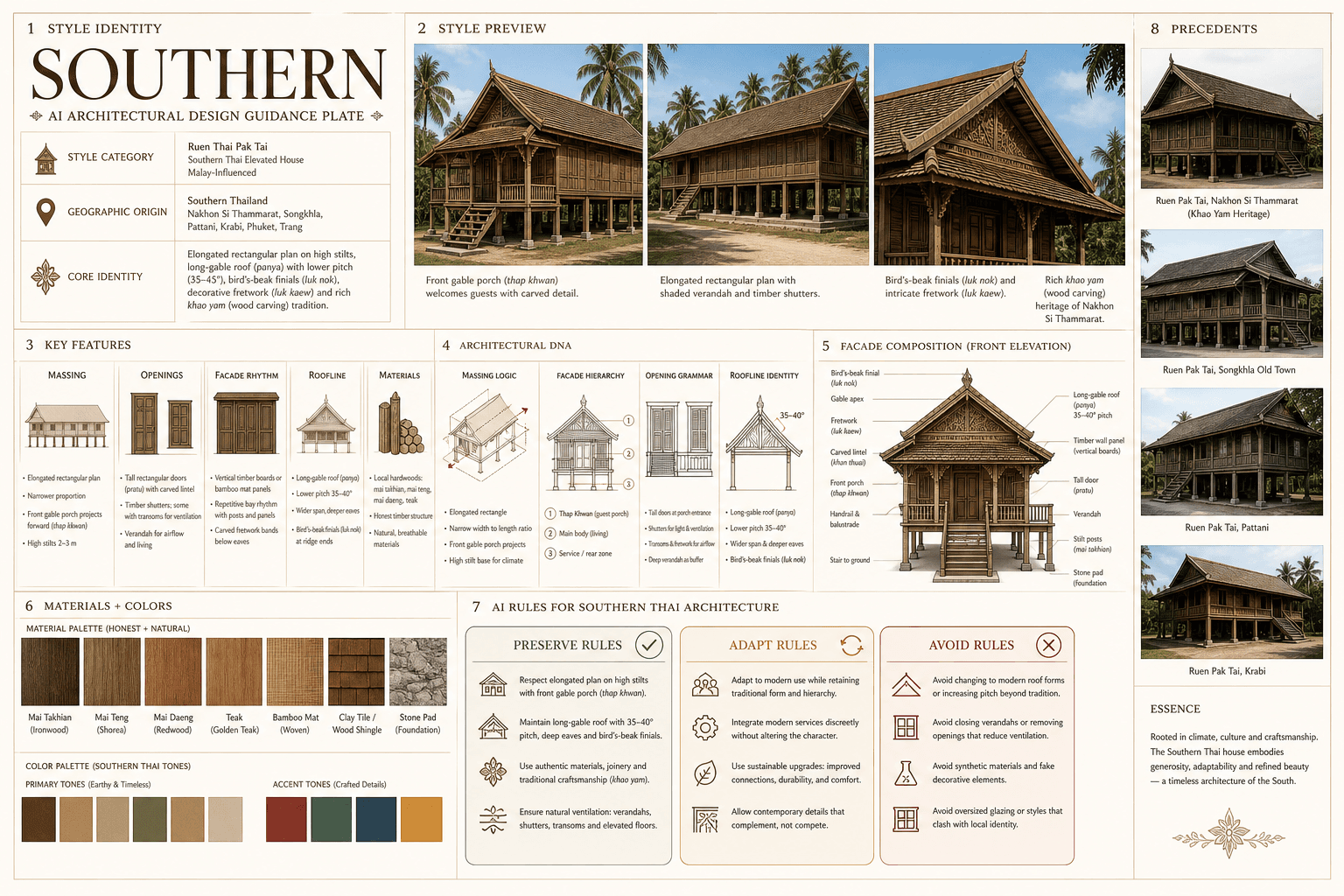
Southern is a regional architectural identity from Thailand. Malay-Stilt Houses, Sino-Portuguese Shophouses & Andaman Coastal Vernacular.
- Country
- Thailand
- Region
- Southern Thailand
- Massing
- Southern Thai house (ruen pak tai): elongated rectangular plan, often with a narrower proportion than Central Thai houses.
- Materials
- Timber: local hardwoods — mai takhian (ironwood — Hopea odorata), mai teng (Shorea obtusa), mai daeng (redwood). Teak (mai sak) less common than in the North.
- Palette
- White, cream, pale sand, warm timber, and shadow-driven dark metal accents define the palette.
- Climate response
- Tropical monsoon and rainforest — hot humid year-round (26-34°C), very high rainfall (2,000-4,000mm), two monsoon seasons (Southwest May-October, Northeast November-January).
Overview
Southern is a regional architectural identity in Thailand. Southern Thailand — Nakhon Si Thammarat, Songkhla, Pattani, Krabi, Phuket, Trang. Ruen Thai Pak Tai — Southern Thai elevated house, Malay-influenced elongated rectangular plan on high stilt posts (2-3m), long-gable roof (panya) with lower pitch (35-45°) than other Thai regions — wider span, less steep, bird's-beak gable finials (luk nok) at ridge ends, decorative timber fretwork (luk kaew) below gable eaves, extended...
Visual DNA
Massing & Form
Southern Thai house (ruen pak tai): elongated rectangular plan, often with a narrower proportion than Central Thai houses. Long-gable roof (panya): the gable runs the length of the house, rather than facing the street — unlike Central/Northern Thailand.
Facade Language
The long-gable roof orientation creates fundamentally different facade rhythm from other Thai regions: the gable is a side element, not the primary facade. The long wall (with veranda) is the social face.
Materials & Texture
Timber: local hardwoods — mai takhian (ironwood — Hopea odorata), mai teng (Shorea obtusa), mai daeng (redwood). Teak (mai sak) less common than in the North.
Color Palette
White, cream, pale sand, warm timber, and shadow-driven dark metal accents define the palette. The facade should stay bright and climate-aware rather than heavy, gray, or over-saturated.
Ornament & Detail
Khao yam wood carving (Nakhon Si Thammarat): the highest expression of Southern Thai domestic ornament — deep relief carving on wall panels, door panels, and window shutters with flowing vegetal motifs (lai kranok adapted to Southern style), phum khao bin (bushy rice sheaf pattern), and kranok plaew (flame-like motifs)...
Climate Response
Tropical monsoon and rainforest — hot humid year-round (26-34°C), very high rainfall (2,000-4,000mm), two monsoon seasons (Southwest May-October, Northeast November-January), coastal exposure with salt spray and occasional storm surge. High stilt elevation (2-3m): above tidal and monsoon flooding — critical in low-lyin...
Landscape & Ground
Southern Thailand — Nakhon Si Thammarat, Songkhla, Pattani, Krabi, Phuket, Trang. Tropical monsoon and rainforest — hot humid year-round (26-34°C), very high rainfall (2,000-4,000mm), two monsoon seasons (Southwest May-October, Northeast November-January), coastal exposure with salt spray and occasional storm surge.
Reference elevation
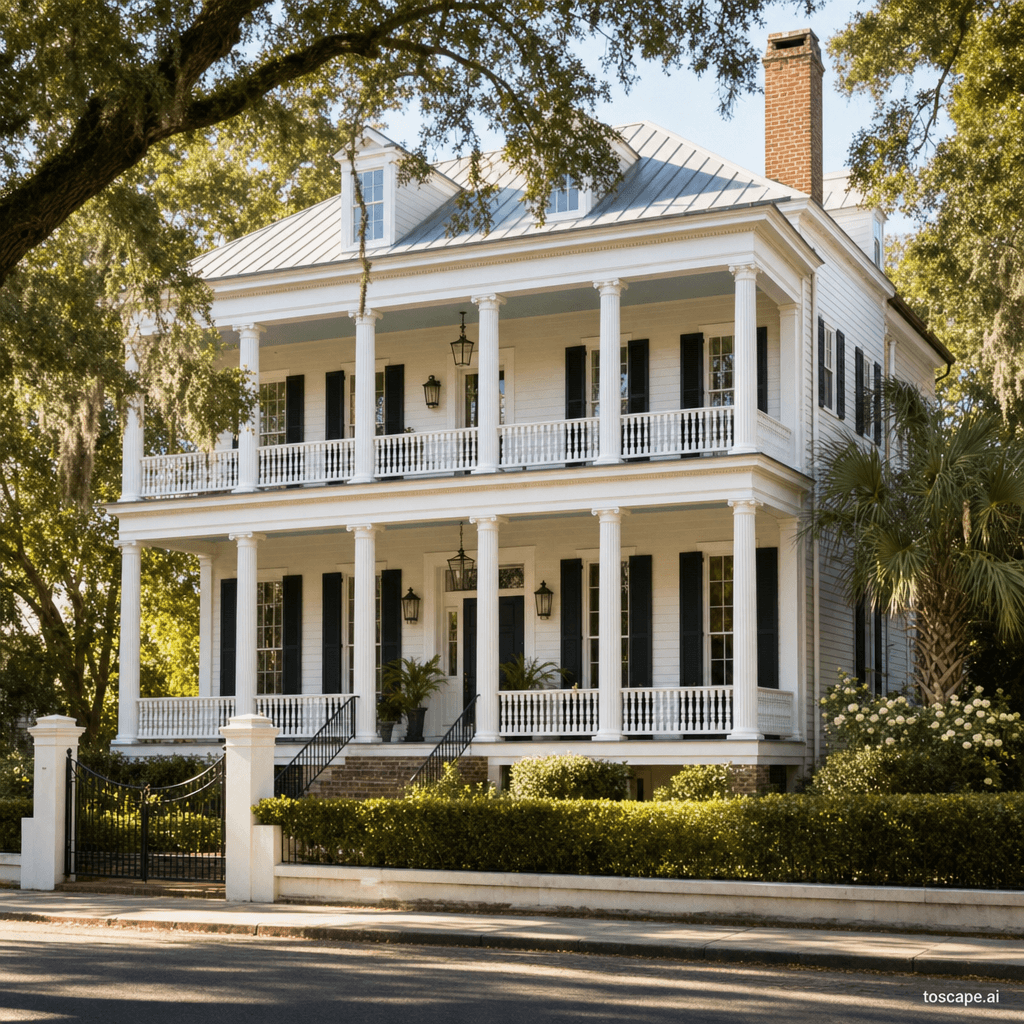
Southern — characteristic facade composition, Southern Thailand.
Context Snapshot
Southern Thailand — Nakhon Si Thammarat, Songkhla, Pattani, Krabi, Phuket, Trang Tropical monsoon and rainforest — hot humid year-round (26-34°C), very high rainfall (2,000-4,000mm), two monsoon seasons (Southwest May-October, Northeast November-January), coastal exposure with salt spray and occasion...
Contemporary Relevance
Southern is useful today for residential, hospitality, civic, and place-branding work that needs Thailand-specific character grounded in local massing, material tone, climate response, and settlement logic rather than generic international styling.
Use this style in Toscape
Explore Southern directly inside Toscape using the Facade Re-Style and Design Options workflows.
Open Southern in the galleryFrequently asked questions
What is Southern?
Southern is a regional architectural identity from Thailand. Malay-Stilt Houses, Sino-Portuguese Shophouses & Andaman Coastal Vernacular.
What materials define Southern?
Timber: local hardwoods — mai takhian (ironwood — Hopea odorata), mai teng (Shorea obtusa), mai daeng (redwood). Teak (mai sak) less common than in the North.
What is the Southern color palette?
White, cream, pale sand, warm timber, and shadow-driven dark metal accents define the palette. The facade should stay bright and climate-aware rather than heavy, gray, or over-saturated.
Where does Southern come from?
Southern Thailand — Nakhon Si Thammarat, Songkhla, Pattani, Krabi, Phuket, Trang Tropical monsoon and rainforest — hot humid year-round (26-34°C), very high rainfall (2,000-4,000mm), two monsoon seasons (Southwest May-October, Northeast November-January), coastal exposure with salt spray and occasion.
When should architects use Southern?
Southern is useful today for residential, hospitality, civic, and place-branding work that needs Thailand-specific character grounded in local massing, material tone, climate response, and settlement logic rather than generic international styling.
How do you render Southern in Toscape?
Open Toscape on Windows, load your own photo, elevation, sketch, or CAD view, then apply the Southern reference from the built-in style library. The Facade Re-Style and Design Options workflows keep your project geometry and camera while shifting materials, proportion, and detailing toward Southern.