Austrian Styria Wine-Country Courtyard House
Austria · Styrian courtyard farmhouse (Vierseithof / Steirischer Hof) of southeastern Aust...
The Styrian wine-country farmhouse (Steirisches Bauernhaus / Vierseithof) of southern Austria — a distinctive four-sided courtyard farm (Vierseithof) typical of the Styrian Weinlan...
Definition
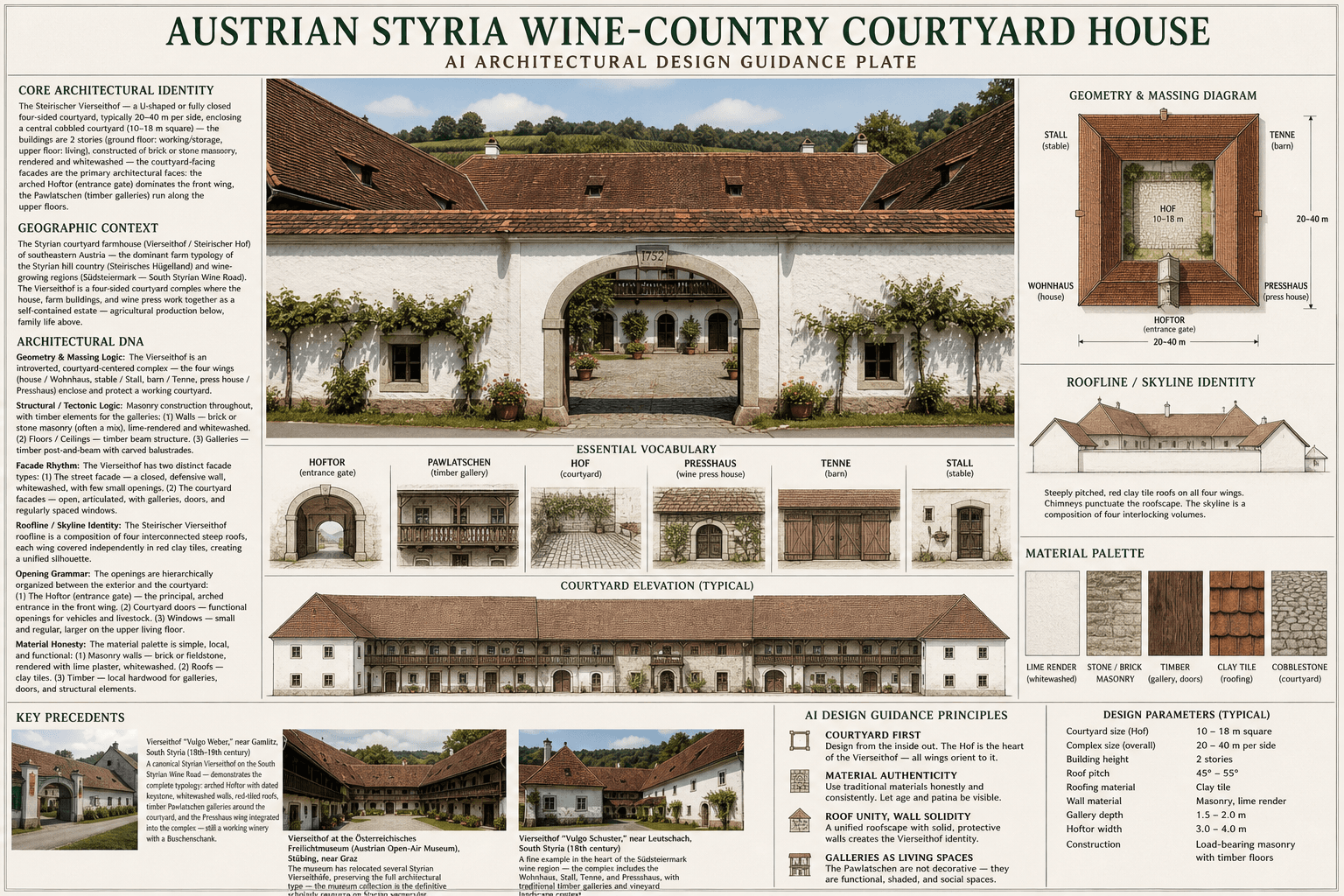
Austrian Styria Wine-Country Courtyard House is a regional architectural identity from Austria. The Styrian wine-country farmhouse (Steirisches Bauernhaus / Vierseithof) of southern Austria — a distinctive four-sided courtyard farm (Vierseithof) typical of the Styrian Weinlan.
- Country
- Austria
- Region
- Styrian courtyard farmhouse (Vierseithof / Steirischer Hof) of southeastern Aust.
- Massing
- The Vierseithof is an introverted, courtyard-centered complex — the four wings (house / Wohnhaus, stable / Stall, barn / Stadel.
- Materials
- The material palette is simple, local, and functional: (1) Masonry walls — brick or fieldstone.
- Palette
- White, cream, pale sand, warm timber, and shadow-driven dark metal accents define the palette.
- Climate response
- The Styrian wine country (Südsteiermark) has a mild Pannonian-continental climate ideal for viticulture: (1) Warm summers (25–35°C) with adequate rainfall — the Vierseithof's closed courtyard creates.
Overview
Austrian Styria Wine-Country Courtyard House is a regional architectural identity in Austria. The Styrian courtyard farmhouse (Vierseithof / Steirischer Hof) of southeastern Austria — the dominant farm typology of the Styrian hill country (Steirisches Hügelland) and wine-growing regions (Südsteiermark — South Styrian Wine Road) — the Vierseithof is a four-sided courtyard complex where the house, stables, barn, and wine press house (Presshaus / Kellerstöckl) are arranged around a central paved courtyard (Innen...
Visual DNA
Massing & Form
The Vierseithof is an introverted, courtyard-centered complex — the four wings (house / Wohnhaus, stable / Stall, barn / Stadel, and wine press / Presshaus) enclose a central courtyard, creating a protected microcosm. The wings are typically 2 stories (6–9 m high to the eaves), with the roof pitch (30–40°) adding anoth...
Facade Language
The Vierseithof has two distinct facade types: (1) The street facade — a closed, defensive wall, whitewashed, with few small windows (shuttered), and the Hoftor as the single dominant element — the street facade is more about mass and surface than about rhythm. (2) The courtyard facades — the four interior elevations a...
Materials & Texture
The material palette is simple, local, and functional: (1) Masonry walls — brick or fieldstone, rendered with lime plaster and whitewashed (gekalkt) — the whitewash is functional (reflecting summer heat) and traditional (the Styrian landscape identity). (2) Stone — the local sandstone (Sandstein) or limestone (Kalkstei...
Color Palette
White, cream, pale sand, warm timber, and shadow-driven dark metal accents define the palette. The facade should stay bright and climate-aware rather than heavy, gray, or over-saturated.
Ornament & Detail
The Vierseithof ornament is restrained and functional: (1) The Hoftor — the most ornamented element: the dressed stone arch with a carved keystone bearing the date, the Vulgoname (farm name — often the original settler's name, e.g., "Vulgo Weber," "Vulgo Schuster"), and sometimes a religious symbol (cross, monogram of...
Climate Response
The Styrian wine country (Südsteiermark) has a mild Pannonian-continental climate ideal for viticulture: (1) Warm summers (25–35°C) with adequate rainfall — the Vierseithof's closed courtyard creates a microclimate: shaded, cooler in summer, protected from wind — the white walls reflect heat — the Pawlatschen galleries...
Landscape & Ground
The Styrian courtyard farmhouse (Vierseithof / Steirischer Hof) of southeastern Austria — the dominant farm typology of the Styrian hill country (Steirisches Hügelland) and wine-growing regions (Südsteiermark — South Styrian Wine Road) — the Vierseithof is a four-sided courtyard complex where the house, stables, barn...
Reference elevation
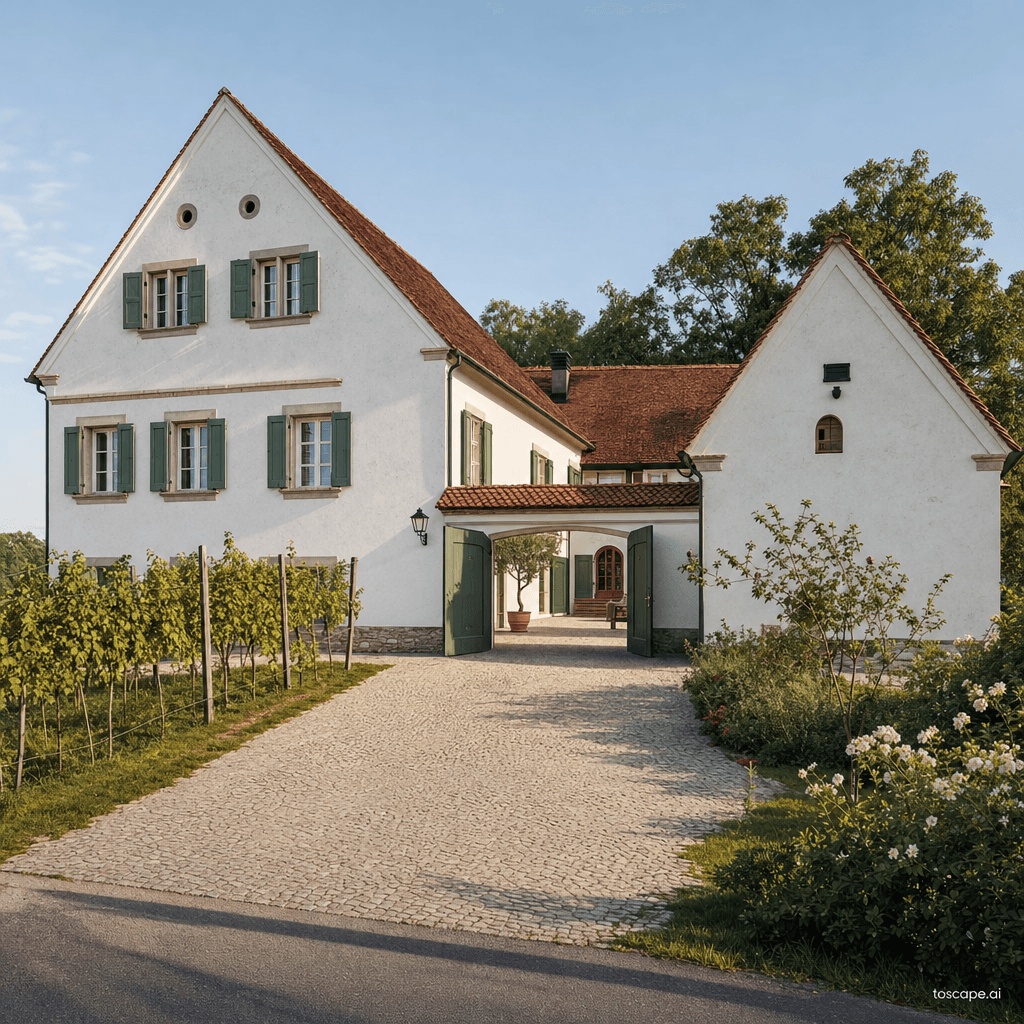
Austrian Styria Wine-Country Courtyard House — characteristic facade composition, Styrian courtyard farmhouse (Vierseithof / Steirischer Hof) of southeastern Aust....
Context Snapshot
The Styrian courtyard farmhouse (Vierseithof / Steirischer Hof) of southeastern Austria — the dominant farm typology of the Styrian hill country (Steirisches Hügelland) and wine-growing regions (Südst... The Styrian wine country (Südsteiermark) has a mild Pannonian-continental climate ideal for viticulture: (1) Warm summers (25–35°C) with adequate rainfall — the Vierseithof's closed courtyard creates a microclimate: shad...
Contemporary Relevance
Austrian Styria Wine-Country Courtyard House is useful today for residential, hospitality, civic, and place-branding work that needs Austria-specific character grounded in local massing, material tone, climate response, and settlement logic rather than generic international styling.
Use this style in Toscape
Explore Austrian Styria Wine-Country Courtyard House directly inside Toscape using the Facade Re-Style and Design Options workflows.
Open Austrian Styria Wine-Country Courtyard House in the galleryFrequently asked questions
What is Austrian Styria Wine-Country Courtyard House?
Austrian Styria Wine-Country Courtyard House is a regional architectural identity from Austria. The Styrian wine-country farmhouse (Steirisches Bauernhaus / Vierseithof) of southern Austria — a distinctive four-sided courtyard farm (Vierseithof) typical of the Styrian Weinlan.
What materials define Austrian Styria Wine-Country Courtyard House?
The material palette is simple, local, and functional: (1) Masonry walls — brick or fieldstone, rendered with lime plaster and whitewashed (gekalkt) — the whitewash is functional (reflecting summer heat) and traditional (the Styrian landscape identity). (2) Stone — the local sandstone (Sandstein) or limestone (Kalkstei.
What is the Austrian Styria Wine-Country Courtyard House color palette?
White, cream, pale sand, warm timber, and shadow-driven dark metal accents define the palette. The facade should stay bright and climate-aware rather than heavy, gray, or over-saturated.
Where does Austrian Styria Wine-Country Courtyard House come from?
The Styrian courtyard farmhouse (Vierseithof / Steirischer Hof) of southeastern Austria — the dominant farm typology of the Styrian hill country (Steirisches Hügelland) and wine-growing regions (Südst... The Styrian wine country (Südsteiermark) has a mild Pannonian-continental climate ideal for viticulture: (1) Warm summers (25–35°C) with adequate rainfall — the Vierseithof's closed courtyard creates a microclimate: shad.
When should architects use Austrian Styria Wine-Country Courtyard House?
Austrian Styria Wine-Country Courtyard House is useful today for residential, hospitality, civic, and place-branding work that needs Austria-specific character grounded in local massing, material tone, climate response, and settlement logic rather than generic international styling.
How do you render Austrian Styria Wine-Country Courtyard House in Toscape?
Open Toscape on Windows, load your own photo, elevation, sketch, or CAD view, then apply the Austrian Styria Wine-Country Courtyard House reference from the built-in style library. The Facade Re-Style and Design Options workflows keep your project geometry and camera while shifting materials, proportion, and detailing toward Austrian Styria Wine-Country Courtyard House.