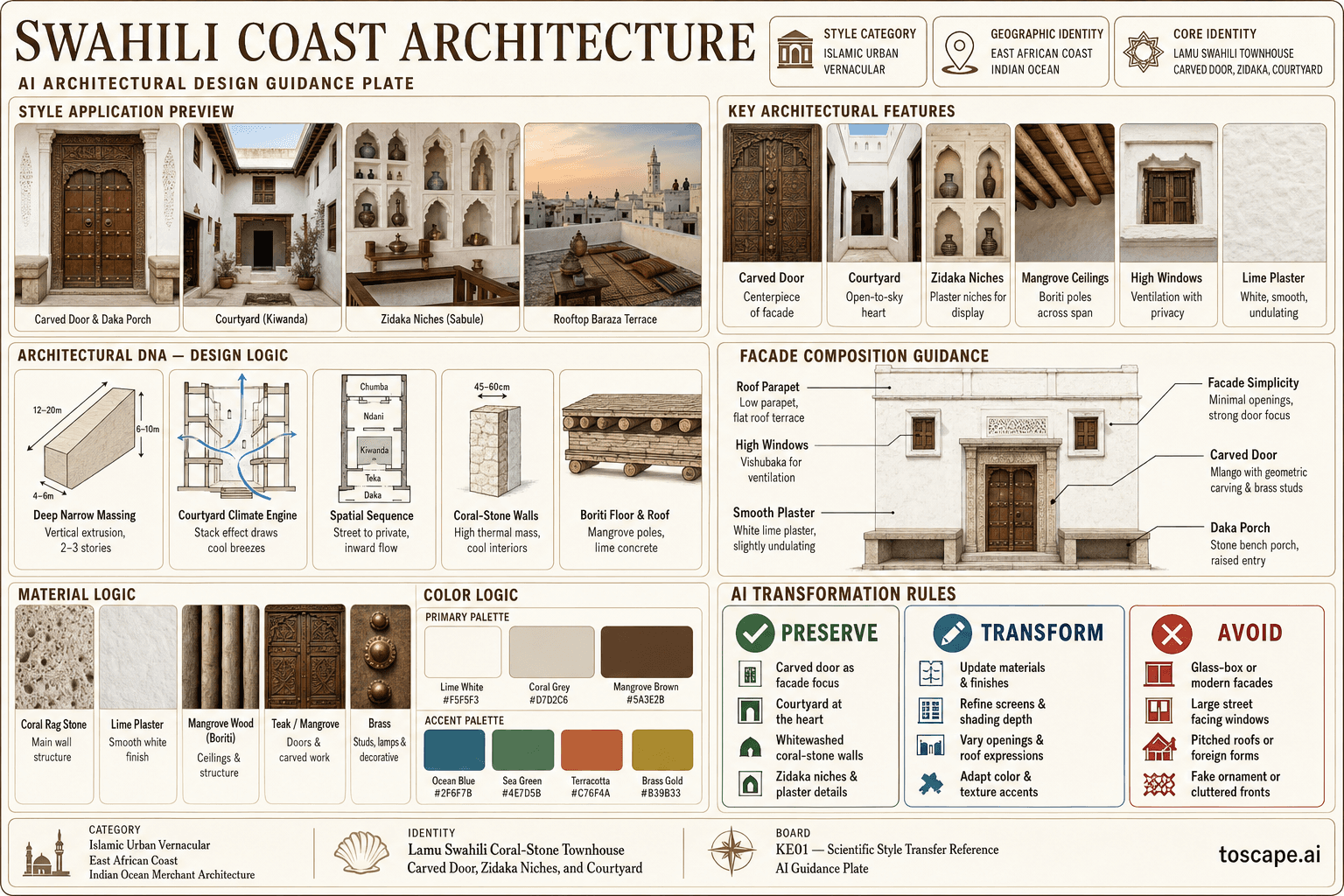
Swahili Coast
Kenya · architectural identity of the Swahili coast as expressed in Lamu Old Town (Kenya...
The coral-stone courtyard houses of Lamu and the Swahili coast — the 18th–19th century merchant townhouses with their intricately carved wooden doors, plasterwork niches (zidaka)...
Definition
Swahili Coast is a regional architectural identity from Kenya. The coral-stone courtyard houses of Lamu and the Swahili coast — the 18th–19th century merchant townhouses with their intricately carved wooden doors, plasterwork niches (zidaka).
- Country
- Kenya
- Region
- architectural identity of the Swahili coast as expressed in Lamu Old Town (Kenya.
- Massing
- The Swahili townhouse is a deep vertical extrusion — narrow street frontage (4–6 m), great depth (12–20 m), rising 2–3 stories (6–10 m).
- Materials
- The material palette is radically limited and locally sourced: (1) Coral rag stone — the reef itself, quarried, squared.
- Palette
- White, cream, pale sand, warm timber, and shadow-driven dark metal accents define the palette.
- Climate response
- Lamu Island (2°S latitude, tropical monsoon climate) experiences high temperatures (28–34°C) and humidity (70–85%) year-round, with the cooling kaskazi (northeast monsoon.
Overview
Swahili Coast is a regional architectural identity in Kenya. The architectural identity of the Swahili coast as expressed in Lamu Old Town (Kenya, UNESCO World Heritage) — the coral-rag-and-lime townhouse (nyumba) of the Swahili mercantile elite, a two-to-three-story rectilinear structure built around an internal courtyard (kiwanda), defined by its massive carved wooden front door, the zidaka (plaster wall niches) of the interior reception room (sabule), and the flat roof terr...
Visual DNA
Massing & Form
The Swahili townhouse is a deep vertical extrusion — narrow street frontage (4–6 m), great depth (12–20 m), rising 2–3 stories (6–10 m). The plan is organized sequentially from public to private: street → daka (entry porch) → teka (entrance lobby, often with a bench) → kiwanda (courtyard) → ndani (main living room, mos...
Facade Language
The street facade is a whitewashed plaster plane with a single compositional focus: the carved door. The daka (stone bench porch, often raised 30–60 cm above the alley) frames the entrance — a recessed bay with stone seats on either side.
Materials & Texture
The material palette is radically limited and locally sourced: (1) Coral rag stone — the reef itself, quarried, squared, and built into walls — the building is literally made from the sea. (2) Lime — burnt from the same coral, used as mortar, plaster, and floor finish.
Color Palette
White, cream, pale sand, warm timber, and shadow-driven dark metal accents define the palette. The facade should stay bright and climate-aware rather than heavy, gray, or over-saturated.
Ornament & Detail
Swahili ornament is concentrated at two points: (1) The carved door — the public face of the house, displaying wealth, piety, and Swahili identity — the door IS the facade ornament. (2) The zidaka plaster niches of the ndani (main room) — the interior ornament: arched recesses carved into the plaster walls in geometric...
Climate Response
Lamu Island (2°S latitude, tropical monsoon climate) experiences high temperatures (28–34°C) and humidity (70–85%) year-round, with the cooling kaskazi (northeast monsoon, December–March) and kusi (southeast monsoon, April–October). The Swahili house is a passive cooling machine: (1) High thermal mass — 45–60 cm coral...
Landscape & Ground
The architectural identity of the Swahili coast as expressed in Lamu Old Town (Kenya, UNESCO World Heritage) — the coral-rag-and-lime townhouse (nyumba) of the Swahili mercantile elite, a two-to-three-story rectilinear structure built around an internal courtyard (kiwanda), defined by its massive carved wooden front do...
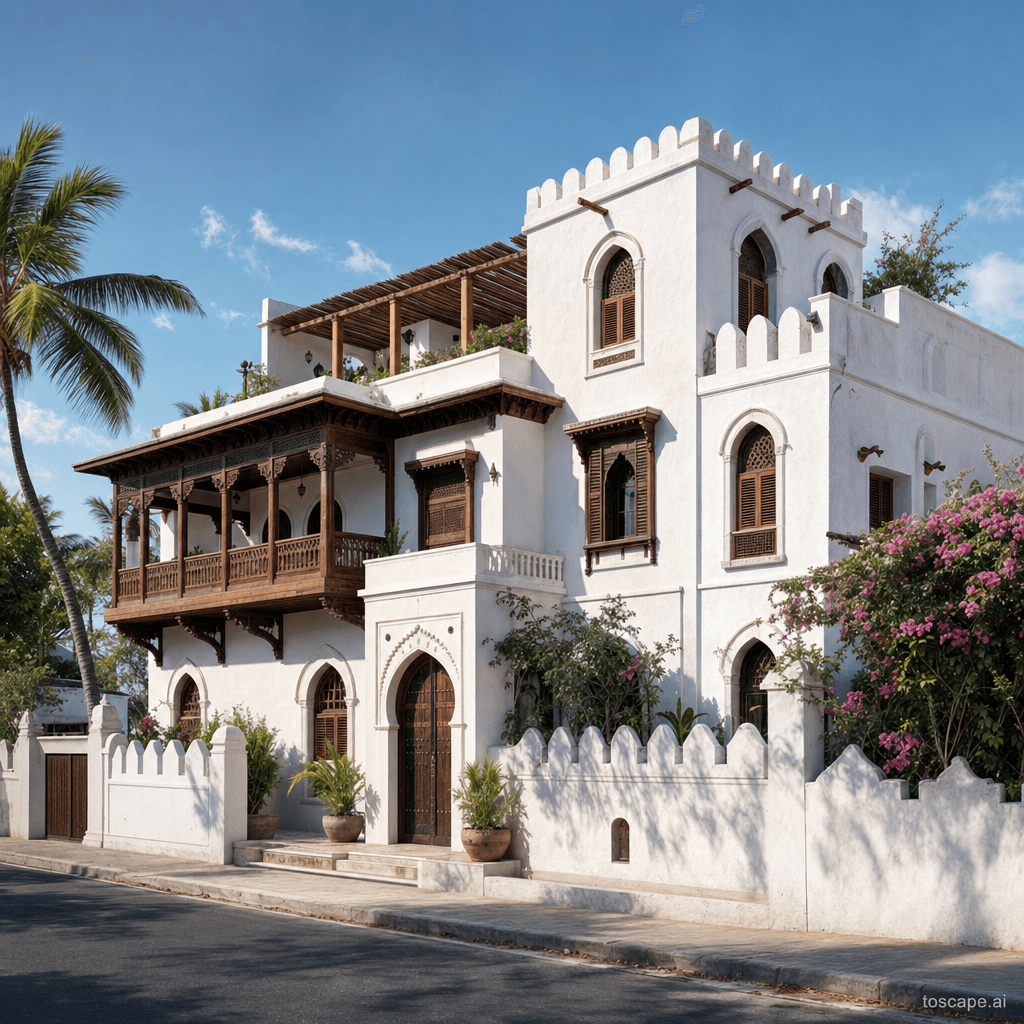
Reference elevation
Swahili Coast — characteristic facade composition, architectural identity of the Swahili coast as expressed in Lamu Old Town (Kenya....
Context Snapshot
The architectural identity of the Swahili coast as expressed in Lamu Old Town (Kenya, UNESCO World Heritage) — the coral-rag-and-lime townhouse (nyumba) of the Swahili mercantile elite, a two-to-three... Lamu Island (2°S latitude, tropical monsoon climate) experiences high temperatures (28–34°C) and humidity (70–85%) year-round, with the cooling kaskazi (northeast monsoon, December–March) and kusi (southeast monsoon, Apr...
Contemporary Relevance
Swahili Coast is useful today for residential, hospitality, civic, and place-branding work that needs Kenya-specific character grounded in local massing, material tone, climate response, and settlement logic rather than generic international styling.
Use this style in Toscape
Explore Swahili Coast directly inside Toscape using the Facade Re-Style and Design Options workflows.
Open Swahili Coast in the galleryFrequently asked questions
What is Swahili Coast?
Swahili Coast is a regional architectural identity from Kenya. The coral-stone courtyard houses of Lamu and the Swahili coast — the 18th–19th century merchant townhouses with their intricately carved wooden doors, plasterwork niches (zidaka).
What materials define Swahili Coast?
The material palette is radically limited and locally sourced: (1) Coral rag stone — the reef itself, quarried, squared, and built into walls — the building is literally made from the sea. (2) Lime — burnt from the same coral, used as mortar, plaster, and floor finish.
What is the Swahili Coast color palette?
White, cream, pale sand, warm timber, and shadow-driven dark metal accents define the palette. The facade should stay bright and climate-aware rather than heavy, gray, or over-saturated.
Where does Swahili Coast come from?
The architectural identity of the Swahili coast as expressed in Lamu Old Town (Kenya, UNESCO World Heritage) — the coral-rag-and-lime townhouse (nyumba) of the Swahili mercantile elite, a two-to-three... Lamu Island (2°S latitude, tropical monsoon climate) experiences high temperatures (28–34°C) and humidity (70–85%) year-round, with the cooling kaskazi (northeast monsoon, December–March) and kusi (southeast monsoon, Apr.
When should architects use Swahili Coast?
Swahili Coast is useful today for residential, hospitality, civic, and place-branding work that needs Kenya-specific character grounded in local massing, material tone, climate response, and settlement logic rather than generic international styling.
How do you render Swahili Coast in Toscape?
Open Toscape on Windows, load your own photo, elevation, sketch, or CAD view, then apply the Swahili Coast reference from the built-in style library. The Facade Re-Style and Design Options workflows keep your project geometry and camera while shifting materials, proportion, and detailing toward Swahili Coast.