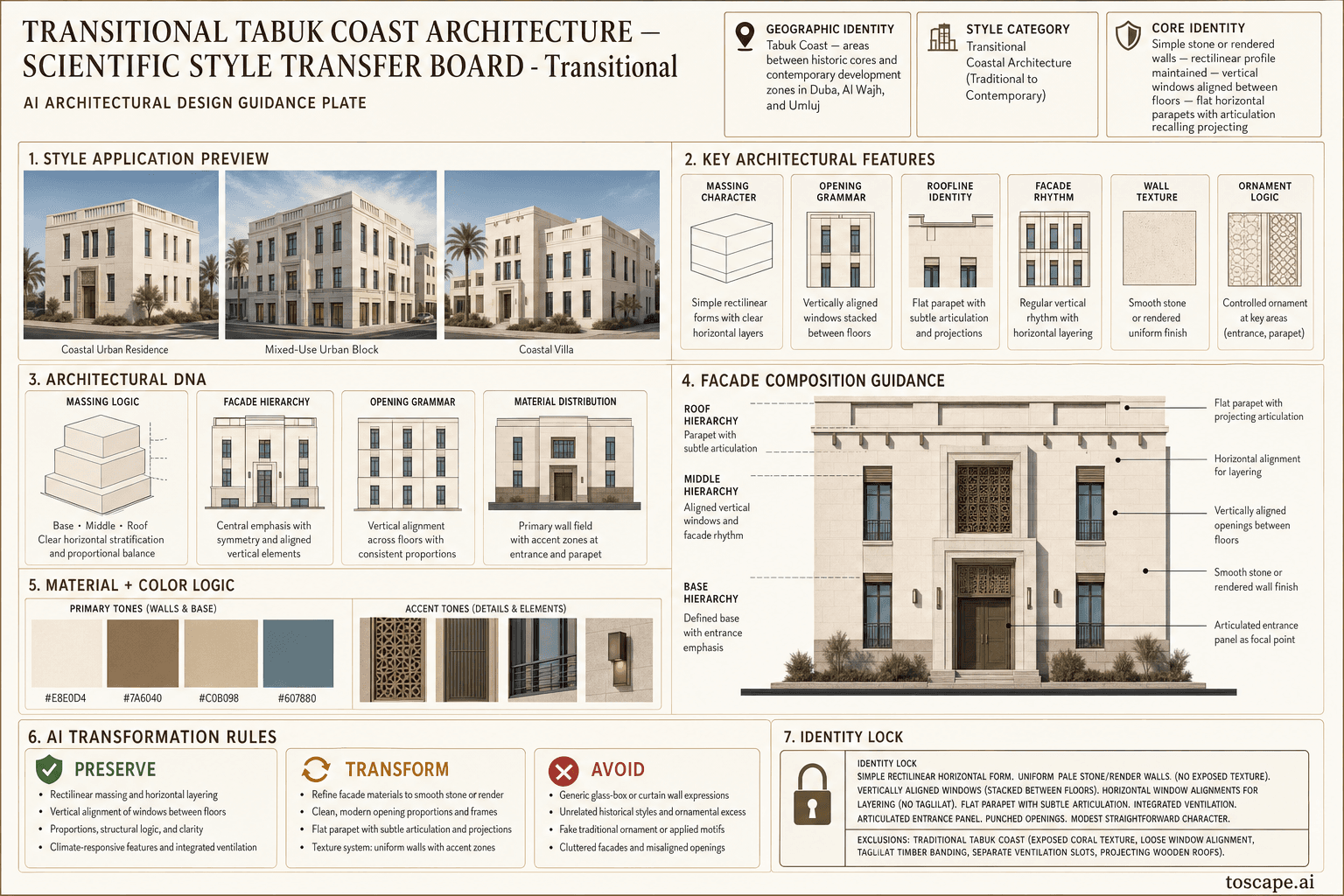
Tabuk Coast Transitional
Saudi Arabia · Tabuk Coast
The evolved Red Sea port expression — simple stone walls with aligned vertical windows, flat parapets, integrated ventilation, horizontal window alignments, articulated entrances
Definition
Tabuk Coast Transitional is a regional architectural identity from Saudi Arabia. The evolved Red Sea port expression — simple stone walls with aligned vertical windows, flat parapets, integrated ventilation, horizontal window alignments, articulated entrances.
- Country
- Saudi Arabia
- Region
- Tabuk Coast
- Massing
- Transitional buildings retain the simple rectangular building forms and horizontal proportions of the traditional model — the overall massing and proportions remain similar .
- Materials
- Solid pale walls in either stone or render — simpler and more uniform than traditional .
- Palette
- Use a light mineral field of sand, shell, coral, and sun-softened white, then introduce timber, bronze, or darker screened shadow as accent.
- Climate response
- Continuous streetwalls with organic variation continue from the traditional model — buildings work with neighbors to define clear street edges .
Overview
Tabuk Coast Transitional is a Saudi architectural identity rooted in Tabuk Coast. Northern Red Sea Coastal Architecture — Transitional level. Tabuk Coast — areas between historic cores and contemporary development zones in Duba, Al Wajh, and Umluj.
Visual DNA
Massing & Form
Transitional buildings retain the simple rectangular building forms and horizontal proportions of the traditional model — the overall massing and proportions remain similar . The transitional model is a progression of the traditional form without embracing all elements of the contemporary model .
Facade Language
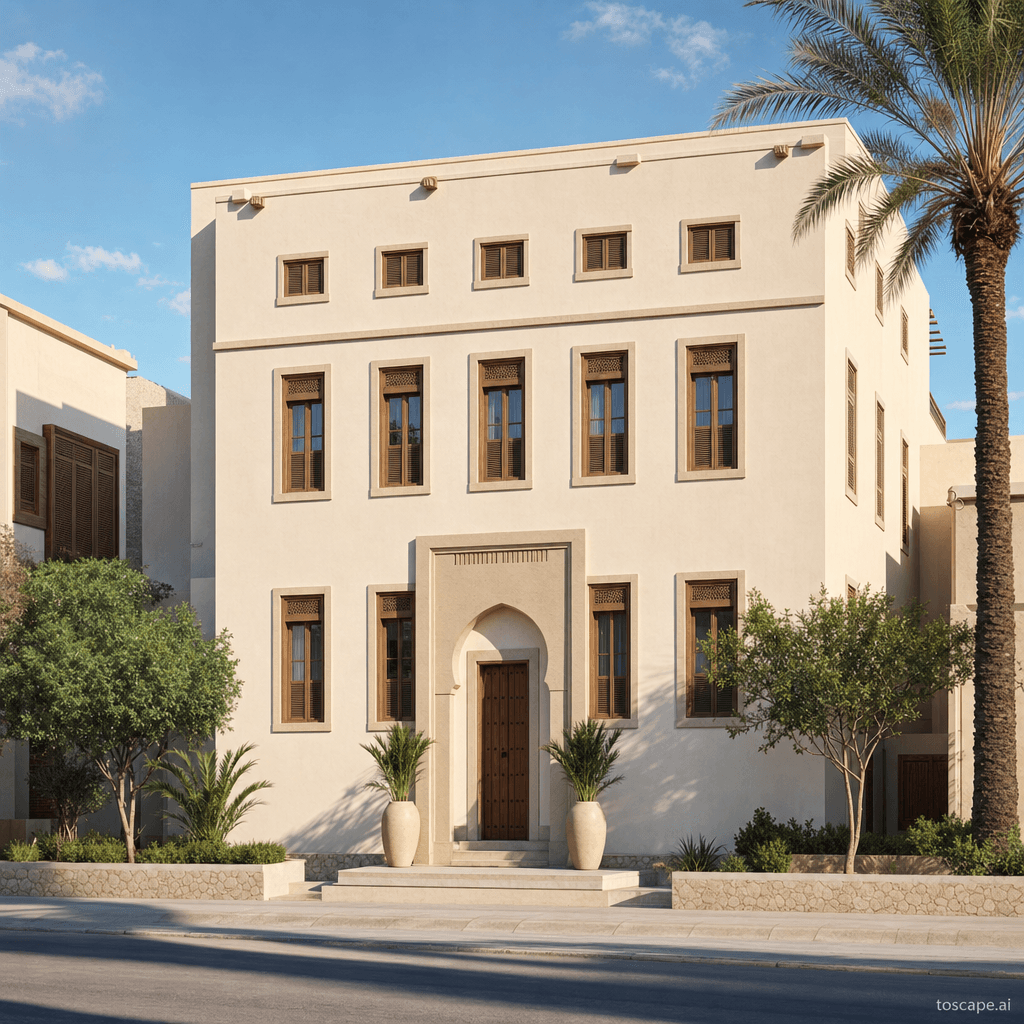
The key transitional shift: windows are aligned between upper and lower floors — a departure from the loose, misaligned traditional placement . Facades maintain localized symmetries and alignments between upper and lower floor windows.
Materials & Texture
Solid pale walls in either stone or render — simpler and more uniform than traditional . The exposed coral stone texture and lime-wash variation of the traditional model gives way to consistent wall finishes.
Color Palette
Use a light mineral field of sand, shell, coral, and sun-softened white, then introduce timber, bronze, or darker screened shadow as accent. Coastal and oasis palettes should feel bright, breathable, and climate-tempered rather than heavy or monochrome.
Ornament & Detail
Decoration is simplified further from traditional — the diamond motif may be abstracted or omitted . Horizontal window alignments serve as the primary visual ordering device, replacing decorative timber banding.
Climate Response
Continuous streetwalls with organic variation continue from the traditional model — buildings work with neighbors to define clear street edges . Private courtyards and lightwells remain important.
Landscape & Ground
Tabuk Coast — areas between historic cores and contemporary development zones in Duba, Al Wajh, and Umluj. Continuous streetwalls with organic variation continue from the traditional model — buildings work with neighbors to define clear street edges .
Reference elevation
Tabuk Coast Transitional — characteristic facade composition, Tabuk Coast.
Context Snapshot
Transitional interpretation of Tabuk Coast vernacular — rooted in the traditional model with acknowledgment of modern construction, skills, and interpretation — characterized by aligned vertical windo... Northern Red Sea Coastal Architecture — Transitional level Tabuk Coast — areas between historic cores and contemporary development zones in Duba, Al Wajh, and Umluj
Contemporary Relevance
Tabuk Coast Transitional is the bridge between conservation and current construction across Tabuk Coast, allowing contemporary programs to keep regional identity legible while using modern structure, services, and envelope systems. It is the most practical mode for streetscapes that need to feel rooted without becoming literal replicas.
Use this style in Toscape
Explore Tabuk Coast Transitional directly inside Toscape using the Facade Re-Style and Design Options workflows.
Open Tabuk Coast Transitional in the galleryFrequently asked questions
What is Tabuk Coast Transitional?
Tabuk Coast Transitional is a regional architectural identity from Saudi Arabia. The evolved Red Sea port expression — simple stone walls with aligned vertical windows, flat parapets, integrated ventilation, horizontal window alignments, articulated entrances.
What materials define Tabuk Coast Transitional?
Solid pale walls in either stone or render — simpler and more uniform than traditional . The exposed coral stone texture and lime-wash variation of the traditional model gives way to consistent wall finishes.
What is the Tabuk Coast Transitional color palette?
Use a light mineral field of sand, shell, coral, and sun-softened white, then introduce timber, bronze, or darker screened shadow as accent. Coastal and oasis palettes should feel bright, breathable, and climate-tempered rather than heavy or monochrome.
Where does Tabuk Coast Transitional come from?
Transitional interpretation of Tabuk Coast vernacular — rooted in the traditional model with acknowledgment of modern construction, skills, and interpretation — characterized by aligned vertical windo... Northern Red Sea Coastal Architecture — Transitional level Tabuk Coast — areas between historic cores and contemporary development zones in Duba, Al Wajh, and Umluj.
When should architects use Tabuk Coast Transitional?
Tabuk Coast Transitional is the bridge between conservation and current construction across Tabuk Coast, allowing contemporary programs to keep regional identity legible while using modern structure, services, and envelope systems. It is the most practical mode for streetscapes that need to feel rooted without becoming literal replicas.
How do you render Tabuk Coast Transitional in Toscape?
Open Toscape on Windows, load your own photo, elevation, sketch, or CAD view, then apply the Tabuk Coast Transitional reference from the built-in style library. The Facade Re-Style and Design Options workflows keep your project geometry and camera while shifting materials, proportion, and detailing toward Tabuk Coast Transitional.