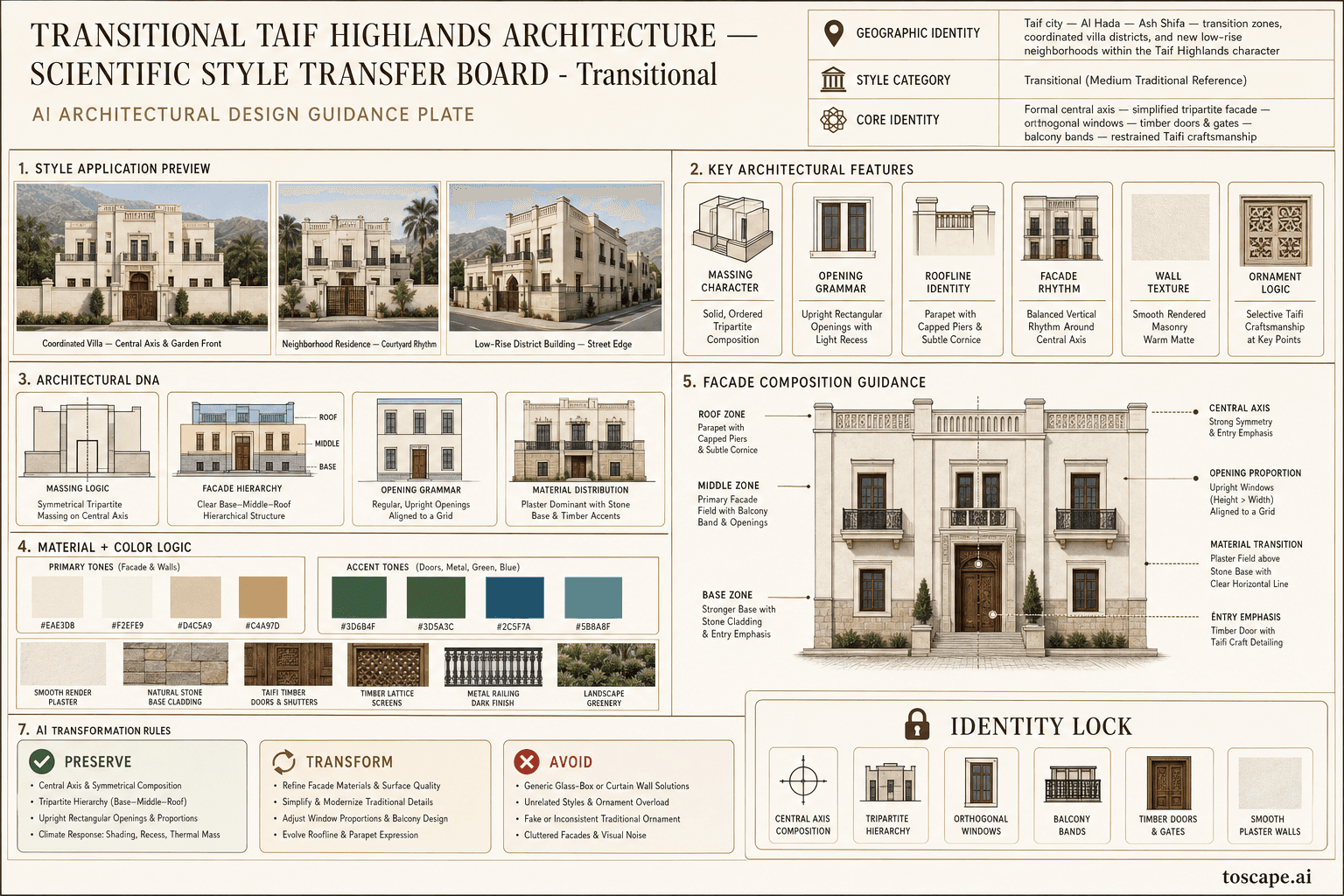
Taif Highlands Transitional
Saudi Arabia · Taif Highlands
The simplified rendered masonry tradition adapted for contemporary construction, mid-late 20th century CE
Definition
Taif Highlands Transitional is a regional architectural identity from Saudi Arabia. The simplified rendered masonry tradition adapted for contemporary construction, mid-late 20th century CE.
- Country
- Saudi Arabia
- Region
- Taif Highlands
- Massing
- Transitional Taif Highlands architecture remains recognizably descended from the traditional mansion and villa language, but simplifies it for contemporary implementation.
- Materials
- Rendered wall surfaces remain dominant, supported by stone, timber, and compatible substitute materials .
- Palette
- Stone greys, lime white, sun-aged timber, and selective mineral accents shape the palette.
- Climate response
- The style still belongs to Taif's temperate mountain plateau and should feel compatible with orchard landscapes, mild weather, and elevated streetscapes .
Overview
Taif Highlands Transitional is a Saudi architectural identity rooted in Taif Highlands. Taif highland mansion character adapted through simplified detailing, modern construction methods, and controlled reinterpretation of traditional forms. Taif city — Al Hada — Ash Shifa — transition zones, coordinated villa districts, and new low-rise neighborhoods within the Taif Highlands character area.
Visual DNA
Massing & Form
Transitional Taif Highlands architecture remains recognizably descended from the traditional mansion and villa language, but simplifies it for contemporary implementation. The facade should still read around a central axis with pronounced symmetry, a clear base-middle-top structure, and a composed street presence .
Facade Language
Rhythm comes from symmetry, vertical bays, horizontal cornicing, balconies, and coordinated opening spacing. Transitional facades emphasize horizontality more clearly than the traditional style while preserving formal order .
Materials & Texture
Rendered wall surfaces remain dominant, supported by stone, timber, and compatible substitute materials . Transitional design may simplify timber craft, use practical substitutes (stone-look cladding, painted metal), and reduce ornamental labor, but it must still look credible within the Taif Highlands palette.
Color Palette
Stone greys, lime white, sun-aged timber, and selective mineral accents shape the palette. Highland and escarpment identities can carry stronger painted or stratified contrast, but the wall mass should still feel geologic and rooted in terrain.
Ornament & Detail
Ornament is edited down, not abandoned. Transitional Taif uses simpler cornices, cleaner balcony lines, more restrained shutters and screens, and a controlled application of local patterns in gates, doors, and selected facade elements .
Climate Response
The style still belongs to Taif's temperate mountain plateau and should feel compatible with orchard landscapes, mild weather, and elevated streetscapes . Roof terraces, boundary walls, planted setbacks, and privacy-conscious openings remain important.
Landscape & Ground
Taif city — Al Hada — Ash Shifa — transition zones, coordinated villa districts, and new low-rise neighborhoods within the Taif Highlands character area. The style still belongs to Taif's temperate mountain plateau and should feel compatible with orchard landscapes, mild weather, and elevated streetscapes .
Reference elevation
Taif Highlands Transitional — characteristic facade composition, Taif Highlands.
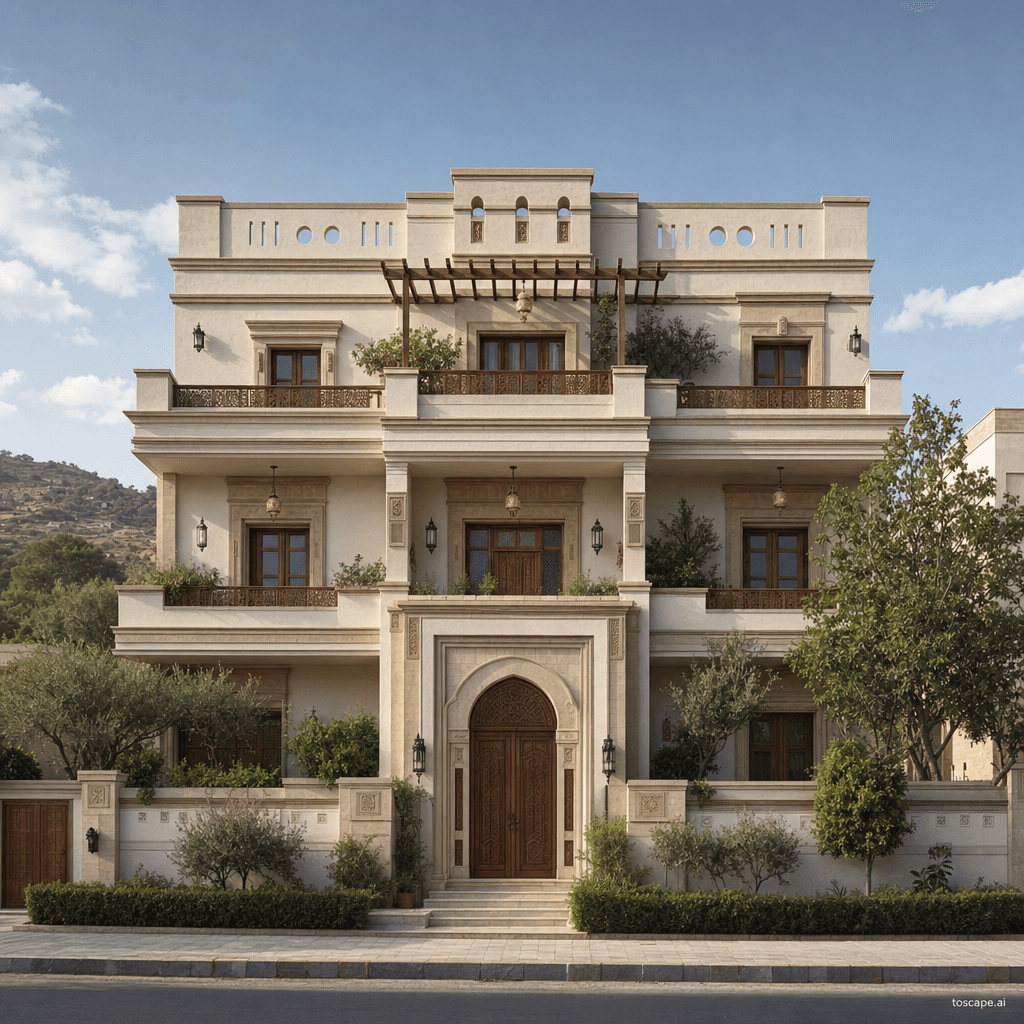
Context Snapshot
Balanced bridge between heritage Taif architecture and contemporary building delivery Taif highland mansion character adapted through simplified detailing, modern construction methods, and controlled reinterpretation of traditional forms Taif city — Al Hada — Ash Shifa — transition zones, coordinated villa districts, and new low-rise neighborhoods within the Taif Highlands character area
Contemporary Relevance
Taif Highlands Transitional is the bridge between conservation and current construction across Taif Highlands, allowing contemporary programs to keep regional identity legible while using modern structure, services, and envelope systems. It is the most practical mode for streetscapes that need to feel rooted without becoming literal replicas.
Use this style in Toscape
Explore Taif Highlands Transitional directly inside Toscape using the Facade Re-Style and Design Options workflows.
Open Taif Highlands Transitional in the galleryFrequently asked questions
What is Taif Highlands Transitional?
Taif Highlands Transitional is a regional architectural identity from Saudi Arabia. The simplified rendered masonry tradition adapted for contemporary construction, mid-late 20th century CE.
What materials define Taif Highlands Transitional?
Rendered wall surfaces remain dominant, supported by stone, timber, and compatible substitute materials . Transitional design may simplify timber craft, use practical substitutes (stone-look cladding, painted metal), and reduce ornamental labor, but it must still look credible within the Taif Highlands palette.
What is the Taif Highlands Transitional color palette?
Stone greys, lime white, sun-aged timber, and selective mineral accents shape the palette. Highland and escarpment identities can carry stronger painted or stratified contrast, but the wall mass should still feel geologic and rooted in terrain.
Where does Taif Highlands Transitional come from?
Balanced bridge between heritage Taif architecture and contemporary building delivery Taif highland mansion character adapted through simplified detailing, modern construction methods, and controlled reinterpretation of traditional forms Taif city — Al Hada — Ash Shifa — transition zones, coordinated villa districts, and new low-rise neighborhoods within the Taif Highlands character area.
When should architects use Taif Highlands Transitional?
Taif Highlands Transitional is the bridge between conservation and current construction across Taif Highlands, allowing contemporary programs to keep regional identity legible while using modern structure, services, and envelope systems. It is the most practical mode for streetscapes that need to feel rooted without becoming literal replicas.
How do you render Taif Highlands Transitional in Toscape?
Open Toscape on Windows, load your own photo, elevation, sketch, or CAD view, then apply the Taif Highlands Transitional reference from the built-in style library. The Facade Re-Style and Design Options workflows keep your project geometry and camera while shifting materials, proportion, and detailing toward Taif Highlands Transitional.