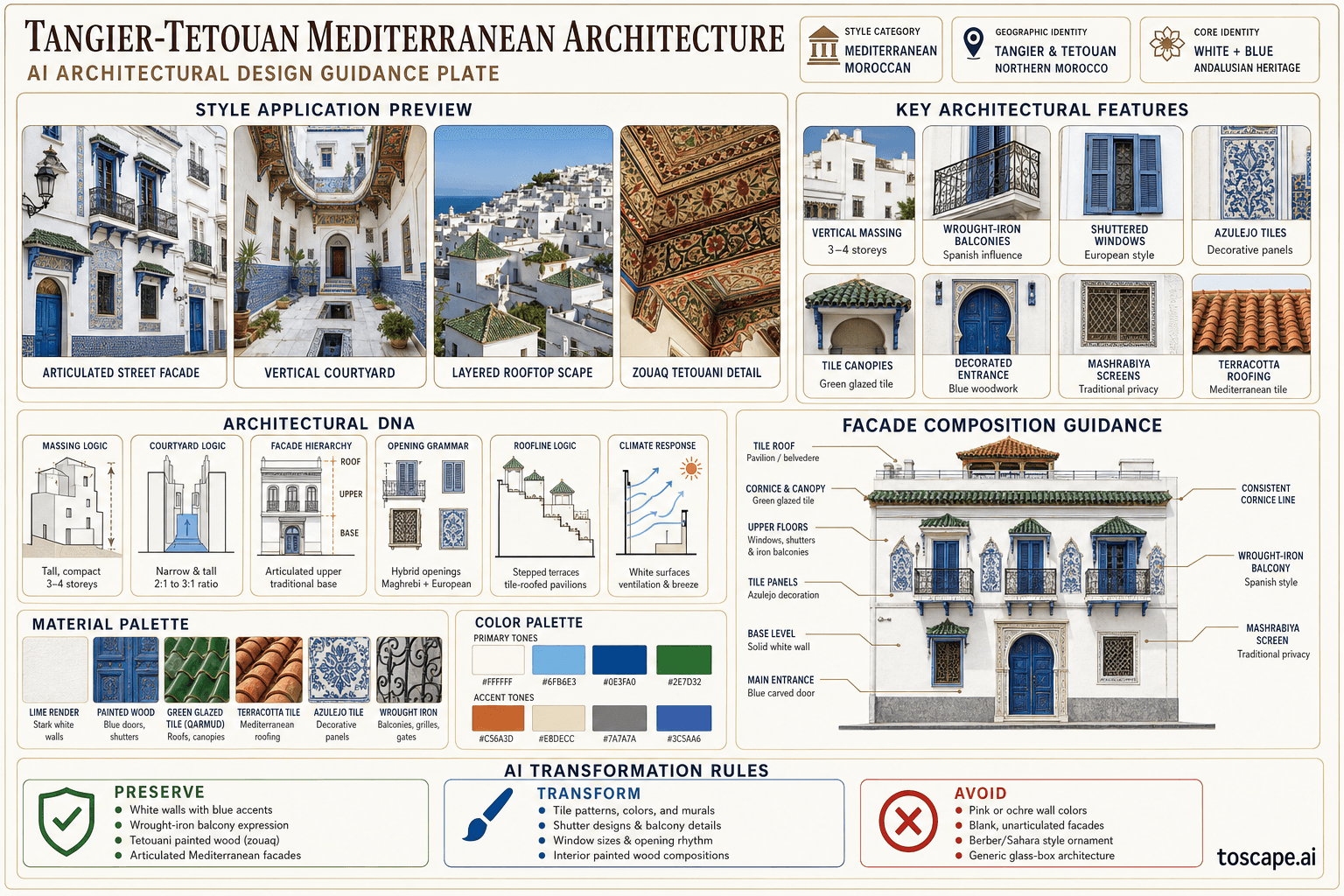
Tangier-Tetouan Mediterranean
Morocco · domestic architecture of Tangier and Tetouan
The Strait of Gibraltar gateway — the most cosmopolitan Moroccan architectural tradition, blending Maghrebi, Andalusian, and European Mediterranean influences
Definition
Tangier-Tetouan Mediterranean is a regional architectural identity from Morocco. The Strait of Gibraltar gateway — the most cosmopolitan Moroccan architectural tradition, blending Maghrebi, Andalusian, and European Mediterranean influences.
- Country
- Morocco
- Region
- domestic architecture of Tangier and Tetouan.
- Massing
- Tangier and Tetouan houses share the courtyard typology but with greater height and more external expression than any other Moroccan city: Vertical emphasis: Buildings in Tangier's.
- Materials
- The Tangier palette is Mediterranean-bright: Stark white lime wash — the brightest white in Morocco Cobalt/sky-blue painted woodwork — doors, shutters.
- Palette
- White, cream, pale sand, warm timber, and shadow-driven dark metal accents define the palette.
- Climate response
- The Strait of Gibraltar climate is Mediterranean: mild, wet winters (8–15°C, 800–1,000 mm rainfall — the wettest region in Morocco), warm dry summers (25–32°C).
Overview
Tangier-Tetouan Mediterranean is a regional architectural identity in Morocco. Traditional domestic architecture of Tangier and Tetouan — the Mediterranean-facing northern cities at the crossroads of Africa and Europe, where Moroccan courtyard traditions meet Spanish, Portuguese, and British colonial influences at the Strait of Gibraltar. Whitewashed lime-rendered walls (bright stark white) with blue accents — the strongest "white village" aesthetic in Morocco — Tetouan's distinctive painted wo...
Visual DNA
Massing & Form
Tangier and Tetouan houses share the courtyard typology but with greater height and more external expression than any other Moroccan city: Vertical emphasis: Buildings in Tangier's medina are taller than typical Moroccan medinas — 3–4 storeys is common (compared to Fès's 2–3) — the steep hillside topography of Tangier...
Facade Language
The Tangier-Tetouan street facade is the most articulated in Morocco — a hybrid of the Maghrebi blank wall and the European articulated elevation: Ground floor: The traditional blank rendered wall with a single decorated entrance door (Moroccan). Upper floors: A hybrid zone — larger windows (European-influenced) but st...
Materials & Texture
The Tangier palette is Mediterranean-bright: Stark white lime wash — the brightest white in Morocco Cobalt/sky-blue painted woodwork — doors, shutters, balconies — the "Blue City" identity (though Chefchaouen, nearby, is more famous for blue) Green glazed tile (qarmud) — roof canopies and accents Terracotta barrel tile...
Color Palette
White, cream, pale sand, warm timber, and shadow-driven dark metal accents define the palette. The facade should stay bright and climate-aware rather than heavy, gray, or over-saturated.
Ornament & Detail
Tetouan is renowned for its painted wood (zouaq) — a distinctively Tetouani craft that differs from both the Fassi and Marrakchi traditions: Zouaq Tetouani: Tetouani painted wood features more elaborate floral motifs (roses, carnations, vine scrolls) and a brighter, more varied color palette than other regions. The pai...
Climate Response
The Strait of Gibraltar climate is Mediterranean: mild, wet winters (8–15°C, 800–1,000 mm rainfall — the wettest region in Morocco), warm dry summers (25–32°C), high humidity, strong winds through the Strait. Key responses: White reflective surfaces: Maximum solar reflection — the stark white walls reduce heat absorpti...
Landscape & Ground
Traditional domestic architecture of Tangier and Tetouan — the Mediterranean-facing northern cities at the crossroads of Africa and Europe, where Moroccan courtyard traditions meet Spanish, Portuguese, and British colonial influences at the Strait of Gibraltar. The Strait of Gibraltar climate is Mediterranean: mild, we...
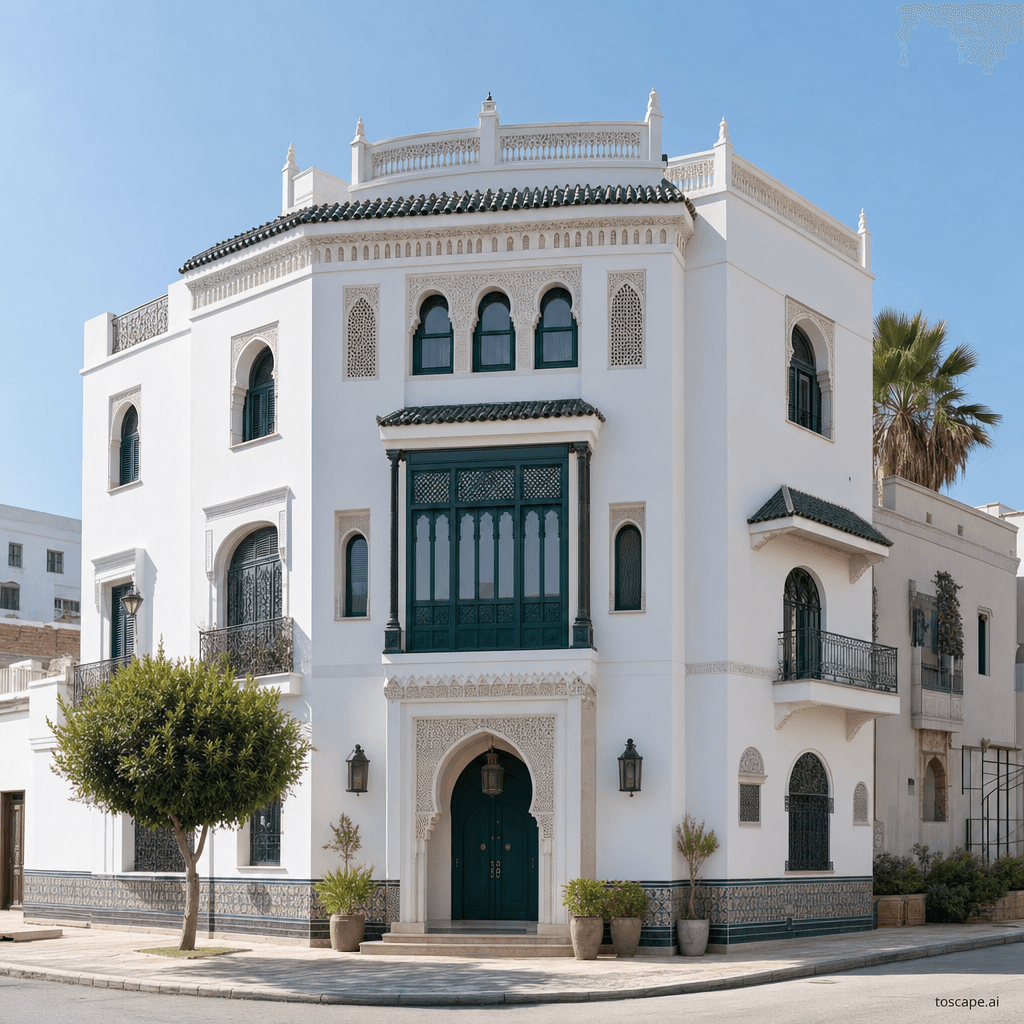
Reference elevation
Tangier-Tetouan Mediterranean — characteristic facade composition, domestic architecture of Tangier and Tetouan.
Context Snapshot
Traditional domestic architecture of Tangier and Tetouan — the Mediterranean-facing northern cities at the crossroads of Africa and Europe, where Moroccan courtyard traditions meet Spanish, Portuguese... The Strait of Gibraltar climate is Mediterranean: mild, wet winters (8–15°C, 800–1,000 mm rainfall — the wettest region in Morocco), warm dry summers (25–32°C), high humidity, strong winds through the Strait.
Contemporary Relevance
Tangier-Tetouan Mediterranean is useful today for residential, hospitality, civic, and place-branding work that needs Morocco-specific character grounded in local massing, material tone, climate response, and settlement logic rather than generic international styling.
Use this style in Toscape
Explore Tangier-Tetouan Mediterranean directly inside Toscape using the Facade Re-Style and Design Options workflows.
Open Tangier-Tetouan Mediterranean in the galleryFrequently asked questions
What is Tangier-Tetouan Mediterranean?
Tangier-Tetouan Mediterranean is a regional architectural identity from Morocco. The Strait of Gibraltar gateway — the most cosmopolitan Moroccan architectural tradition, blending Maghrebi, Andalusian, and European Mediterranean influences.
What materials define Tangier-Tetouan Mediterranean?
The Tangier palette is Mediterranean-bright: Stark white lime wash — the brightest white in Morocco Cobalt/sky-blue painted woodwork — doors, shutters, balconies — the "Blue City" identity (though Chefchaouen, nearby, is more famous for blue) Green glazed tile (qarmud) — roof canopies and accents Terracotta barrel tile.
What is the Tangier-Tetouan Mediterranean color palette?
White, cream, pale sand, warm timber, and shadow-driven dark metal accents define the palette. The facade should stay bright and climate-aware rather than heavy, gray, or over-saturated.
Where does Tangier-Tetouan Mediterranean come from?
Traditional domestic architecture of Tangier and Tetouan — the Mediterranean-facing northern cities at the crossroads of Africa and Europe, where Moroccan courtyard traditions meet Spanish, Portuguese... The Strait of Gibraltar climate is Mediterranean: mild, wet winters (8–15°C, 800–1,000 mm rainfall — the wettest region in Morocco), warm dry summers (25–32°C), high humidity, strong winds through the Strait.
When should architects use Tangier-Tetouan Mediterranean?
Tangier-Tetouan Mediterranean is useful today for residential, hospitality, civic, and place-branding work that needs Morocco-specific character grounded in local massing, material tone, climate response, and settlement logic rather than generic international styling.
How do you render Tangier-Tetouan Mediterranean in Toscape?
Open Toscape on Windows, load your own photo, elevation, sketch, or CAD view, then apply the Tangier-Tetouan Mediterranean reference from the built-in style library. The Facade Re-Style and Design Options workflows keep your project geometry and camera while shifting materials, proportion, and detailing toward Tangier-Tetouan Mediterranean.