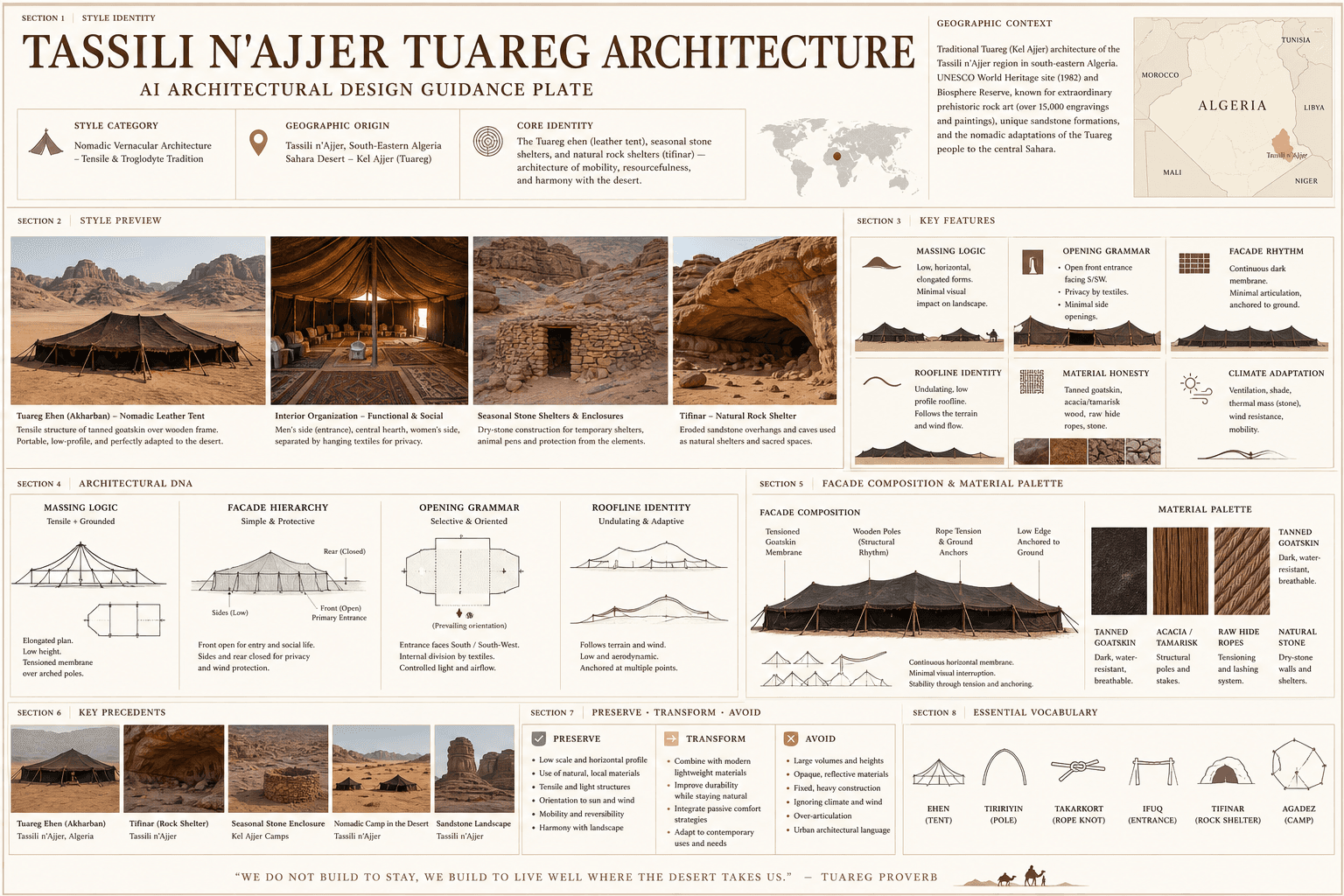
Tassili N'ajjer Tuareg
Algeria · Tuareg (Kel Ajjer) architecture of the Tassili n'Ajjer region in south-eastern A...
The Tuareg desert vernacular of the Tassili n'Ajjer plateau — nomadic tent architecture, stone shelters, and the architectural identity of the Kel Ajjer Tuareg in the central Sahar...
Definition
Tassili N'ajjer Tuareg is a regional architectural identity from Algeria. The Tuareg desert vernacular of the Tassili n'Ajjer plateau — nomadic tent architecture, stone shelters, and the architectural identity of the Kel Ajjer Tuareg in the central Sahar.
- Country
- Algeria
- Region
- Tuareg (Kel Ajjer) architecture of the Tassili n'Ajjer region in south-eastern.
- Massing
- Tuareg architecture of the Tassili n'Ajjer exists entirely on the spectrum of temporary and semi-permanent structures — there is no tradition of permanent masonry construction among.
- Materials
- Tanned goatskin — the traditional tent covering material, dark brown-black.
- Palette
- Warm earth, sandy beige, ochre, clay brown, and sun-softened mineral tones should dominate, with palm green or weathered timber as secondary accents.
- Climate response
- The Tuareg architectural system is an extreme desert adaptation: (1) Mobility — the tent is the primary response to nomadic pastoralism.
Overview
Tassili N'ajjer Tuareg is a regional architectural identity in Algeria. Traditional Tuareg (Kel Ajjer) architecture of the Tassili n'Ajjer region in south-eastern Algeria — a UNESCO World Heritage site (1982) and Biosphere Reserve, known for its extraordinary prehistoric rock art (over 15,000 engravings and paintings), unique sandstone rock formations, and the nomadic architectural traditions of the Tuareg people inhabiting this hyper-arid Saharan plateau. The Tuareg leather tent (ehen /...
Visual DNA
Massing & Form
Tuareg architecture of the Tassili n'Ajjer exists entirely on the spectrum of temporary and semi-permanent structures — there is no tradition of permanent masonry construction among the nomadic Kel Ajjer: Ehen (leather tent): The Tuareg tent is a low, elongated tensile structure — typically 3–4 m wide × 5–8 m long × 1....
Facade Language
The Tuareg tent facade is a dark, low, horizontal membrane in the desert landscape: Tent exterior: The tanned goatskin is dark brown to black — absorbing solar radiation and creating deep shade within. The tent presents as a simple geometric form — a low arch or ridge with sloping sides.
Materials & Texture
Tanned goatskin — the traditional tent covering material, dark brown-black, naturally water-resistant Acacia and tamarisk wood — for tent poles and frame elements Goat-hair rope and leather cord — for tent tensioning and lashing Woven palm-frond mats (asala) — for tent walls, ground covering, and windbreaks Local sands...
Color Palette
Warm earth, sandy beige, ochre, clay brown, and sun-softened mineral tones should dominate, with palm green or weathered timber as secondary accents. The palette should read as land-derived rather than polished or urban-generic.
Ornament & Detail
Tuareg material culture is expressed through portable arts rather than architectural ornament: (1) Leatherwork — intricately tooled, dyed, and appliquéd leather tent panels, bags, cushions, and saddlery — geometric patterns in red, yellow, green, and black, (2) silver jewelry and ornament — the Tuareg are renowned silv...
Climate Response
The Tuareg architectural system is an extreme desert adaptation: (1) Mobility — the tent is the primary response to nomadic pastoralism, allowing the group to follow seasonal pastures and water sources across the Tassili plateau and surrounding desert. (2) Shade creation — the dark tent membrane creates deep shade, red...
Landscape & Ground
Traditional Tuareg (Kel Ajjer) architecture of the Tassili n'Ajjer region in south-eastern Algeria — a UNESCO World Heritage site (1982) and Biosphere Reserve, known for its extraordinary prehistoric rock art (over 15,000 engravings and paintings), unique sandstone rock formations, and the nomadic architectural traditi...
Reference elevation
Tassili N'ajjer Tuareg — characteristic facade composition, Tuareg (Kel Ajjer) architecture of the Tassili n'Ajjer region in south-eastern A....
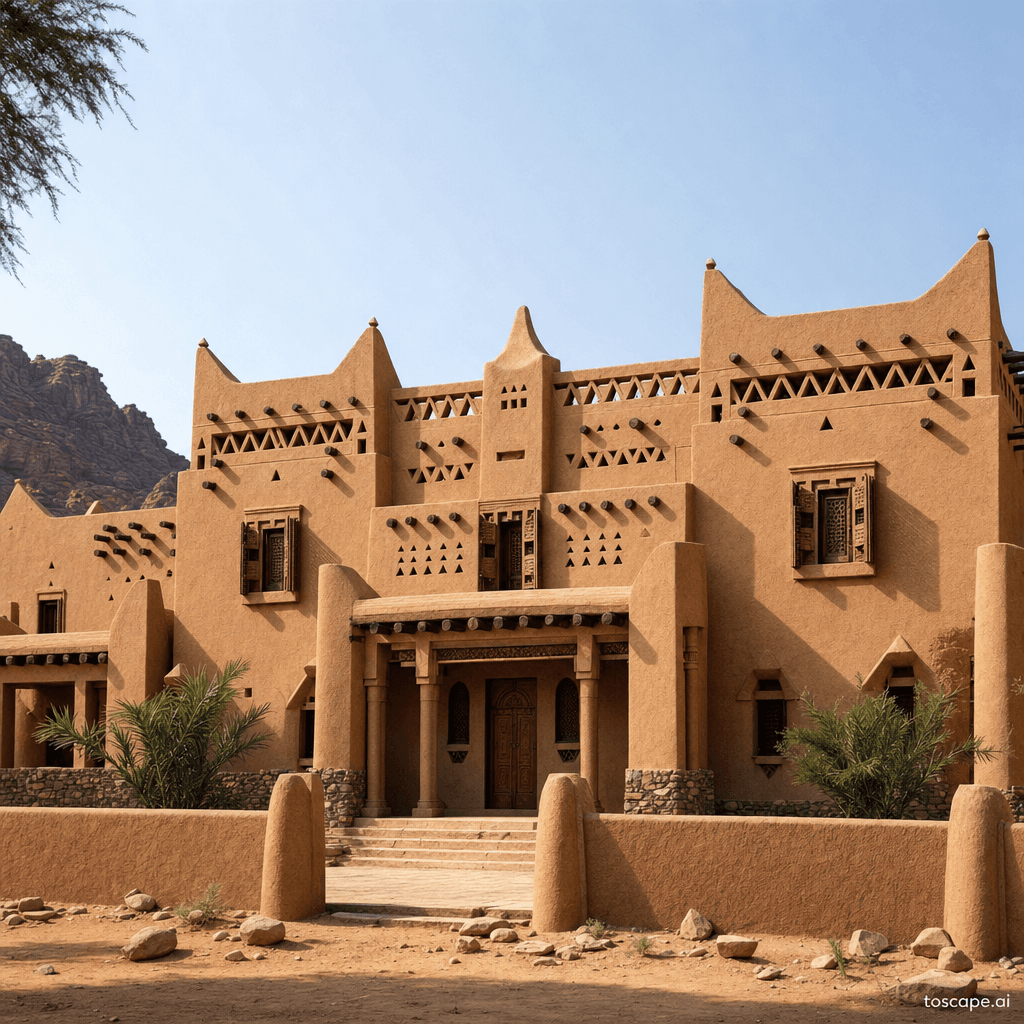
Context Snapshot
Traditional Tuareg (Kel Ajjer) architecture of the Tassili n'Ajjer region in south-eastern Algeria — a UNESCO World Heritage site (1982) and Biosphere Reserve, known for its extraordinary prehistoric... The Tuareg architectural system is an extreme desert adaptation: (1) Mobility — the tent is the primary response to nomadic pastoralism, allowing the group to follow seasonal pastures and water sources across the Tassili...
Contemporary Relevance
Tassili N'ajjer Tuareg is useful today for residential, hospitality, civic, and place-branding work that needs Algeria-specific character grounded in local massing, material tone, climate response, and settlement logic rather than generic international styling.
Use this style in Toscape
Explore Tassili N'ajjer Tuareg directly inside Toscape using the Facade Re-Style and Design Options workflows.
Open Tassili N'ajjer Tuareg in the galleryFrequently asked questions
What is Tassili N'ajjer Tuareg?
Tassili N'ajjer Tuareg is a regional architectural identity from Algeria. The Tuareg desert vernacular of the Tassili n'Ajjer plateau — nomadic tent architecture, stone shelters, and the architectural identity of the Kel Ajjer Tuareg in the central Sahar.
What materials define Tassili N'ajjer Tuareg?
Tanned goatskin — the traditional tent covering material, dark brown-black, naturally water-resistant Acacia and tamarisk wood — for tent poles and frame elements Goat-hair rope and leather cord — for tent tensioning and lashing Woven palm-frond mats (asala) — for tent walls, ground covering, and windbreaks Local sands.
What is the Tassili N'ajjer Tuareg color palette?
Warm earth, sandy beige, ochre, clay brown, and sun-softened mineral tones should dominate, with palm green or weathered timber as secondary accents. The palette should read as land-derived rather than polished or urban-generic.
Where does Tassili N'ajjer Tuareg come from?
Traditional Tuareg (Kel Ajjer) architecture of the Tassili n'Ajjer region in south-eastern Algeria — a UNESCO World Heritage site (1982) and Biosphere Reserve, known for its extraordinary prehistoric.
When should architects use Tassili N'ajjer Tuareg?
Tassili N'ajjer Tuareg is useful today for residential, hospitality, civic, and place-branding work that needs Algeria-specific character grounded in local massing, material tone, climate response, and settlement logic rather than generic international styling.
How do you render Tassili N'ajjer Tuareg in Toscape?
Open Toscape on Windows, load your own photo, elevation, sketch, or CAD view, then apply the Tassili N'ajjer Tuareg reference from the built-in style library. The Facade Re-Style and Design Options workflows keep your project geometry and camera while shifting materials, proportion, and detailing toward Tassili N'ajjer Tuareg.