Tripoli Coastal Medina
Libya · coastal urban house of Tripoli (Ṭarābulus al-Gharb)
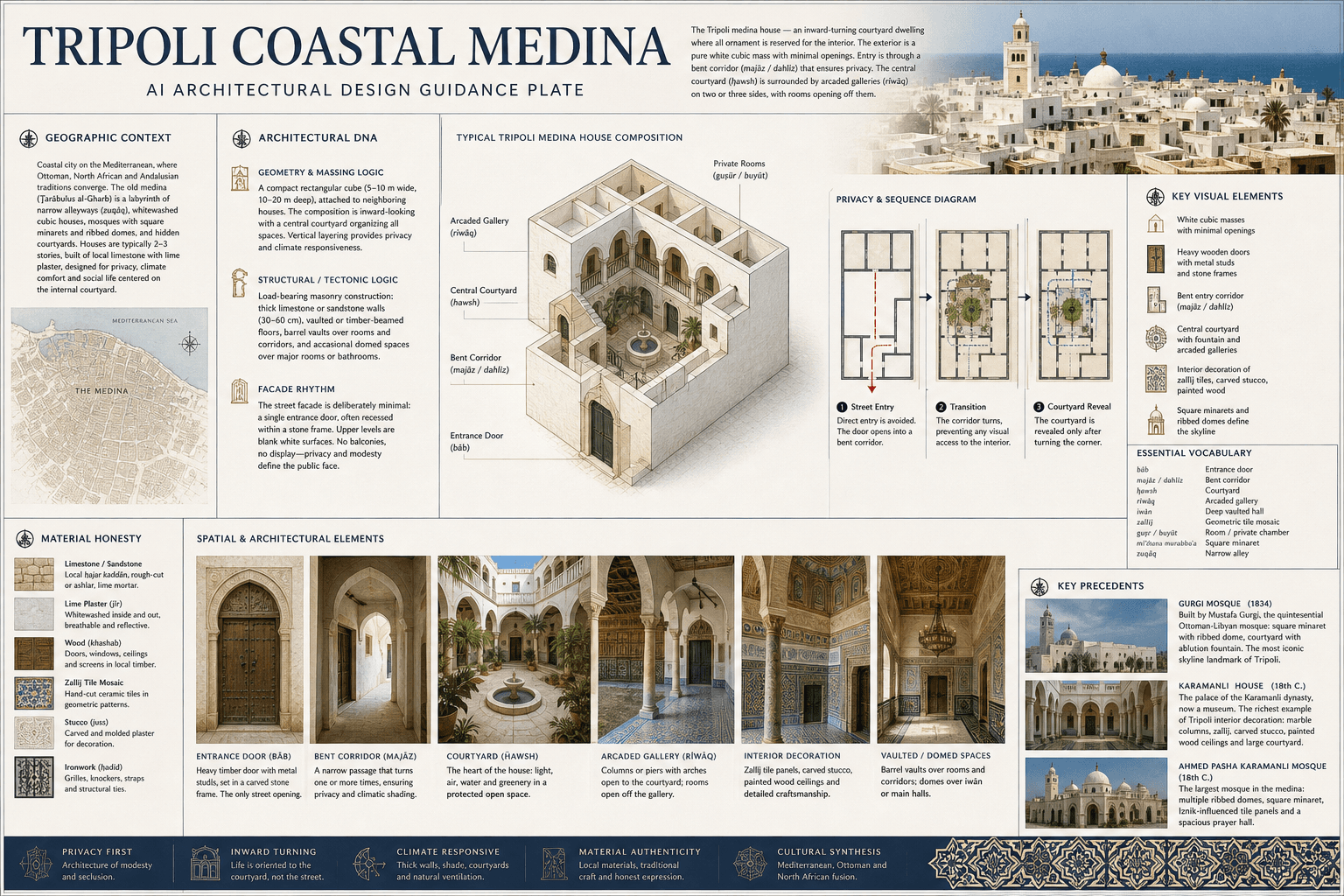
The whitewashed Mediterranean courtyard house of the Tripoli medina (al-madīna al-qadīma) — a dense urban fabric of flat-roofed cubic volumes with narrow arched alleyways, ornate m...
Definition
Tripoli Coastal Medina is a regional architectural identity from Libya. The whitewashed Mediterranean courtyard house of the Tripoli medina (al-madīna al-qadīma) — a dense urban fabric of flat-roofed cubic volumes with narrow arched alleyways, ornate m.
- Country
- Libya
- Region
- coastal urban house of Tripoli (Ṭarābulus al-Gharb).
- Massing
- The Tripoli medina house is a compact rectangular cube (5–10 m wide, 10–20 m deep).
- Materials
- Materials are Mediterranean-coastal with Saharan influences: (1) Limestone/Sandstone (ḥajar kaddān) — the primary masonry material.
- Palette
- White, cream, pale sand, warm timber, and shadow-driven dark metal accents define the palette.
- Climate response
- Tripoli has a hot-summer Mediterranean climate (Csa) with Saharan wind influences: (1) Summer temperatures reach 35–45°C with high humidity from the sea — the courtyard.
Overview
Tripoli Coastal Medina is a regional architectural identity in Libya. The coastal urban house of Tripoli (Ṭarābulus al-Gharb) — the old medina with its labyrinthine alleyways (zuqāq), whitewashed cubic house forms, internal courtyards (ḥawsh), and the fusion of Mediterranean, Ottoman, and North African architectural traditions — the Tripoli house is typically 2–3 stories, built of local limestone (ḥajar kaddān) or sandstone, rendered with lime plaster (jīr) and whitewashed — the flat r...
Visual DNA
Massing & Form
The Tripoli medina house is a compact rectangular cube (5–10 m wide, 10–20 m deep), tightly packed against neighboring houses in a continuous urban wall — the street facade is a single unbroken plane of whitewashed render, 6–10 m high (2–3 stories) — the massing is strictly orthogonal, following the grid of the medina'...
Facade Language
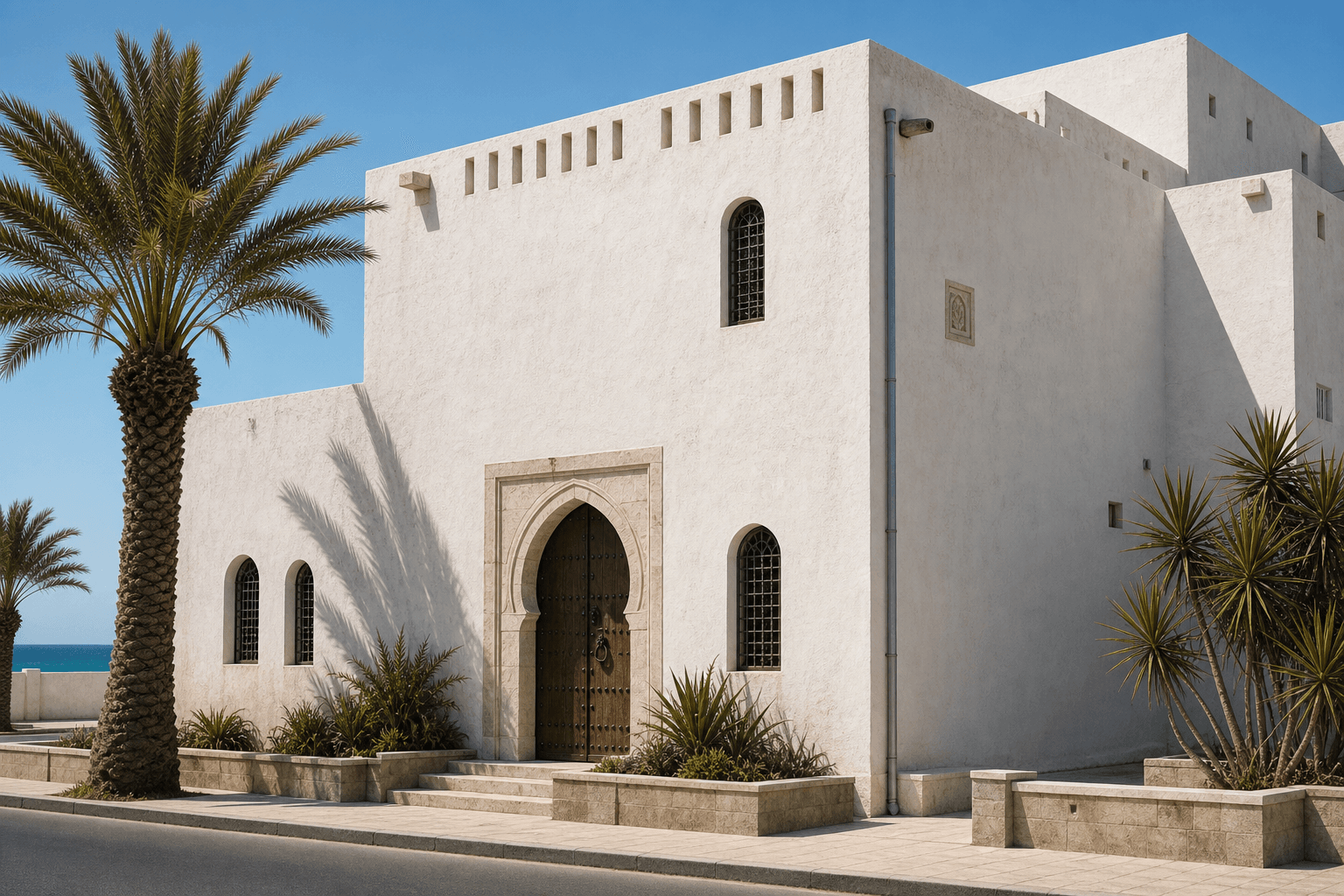
The street facade is deliberately minimal: (1) The ground floor — a single heavy entrance door, often recessed within a stone portal (bawwāba), with a carved stone arch or lintel — the door is of thick timber studded with iron nails (musāmīr) and fitted with a heavy iron knocker (daqqāqa). (2) Above the door, small hig...
Materials & Texture
Materials are Mediterranean-coastal with Saharan influences: (1) Limestone/Sandstone (ḥajar kaddān) — the primary masonry material, a cream-to-buff colored stone quarried near the coast — rendered with lime plaster and whitewashed. (2) Lime plaster (jīr) — produced by burning limestone in kilns — mixed with sand and wa...
Color Palette
White, cream, pale sand, warm timber, and shadow-driven dark metal accents define the palette. The facade should stay bright and climate-aware rather than heavy, gray, or over-saturated.
Ornament & Detail
Tripoli ornament is concentrated in the courtyard interior: (1) Zallīj tilework — geometric star patterns (khamāsī/five-pointed, thumānī/eight-pointed star compositions) covering dado-height wall panels (wazra) in the courtyard — the same tradition as Moroccan zellij but with distinctively Libyan color proportions (mor...
Climate Response
Tripoli has a hot-summer Mediterranean climate (Csa) with Saharan wind influences: (1) Summer temperatures reach 35–45°C with high humidity from the sea — the courtyard with its fountain and shade arcades creates a microclimate of evaporative cooling — the thick masonry walls delay heat transmission, keeping interiors...
Landscape & Ground
The coastal urban house of Tripoli (Ṭarābulus al-Gharb) — the old medina with its labyrinthine alleyways (zuqāq), whitewashed cubic house forms, internal courtyards (ḥawsh), and the fusion of Mediterranean, Ottoman, and North African architectural traditions — the Tripoli house is typically 2–3 stories, built of local...
Reference elevation
Tripoli Coastal Medina — characteristic facade composition, coastal urban house of Tripoli (Ṭarābulus al-Gharb).
Context Snapshot
The coastal urban house of Tripoli (Ṭarābulus al-Gharb) — the old medina with its labyrinthine alleyways (zuqāq), whitewashed cubic house forms, internal courtyards (ḥawsh), and the fusion of Mediterr... Tripoli has a hot-summer Mediterranean climate (Csa) with Saharan wind influences: (1) Summer temperatures reach 35–45°C with high humidity from the sea — the courtyard with its fountain and shade arcades creates a micro...
Contemporary Relevance
Tripoli Coastal Medina is useful today for residential, hospitality, civic, and place-branding work that needs Libya-specific character grounded in local massing, material tone, climate response, and settlement logic rather than generic international styling.
Use this style in Toscape
Explore Tripoli Coastal Medina directly inside Toscape using the Facade Re-Style and Design Options workflows.
Open Tripoli Coastal Medina in the galleryFrequently asked questions
What is Tripoli Coastal Medina?
Tripoli Coastal Medina is a regional architectural identity from Libya. The whitewashed Mediterranean courtyard house of the Tripoli medina (al-madīna al-qadīma) — a dense urban fabric of flat-roofed cubic volumes with narrow arched alleyways, ornate m.
What materials define Tripoli Coastal Medina?
Materials are Mediterranean-coastal with Saharan influences: (1) Limestone/Sandstone (ḥajar kaddān) — the primary masonry material, a cream-to-buff colored stone quarried near the coast — rendered with lime plaster and whitewashed. (2) Lime plaster (jīr) — produced by burning limestone in kilns — mixed with sand and wa.
What is the Tripoli Coastal Medina color palette?
White, cream, pale sand, warm timber, and shadow-driven dark metal accents define the palette. The facade should stay bright and climate-aware rather than heavy, gray, or over-saturated.
Where does Tripoli Coastal Medina come from?
The coastal urban house of Tripoli (Ṭarābulus al-Gharb) — the old medina with its labyrinthine alleyways (zuqāq), whitewashed cubic house forms, internal courtyards (ḥawsh), and the fusion of Mediterr.
When should architects use Tripoli Coastal Medina?
Tripoli Coastal Medina is useful today for residential, hospitality, civic, and place-branding work that needs Libya-specific character grounded in local massing, material tone, climate response, and settlement logic rather than generic international styling.
How do you render Tripoli Coastal Medina in Toscape?
Open Toscape on Windows, load your own photo, elevation, sketch, or CAD view, then apply the Tripoli Coastal Medina reference from the built-in style library. The Facade Re-Style and Design Options workflows keep your project geometry and camera while shifting materials, proportion, and detailing toward Tripoli Coastal Medina.