Tuhama Coast Transitional
Saudi Arabia · Tuhama Coast
The evolved stone arch house language — simplified traditional detail with contemporary material integration, mediating between heritage fidelity and modern construction
Definition
Tuhama Coast Transitional is a regional architectural identity from Saudi Arabia. The evolved stone arch house language — simplified traditional detail with contemporary material integration, mediating between heritage fidelity and modern construction.
- Country
- Saudi Arabia
- Region
- Tuhama Coast
- Massing
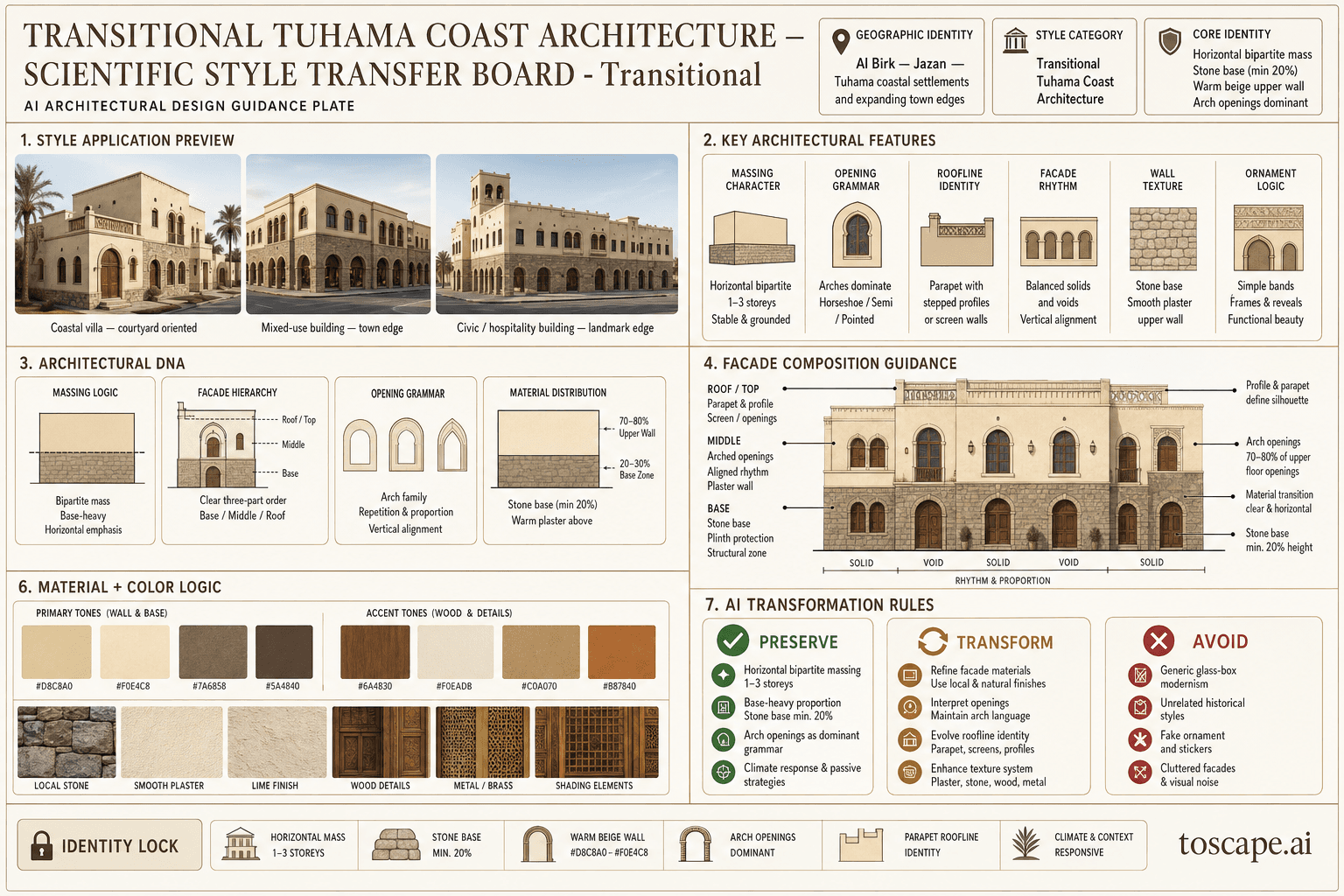
- Transitional Tuhama Coast buildings retain the horizontal emphasis of the Traditional style while expanding the height range to 1–3 storeys (typically 2). Documented width-to-height ratio: 1:0.
- Materials
- Primary material: 70–80% of facade in one consistent material — any quality material within the earth tone palette .
- Palette
- Stone greys, lime white, sun-aged timber, and selective mineral accents shape the palette.
- Climate response
- The Transitional style operates in the same hot humid coastal climate as Traditional but allows a slightly more open facade — 40% opening ratio permits more.
Overview
Tuhama Coast Transitional is a Saudi architectural identity rooted in Tuhama Coast. Tuhama Coast Architecture — Red Sea coastal vernacular, Transitional level. Al Birk — Jazan — Tuhama coastal settlements and expanding town edges.
Visual DNA
Massing & Form
Transitional Tuhama Coast buildings retain the horizontal emphasis of the Traditional style while expanding the height range to 1–3 storeys (typically 2). Documented width-to-height ratio: 1:0.5 to 1:1.5 — horizontal or balanced .
Facade Language
Facade rhythm follows a loosened bipartite system: solid grounded base + upper zone with mixed arch and rectangular openings. Arch-shaped openings remain dominant — horseshoe, semicircular, or pointed arch — but rectangular windows now appear in balance as secondary elements .
Materials & Texture
Primary material: 70–80% of facade in one consistent material — any quality material within the earth tone palette . The stone requirement shifts from "stone base mandatory" to "minimum 20% of facade must use stone or stone equivalent" — a quantified but more flexible rule .
Color Palette
Stone greys, lime white, sun-aged timber, and selective mineral accents shape the palette. Highland and escarpment identities can carry stronger painted or stratified contrast, but the wall mass should still feel geologic and rooted in terrain.
Ornament & Detail
The Transitional ornamental system simplifies the Traditional system while retaining its essential structure. Niche over-panels above arch openings are present but interpreted — stylized versions of the curvilinear/geometric/floral tradition, not exact copies .
Climate Response
The Transitional style operates in the same hot humid coastal climate as Traditional but allows a slightly more open facade — 40% opening ratio permits more daylight and ventilation while still maintaining the thermal logic of the bipartite mass. The stone or stone-equivalent base continues to provide thermal mass at g...
Landscape & Ground
Al Birk — Jazan — Tuhama coastal settlements and expanding town edges. The Transitional style operates in the same hot humid coastal climate as Traditional but allows a slightly more open facade — 40% opening ratio permits more daylight and ventilation while still maintaining the thermal logic of the bipartite mass.
Reference elevation
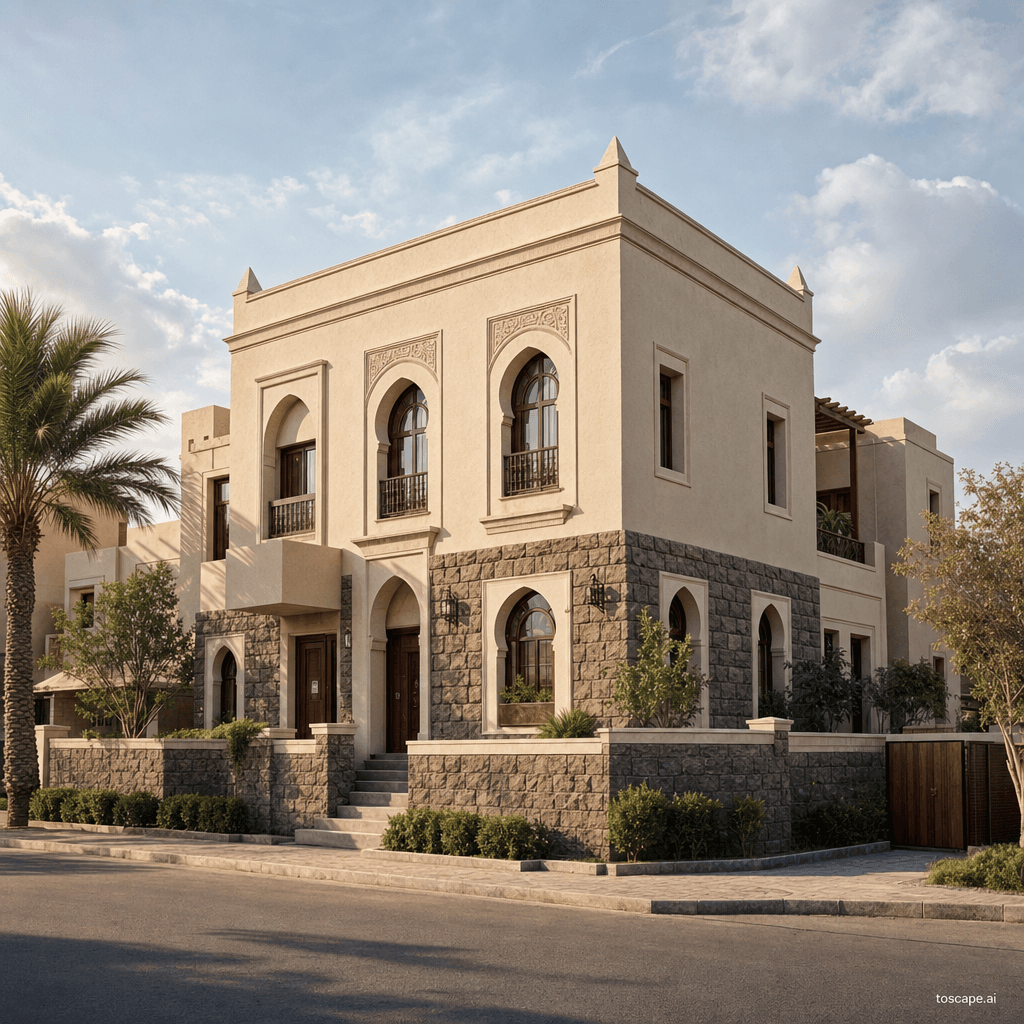
Tuhama Coast Transitional — characteristic facade composition, Tuhama Coast.
Context Snapshot
Faithful translation of Tuhama Coast identity signals — arch openings, bipartite facade, carved niche references, warm earth palette — in a simplified, buildable expression for current construction pr... Tuhama Coast Architecture — Red Sea coastal vernacular, Transitional level Al Birk — Jazan — Tuhama coastal settlements and expanding town edges
Contemporary Relevance
Tuhama Coast Transitional is the bridge between conservation and current construction across Tuhama Coast, allowing contemporary programs to keep regional identity legible while using modern structure, services, and envelope systems. It is the most practical mode for streetscapes that need to feel rooted without becoming literal replicas.
Use this style in Toscape
Explore Tuhama Coast Transitional directly inside Toscape using the Facade Re-Style and Design Options workflows.
Open Tuhama Coast Transitional in the galleryFrequently asked questions
What is Tuhama Coast Transitional?
Tuhama Coast Transitional is a regional architectural identity from Saudi Arabia. The evolved stone arch house language — simplified traditional detail with contemporary material integration, mediating between heritage fidelity and modern construction.
What materials define Tuhama Coast Transitional?
Primary material: 70–80% of facade in one consistent material — any quality material within the earth tone palette . The stone requirement shifts from "stone base mandatory" to "minimum 20% of facade must use stone or stone equivalent" — a quantified but more flexible rule .
What is the Tuhama Coast Transitional color palette?
Stone greys, lime white, sun-aged timber, and selective mineral accents shape the palette. Highland and escarpment identities can carry stronger painted or stratified contrast, but the wall mass should still feel geologic and rooted in terrain.
Where does Tuhama Coast Transitional come from?
Faithful translation of Tuhama Coast identity signals — arch openings, bipartite facade, carved niche references, warm earth palette — in a simplified, buildable expression for current construction pr... Tuhama Coast Architecture — Red Sea coastal vernacular, Transitional level Al Birk — Jazan — Tuhama coastal settlements and expanding town edges.
When should architects use Tuhama Coast Transitional?
Tuhama Coast Transitional is the bridge between conservation and current construction across Tuhama Coast, allowing contemporary programs to keep regional identity legible while using modern structure, services, and envelope systems. It is the most practical mode for streetscapes that need to feel rooted without becoming literal replicas.
How do you render Tuhama Coast Transitional in Toscape?
Open Toscape on Windows, load your own photo, elevation, sketch, or CAD view, then apply the Tuhama Coast Transitional reference from the built-in style library. The Facade Re-Style and Design Options workflows keep your project geometry and camera while shifting materials, proportion, and detailing toward Tuhama Coast Transitional.