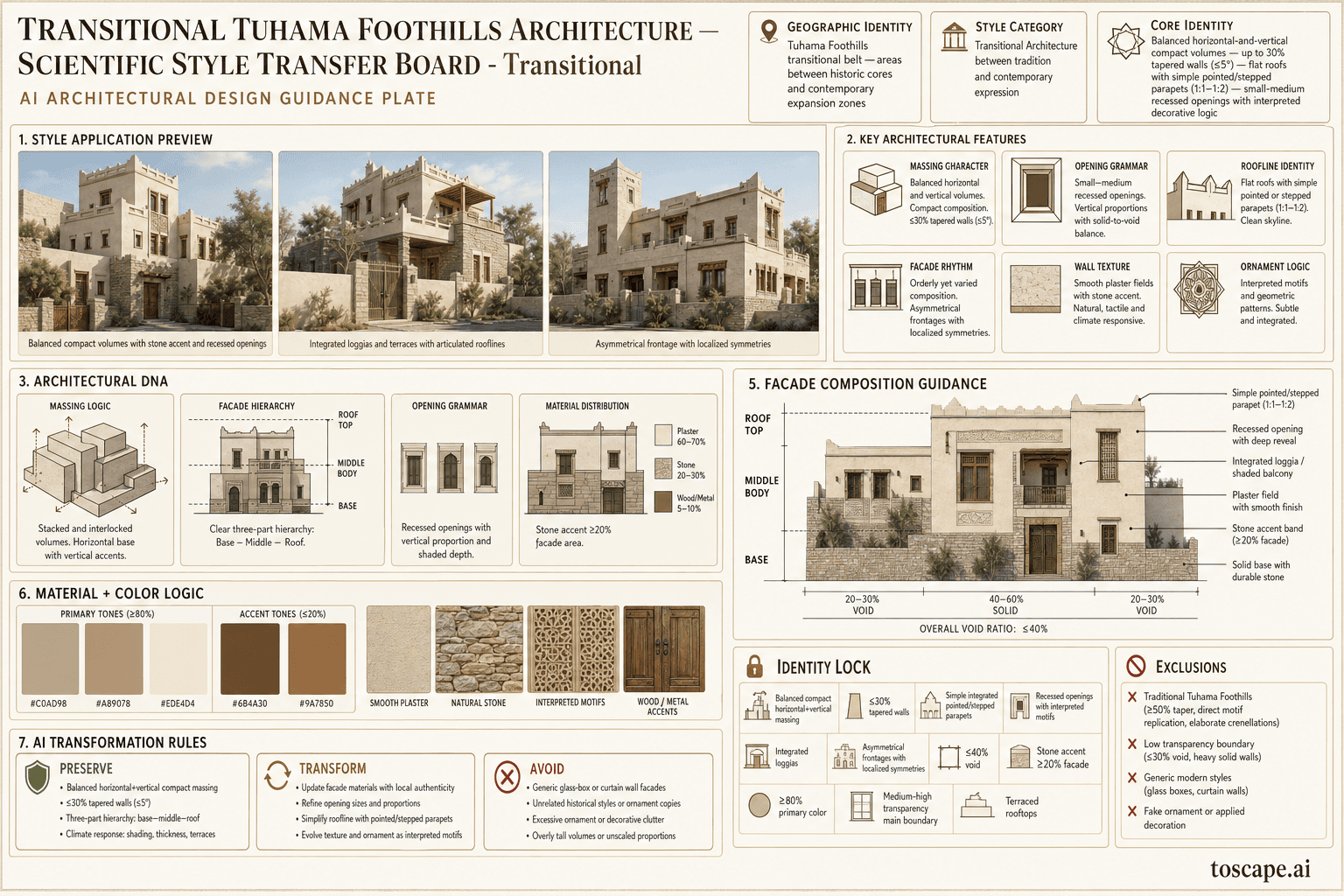
Tuhama Foothills Transitional
Saudi Arabia · Tuhama Foothills
The interpreted escarpment-foothills hybrid — simplified stone-and-plaster volumes, integrated parapets, recessed openings with interpreted motifs, loggias, medium-transparency bou...
Definition
Tuhama Foothills Transitional is a regional architectural identity from Saudi Arabia. The interpreted escarpment-foothills hybrid — simplified stone-and-plaster volumes, integrated parapets, recessed openings with interpreted motifs, loggias, medium-transparency bou.
- Country
- Saudi Arabia
- Region
- Tuhama Foothills
- Massing
- Transitional buildings adopt a balanced form of horizontal and vertical volumes, compact with strong geometric and inclined shapes (max 5 degrees) .
- Materials
- 60–70% of facade composed of one consistent material . At least 20% of facade uses stone — as base highlight, main frontage, or accent on doors/entrances.
- Palette
- Stone greys, lime white, sun-aged timber, and selective mineral accents shape the palette.
- Climate response
- Perimeter wall on main frontage has medium to high transparency — more permeable connection to the public domain .
Overview
Tuhama Foothills Transitional is a Saudi architectural identity rooted in Tuhama Foothills. Southwestern Arabian Escarpment-Foothills Architecture — Transitional level. Tuhama Foothills transitional belt — areas between historic cores and contemporary expansion zones.
Visual DNA
Massing & Form
Transitional buildings adopt a balanced form of horizontal and vertical volumes, compact with strong geometric and inclined shapes (max 5 degrees) . Up to 30% of the building form has gently tapered walls (max 5° inclination) — a reduction from the traditional ≥50%.
Facade Language
Facades maintain asymmetrical composition with localized symmetries in placement, size, rhythm, and patterns of openings — interpreting the general asymmetry of vernacular buildings . Solid facades with recessed openings ground the building to the street.
Materials & Texture
60–70% of facade composed of one consistent material . At least 20% of facade uses stone — as base highlight, main frontage, or accent on doors/entrances.
Color Palette
Stone greys, lime white, sun-aged timber, and selective mineral accents shape the palette. Highland and escarpment identities can carry stronger painted or stratified contrast, but the wall mass should still feel geologic and rooted in terrain.
Ornament & Detail
Interpretations of traditional patterns replace direct replication — inspired by historic precedents while preserving balance, rhythm, and movement . Decorative patterns: 10–15% of total facade area.
Climate Response
Perimeter wall on main frontage has medium to high transparency — more permeable connection to the public domain . Side/back boundary walls may have low, medium, or high transparency.
Landscape & Ground
Tuhama Foothills transitional belt — areas between historic cores and contemporary expansion zones. Perimeter wall on main frontage has medium to high transparency — more permeable connection to the public domain .
Reference elevation
Tuhama Foothills Transitional — characteristic facade composition, Tuhama Foothills.
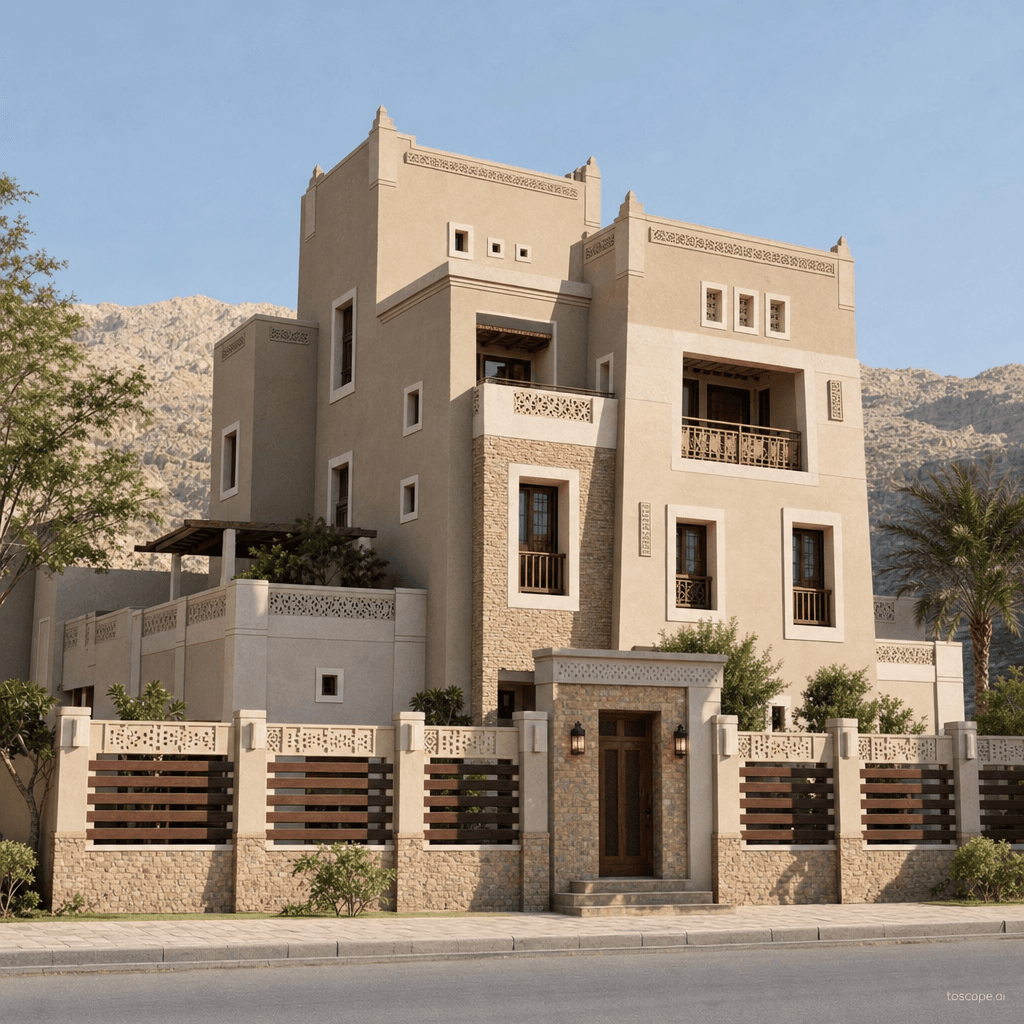
Context Snapshot
Transitional interpretation of Tuhama Foothills vernacular — bridging traditional clustered forms with larger urban context — simplified details, interpreted decorative motifs, increased openings, and... Southwestern Arabian Escarpment-Foothills Architecture — Transitional level Tuhama Foothills transitional belt — areas between historic cores and contemporary expansion zones
Contemporary Relevance
Tuhama Foothills Transitional is the bridge between conservation and current construction across Tuhama Foothills, allowing contemporary programs to keep regional identity legible while using modern structure, services, and envelope systems. It is the most practical mode for streetscapes that need to feel rooted without becoming literal replicas.
Use this style in Toscape
Explore Tuhama Foothills Transitional directly inside Toscape using the Facade Re-Style and Design Options workflows.
Open Tuhama Foothills Transitional in the galleryFrequently asked questions
What is Tuhama Foothills Transitional?
Tuhama Foothills Transitional is a regional architectural identity from Saudi Arabia. The interpreted escarpment-foothills hybrid — simplified stone-and-plaster volumes, integrated parapets, recessed openings with interpreted motifs, loggias, medium-transparency bou.
What materials define Tuhama Foothills Transitional?
60–70% of facade composed of one consistent material . At least 20% of facade uses stone — as base highlight, main frontage, or accent on doors/entrances.
What is the Tuhama Foothills Transitional color palette?
Stone greys, lime white, sun-aged timber, and selective mineral accents shape the palette. Highland and escarpment identities can carry stronger painted or stratified contrast, but the wall mass should still feel geologic and rooted in terrain.
Where does Tuhama Foothills Transitional come from?
Transitional interpretation of Tuhama Foothills vernacular — bridging traditional clustered forms with larger urban context — simplified details, interpreted decorative motifs, increased openings, and... Southwestern Arabian Escarpment-Foothills Architecture — Transitional level Tuhama Foothills transitional belt — areas between historic cores and contemporary expansion zones.
When should architects use Tuhama Foothills Transitional?
Tuhama Foothills Transitional is the bridge between conservation and current construction across Tuhama Foothills, allowing contemporary programs to keep regional identity legible while using modern structure, services, and envelope systems. It is the most practical mode for streetscapes that need to feel rooted without becoming literal replicas.
How do you render Tuhama Foothills Transitional in Toscape?
Open Toscape on Windows, load your own photo, elevation, sketch, or CAD view, then apply the Tuhama Foothills Transitional reference from the built-in style library. The Facade Re-Style and Design Options workflows keep your project geometry and camera while shifting materials, proportion, and detailing toward Tuhama Foothills Transitional.