Southern Tunisia Desert
Tunisia · vernacular architecture of southern Tunisia (Gouvernorat de Tataouine, Médenine...
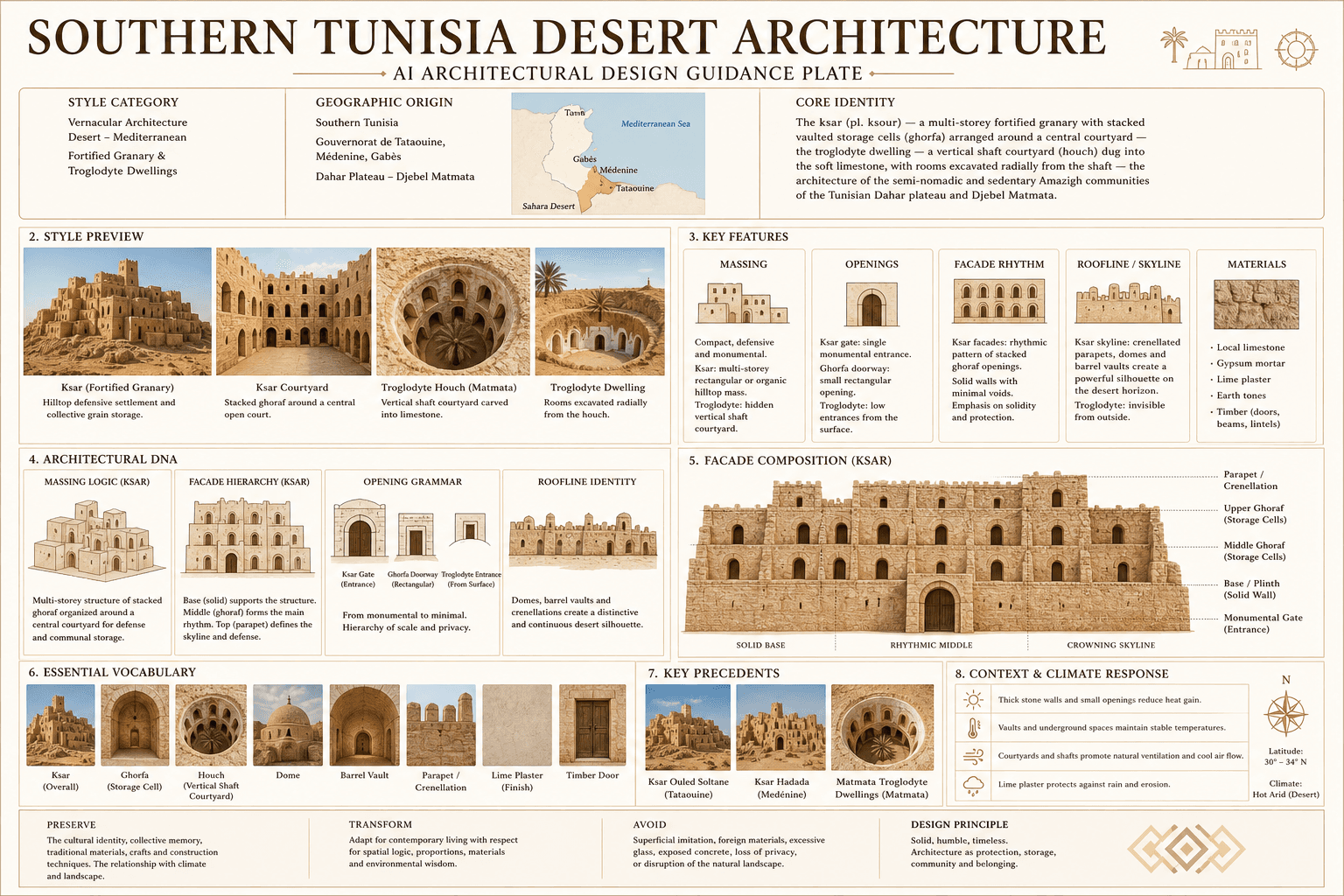
The ksour granaries and troglodyte dwellings of southern Tunisia — Matmata cave houses, desert ksour, and the Berber architectural adaptation to the Saharan margin
Definition
Southern Tunisia Desert is a regional architectural identity from Tunisia. The ksour granaries and troglodyte dwellings of southern Tunisia — Matmata cave houses, desert ksour, and the Berber architectural adaptation to the Saharan margin.
- Country
- Tunisia
- Region
- vernacular architecture of southern Tunisia (Gouvernorat de Tataouine, Médenine.
- Massing
- Southern Tunisia presents two radically different architectural typologies: Ksar (fortified granary): The ksar is a compact.
- Materials
- Local limestone — the universal building material for ksour Gypsum mortar — for vault and wall construction Lime plaster — white render for ghorfa interiors.
- Palette
- White, cream, pale sand, warm timber, and shadow-driven dark metal accents define the palette.
- Climate response
- Both ksar and troglodyte typologies are extreme climate adaptations: (1) Ksar thermal mass — thick stone walls and barrel vaults provide thermal lag.
Overview
Southern Tunisia Desert is a regional architectural identity in Tunisia. Traditional vernacular architecture of southern Tunisia (Gouvernorat de Tataouine, Médenine, and Gabès) — a region defined by the transition from the Mediterranean coast to the Sahara Desert, featuring two remarkable architectural typologies: the multi-storey ksar (fortified granary) and the troglodyte dwelling (Matmata cave house), representing extraordinary Amazigh (Berber) adaptations to the extreme arid environme...
Visual DNA
Massing & Form
Southern Tunisia presents two radically different architectural typologies: Ksar (fortified granary): The ksar is a compact, often hilltop or hillside structure — a central courtyard (typically 20–40 m × 20–40 m) surrounded by multi-storey walls of stacked barrel-vaulted rooms (ghorfa, pl. ghoraf).
Facade Language
Ksar facade: The ksar exterior is characterized by massive solidity — the stacked ghoraf create a rhythmic pattern of small rectangular doorways (one per cell) arranged in horizontal bands. The upper ghoraf doorways are accessed by external staircases or ladders — creating a distinctive facade composition of white-rend...
Materials & Texture
Local limestone — the universal building material for ksour Gypsum mortar — for vault and wall construction Lime plaster — white render for ghorfa interiors and troglodyte courtyard walls Palm trunk timber — for door lintels and ghorfa ceiling reinforcement Earth — for ksar courtyard flooring and troglodyte floors Wove...
Color Palette
White, cream, pale sand, warm timber, and shadow-driven dark metal accents define the palette. The facade should stay bright and climate-aware rather than heavy, gray, or over-saturated.
Ornament & Detail
Southern Tunisian ornament is minimal — reflecting the resource-scarce environment and functional priorities: (1) Whitewashed ghorfa openings — the contrast of white rendered door frames against the earth-toned ksar wall creates a distinctive geometric pattern, (2) crenellated parapets — sometimes with stepped merlons...
Climate Response
Both ksar and troglodyte typologies are extreme climate adaptations: (1) Ksar thermal mass — thick stone walls and barrel vaults provide thermal lag, keeping grain (and people) cool in summer and protected from winter cold. (2) Ksar hilltop siting — captures cooling breezes, provides defensive visibility, preserves val...
Landscape & Ground
Traditional vernacular architecture of southern Tunisia (Gouvernorat de Tataouine, Médenine, and Gabès) — a region defined by the transition from the Mediterranean coast to the Sahara Desert, featuring two remarkable architectural typologies: the multi-storey ksar (fortified granary) and the troglodyte dwelling (Matmat...
Reference elevation
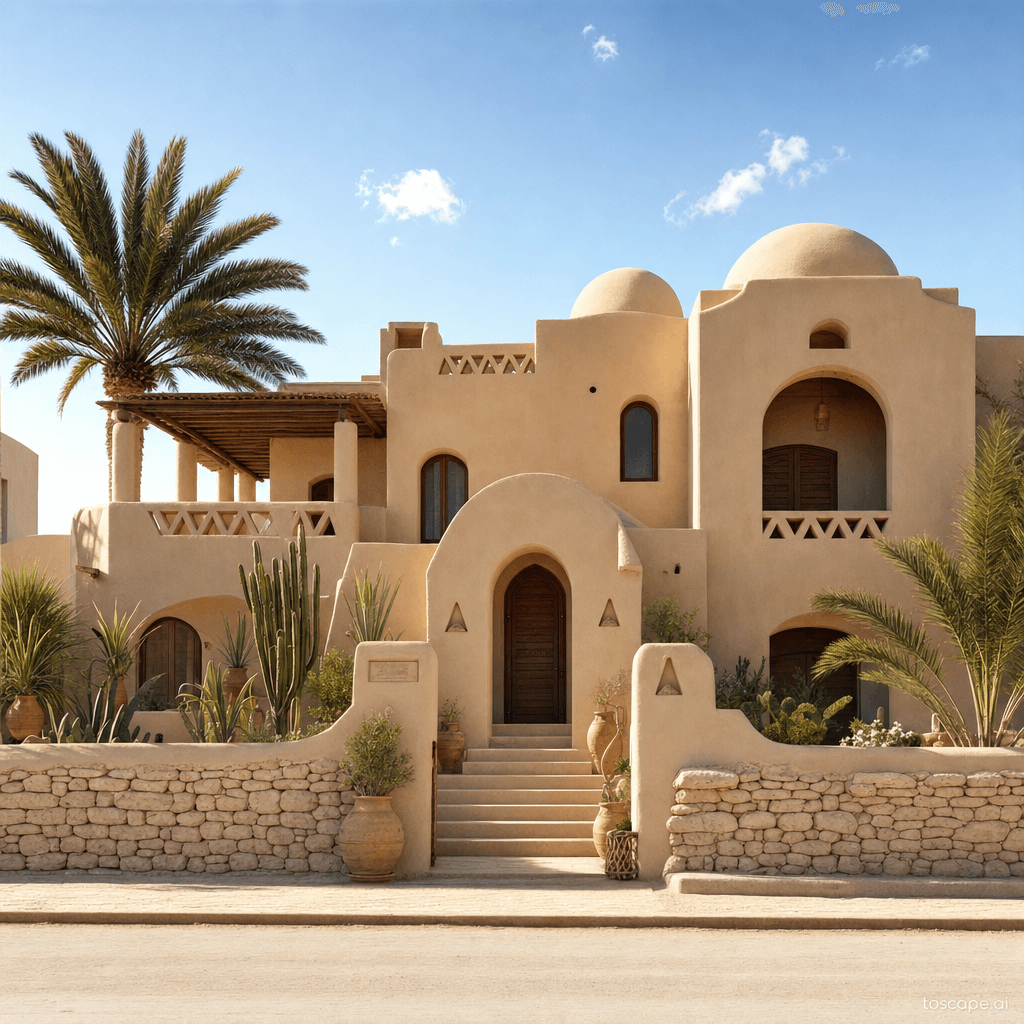
Southern Tunisia Desert — characteristic facade composition, vernacular architecture of southern Tunisia (Gouvernorat de Tataouine, Médenine....
Context Snapshot
Traditional vernacular architecture of southern Tunisia (Gouvernorat de Tataouine, Médenine, and Gabès) — a region defined by the transition from the Mediterranean coast to the Sahara Desert, featurin... Both ksar and troglodyte typologies are extreme climate adaptations: (1) Ksar thermal mass — thick stone walls and barrel vaults provide thermal lag, keeping grain (and people) cool in summer and protected from winter co...
Contemporary Relevance
Southern Tunisia Desert is useful today for residential, hospitality, civic, and place-branding work that needs Tunisia-specific character grounded in local massing, material tone, climate response, and settlement logic rather than generic international styling.
Use this style in Toscape
Explore Southern Tunisia Desert directly inside Toscape using the Facade Re-Style and Design Options workflows.
Open Southern Tunisia Desert in the galleryFrequently asked questions
What is Southern Tunisia Desert?
Southern Tunisia Desert is a regional architectural identity from Tunisia. The ksour granaries and troglodyte dwellings of southern Tunisia — Matmata cave houses, desert ksour, and the Berber architectural adaptation to the Saharan margin.
What materials define Southern Tunisia Desert?
Local limestone — the universal building material for ksour Gypsum mortar — for vault and wall construction Lime plaster — white render for ghorfa interiors and troglodyte courtyard walls Palm trunk timber — for door lintels and ghorfa ceiling reinforcement Earth — for ksar courtyard flooring and troglodyte floors Wove.
What is the Southern Tunisia Desert color palette?
White, cream, pale sand, warm timber, and shadow-driven dark metal accents define the palette. The facade should stay bright and climate-aware rather than heavy, gray, or over-saturated.
Where does Southern Tunisia Desert come from?
Traditional vernacular architecture of southern Tunisia (Gouvernorat de Tataouine, Médenine, and Gabès) — a region defined by the transition from the Mediterranean coast to the Sahara Desert, featurin.
When should architects use Southern Tunisia Desert?
Southern Tunisia Desert is useful today for residential, hospitality, civic, and place-branding work that needs Tunisia-specific character grounded in local massing, material tone, climate response, and settlement logic rather than generic international styling.
How do you render Southern Tunisia Desert in Toscape?
Open Toscape on Windows, load your own photo, elevation, sketch, or CAD view, then apply the Southern Tunisia Desert reference from the built-in style library. The Facade Re-Style and Design Options workflows keep your project geometry and camera while shifting materials, proportion, and detailing toward Southern Tunisia Desert.