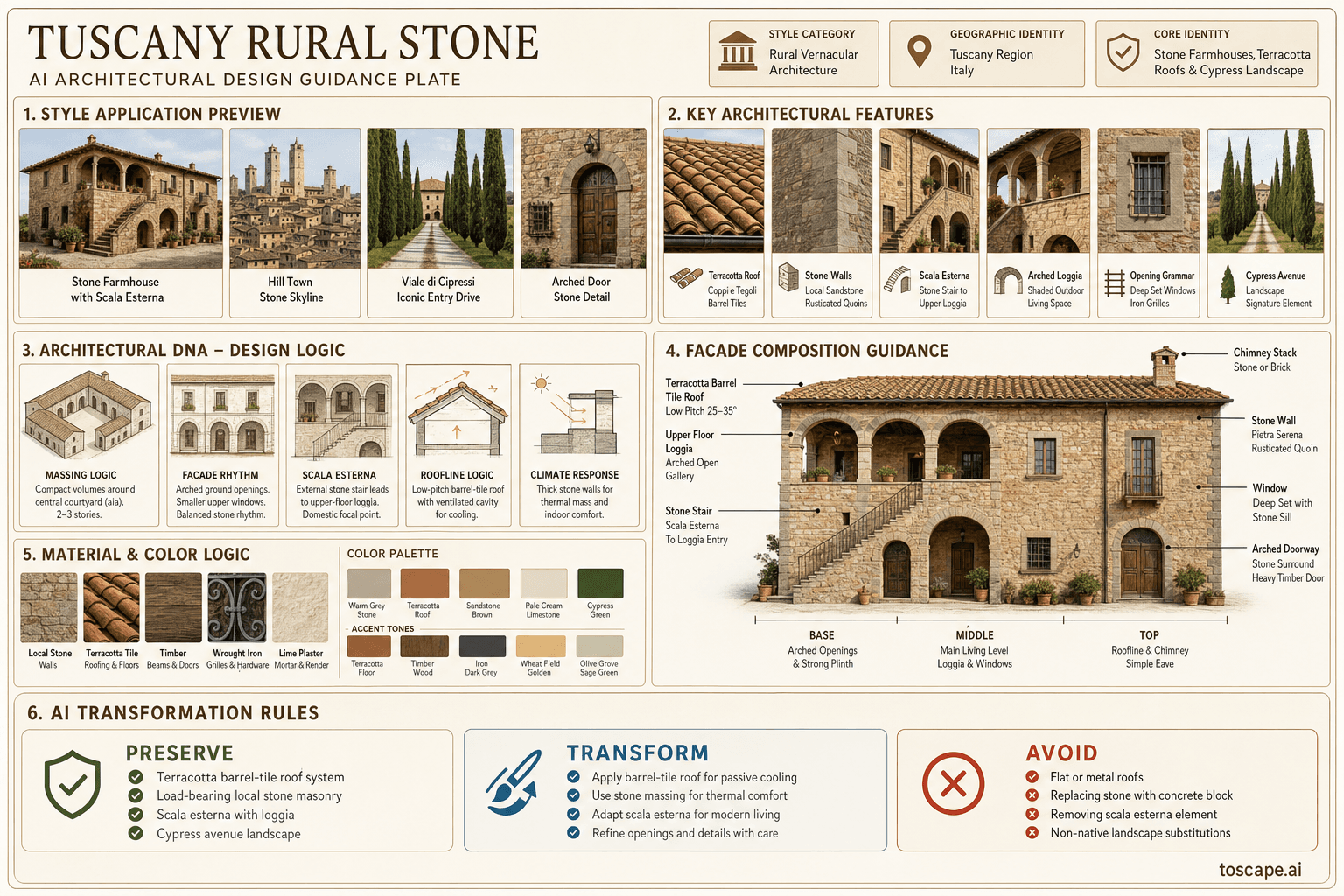
Tuscany Rural Stone
Italy · Tuscan rural
Cypress-Lined Hill Towns, Terracotta Roofs & Rusticated Pietra Serena Farmhouses
Definition
Tuscany Rural Stone is a regional architectural identity from Italy. Cypress-Lined Hill Towns, Terracotta Roofs & Rusticated Pietra Serena Farmhouses.
- Country
- Italy
- Region
- Tuscan rural
- Massing
- Compact rectangular or L-plan volumes, 2-3 stories. Farmhouses (casa colonica): central courtyard (aia), main house with attached barn/stable forming enclosed compound.
- Materials
- Pietra serena (grey sandstone) — walls, quoins, stair treads, columns. Pietra forte (brown sandstone) — walls in Florence area.
- Palette
- White, cream, pale sand, warm timber, and shadow-driven dark metal accents define the palette.
- Climate response
- Mediterranean: hot dry summers, mild wet winters. Thick stone walls for thermal mass — cool interior in summer, warm in winter.
Overview
Tuscany Rural Stone is a regional architectural identity in Italy. Tuscan rural architecture — medieval hill towns, stone farmhouses (casa colonica), and the Val d'Orcia cultural landscape. Warm terracotta barrel-tile roofs (coppi/tegoli), local sandstone (pietra serena / pietra forte) and limestone walls, rusticated stone quoins and surrounds, cypress-lined drives (viale di cipressi), arched loggias, external stone staircases (scala esterna)
Visual DNA
Massing & Form
Compact rectangular or L-plan volumes, 2-3 stories. Farmhouses (casa colonica): central courtyard (aia), main house with attached barn/stable forming enclosed compound.
Facade Language
Stone wall with rhythmic rectangular or arched windows, deeply recessed in thick walls. Ground floor: arched doorways and stable entrances.
Materials & Texture
Pietra serena (grey sandstone) — walls, quoins, stair treads, columns. Pietra forte (brown sandstone) — walls in Florence area.
Color Palette
White, cream, pale sand, warm timber, and shadow-driven dark metal accents define the palette. The facade should stay bright and climate-aware rather than heavy, gray, or over-saturated.
Ornament & Detail
Stone carving restraint: rusticated quoins and surrounds, occasional family coat of arms (stemma) over door. Wrought iron: scroll brackets for external lights, ring door handles, simple balcony grilles.
Climate Response
Mediterranean: hot dry summers, mild wet winters. Thick stone walls for thermal mass — cool interior in summer, warm in winter.
Landscape & Ground
Tuscan rural architecture — medieval hill towns, stone farmhouses (casa colonica), and the Val d'Orcia cultural landscape. Mediterranean: hot dry summers, mild wet winters.
Reference elevation
Tuscany Rural Stone — characteristic facade composition, Tuscan rural.
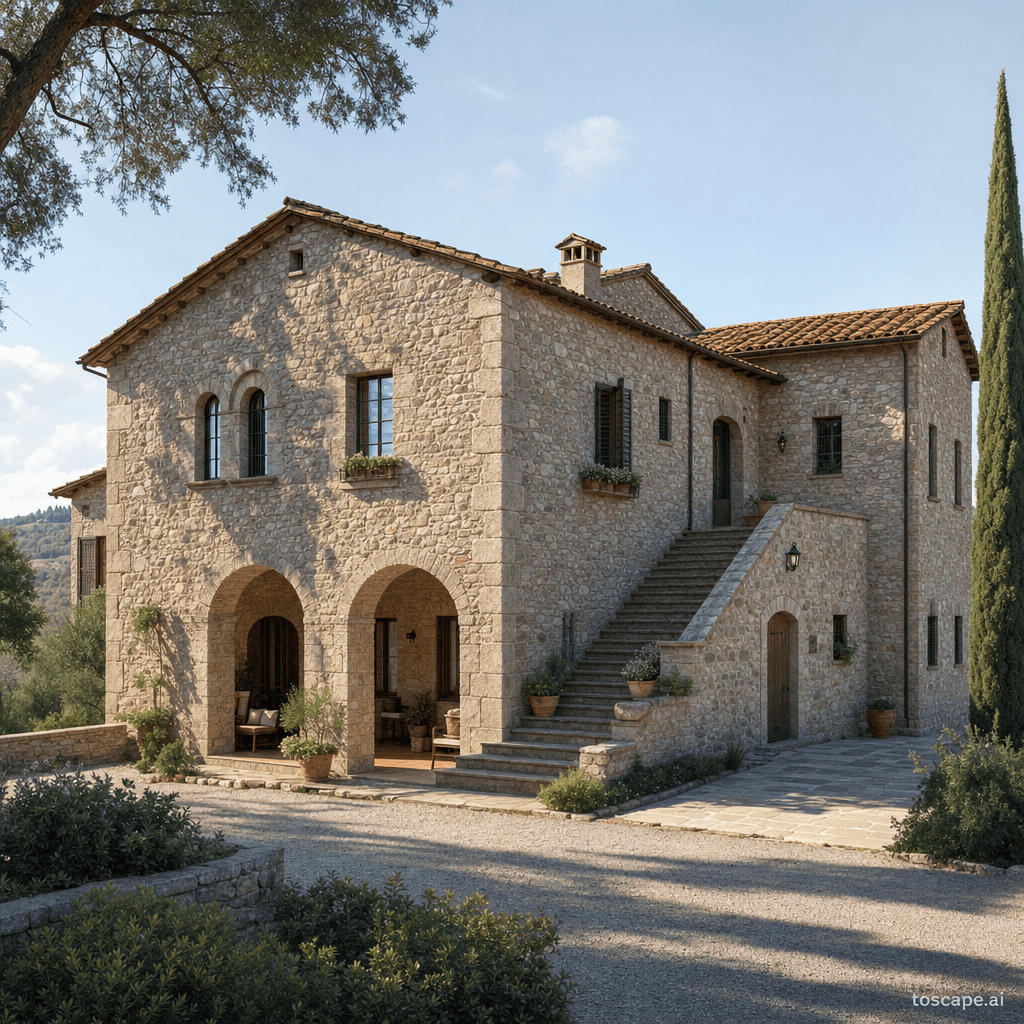
Context Snapshot
Tuscan rural architecture — medieval hill towns, stone farmhouses (casa colonica), and the Val d'Orcia cultural landscape Mediterranean: hot dry summers, mild wet winters.
Contemporary Relevance
Tuscany Rural Stone is useful today for residential, hospitality, civic, and place-branding work that needs Italy-specific character grounded in local massing, material tone, climate response, and settlement logic rather than generic international styling.
Use this style in Toscape
Explore Tuscany Rural Stone directly inside Toscape using the Facade Re-Style and Design Options workflows.
Open Tuscany Rural Stone in the galleryFrequently asked questions
What is Tuscany Rural Stone?
Tuscany Rural Stone is a regional architectural identity from Italy. Cypress-Lined Hill Towns, Terracotta Roofs & Rusticated Pietra Serena Farmhouses.
What materials define Tuscany Rural Stone?
Pietra serena (grey sandstone) — walls, quoins, stair treads, columns. Pietra forte (brown sandstone) — walls in Florence area.
What is the Tuscany Rural Stone color palette?
White, cream, pale sand, warm timber, and shadow-driven dark metal accents define the palette. The facade should stay bright and climate-aware rather than heavy, gray, or over-saturated.
Where does Tuscany Rural Stone come from?
Tuscan rural architecture — medieval hill towns, stone farmhouses (casa colonica), and the Val d'Orcia cultural landscape Mediterranean: hot dry summers, mild wet winters.
When should architects use Tuscany Rural Stone?
Tuscany Rural Stone is useful today for residential, hospitality, civic, and place-branding work that needs Italy-specific character grounded in local massing, material tone, climate response, and settlement logic rather than generic international styling.
How do you render Tuscany Rural Stone in Toscape?
Open Toscape on Windows, load your own photo, elevation, sketch, or CAD view, then apply the Tuscany Rural Stone reference from the built-in style library. The Facade Re-Style and Design Options workflows keep your project geometry and camera while shifting materials, proportion, and detailing toward Tuscany Rural Stone.