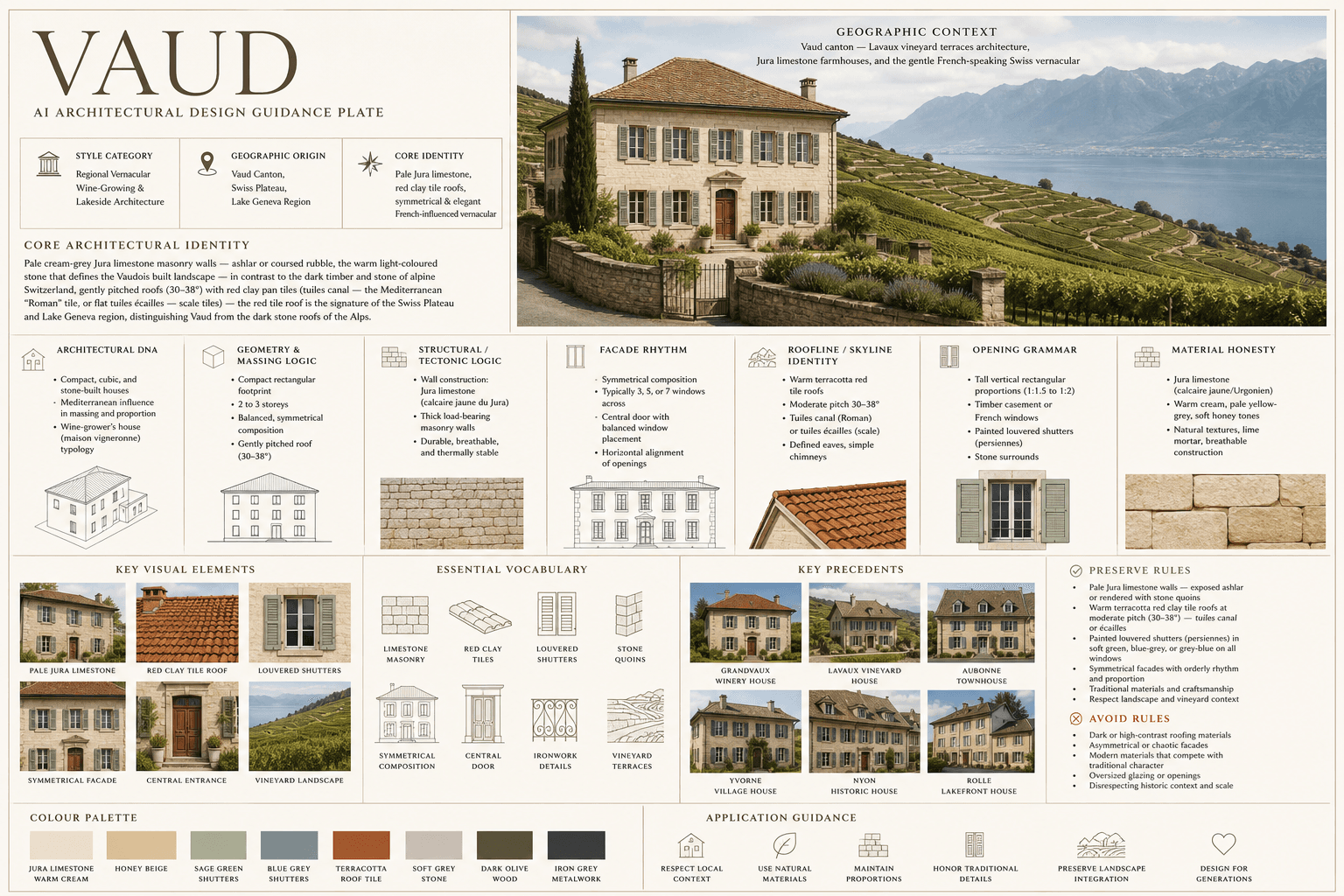
Vaud
Switzerland · Vaud canton
Lavaux Wine-Growers' Houses, Jura Limestone & French-Swiss Vernacular Architecture
Definition
Vaud is a regional architectural identity from Switzerland. Lavaux Wine-Growers' Houses, Jura Limestone & French-Swiss Vernacular Architecture.
- Country
- Switzerland
- Region
- Vaud canton
- Massing
- The Vaudois house is compact, cubic, and stone-built — a Mediterranean-influenced massing.
- Materials
- Jura limestone (calcaire jaune/Urgonien): warm cream, pale yellow-grey, soft honey tones — the defining stone of the Vaudois region, quarried locally.
- Palette
- White, cream, pale sand, warm timber, and shadow-driven dark metal accents define the palette.
- Climate response
- Lacustrine (lake-influenced) climate — the moderating effect of Lake Geneva (Lac Léman): mild winters, warm summers, significant sunshine hours, moderate rainfall (1000-1200mm).
Overview
Vaud is a regional architectural identity in Switzerland. Vaud canton — Lavaux vineyard terraces architecture, Jura limestone farmhouses, and the gentle French-speaking Swiss vernacular. Pale cream-grey Jura limestone masonry walls — ashlar or coursed rubble, the warm light-coloured stone that defines the Vaudois built landscape — in contrast to the dark timber and stone of alpine Switzerland, gently pitched roofs (30-38°) with red clay pan tiles (tuiles canal — the Mediter...
Visual DNA
Massing & Form
The Vaudois house is compact, cubic, and stone-built — a Mediterranean-influenced massing. Wine-grower's house (maison vigneronne): typically rectangular plan, 2-3 storeys plus attic under roof, with the ground floor partially embedded into the terraced hillside — the wine cellar (cave) is at ground level, accessed dir...
Facade Language
The Vaudois facade is orderly, formal, and French-classical in spirit: symmetrical composition — typically 3, 5, or 7 window bays, with the entrance door in the central bay. Window bays are evenly spaced, vertically aligned across all floors.
Materials & Texture
Jura limestone (calcaire jaune/Urgonien): warm cream, pale yellow-grey, soft honey tones — the defining stone of the Vaudois region, quarried locally. The limestone weathers gently, acquiring a soft golden patina.
Color Palette
White, cream, pale sand, warm timber, and shadow-driven dark metal accents define the palette. The facade should stay bright and climate-aware rather than heavy, gray, or over-saturated.
Ornament & Detail
Vaudois ornament is classical, French-influenced, and restrained: dressed stone quoins and window surrounds — the exposed cut limestone elements create a decorative grid pattern on the rendered facade — stone chaines d'angle (corner quoins) and encadrements (window frames) in contrasting light cream stone against the c...
Climate Response
Lacustrine (lake-influenced) climate — the moderating effect of Lake Geneva (Lac Léman): mild winters, warm summers, significant sunshine hours, moderate rainfall (1000-1200mm). The lake creates a microclimate suitable for viticulture — the Lavaux terraces are a UNESCO World Heritage cultural landscape.
Landscape & Ground
Vaud canton — Lavaux vineyard terraces architecture, Jura limestone farmhouses, and the gentle French-speaking Swiss vernacular. Lacustrine (lake-influenced) climate — the moderating effect of Lake Geneva (Lac Léman): mild winters, warm summers, significant sunshine hours, moderate rainfall (1000-1200mm).
Reference elevation
Vaud — characteristic facade composition, Vaud canton.
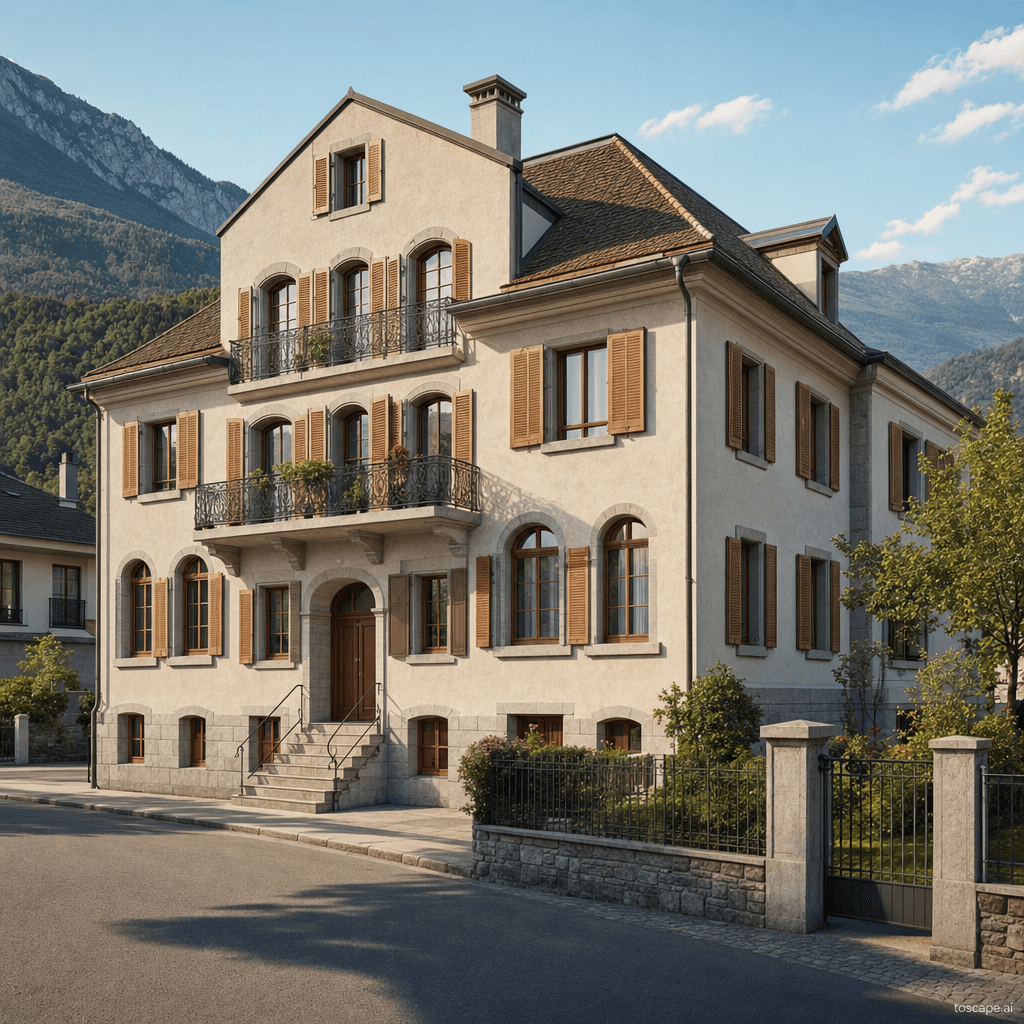
Context Snapshot
Vaud canton — Lavaux vineyard terraces architecture, Jura limestone farmhouses, and the gentle French-speaking Swiss vernacular Lacustrine (lake-influenced) climate — the moderating effect of Lake Geneva (Lac Léman): mild winters, warm summers, significant sunshine hours, moderate rainfall (1000-1200mm).
Contemporary Relevance
Vaud is useful today for residential, hospitality, civic, and place-branding work that needs Switzerland-specific character grounded in local massing, material tone, climate response, and settlement logic rather than generic international styling.
Use this style in Toscape
Explore Vaud directly inside Toscape using the Facade Re-Style and Design Options workflows.
Open Vaud in the galleryFrequently asked questions
What is Vaud?
Vaud is a regional architectural identity from Switzerland. Lavaux Wine-Growers' Houses, Jura Limestone & French-Swiss Vernacular Architecture.
What materials define Vaud?
Jura limestone (calcaire jaune/Urgonien): warm cream, pale yellow-grey, soft honey tones — the defining stone of the Vaudois region, quarried locally. The limestone weathers gently, acquiring a soft golden patina.
What is the Vaud color palette?
White, cream, pale sand, warm timber, and shadow-driven dark metal accents define the palette. The facade should stay bright and climate-aware rather than heavy, gray, or over-saturated.
Where does Vaud come from?
Vaud canton — Lavaux vineyard terraces architecture, Jura limestone farmhouses, and the gentle French-speaking Swiss vernacular Lacustrine (lake-influenced) climate — the moderating effect of Lake Geneva (Lac Léman): mild winters, warm summers, significant sunshine hours, moderate rainfall (1000-1200mm).
When should architects use Vaud?
Vaud is useful today for residential, hospitality, civic, and place-branding work that needs Switzerland-specific character grounded in local massing, material tone, climate response, and settlement logic rather than generic international styling.
How do you render Vaud in Toscape?
Open Toscape on Windows, load your own photo, elevation, sketch, or CAD view, then apply the Vaud reference from the built-in style library. The Facade Re-Style and Design Options workflows keep your project geometry and camera while shifting materials, proportion, and detailing toward Vaud.