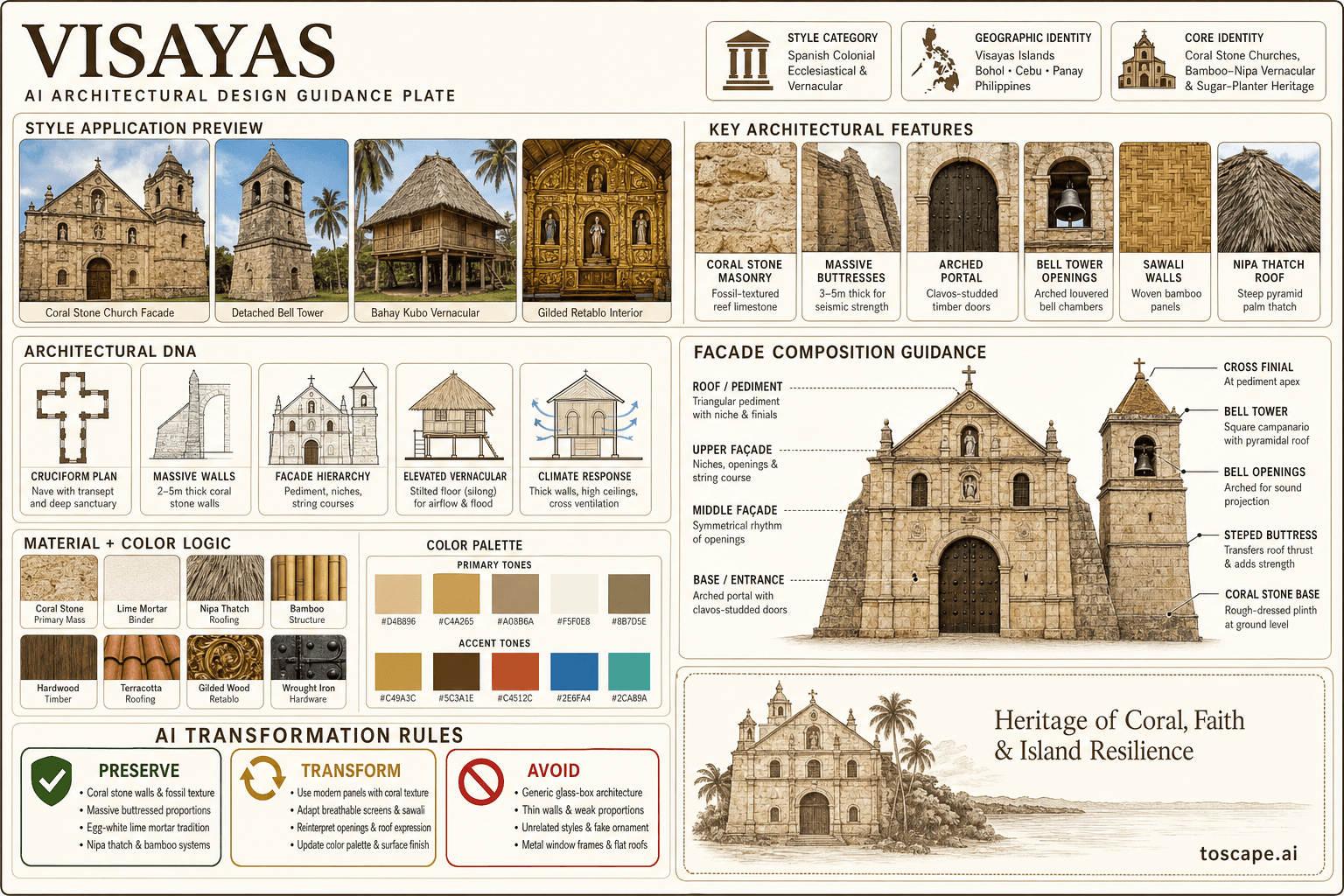
Visayas
Philippines · Bohol, Cebu, Panay
Coral Stone Churches, Bamboo-Nipa Vernacular & Sugar-Planter Heritage
Definition
Visayas is a regional architectural identity from Philippines. Coral Stone Churches, Bamboo-Nipa Vernacular & Sugar-Planter Heritage.
- Country
- Philippines
- Region
- Bohol, Cebu, Panay
- Massing
- Ecclesiastical: monumental rectangular nave with cruciform plan (Latin cross), thick buttressed walls, projecting transept, deep sanctuary apse, attached or detached square bell towers (often massive.
- Materials
- Piedra de coral (batong korales): reef limestone — the defining Visayan ecclesiastical material — quarried from uplifted Pleistocene coral reefs.
- Palette
- White, cream, pale sand, warm timber, and shadow-driven dark metal accents define the palette.
- Climate response
- Tropical monsoon and rainforest — hot humid year-round, typhoon belt (June-December), coral limestone islands (Bohol, Cebu) with uplifted marine terraces.
Overview
Visayas is a regional architectural identity in Philippines. Bohol, Cebu, Panay — Spanish-colonial coral stone ecclesiastical architecture. Massive coral stone (piedra de coral / batong korales) churches and watchtowers — quarried from reef limestone, buff-cream to honey-brown with visible coral fossils and shell inclusions, set with white lime mortar enhanced with egg-white (clara de huevo) for hardening, monumental Baroque proportions with thick buttressed walls (3-5 meters)...
Visual DNA
Massing & Form
Ecclesiastical: monumental rectangular nave with cruciform plan (Latin cross), thick buttressed walls, projecting transept, deep sanctuary apse, attached or detached square bell towers (often massive, fortress-like — example: Baclayon Church in Bohol). Church dimensions: nave 50-70m length, 12-15m width, walls 2-5m thi...
Facade Language
Church facades: the supreme expression — coral stone blocks in warm buff, cream, and honey tones, weathered to grey-brown with lichen patina. Central portal: arched entrance with carved coral stone jambs and voussoirs, massive wooden doors with iron strap hinges and clavos (bosses).
Materials & Texture
Piedra de coral (batong korales): reef limestone — the defining Visayan ecclesiastical material — quarried from uplifted Pleistocene coral reefs, buff-cream to honey-brown with embedded fossil corals (brain coral, branching coral) and mollusk shells, texture ranging from rough-hewn to finely dressed. Argamasa de cal co...
Color Palette
White, cream, pale sand, warm timber, and shadow-driven dark metal accents define the palette. The facade should stay bright and climate-aware rather than heavy, gray, or over-saturated.
Ornament & Detail
Coral stone carving: rosettes, foliage scrolls, cherub heads, and Augustinian emblems carved directly into coral facade blocks — softer than marble, with distinctive pitted texture from fossil inclusions. Retablo (altarpiece): carved hardwood, polychrome and gilded — niches for santos framed by Solomonic columns, flora...
Climate Response
Tropical monsoon and rainforest — hot humid year-round, typhoon belt (June-December), coral limestone islands (Bohol, Cebu) with uplifted marine terraces. Coral stone's porosity: absorbs and releases moisture, moderating interior humidity — churches remain relatively cool despite tropical heat.
Landscape & Ground
Bohol, Cebu, Panay — Spanish-colonial coral stone ecclesiastical architecture. Tropical monsoon and rainforest — hot humid year-round, typhoon belt (June-December), coral limestone islands (Bohol, Cebu) with uplifted marine terraces.
Reference elevation
Visayas — characteristic facade composition, Bohol, Cebu, Panay.
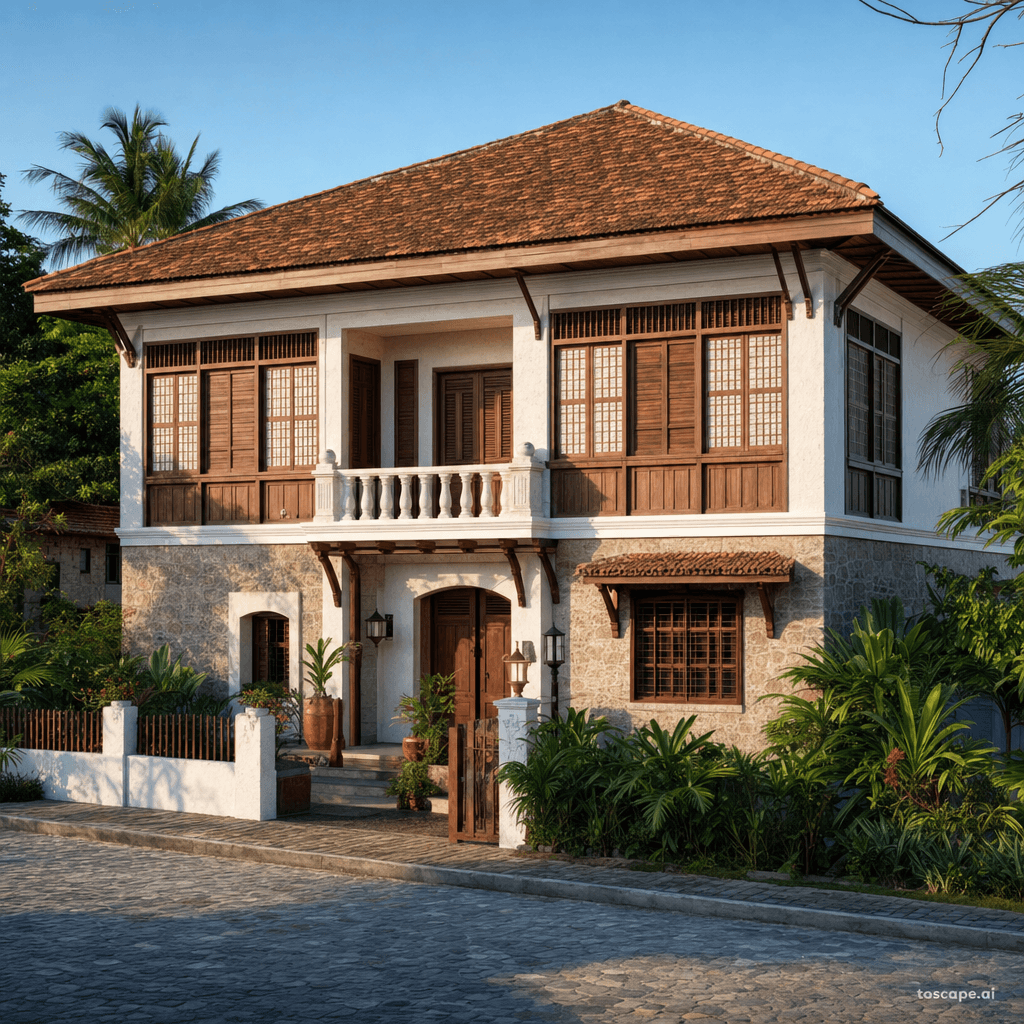
Context Snapshot
Bohol, Cebu, Panay — Spanish-colonial coral stone ecclesiastical architecture Tropical monsoon and rainforest — hot humid year-round, typhoon belt (June-December), coral limestone islands (Bohol, Cebu) with uplifted marine terraces.
Contemporary Relevance
Visayas is useful today for residential, hospitality, civic, and place-branding work that needs Philippines-specific character grounded in local massing, material tone, climate response, and settlement logic rather than generic international styling.
Use this style in Toscape
Explore Visayas directly inside Toscape using the Facade Re-Style and Design Options workflows.
Open Visayas in the galleryFrequently asked questions
What is Visayas?
Visayas is a regional architectural identity from Philippines. Coral Stone Churches, Bamboo-Nipa Vernacular & Sugar-Planter Heritage.
What materials define Visayas?
Piedra de coral (batong korales): reef limestone — the defining Visayan ecclesiastical material — quarried from uplifted Pleistocene coral reefs, buff-cream to honey-brown with embedded fossil corals (brain coral, branching coral) and mollusk shells, texture ranging from rough-hewn to finely dressed. Argamasa de cal co.
What is the Visayas color palette?
White, cream, pale sand, warm timber, and shadow-driven dark metal accents define the palette. The facade should stay bright and climate-aware rather than heavy, gray, or over-saturated.
Where does Visayas come from?
Bohol, Cebu, Panay — Spanish-colonial coral stone ecclesiastical architecture Tropical monsoon and rainforest — hot humid year-round, typhoon belt (June-December), coral limestone islands (Bohol, Cebu) with uplifted marine terraces.
When should architects use Visayas?
Visayas is useful today for residential, hospitality, civic, and place-branding work that needs Philippines-specific character grounded in local massing, material tone, climate response, and settlement logic rather than generic international styling.
How do you render Visayas in Toscape?
Open Toscape on Windows, load your own photo, elevation, sketch, or CAD view, then apply the Visayas reference from the built-in style library. The Facade Re-Style and Design Options workflows keep your project geometry and camera while shifting materials, proportion, and detailing toward Visayas.