Western Cape
South Africa · Western Cape
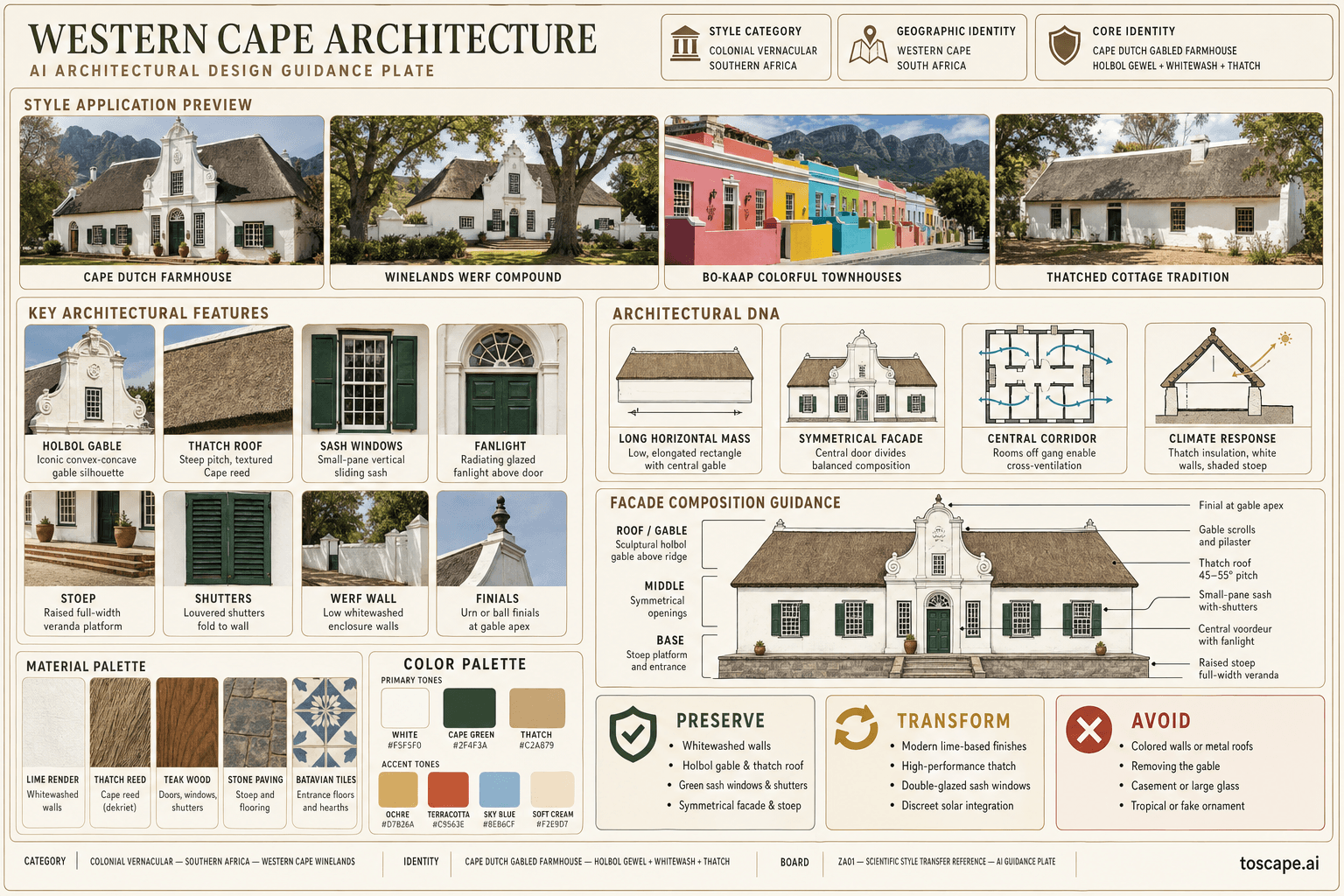
The Cape Dutch gable and whitewashed thatch of the Winelands — the distinctive Cape Dutch farmstead (werf), the flat-roofed Kaapse-Hollandse townhouse, the Malay quarter's colored...
Definition
Western Cape is a regional architectural identity from South Africa. The Cape Dutch gable and whitewashed thatch of the Winelands — the distinctive Cape Dutch farmstead (werf), the flat-roofed Kaapse-Hollandse townhouse, the Malay quarter's colored.
- Country
- South Africa
- Region
- Western Cape
- Massing
- The Cape Dutch farmhouse is a long, low, symmetrical rectangle — a horizontal bar form with a prominent central gable.
- Materials
- Lime-washed brick/stone walls — brilliant white to soft cream — the defining surface Cape thatching reed (dekriet / Thamnochortus insignis) — the unique restio species.
- Palette
- White, cream, pale sand, warm timber, and shadow-driven dark metal accents define the palette.
- Climate response
- The Western Cape's Mediterranean climate — warm dry summers (25–35°C), cool wet winters (7–15°C, 500–1,000 mm rainfall) — perfectly matches the architecture's origins: (1) Whitewashed walls.
Overview
Western Cape is a regional architectural identity in South Africa. Traditional architecture of the Western Cape — the Cape Dutch farmhouse (Kaaps-Hollandse styl) of the Winelands (Stellenbosch, Franschhoek, Paarl), the flat-roofed urban townhouses of Cape Town's Bo-Kaap, and the thatched cottage tradition. Defined by the iconic Cape Dutch gable (holbol gewel — convex-concave gable), whitewashed lime-plastered walls, thatched roofs, green shuttered sash windows, the werf (farmyard) s...
Visual DNA
Massing & Form
The Cape Dutch farmhouse is a long, low, symmetrical rectangle — a horizontal bar form with a prominent central gable. Typical proportions: 15–35 m long × 6–10 m deep, with a central front door dividing the facade into symmetrical halves.
Facade Language
The Cape Dutch facade is the most compositionally formal of any African vernacular — derived from Dutch Renaissance and Indonesian colonial models: Central gable: The dominant vertical element — the holbol (convex-concave) gable rises above the main roof ridge. The gable features: a central pilaster or recessed panel...
Materials & Texture
Lime-washed brick/stone walls — brilliant white to soft cream — the defining surface Cape thatching reed (dekriet / Thamnochortus insignis) — the unique restio species of the Cape Floral Kingdom — golden-brown when fresh, silver-gray with age Teak timber — for sash windows, front doors, shutters, and furniture — import...
Color Palette
White, cream, pale sand, warm timber, and shadow-driven dark metal accents define the palette. The facade should stay bright and climate-aware rather than heavy, gray, or over-saturated.
Ornament & Detail
Cape Dutch ornament is disciplined and classical: (1) The gable — the primary ornamental surface: Baroque scrollwork, pilasters, recessed panels, date stones, and urn finials — molded in lime plaster over brick. (2) The fanlight — the secondary ornamental focus: radiating, geometric, or floral glazing patterns above th...
Climate Response
The Western Cape's Mediterranean climate — warm dry summers (25–35°C), cool wet winters (7–15°C, 500–1,000 mm rainfall) — perfectly matches the architecture's origins: (1) Whitewashed walls reflect summer sun — the white surface is a climate device, reducing heat absorption. (2) Thatched roof provides exceptional insul...
Landscape & Ground
Traditional architecture of the Western Cape — the Cape Dutch farmhouse (Kaaps-Hollandse styl) of the Winelands (Stellenbosch, Franschhoek, Paarl), the flat-roofed urban townhouses of Cape Town's Bo-Kaap, and the thatched cottage tradition. Defined by the iconic Cape Dutch gable (holbol gewel — convex-concave gable), w...
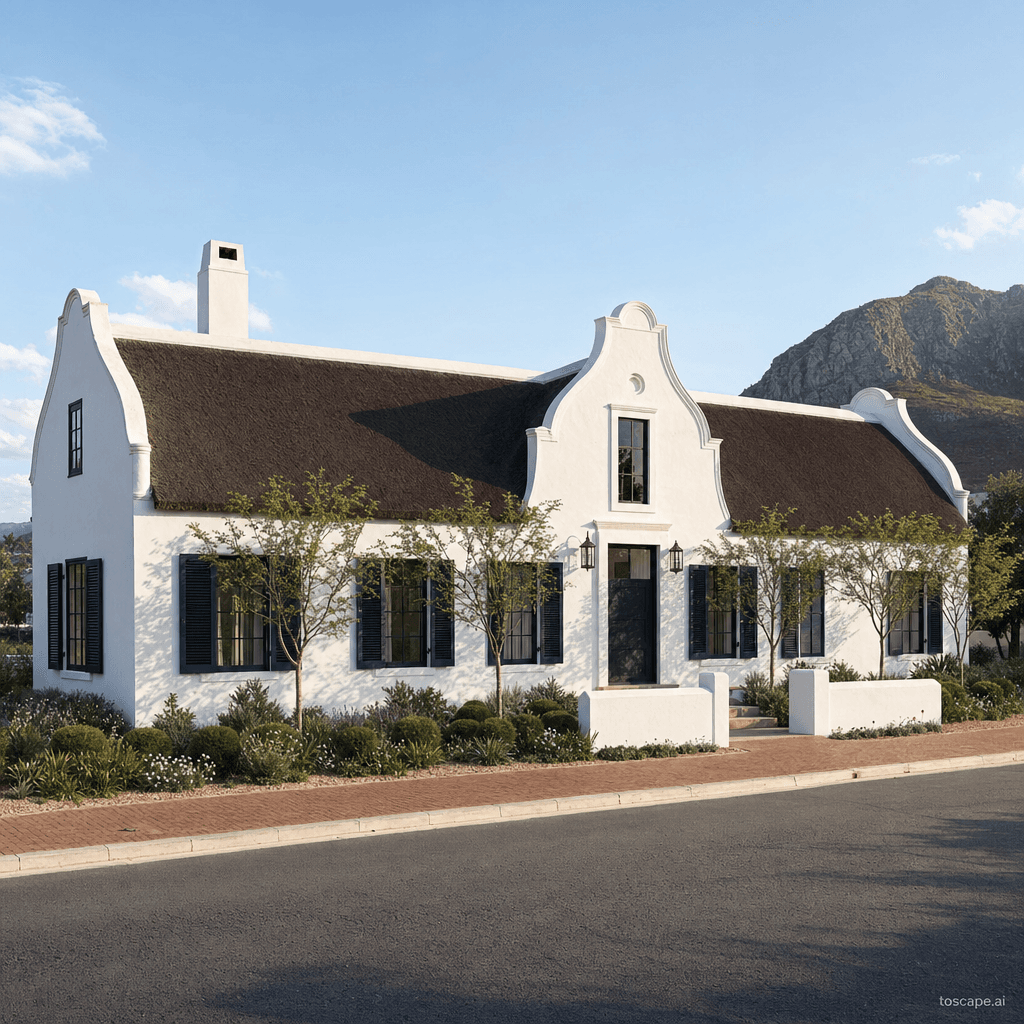
Reference elevation
Western Cape — characteristic facade composition, Western Cape.
Context Snapshot
Traditional architecture of the Western Cape — the Cape Dutch farmhouse (Kaaps-Hollandse styl) of the Winelands (Stellenbosch, Franschhoek, Paarl), the flat-roofed urban townhouses of Cape Town's Bo-K... The Western Cape's Mediterranean climate — warm dry summers (25–35°C), cool wet winters (7–15°C, 500–1,000 mm rainfall) — perfectly matches the architecture's origins: (1) Whitewashed walls reflect summer sun — the white...
Contemporary Relevance
Western Cape is useful today for residential, hospitality, civic, and place-branding work that needs South Africa-specific character grounded in local massing, material tone, climate response, and settlement logic rather than generic international styling.
Use this style in Toscape
Explore Western Cape directly inside Toscape using the Facade Re-Style and Design Options workflows.
Open Western Cape in the galleryFrequently asked questions
What is Western Cape?
Western Cape is a regional architectural identity from South Africa. The Cape Dutch gable and whitewashed thatch of the Winelands — the distinctive Cape Dutch farmstead (werf), the flat-roofed Kaapse-Hollandse townhouse, the Malay quarter's colored.
What materials define Western Cape?
Lime-washed brick/stone walls — brilliant white to soft cream — the defining surface Cape thatching reed (dekriet / Thamnochortus insignis) — the unique restio species of the Cape Floral Kingdom — golden-brown when fresh, silver-gray with age Teak timber — for sash windows, front doors, shutters, and furniture — import.
What is the Western Cape color palette?
White, cream, pale sand, warm timber, and shadow-driven dark metal accents define the palette. The facade should stay bright and climate-aware rather than heavy, gray, or over-saturated.
Where does Western Cape come from?
Traditional architecture of the Western Cape — the Cape Dutch farmhouse (Kaaps-Hollandse styl) of the Winelands (Stellenbosch, Franschhoek, Paarl), the flat-roofed urban townhouses of Cape Town's Bo-K... The Western Cape's Mediterranean climate — warm dry summers (25–35°C), cool wet winters (7–15°C, 500–1,000 mm rainfall) — perfectly matches the architecture's origins: (1) Whitewashed walls reflect summer sun — the white.
When should architects use Western Cape?
Western Cape is useful today for residential, hospitality, civic, and place-branding work that needs South Africa-specific character grounded in local massing, material tone, climate response, and settlement logic rather than generic international styling.
How do you render Western Cape in Toscape?
Open Toscape on Windows, load your own photo, elevation, sketch, or CAD view, then apply the Western Cape reference from the built-in style library. The Facade Re-Style and Design Options workflows keep your project geometry and camera while shifting materials, proportion, and detailing toward Western Cape.