Yazd Desert Adobe
Iran · Yazd desert city
Windcatchers, Qanat Water Systems & Mud-Brick Courtyard Architecture
Definition
Yazd Desert Adobe is a regional architectural identity from Iran. Windcatchers, Qanat Water Systems & Mud-Brick Courtyard Architecture.
- Country
- Iran
- Region
- Yazd desert city
- Massing
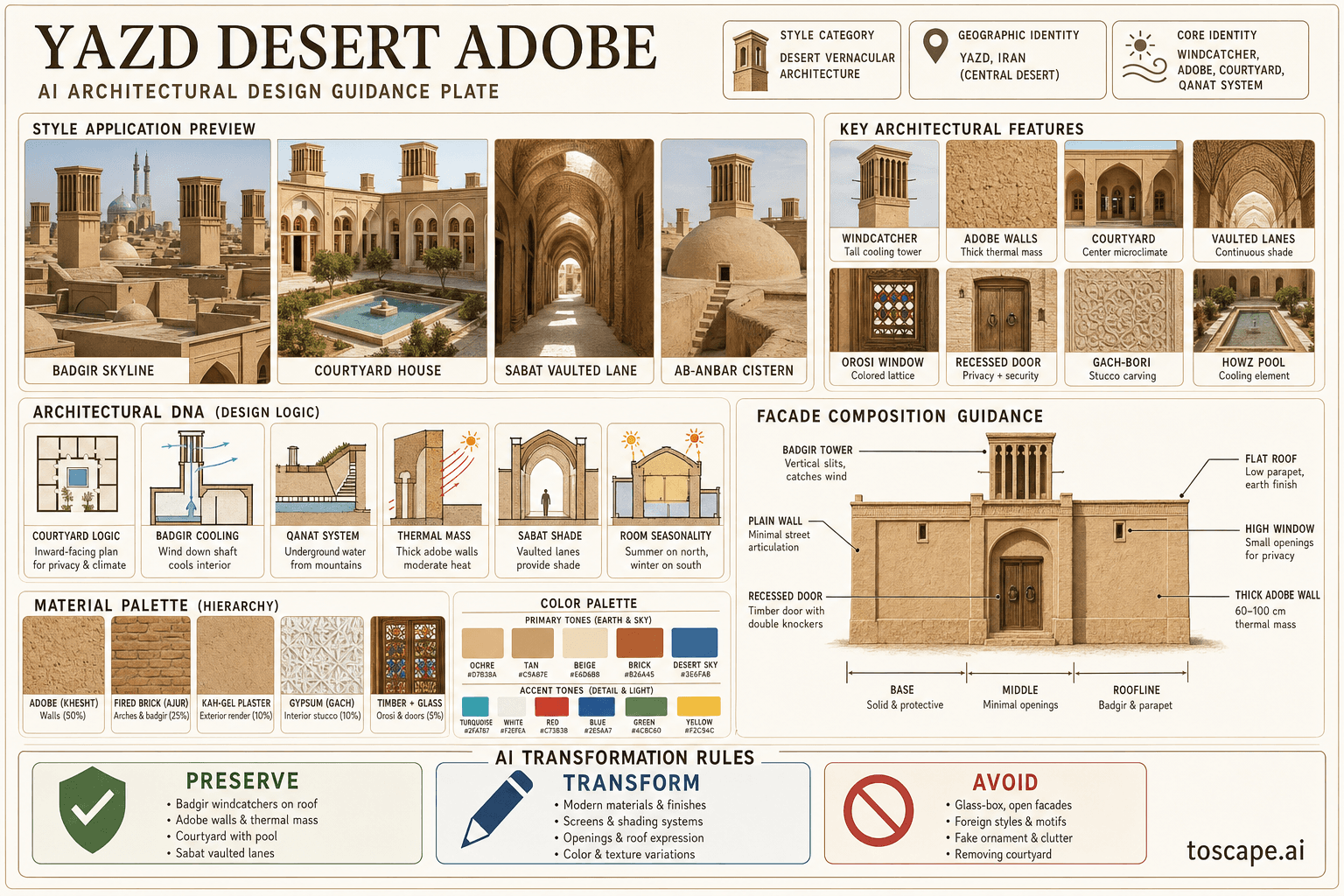
- Courtyard house: inward-facing rooms around central courtyard (hayat-e markazi), single or two-story. Summer living on north side (cooler), winter on south side (solar gain).
- Materials
- Adobe (khesht) — sun-dried mud brick, self-finished. Fired brick (ajur) — arches, vaults, badgir.
- Palette
- White, cream, pale sand, warm timber, and shadow-driven dark metal accents define the palette.
- Climate response
- Extreme hot-arid desert: summer to 50°C, cold winters, minimal rainfall, strong prevailing winds.
Overview
Yazd Desert Adobe is a regional architectural identity in Iran. Yazd desert city architecture — the world's most sophisticated passive cooling vernacular in raw earth. Tall windcatchers (badgir) as iconic skyline element, adobe mud-brick construction, central courtyards with pools (howz), underground qanat water channels, narrow vaulted bazaar lanes (sabats), domed cisterns (ab-anbar)
Visual DNA
Massing & Form
Courtyard house: inward-facing rooms around central courtyard (hayat-e markazi), single or two-story. Summer living on north side (cooler), winter on south side (solar gain).
Facade Language
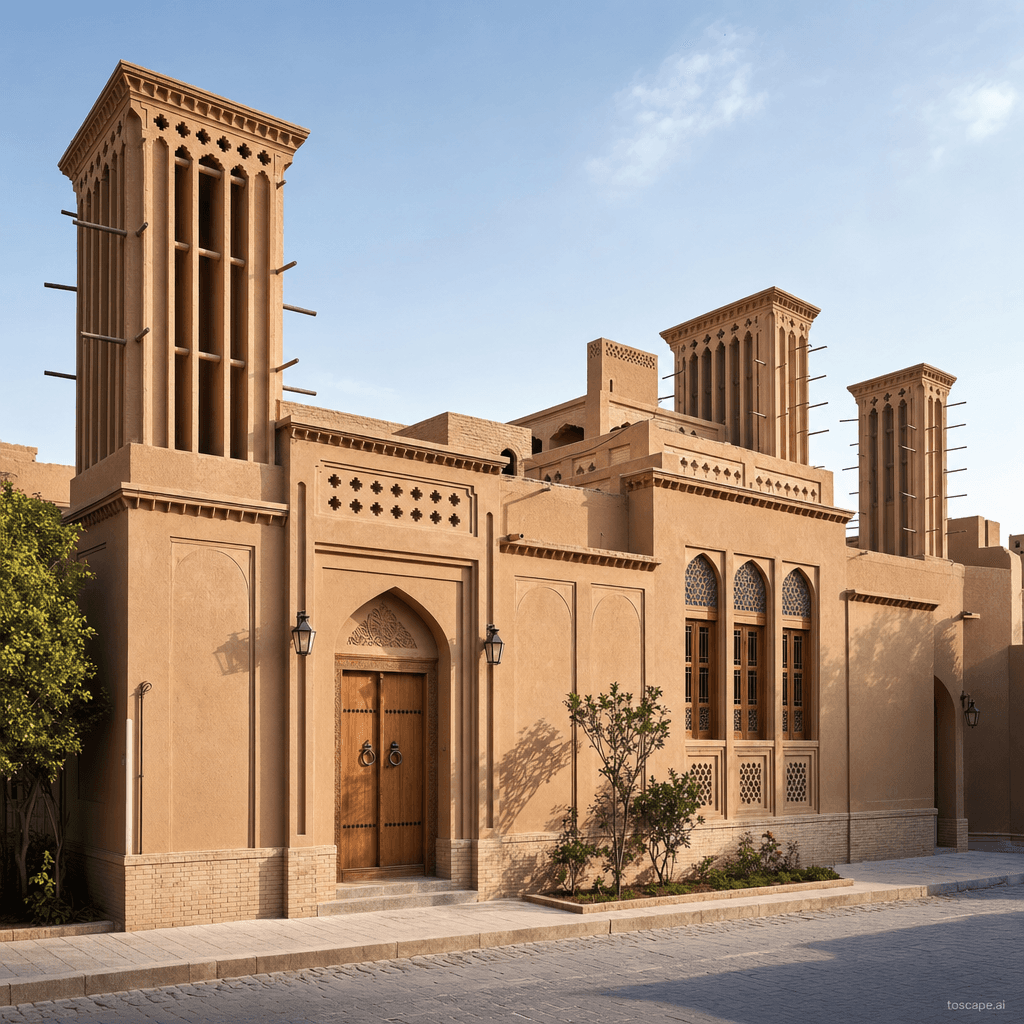
Street-facing: minimal articulation — plain mud-rendered walls with single recessed door, small high windows, no street-level openings. Courtyard-facing: rich articulation — rhythmic arched alcoves (talar), carved stucco panels, colored glass windows.
Materials & Texture
Adobe (khesht) — sun-dried mud brick, self-finished. Fired brick (ajur) — arches, vaults, badgir.
Color Palette
White, cream, pale sand, warm timber, and shadow-driven dark metal accents define the palette. The facade should stay bright and climate-aware rather than heavy, gray, or over-saturated.
Ornament & Detail
Stucco carving (gach-bori) as primary interior ornament: geometric patterns, floral arabesques, ceiling medallions. Orosi windows: geometric wooden lattice with colored glass.
Climate Response
Extreme hot-arid desert: summer to 50°C, cold winters, minimal rainfall, strong prevailing winds. Badgir: passive cooling — catches wind, directs it down shaft over water pool or qanat channel, cooled air circulated through basement (sardab) and rooms.
Landscape & Ground
Yazd desert city architecture — the world's most sophisticated passive cooling vernacular in raw earth. Extreme hot-arid desert: summer to 50°C, cold winters, minimal rainfall, strong prevailing winds.
Reference elevation
Yazd Desert Adobe — characteristic facade composition, Yazd desert city.
Context Snapshot
Yazd desert city architecture — the world's most sophisticated passive cooling vernacular in raw earth Extreme hot-arid desert: summer to 50°C, cold winters, minimal rainfall, strong prevailing winds.
Contemporary Relevance
Yazd Desert Adobe is useful today for residential, hospitality, civic, and place-branding work that needs Iran-specific character grounded in local massing, material tone, climate response, and settlement logic rather than generic international styling.
Use this style in Toscape
Explore Yazd Desert Adobe directly inside Toscape using the Facade Re-Style and Design Options workflows.
Open Yazd Desert Adobe in the galleryFrequently asked questions
What is Yazd Desert Adobe?
Yazd Desert Adobe is a regional architectural identity from Iran. Windcatchers, Qanat Water Systems & Mud-Brick Courtyard Architecture.
What materials define Yazd Desert Adobe?
Adobe (khesht) — sun-dried mud brick, self-finished. Fired brick (ajur) — arches, vaults, badgir.
What is the Yazd Desert Adobe color palette?
White, cream, pale sand, warm timber, and shadow-driven dark metal accents define the palette. The facade should stay bright and climate-aware rather than heavy, gray, or over-saturated.
Where does Yazd Desert Adobe come from?
Yazd desert city architecture — the world's most sophisticated passive cooling vernacular in raw earth Extreme hot-arid desert: summer to 50°C, cold winters, minimal rainfall, strong prevailing winds.
When should architects use Yazd Desert Adobe?
Yazd Desert Adobe is useful today for residential, hospitality, civic, and place-branding work that needs Iran-specific character grounded in local massing, material tone, climate response, and settlement logic rather than generic international styling.
How do you render Yazd Desert Adobe in Toscape?
Open Toscape on Windows, load your own photo, elevation, sketch, or CAD view, then apply the Yazd Desert Adobe reference from the built-in style library. The Facade Re-Style and Design Options workflows keep your project geometry and camera while shifting materials, proportion, and detailing toward Yazd Desert Adobe.