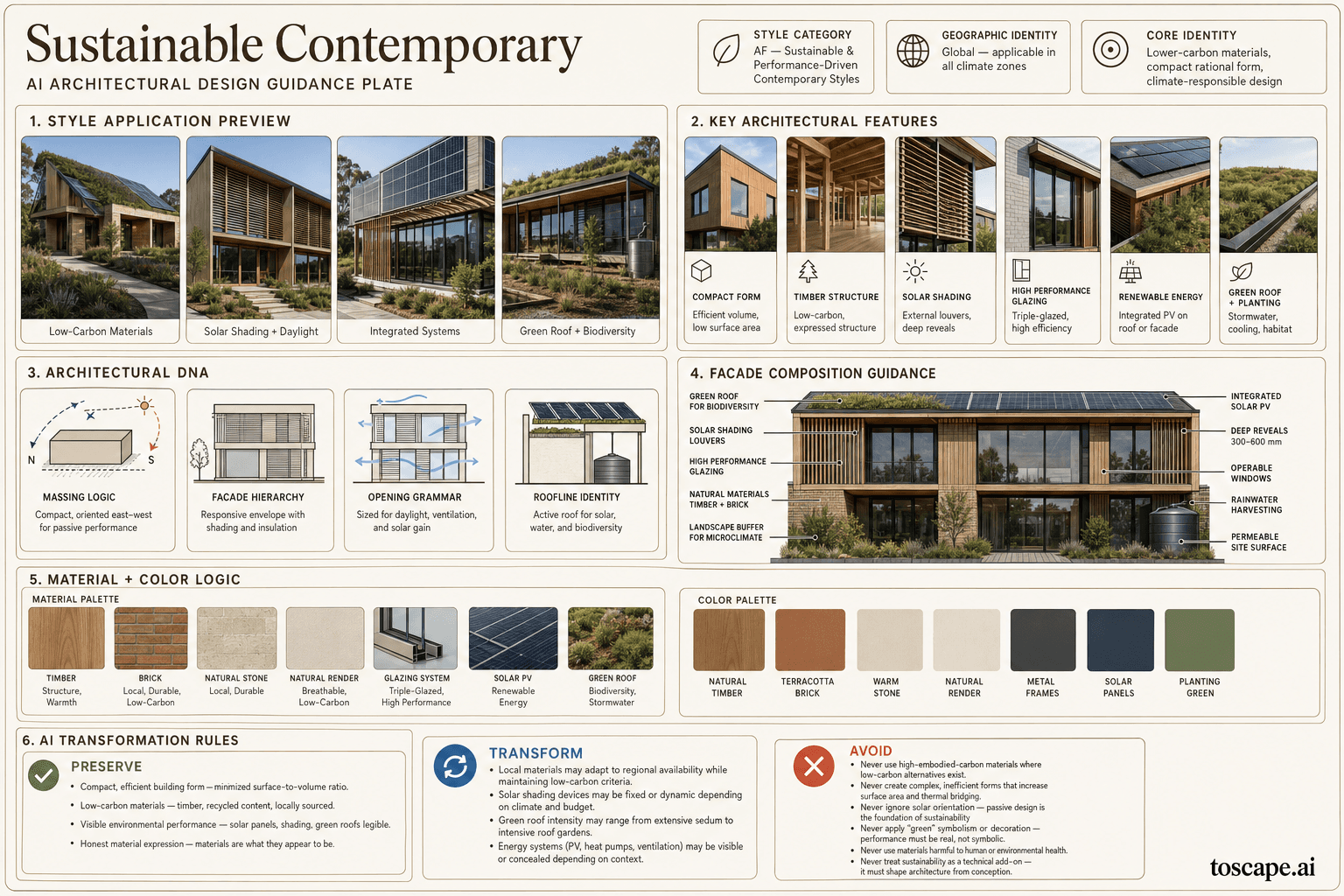
Sustainable Contemporary
Global - applicable in all climate zones. / Sustainable performance
Lower-carbon materials, compact rational form, and durable climate-responsible contemporary expression.
Definition
Sustainable Contemporary is a global architectural style within the sustainable performance. Lower-carbon materials, compact rational form, and durable climate-responsible contemporary expression.
- Family
- Sustainable performance
- Origin
- Global - applicable in all climate zones.
- Massing
- Massing is optimized for environmental performance. Compact form to minimize heat loss/gain, orientation for passive solar gain, and form shaped for natural ventilation.
- Materials
- Structure: timber (glulam, CLT), low-carbon concrete, or recycled steel Facade: locally sourced brick, stone, timber, or low-carbon render Insulation: natural fiber (wood fiber, hemp.
- Palette
- Primary tones: natural material colors. Timber, brick, stone, render The palette is honest.
- Climate response
- Global. Applicable in all climate zones.
Overview
Sustainable Contemporary is a global architectural style rooted in Global - applicable in all climate zones. The architecture is defined by environmental performance rather than regional tradition, though local climate, materials, and ecology fundamentally shape each project. Lower-carbon materials, compact rational form, and durable climate-responsible contemporary expression. Responsible, intelligent, and quietly confident.
Visual DNA
Massing & Form
Massing is optimized for environmental performance. compact form to minimize heat loss/gain, orientation for passive solar gain, and form shaped for natural ventilation.
Facade Language
The facade is a high-performance environmental skin. insulation, airtightness, solar control, and ventilation integrated into a coherent architectural expression.
Materials & Texture
Structure: timber (glulam, CLT), low-carbon concrete, or recycled steel Facade: locally sourced brick, stone, timber, or low-carbon render Insulation: natural fiber (wood fiber, hemp, cellulose) or high-performance mineral wool Glazing:...
Color Palette
Primary tones: natural material colors. timber, brick, stone, render The palette is honest.
Ornament & Detail
Compact, efficient building form. minimized surface-to-volume ratio.
Climate Response
Global. applicable in all climate zones.
Landscape & Ground
Global. applicable in all climate zones.
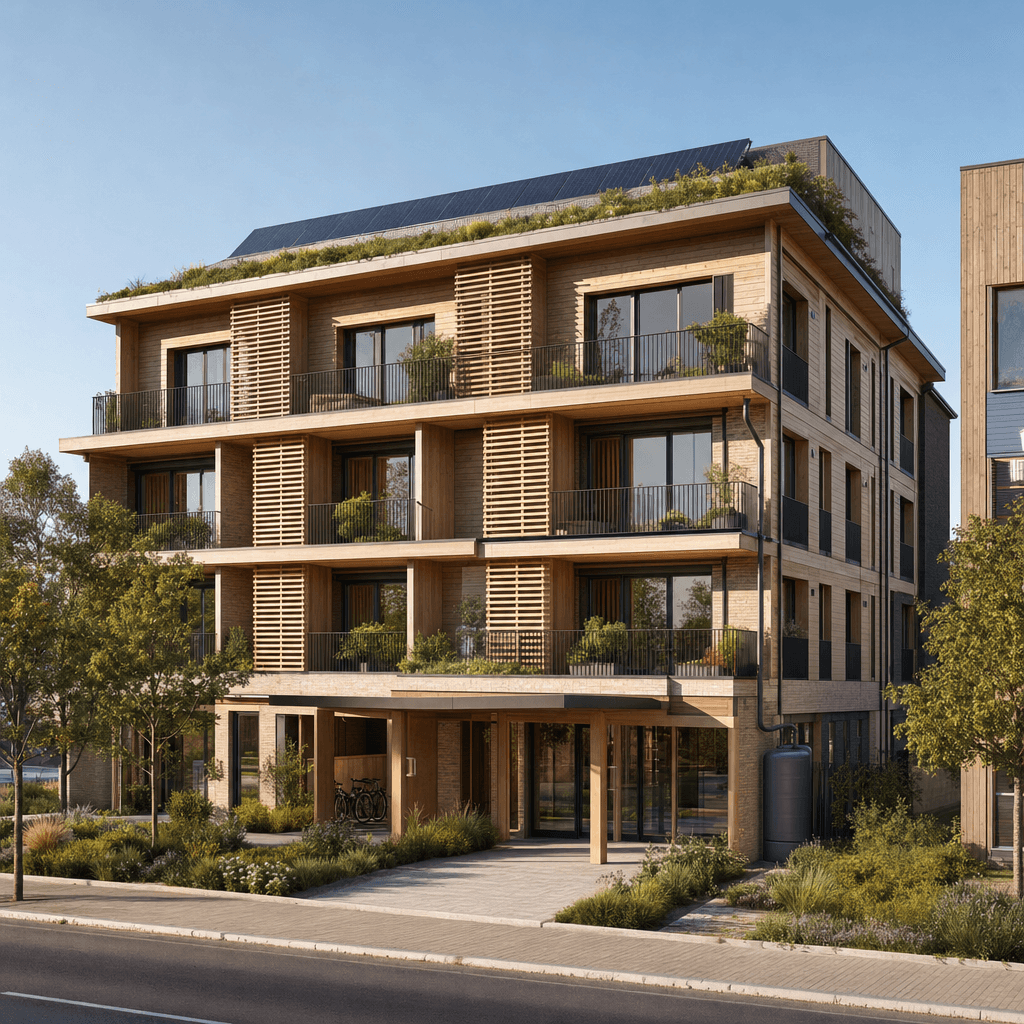
Reference elevation
Sustainable Contemporary - characteristic facade composition within the sustainable performance.
Context Snapshot
Responsible, intelligent, and quietly confident. Massing is optimized for environmental performance - compact form to minimize heat loss/gain, orientation for passive solar gain, and form shaped for natural ventilation. Global - applicable in all climate zones.
Contemporary Relevance
Today, Sustainable Contemporary remains relevant wherever projects need sustainable performance cues without losing performance or contemporary usability. In Toscape it responds best when prompts emphasize massing is optimized for environmental performance - compact form to minimize heat loss/gain, orientation for passive solar gain, and form shaped for natural ventilation. structure: timber (glulam, clt), low-carbon concrete, or recycled steel facade:...
Use this style in Toscape
Explore Sustainable Contemporary directly inside Toscape using Facade Re-Style and design workflow prompts tuned for global architectural references.
Open Sustainable Contemporary in the galleryFrequently asked questions
What is Sustainable Contemporary?
Sustainable Contemporary is a global architectural style within the sustainable performance. Lower-carbon materials, compact rational form, and durable climate-responsible contemporary expression.
What materials define Sustainable Contemporary?
Structure: timber (glulam, CLT), low-carbon concrete, or recycled steel Facade: locally sourced brick, stone, timber, or low-carbon render Insulation: natural fiber (wood fiber, hemp, cellulose) or high-performance mineral wool Glazing.
What is the Sustainable Contemporary color palette?
Primary tones: natural material colors. Timber, brick, stone, render The palette is honest.
What is the origin of Sustainable Contemporary?
Responsible, intelligent, and quietly confident. Massing is optimized for environmental performance - compact form to minimize heat loss/gain, orientation for passive solar gain, and form shaped for natural ventilation. Global - applicable in all climate zones.
When should architects use Sustainable Contemporary?
Today, Sustainable Contemporary remains relevant wherever projects need sustainable performance cues without losing performance or contemporary usability. In Toscape it responds best when prompts emphasize massing is optimized for environmental performance - compact form to minimize heat loss/gain, orientation for passive solar gain, and form shaped for natural ventilation. Structure: timber (glulam, clt), low-carbon concrete, or recycled steel facade.
How do you render Sustainable Contemporary in Toscape?
Open Toscape on Windows, load your own photo, elevation, sketch, or CAD view, then apply the Sustainable Contemporary reference from the built-in style library. The Facade Re-Style and Design Options workflows keep your project geometry and camera while shifting materials, proportion, and detailing toward Sustainable Contemporary.